Section Modulus calculation and optimization
AIM
- Use the Section from your Hood design and calculate the Section Modulus using the formula.
S = I/y
Where,
S = Section Modulus
I = Moment of Inertia
y = distance between the neutral axis and the extreme end of the object
- Develop new section that has an improved section modulus compared to the previous one.
SECTION MODULUS
- Section Modulus is a geometric property of structural member.
- It is used to calculate the bending stresses in a structural member.
- Section modulus is a direct measure of a strength of any cross sectional area of an object about a neutral axis.
- Section modulus depends only on the cross-section shape of the structure.
- It can be said that the greater the dimensions of a cross-section under a given load, the greater the Section modulus and the smaller the bending stress.
TYPES OF SECTION MODULUS
- Elastic section modulus
- Plastic section modulus
1. ELASTIC SECTION MODULUS
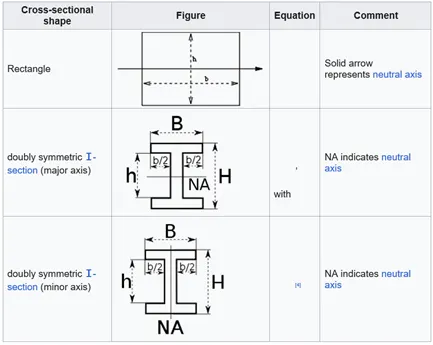
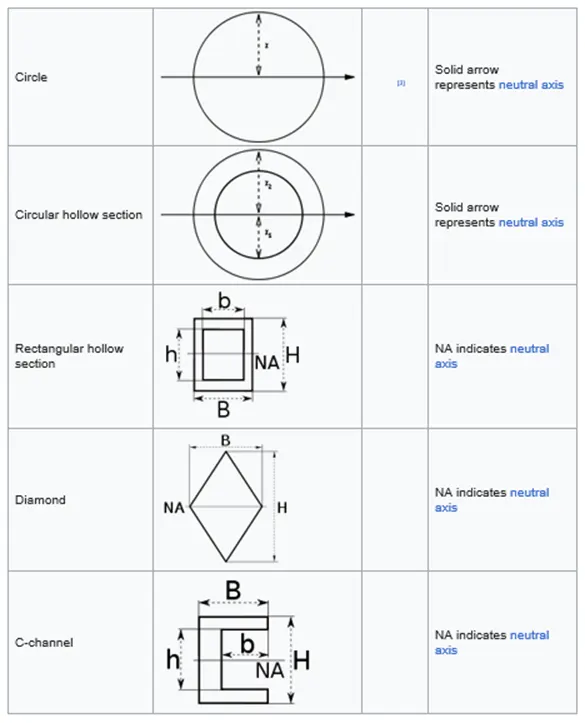
- It is defined as the ratio of the moment of inertia of a section about its centroidal axis and to the distance of the extreme layer from the neutral axis.
- It is denoted by S.
- Mathematically, the elastic section modulus is defined as S = I / y.
- Where,
I = Moment of inertia.
y = Distance between the neutral axis to and the extreme end of the object.
- It is also often used to determine the yield moment (My) such that My = S ⋅ σy, where σy is the yield strength of the material.
2. PLASTIC SECTION MODULUS
- The plastic section modulus is used for materials where elastic yielding is acceptable and plastic behavior is assumed to be an acceptable limit.
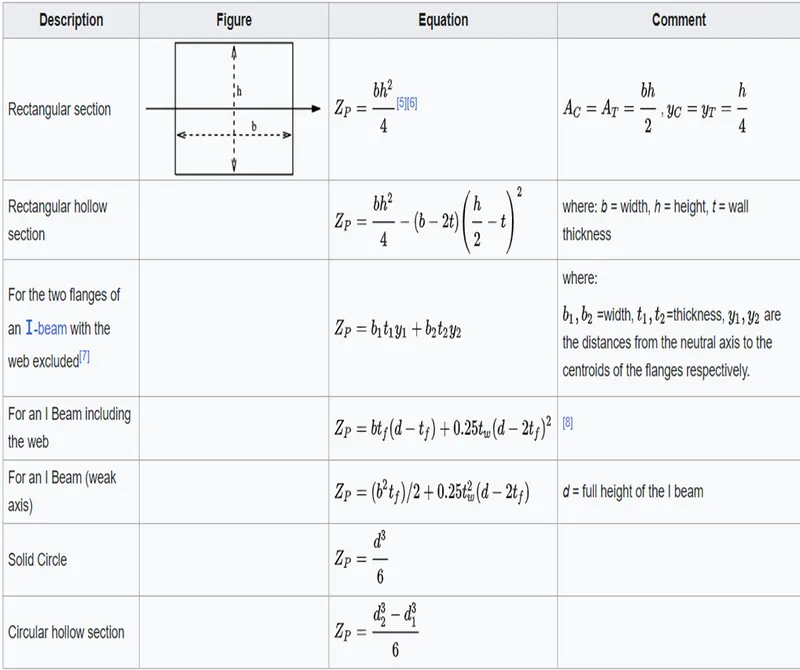
- The plastic section modulus is the sum of the areas of the cross section on each side of the PNA (which may or may not be equal) multiplied by the distance from the local centroids of the two areas to the PNA.
- It is denoted by Zp.
- Mathematically, plastic modulus is defined as
Zp=Acyc + Atyt
SHAPE FACTOR
- Plastic section modulus and elastic section modulus are related by a shape factor, used for an indication of capacity beyond elastic limit of material.
- It can be denoted by k
- Mathematically, Shape Factor is defined as
K=Zp/S
where, k=shape factor
Zp=Plastic section modulus
S =Elastic section modulus
- Shape factor for rectangular section is 1.5.
ELASTIC SECTION MODULUS CONSIDERATION
- Take half of portion of structure for calculating section modulus.
- Create a 2D sketch of structure.
- Find the moment of inertia of the structure.
- Find the distance from the neutral axis.
- Find elastic section modulus by the formula of S=I/y.
CASE -1: BEFORE OPTIMIZATION

Elastic section modulus (Maximum Moment of Inertia)
The elastic section modulus is defined as S = I / y.
Where,
I (max) = Maximum moment of inertia.
y = Distance between the neutral axis to and the extreme end of the object.
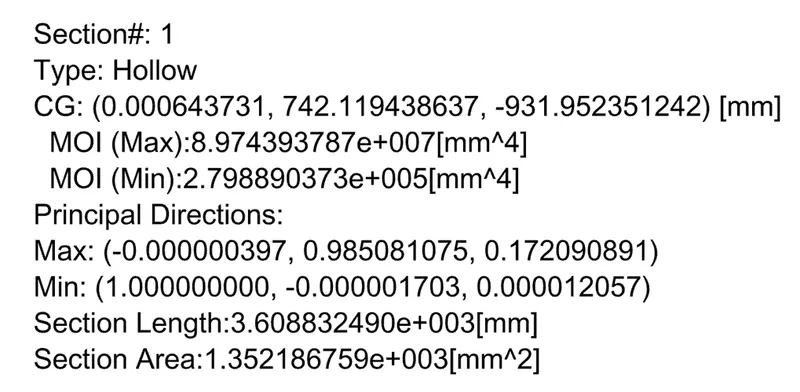
I (max) = 8.9743938787 x 107mm4
y = 881.6/2 = 440.8mm
S = I (max) / y.
S (max) = 8.9743938787 x 107mm4 /440.8mm
= 0.0203593325 x 107mm3
= 203593.325 mm3
Elastic section modulus (Minimum Moment of Inertia)
The elastic section modulus is defined as S = I / y.
Where,
I (Min) = Minimum moment of inertia.
y = Distance between the neutral axis to and the extreme end of the object.
I (Min) =2.798862838 x 105mm4
y =881.6/2=440.8mm
S = I (Min) / y.
S (Min)= 2.798862838 x 10⁵/440.8mm
= 0.00634950735 x 105mm3
= 634.950735 mm3
CASE -2: AFTER OPTIMIZATION
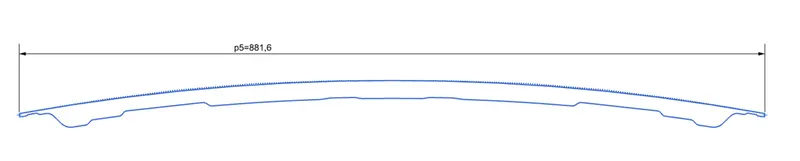
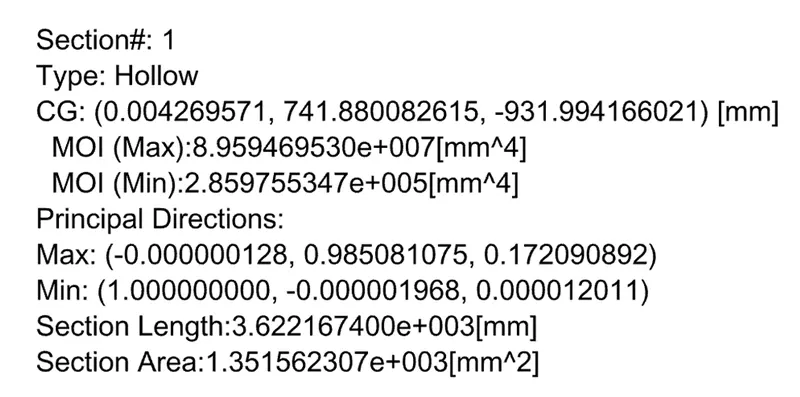
Elastic section modulus (Maximum Moment of Inertia)
The elastic section modulus is defined as S = I / y.
Where,
I (max) = Maximum moment of inertia.
y = Distance between the neutral axis to and the extreme end of the object
I (max) =8.959469530 x 107mm4
y =881.6/2=440.8mm
S (max) = 8.959469530 x 107mm4/440.8mm
= 0.0203254753 x 107mm3
= 203254.753 mm3
Elastic section modulus (Minimum Moment of Inertia)
The elastic section modulus is defined as S = I / y.
Where,
I (Min) = Minimum moment of inertia.
y = Distance between the neutral axis to and the extreme end of the object
I (Min) =2.859755347 x 105mm4
y =881.6/2=440.8mm
S (Min) = 2.859755347 x 105mm4/440.8mm
= 0.00648764825 x 105mm3
=648.764825 mm3
COMPARISON CHART
|
Description |
Before Optimization |
After Optimization |
|
I (Max) |
8.9743938787 x 107mm4 |
8.959469530 x 107mm4 |
|
I (Min) |
2.798862838 x 105mm4 |
2.859755347 x 105mm4 |
|
S (max) |
203593.325 mm3 |
203254.753 mm3 |
|
S (Min) |
634.950735 mm3 |
648.764825 mm3 |
RESULTS-:
- Before optimization maximum moment of inertia is 8.9743938787 x 107mm4 and minimum moment of inertia is 2.798862838 x 105mm4.
- Before optimization maximum Elastic section modulus is 203593.325 mm3 and minimum Elastic section modulus is 634.950735 mm3.
- After optimization maximum moment of inertia is 8.959469530 x 107mm4 and minimum moment of inertia is 2.859755347 x 105mm4.
- After optimization maximum Elastic section modulus is 203254.753 mm3 and minimum Elastic section modulus is 648.764825 mm3.
CONCLUSION-: Elastic Section modulus is directly dependent on the area moment of inertia and the distance from the neutral axis. As section modulus is directly proportional to moment of inertia. After optimization we get more I min (minimum moment of inertia) and Elastic section modulus (Smin) also increased. Thus we can say that Elastic section modulus is improved compared to the previous one and as the result strength is also increased.