Hood design-Week 2
PASSAENGER CAR HOOD (BIW CLOSURES)
Hood:
The Hood is the important panel in BIW (Body in White) made up of sheet metal.
It covers the engine compartment of the vehicles.
It can be opened for the maintenance of the engine.
It is considered as Closures of BIW, as its open and closes and also it comes with
outer panel provided with Inner panel which gives strength to outer panel.
The outer panel and inner panel are joined together with hemming operation.
It is defined to open for maintenance and inspection of engine parts, replacing
cooling water or engine oil, etc.
It’s the critical component because of frontal crash, pedestrian safety regulations.
Also, it dissipates energy to outwards rather than inside of car body in frontal crash.
Figure 1.1 shows the Hood in the BIW.
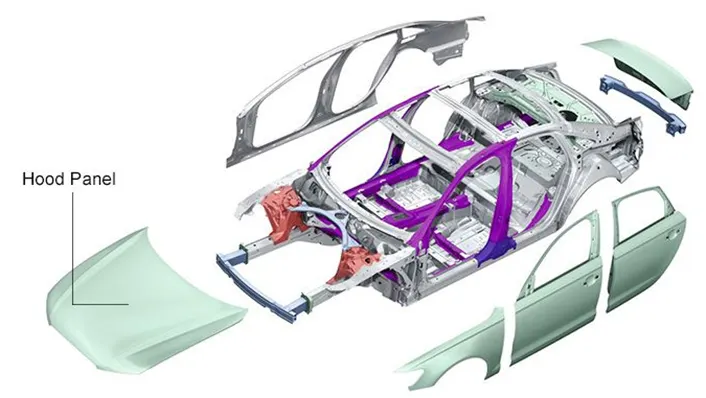
Figure 1.1: Hood Panel
There are two types of Hood, are as follows:
- Inlaid Hood:
In Inlaid Hood end point of car lies on the “Fender”.
From the ground line is made at 45° and it touches the end point of the car.
- Wrap around Hood:
In Wrap around hood, the end point of car lies on the Hood itself.
Form the end point of the Hood a tangential line is drawn at 45° to meets the ground.
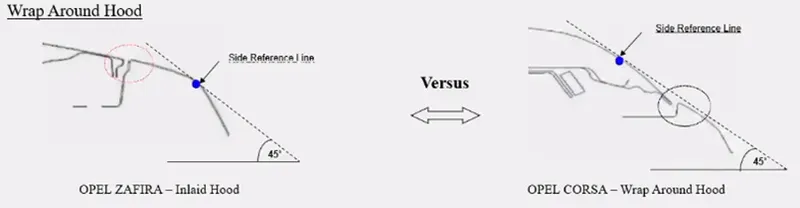
Figure 1.2: Hood Types
Hood Components:
The Hood is made of following components
- Outer Panel
- Inner Panel
- Hinge
- Latch and Sticker
- Reinforcements
- Hood stay
- Stiffener
- Outer Panel of the Hood:
Outer panel is nothing but the outer metal cover of the Hood.
It is main aesthetics look of the car outer but it doesn’t have the strength so it is provided with inner panel.
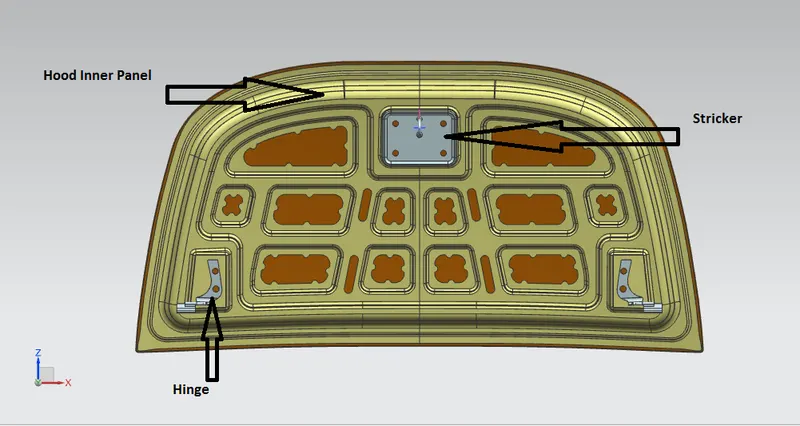
- Inner Panel of the Hood:
Inner panel of the hood is defined for the support and it gives strengths the outer panel.
It provides the rigidity and stability to outer panel.
All other mounting are fitted on inner panel of the Hood.
- Hinge:
Hood is fitted with the help of Hinge to vehicle body.
It provides opening and closing to the Hood with respect to hinge axis.
- Latch and Striker:
Latch and sticker is provided to hood as a locking mechanism.
It’s unlocked in two steps, first in primary unlocking from cabin and 2nd is from outside mechanical lever operated.
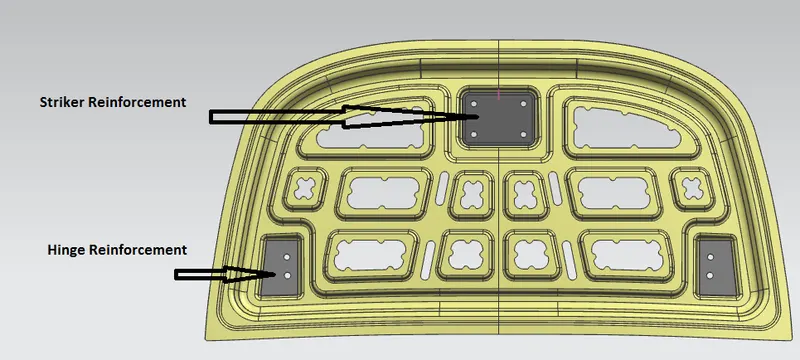
- Reinforcements:
These are provided to strengthen the inner panel of the hood where other parts are mounted over it.
As mountings are provided, due to that strength of panel gets reduces, so to compensate it reinforcements are provided.
- Hood Stay:
It is devise which supports the hood in its open condition.
Vehicle hood is provided to inspect the engine and maintenance of it so we have keep it open condition so Hood stay plays major role in open condition of hood.
There are two types of Hood stays as follows:
- Support Rod:
It’s nothing but the metal rod with some bends provided on it to keep the hood in open condition.
It is generally used in vehicles where hood opening operation force is less than 8kgf.
It is cost effective product as hood stays.
- Gas Stay:
It is cylinder and rod mechanism operated by compressed gas.
It is generally used when hood opening operation force is greater than 8kgf.
It is costlier than support rod.
- Stiffeners:
When vehicle is in running condition, there are some vibrations in outer panel, so avoid it stiffener is provided between outer panel and inner panel.
Design Consideration in Hood Design:
- Hood Head Zone for Lock Striker
- Design consideration of Support rod/ Gas Stay Mounting
- Hinge Axis
- Latch And Striker Position/Trajectory
- Pedestrian Head Impact zone
- NVH
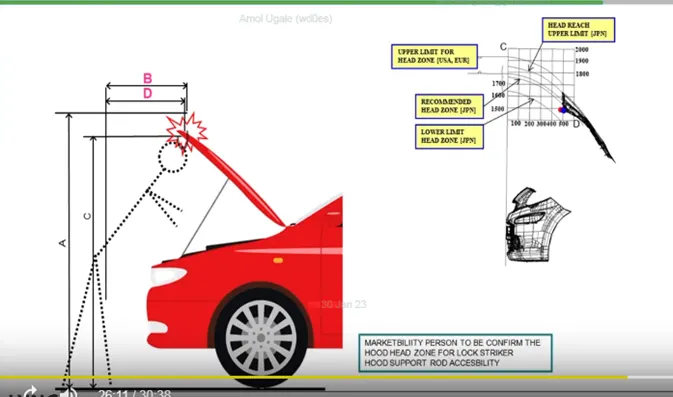
- Hood Head Zone Lock Sticker/ (Opening Angle of Hood):
When we open the hood there should be sufficient gap between Head of the person and striker end to avoid the collision between them.
So, for this opening angle of hood comes factored in.
Opening angle is varies from region to region because of different heights of the human being.
In india average height is 5.6 feet approximately, where as in European region it is about 6 feer approx. So, in india opening angle will be less than European region.
Support rod length defines the opening angle of the hood.
So, an opening angle provides the clearance between striker and human head to avoid injury to human head.
For the opening angle hood stay is mounted it may support rod or gas stay.
If the hood opening operation force is greater than 8kgf then gas stay is used to open the hood otherwise support road is used.
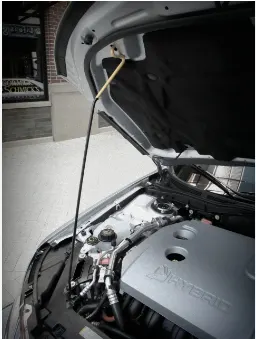
- Design Consideration for Support rod:
Support is either mounted from hood to engine compartment or from engine compartment to hood.
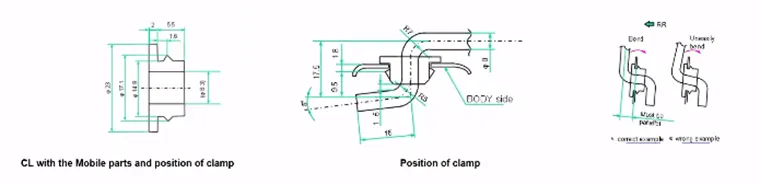
There is always some bend or curvature/ structures are provided to support rod to have more rigidity and strength, maximum bend provided is 35 mm.
Holes flange length should be minimum 6mm and hole is provided with 2 mm clearance.
Also, support road to be located opposite to battery side in engine compartment as support road is fitted first in assembly then battery if fitted.
So, to ease of mounting of battery support rod is placed on opposite side of battery.
Grommets are used to keep part in rest condition.
These are provided in engine compartment as well as in hood region.
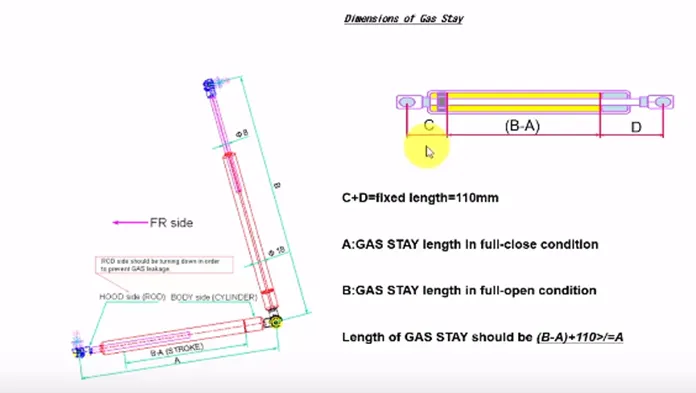
Gas Stay:
If the opening operation force is greater than 8kgf then Gas Stay are used to provide opening of the hood.
In order to use gas stay, we are adding more brackets to compartment to give strength which act as reinforcements.
3. Hinge Axis:
To open and close of the hood, hinges are introduced to hood to have its motion.
Also, striker motion is depends on Hinge axis to close hood properly.
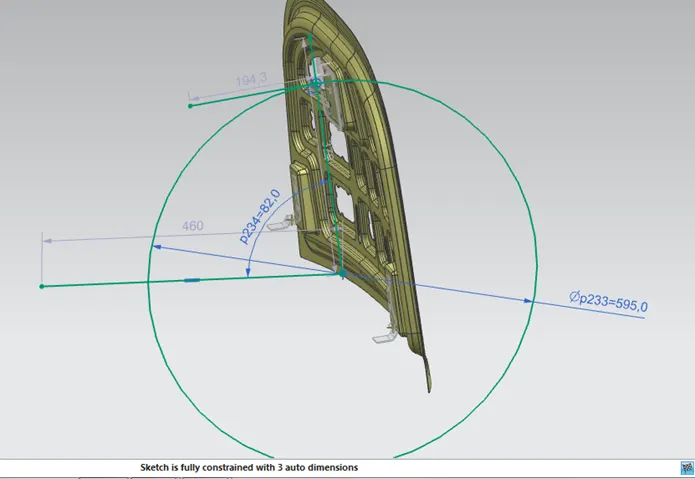
Hinge axis is made by joining points on hinge assembly centre axis, in the middle of that line circle is made for trajectory motion of striker.
4. Latch Trajectory:
Latch trajectory is depends on the hinge axis.
From the centre axis of both hinges, point is taken to draw a circle for trajectory of sticker.
On the car body latch is provided, to get proper locking between latch and striker, striker should moves around trajectory of the circle.
If it not done then we have to move centre axis of the hinges to get trajectory right.
5. Design consideration for better Pedestrian Safty:
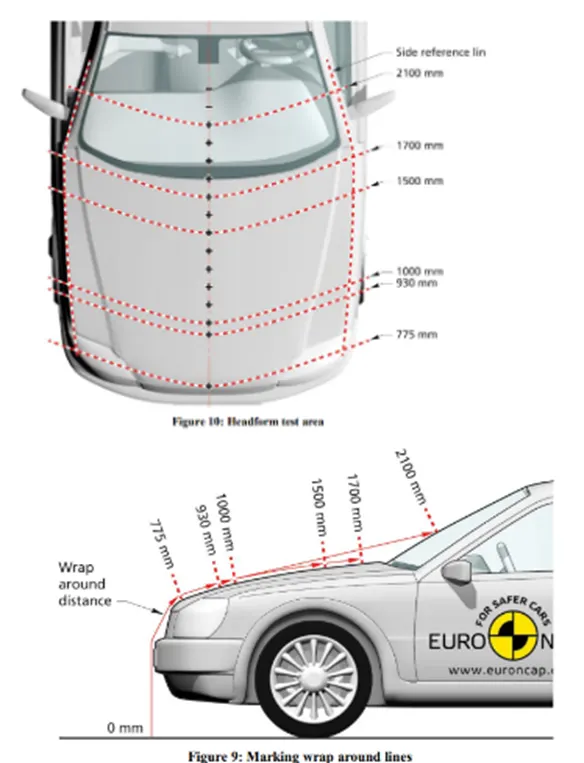
If vehicle hits the pedestrian then its head impact zone should be on hood.
If the side reference line is on car body then pedestrian head impact zone will be less, so to increase the pedestrian head impact zone side reference line should be on hood.
This will increase pedestrian head impact zone of the car which increases the safety for the pedestrian.
As hood area is large, more material will remove from inner panel which allows pedestrian head impact zone will be softer which increase green areas in hood.
Pedestrian safety is divided into two categories one is for adult head impact and for child head impact.
It is defined under wrap around distance; wrap around distance is the distance from road to the where head collides on the hood.
6. NVH(NOISE, VIBRATION, HARASHNESS):
There are mastic regions provided between inner between inner panel and outer panel to have good NVH.
Every mastic point gives strength to 80 mm diameter area. So, mastic region are provided by 80 mm difference between them.
It is nothing but the paste is provided between inner panel and outer panel.
It goes in hot bath before it I furnace so the mastic area gets like hard rubber.
EMBOSS IN HOOD:
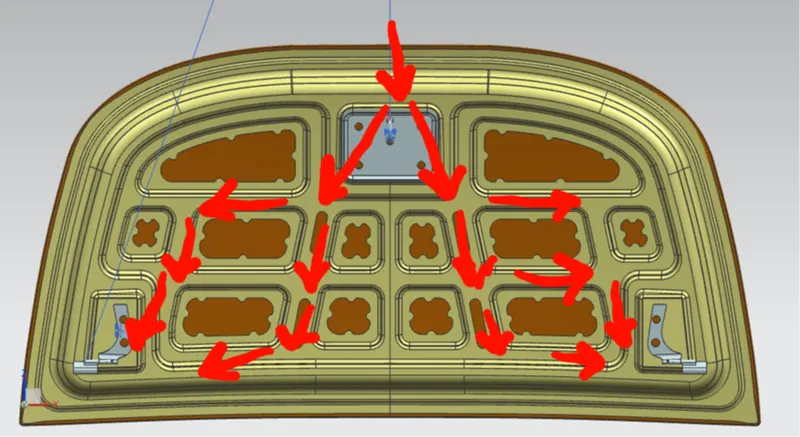
There are no specific criteria for embossing in inner panel, but one should design emboss on the basis of crash and force dissipating outwards from the middle of the car.
Emboss should be provided to transfer crash force to directly outwards to decrease impact of crash towards cabin.
Emboss should have positive draft angle for deep draw process, if its negative then drawing will not possible.
Mastic Data:
Mastic are nothing but the sealant used in car body to connect two sheet metal parts.
In hood outer panel and inner panel are joined together with the help of mastic.
As Hood outer panel is styling surface, we can’t do spot welding to it, so mastics are used.
Mastic is applied in the form of paste before furnace in ED bath where it gets hardened and sticks the outer and inner panel.
Its applied in the hemming region also near cut-outs of inner panel emboss.
One mastic point provides strength in 80-100 mm circular region, so we 80-100 mm distance between two mastic points.
It also reduces vibration and noise by proper application in hood.
Manufacturing Process:
Deep drawing and hemming process are used to make an inner panel and outer panel of the hood.
Deep Drawing:
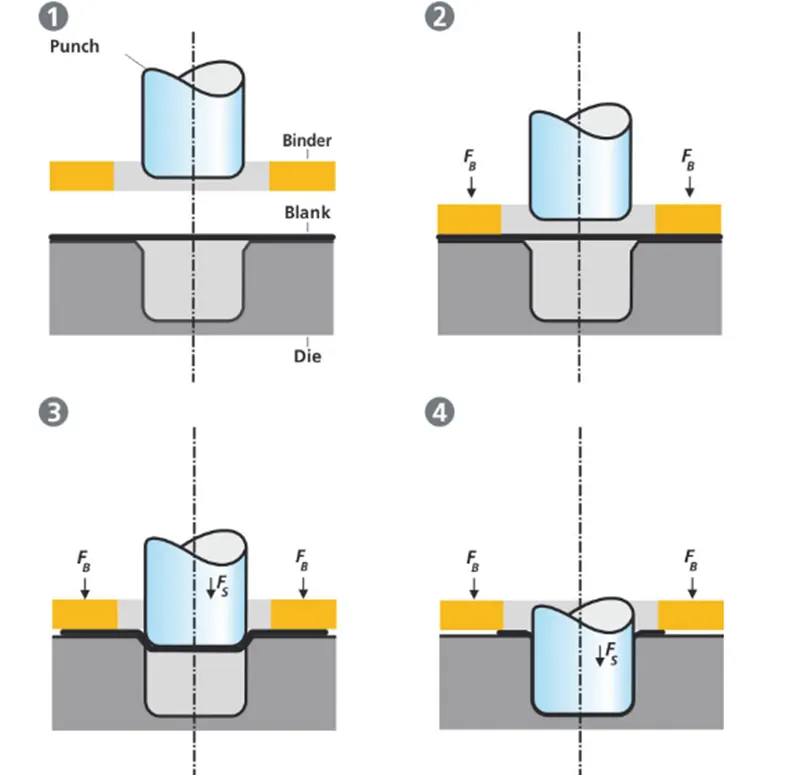
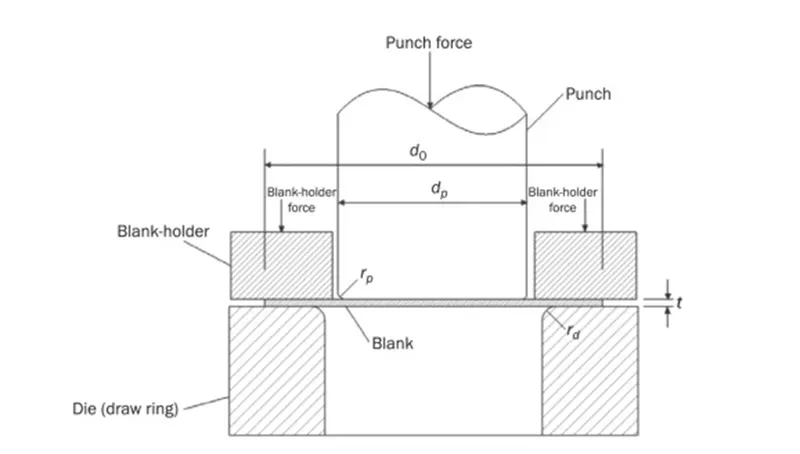
Deep drawing is a sheet metal forming process in which sheet metal blank is drawn in forming die with the help of punch.
Complex parts are also drawn in deep drawing process.
In the process of deep drawing punch is radially drawn on the blank which is kept on the die, then blank holder is then introduced on the blank which holds the blank where blank is not getting formed. After that punch moves down on the blank in downward to form shape of the punch on the blank.
In general, process is called deep drawing when length of drawn of blank exceeds the diameter of it.
The deep drawing process is shown below in figure.
Wrinkling and necking are the two drawbacks of the deep drawing process, which are the maximum limits of this process.
Wrinkling is form due to excessive compressive force at flange region and necking is form due to excessive radial tensile stress.
By controlling the force of the blank holder on top face of the blank, flow of metal into die cavity is controlled in the process. If proper blank holder force is applied while operation wrinkling can be controlled and also it delays the necking formation.
Hemming:
Hemming the sheet metal manufacturing process in which edge of the sheet is folded over or over the another sheer metal part to join together.
It’s generally connects the parts, strengthen the edges of part and also improve the appearance of the part.
It is considered as 6mm flange of hem is good for parts.
In this process, roller are used to give required shape of the parts.
There are two types of hemming :
- Conventional die hemming
- Roll Hemming
- Conventional Die Hemming:
In this process hemming tool is used to fold the flange along the total length of drawing and trimming.
- Roll Hemming:
In this process robots are used which gradually guides the roller on the edges of outer sheet to bend over the inner sheet.
Roller hemming is mostly used un biw closure as its be easily modified as per requirements and with less cost and small changes in robotics programs.
Roll hemming is cheaper the conventional die hemming.
Hemming is also categorized under different hemming edge formed.
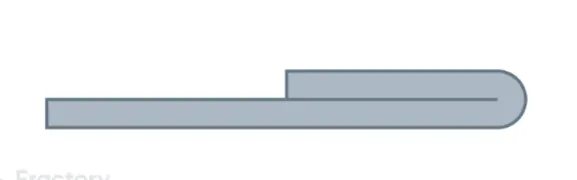
- Flat or Closed Hem:
In this bend edge is completely sits over the sheet. Inside radius is zero, so no gap between returning flange and sheet.
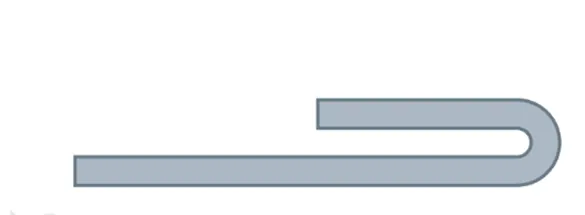
- Open Hem:
In this returning flange is bended over the sheet but gap is present between both flange.
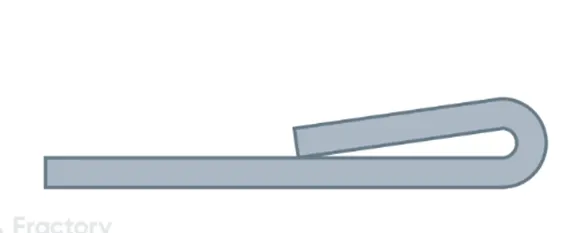
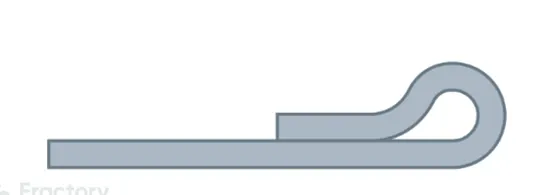
- Teardrop Hem :
In this returning flange is bended over 180° and it looks like teardrop.
It is mostly used in fragile materials.
- Rope Hem:
It is first done like open hem, after that returning flange is pressed over the part surface through flattening die.
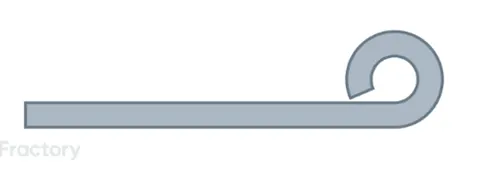
- Rolled Hem
In this bent portion is tucked back into sheet metal surface by creating round edges all around.
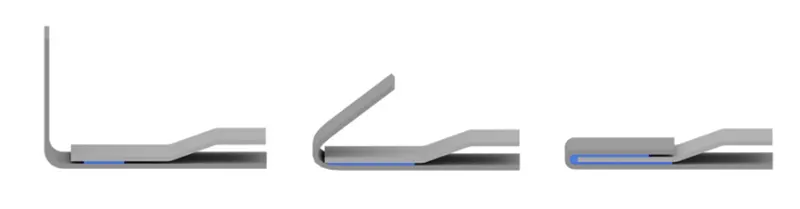
Hemming with adhesives:
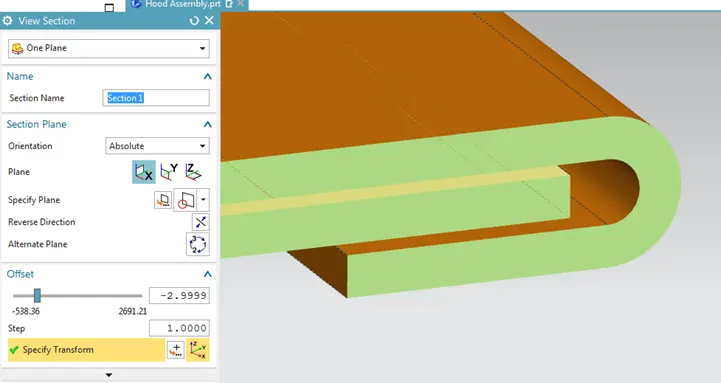
These is used in automotive sheet metal biw closures in which outer panel is open hemmed over the inner panel by placing gap between them for hemming adhesives. Some pictorial views are shown below.
Parameters followed in Design:
- Master Section created as per given details:
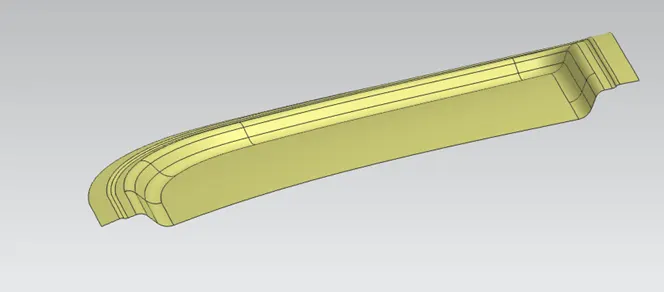
- Hemming created on outer panel as per given data:
Outer Panel thickness: 0.75mm
Gap between Outer Panel and Inner Panel on both sides of Inner panel is maintained 0.2 mm for mastic.
Inner Panel thickness: 0.75 mm
Before Thickening of outer panel hemming crated at distance from outer panel surface at 2.65 mm distance: (0.75+0.2+0.75+0.2+0.75= 2.65 mm)
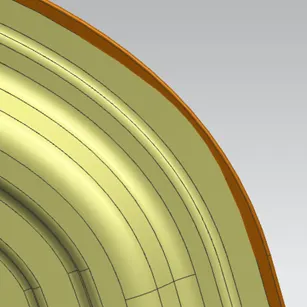
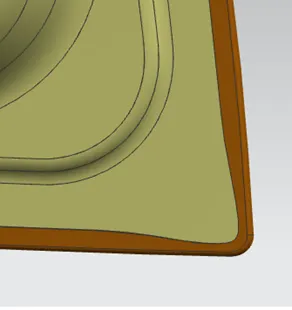
- Corner front and rear Relief provided for hemming to avoid overlapping of sheet
Draft Analysis:
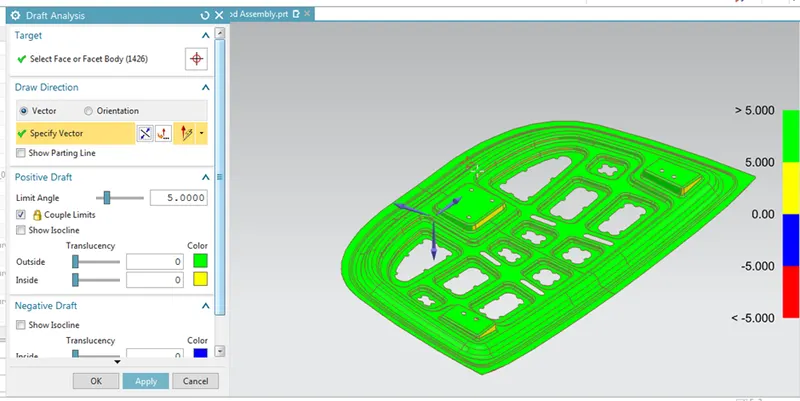
Draft analysis is done for the checking of manufacturing feasibility.
The draft angle must be greater than 5°. If it is so then design is passed if not we have make changes in it.
Negative angles should be avoided.
CONCLUSION:
Here, i have completed inner panel from outer panel reference surface and reinforcement for stricker and hinge added, as per design parameters given. Also, assembly of Hinge, Stricker is done as per design considerations.