Hood design-Week 2
HOOD DESIGN
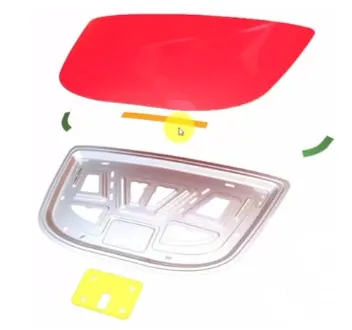
The Hood is the outer panel covering the front engine of the vehicle. It opens to allow access to the engine compartments for the ease of maintenance or repair of the vehicle. Hood is also considered as another door as it consists of the outer panel, an inner panel like side doors of a vehicle.
COMPONENTS OF HOOD
1. Hood Outer Panel
2. Hood Inner panel
3. Striker
4. Hinge assembly
5. Reinforcements for striker and hinge
 r
r
Master section:
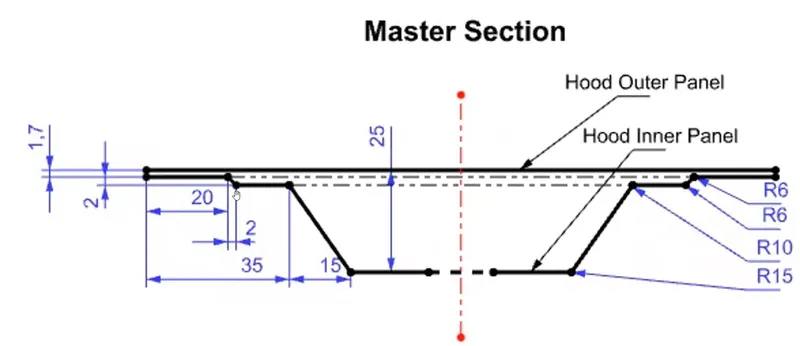
Outer panel: It is the aesthetic part of the hood. In other words, it is the outer skin of the hood which provides a luxurious look to the vehicle.
Inner panel:The inner panel provides strength and supports the outer panel. It is where hood balancer and hinges are attached.
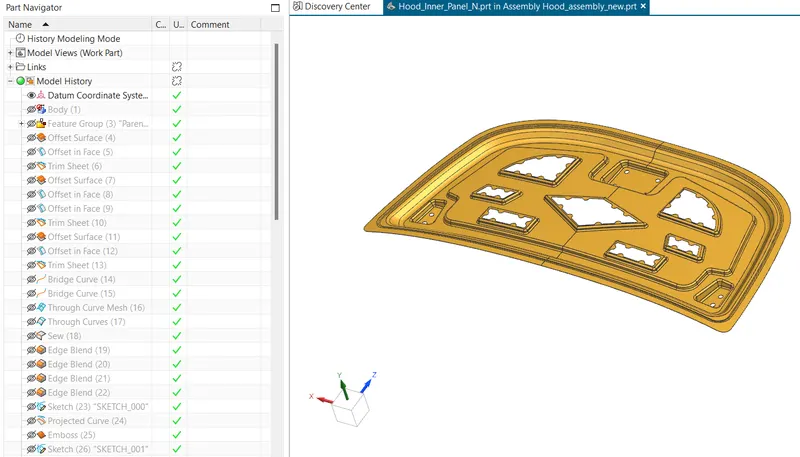
Emboss: We provide different embosses throughout the inner panel . We can increase the stiffness of the inner panel through these embosses. The shape and size of the embosses also determines the direction of the force distribution resulted from frontal collision. The force should be always distributed away from the passengers. Here in the figure the embosses are designed in such a way that the force is directed to either sides of the car.
Hinge assembly:
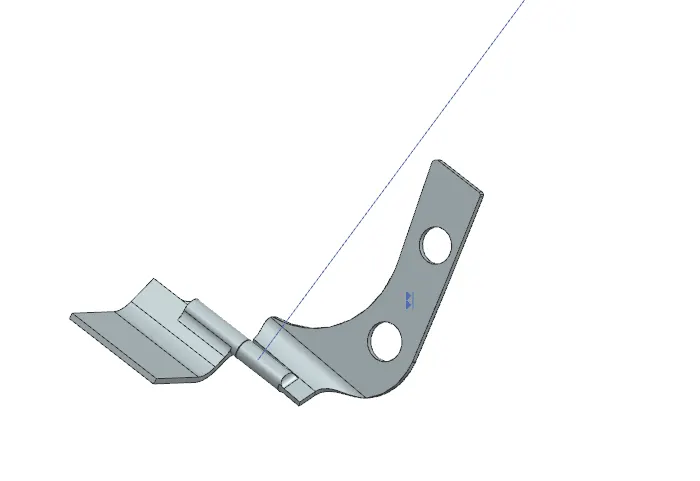
Hinges allow the hood to rotate around a fixed axis for opening and closing movement. One part of the hinge is fixed with the engine compartment, while other part is connected to hood.
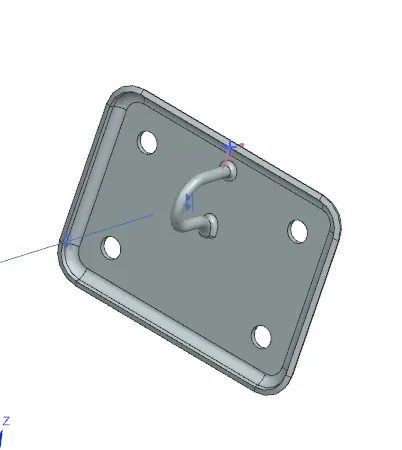
Latch and Striker: Latch and striker mechanism is provided to lock the hood, in order to prevent accidental opening of the hood during driving. The latch is present on the engine compartment while the striker is attached to inner part of hood.
Factors considered while designing Hood
- NVH (Noise Vibration and Harness)
- Hinge Axis
- Gas stay requirement
- Latch and Stricker point
- Deformation Bracket
- Pedestrian Rating
- Euro Ncap regulations
Design Considerations:
The first important criterion for designing the hood is the opening angle of the hood.
This criterion average height of the humans in the region of consideration. For example, the average height of a human being in India is 5.8 feet whereas in European countries the average height of a human being is 6 feet. Hence the opening angle of the hood greatly depends on the height of the human which can be controlled by the support rod or gas stay.
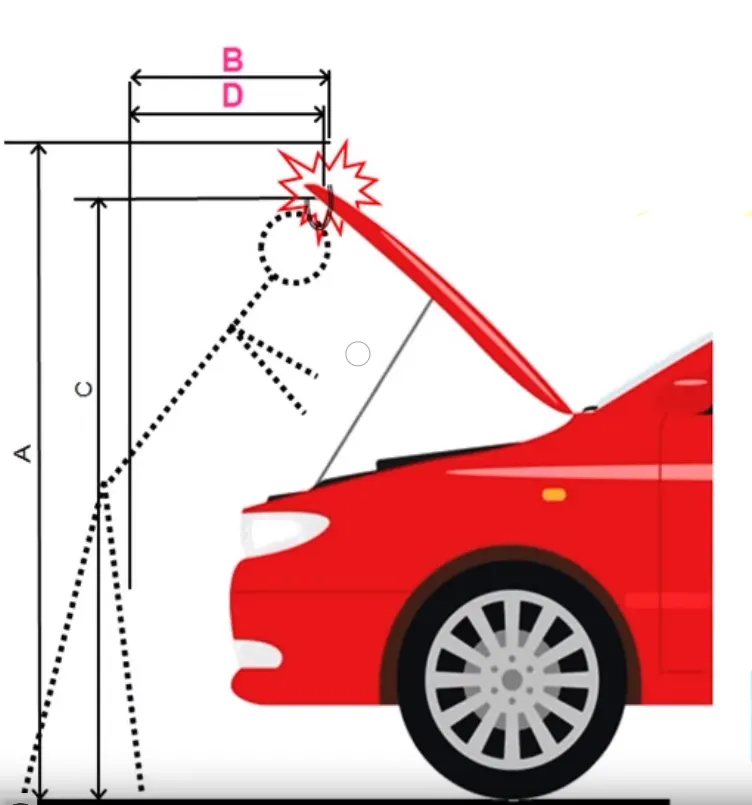
The opening angle is considered important criteria because when the opening angle is less there is a chance of head injury to the human.
By varying the length of the support rod the opening angle can be varied.
Gas Stay is a mini version of the bicycle pump in which the compressed nitrogen is stored in the pump with oil and tightly sealed so that the gas can't escape. The gas allows to store energy which produced by the force acting on the piston and oil damps the movement of the piston and also lubricates it. When force is acted upon the piston, it compresses the gas, and energy is stored and when force is stopped acting on the piston, the stored energy is released moving the piston to its free state position.
Gas stay aids in easily lifting the heavy hood and holding the hood in the open position. Hence there is no human effort needed
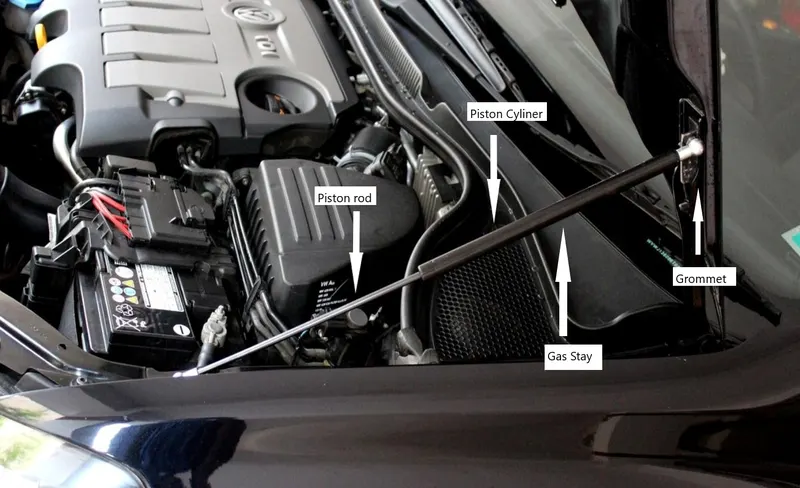
Since gas stay supports the weight of the hood reinforcements should be given at the mounting points of the gas stay and grommets are used to attach the gas stay to the hood inner panel. It rotates with a pivoting point at grommets.
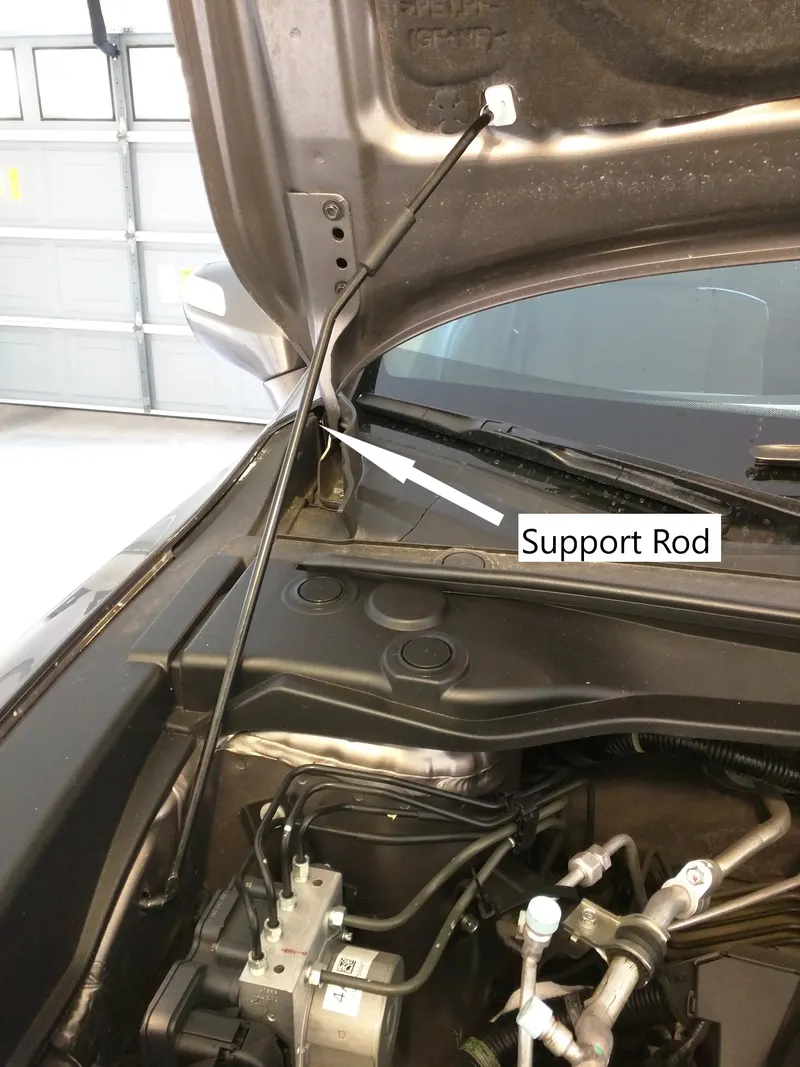
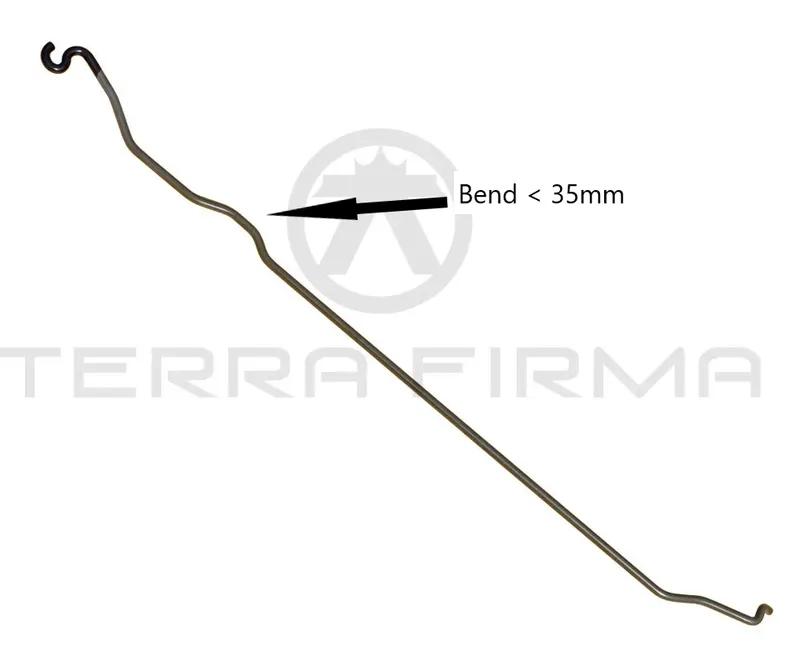
Support rods serve the same function as the gas stay but in this case, the hood has to lift with all the loads and it is held in position using the support rods.
Support rods length is decided based on the opening angle of the hood. In the support rod maximum bend of 35mm is given in order to strengthen the support rod to bear all the load of the hood. There is the human effort needed.
Support rods can either mounted on the hood or on the body of the car. The mounting of the support rod is always on the opposite side of the engine compartment.
Manufacturing Process:
The following are the manufacturing steps done to generate the outer and inner panel of the hood.
Deep Drawing:
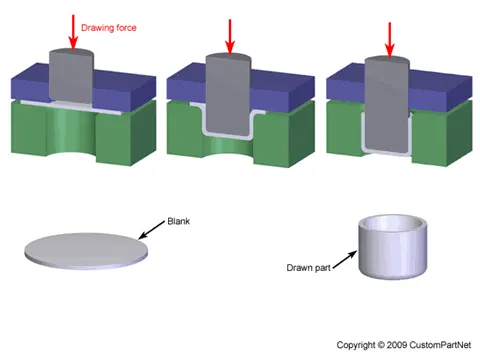
It is a sheet metal forming process in which a sheet metal blank is radially drawn into a forming die by the mechanical action of a punch. The process is considered deep drawing when the depth of the drawn part exceeds its diameter.
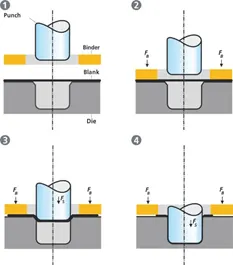
Fig.11 Deep Drawing
Blanking:
It is the process where the required sheet metal material is cut from the sheet metal coil for the manufacturing of the hood using a blanking die.
Stamping:
The material obtained from blanking is stretched using the stamping die. The stamping die is designed according to the embossed design. This process is called deep drawing.
Trimming and punching:
The outer and inner panel is obtained from the forming is placed in the trimming and punching die to carry out trimming and shaping operations to obtain the hood panel with the required dimensions and emboss cutouts.
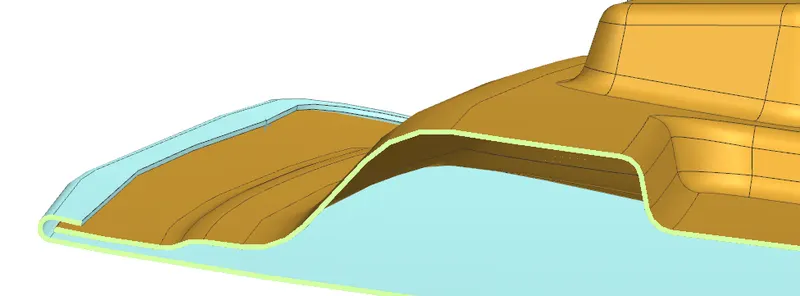
Hemming is a technology used in the automotive industry to join inner and outer closure panels together (hoods, doors, tailgates, etc.). It is the process of bending/folding the flange of the outer panel over the inner one. The accuracy of the operation significantly affects the appearance of the car’s outer surfaces and is, therefore, a critical factor in the final quality of a finished vehicle
Different types of hemming methods are
1. Die hemming method
2. Table-top hemming method
3. Robotic Roller hemming method.
Types of Hemming:
3t flat hem is used to join the outer and inner panel of the hood.
Sealants
Sealants are used to close the gap between two or more substrates. It also acts as a leakproof between the components. It forms a barrier through the physical properties of the sealant itself and by adhesion to the substrate.
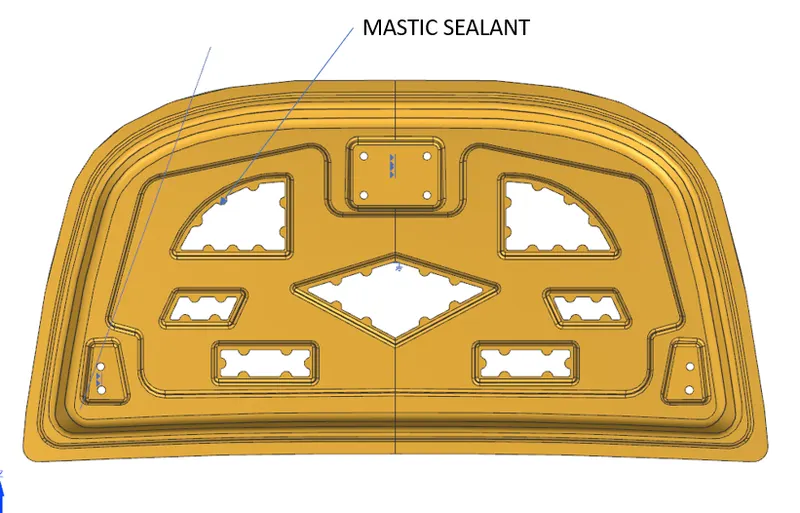
Mastic Sealants are used to join one surface to another or protect the area to which it is applied. It has heat resistant properties and the ability to form a strong bond which is applied using a mastic sealant gun.
Mastic Sealants have an influence area of 80mm diameter.
Mastic Sealant points in the designed hood are shown below.
Reinforcements
Whenever there is an addition of material to the component there is a loss of strength locally. In this case, the additional material is the striker and hinge where additional reinforcements had to be attached due to loss of strength locally in the attachment areas.
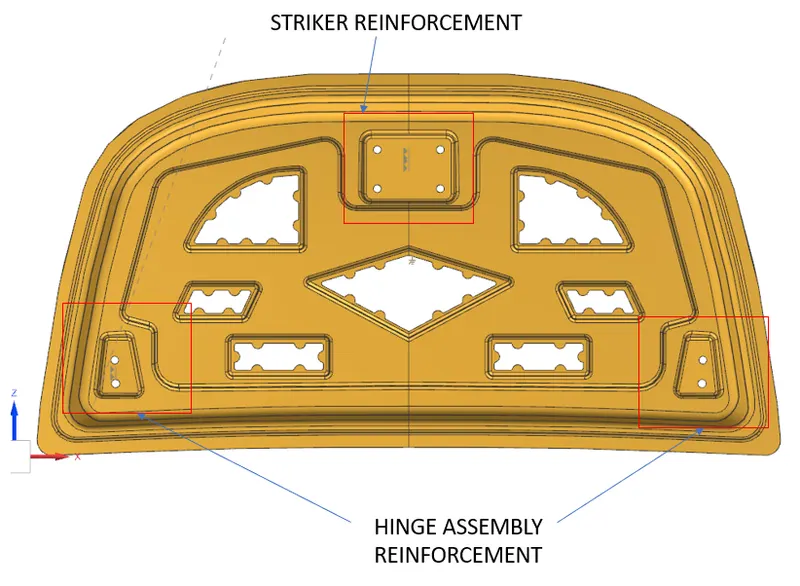
There is additional reinforcement called a stiffener pad which is attached between the hood inner and outer panel. This is done in order to reduce the noise and vibration during the motion of the car. Distance between the outer and inner panel should be 5mm where mastic sealants are placed in the mastic sealant points to form a strong bond between them. This also reduces the noise and vibration in the hood in the car.
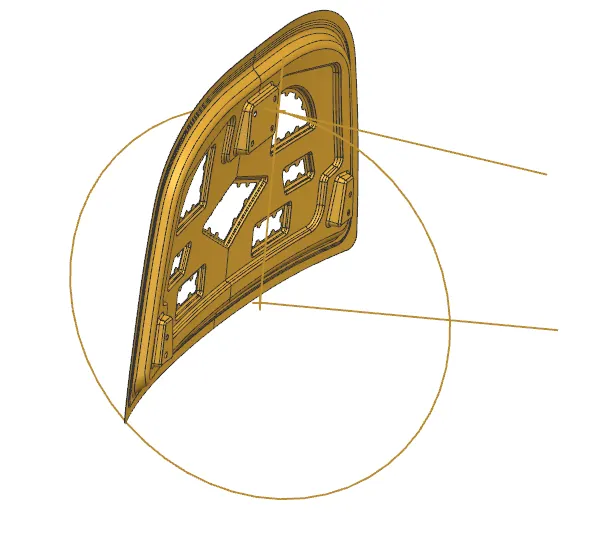
Latch Trajectory: It is the path along which the hood rotates during opening and closing movement. The striker on the hood follows a particular path while opening or closing the hood, which is along circumference of a circle with center at the hinge axis. This path is nothing but latch trajectory. It is a very important aspect in hood design, in order to decide hinge, latch and striker installation points.
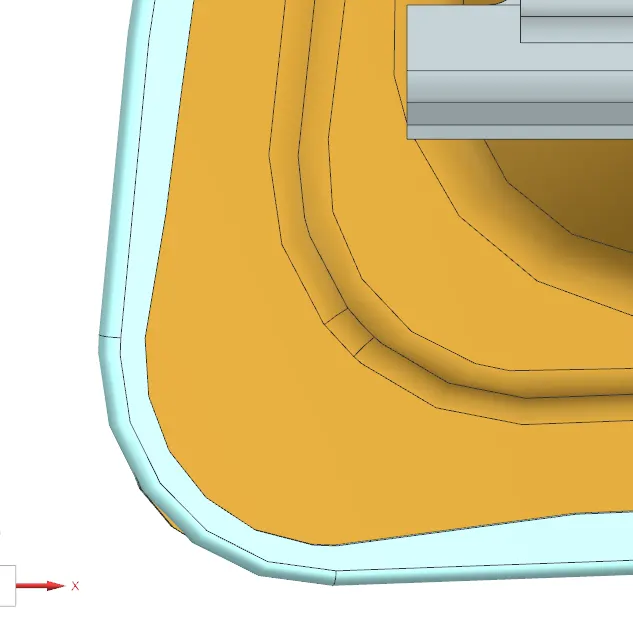
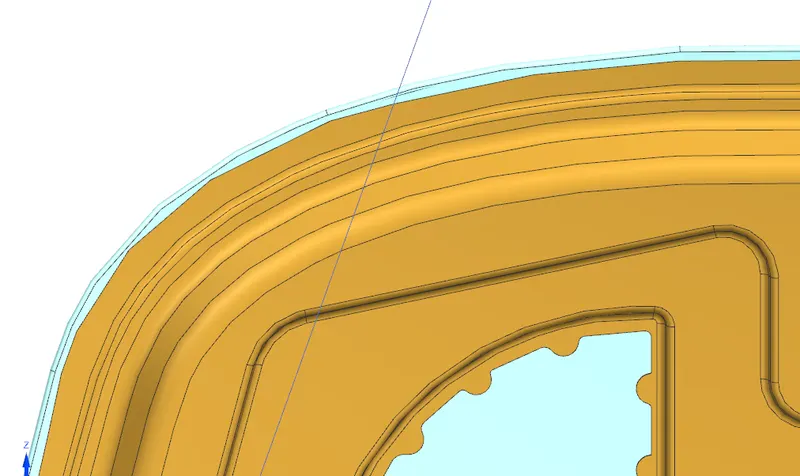
Corner relief:
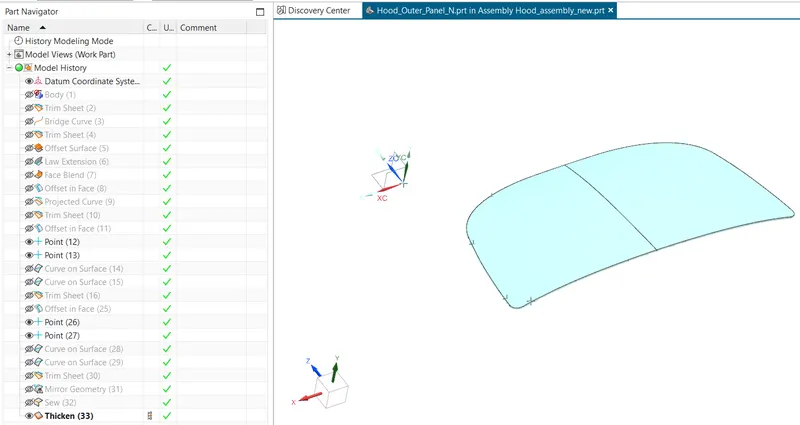
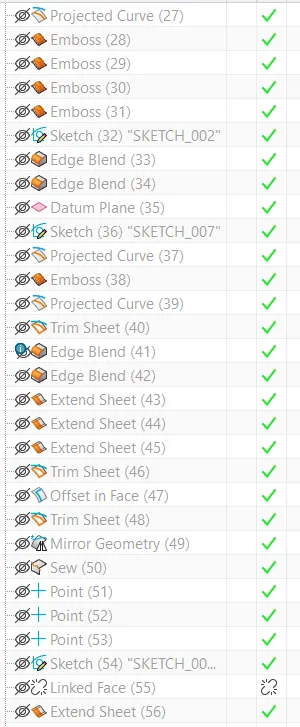
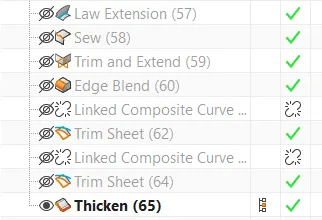
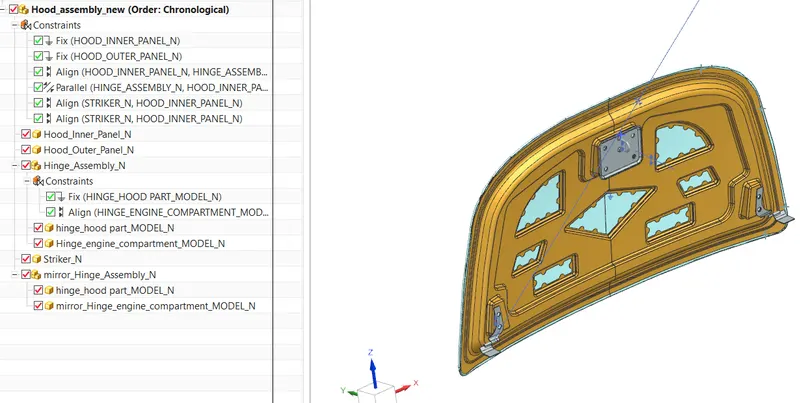
Assembly and model tree
Section view