Hood design-Week 2
AIM
To create and assemble the hood inner panel and outer panel and their reinforcements by following the design rules and master section.
OBJECTIVES
- Design Hood outer panel, inner panel and the necessary reinforcements by following the Master section mentioned with the design parameter and a detailed report about the Hood Design which includes a detailed explanation about hood and its components, Latch trajectory, Mastic data, Emboss definitions, manufacturing process like deep drawing and hemming, and all the parameters followed in the design.
HOOD
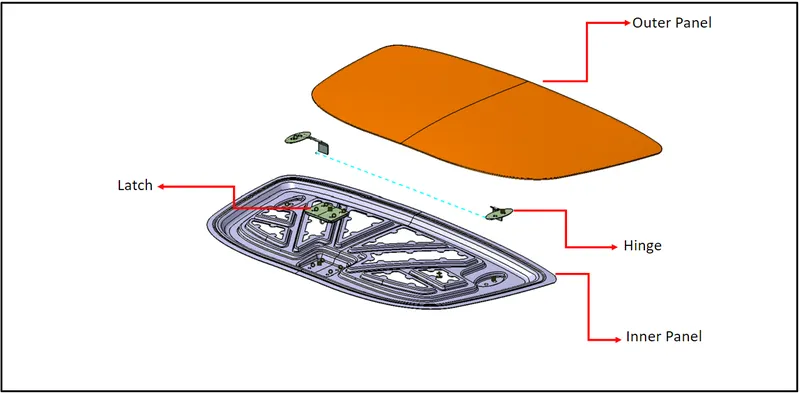
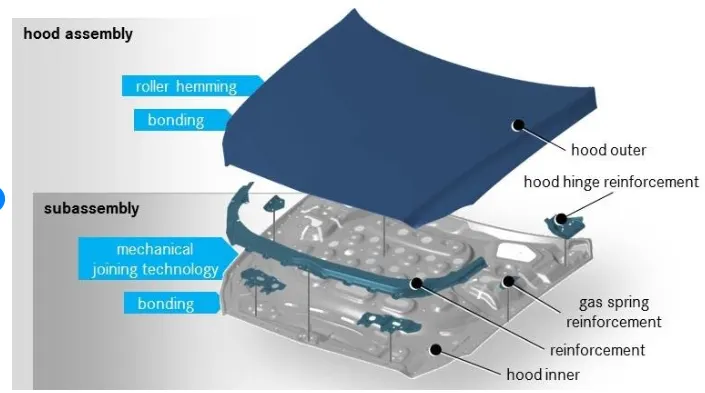
- The car’s hood consists of an inner and an outer panel.
- The inner panel provides strength, while the outer panel is just a metal cover.
- The underside of the hood is often covered with a sound-absorbing material.
- The hood or bonnet is the hinged cover over the engine of motor vehicles that allows access to the engine compartment for maintenance and repair.
- A hood may be held down by a concealed latch.
- A hood may sometimes contain a hood ornament, hood scoop, and/or wiper jets.
- Hood are typically made out of steel or aluminum, although aftermarket manufacturers may manufacture hoods out of fiberglass, carbon fiber, or dry carbon.
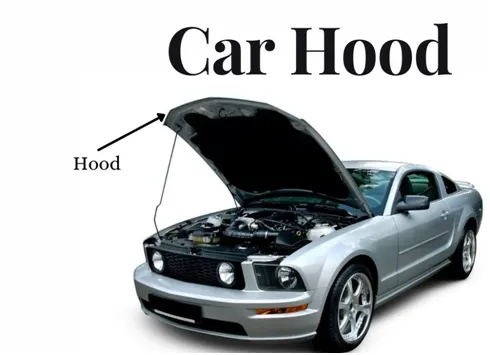
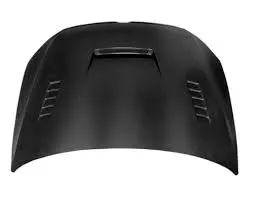
PARTS IN HOOD
SAFETY REQUIREMENTS
- Safety is the most important criteria in automobile designs which concentrates on both pedestrian and occupant safety.
- The pedestrians are the most vulnerable road users and are at high risk of traffic accidents.
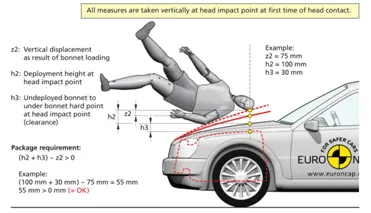
- The major reason for the fatality of the pedestrian in traffic accident is due to the head injury resulting from the hard impact of the head against the stiffer hood or the ground.
- This leads to the necessity of new inner hood panel which is less stiffer and pedestrian friendly.
- The head impact analysis on the present hood of the car was done to study the response of the adult head form at two different locations.
- Structural and modal analysis for the same present hood assembly was done to observe the local and global stiffness.
- In order to reduce the head injury of the pedestrian the local stiffness over the area of head impact has to be reduced thus the new design of hood inner panel was focused on that and the structural and modal analysis was done for the new design.
- The design with lesser local stiffness and similar global stiffness compared to the existing hood was finalized.
- The head impact analysis for the new design of hood inner panel was performed.
- The HIC values of the adult head form for two different locations are found to be 706 and 948 which meets the safety limitations of the adult head acceleration during impact as proposed by EEVC WG17 and Euro NCAP regulations. Thus the new design of the hood is pedestrian friendly, considerably maintaining the overall global stiffness of the hood.
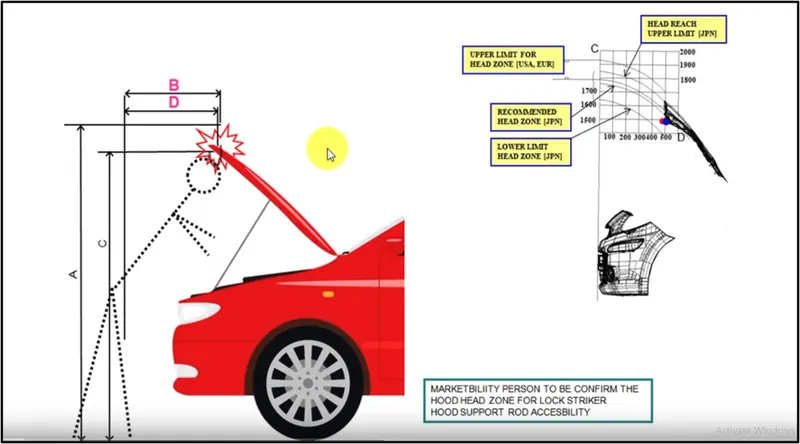
PEDESTRAIN SAFETY
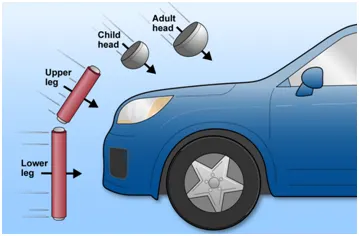
- crash mitigation tests that measure the potential for head and leg injuries resulting from pedestrian-motor vehicle crashes have been in place for many years in Europe and Japan.
- Euro NCAP began head and leg testing in 1997 and Japan began pedestrian head protection testing in 2003 and pedestrian leg protection testing in 2011.
- In general, these tests launch projectiles designed to simulate a person’s legs or head into various locations on a vehicle’s hood and bumper to assess the effectiveness in limiting pedestrian injury.
WRAP AROUND DISTANCE
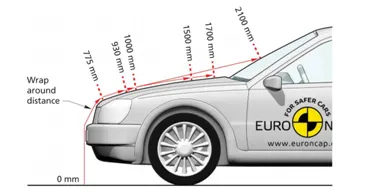
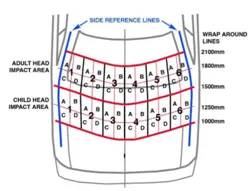
- The headform test area is defined as the outer structure that includes the upper surface of all outer structures.
- It includes, but is not limited to, the bonnet, wings, windscreen scuttle, wiper arms/spindles, windscreen frame, A-pillars and roof.
- It is bounded by the geometric trace of the 1000mm wrap around line in the front, the Bonnet Side Reference Lines and the 2100mm wrap around distance (WAD).
COMPONENTS USED IN HOOD
SUPPORT ROD
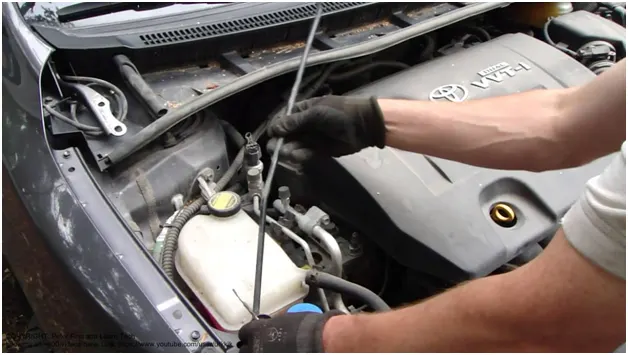
- The support rod is usually inside the engine compartment, when we open the hood and keep it in open condition, one end of the support rod attaches to the hood and supports it.
- This support rod has to be fixed manually onto the hood.
- The design of the support rod is not linear but it should have some bends to increase the rigidity and strength of the rod.
- The support rod should be mounted such that it does not collide with other parts, also the support rod should be mounted on the opposite side of the battery to avoid disturbance while removing the battery from car.
GAS STAY
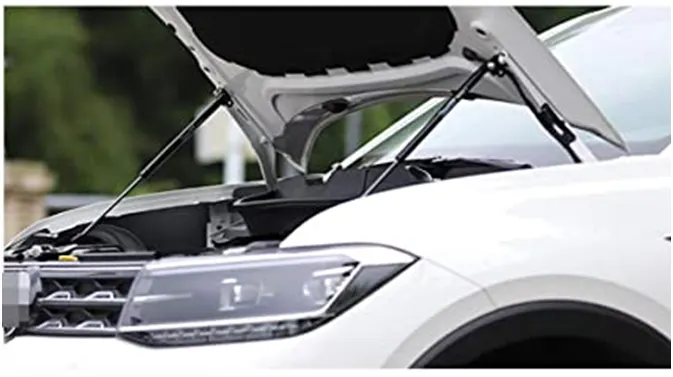
- A gas stay is used to open the hood. it uses compressed gas to open the bonnet automatically.
gas stays for the front hood are mainly used in high end performance cars where the bonnet weight is high.
LATCH TRAJECTORY
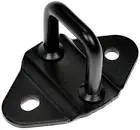
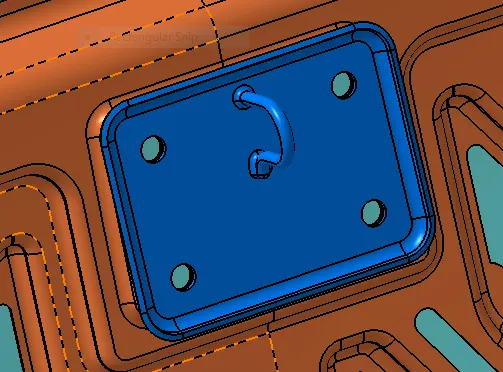
- This is the part of the hood that has a trajectory or hook type design used to lock or unlock from the vehicle engine compartment.
HINGE ASSEMBLY
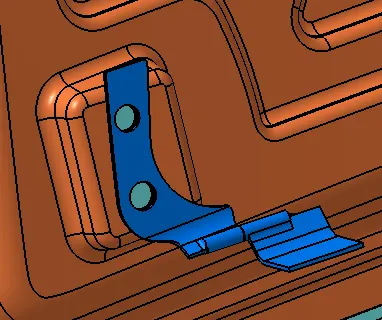
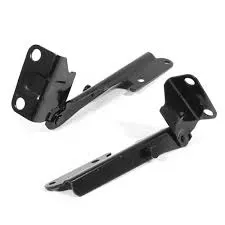
- This hinge was placed on the hood to give rollover action to tilt up or tilt down the hood.
- Creating Hood Inner Panel.
- Creating Hood Outer Panel.
- Creating Embossment for Hinge.
- Creating Embossment for Latch.
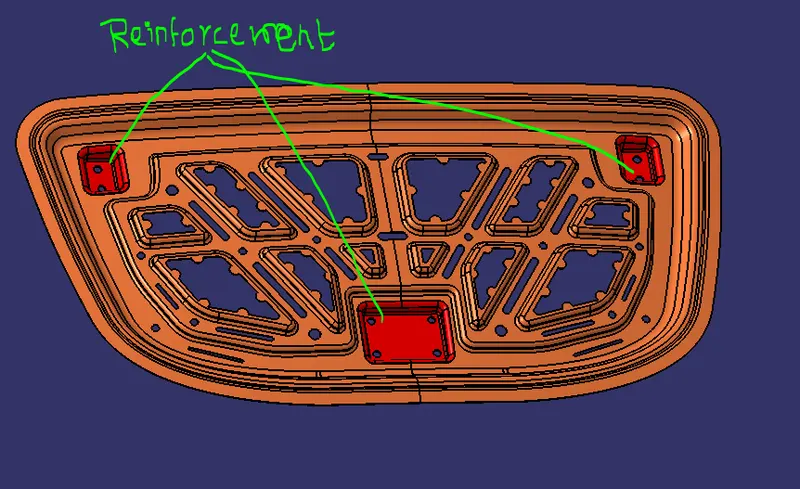
- Creating Reinforcements.
- Assembling the components.
- Performing Draft Analysis on CAD Model.
HOOD OUTER PANEL
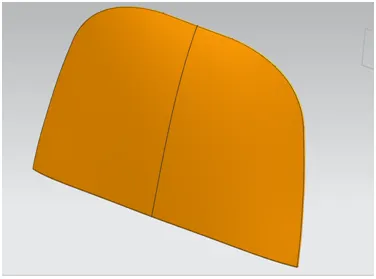
- The outer panel is actually called the skin of the vehicle which is designed by the styling team to get a good look for a vehicle by covering the inner panel and engine parts of the car.
- This part should not be welded to the inner panel but using the sealant and mastic points makes contact between the inner and outer panel which acts as a bond between both and makes the hood stiff.

HOOD INNER PANEL
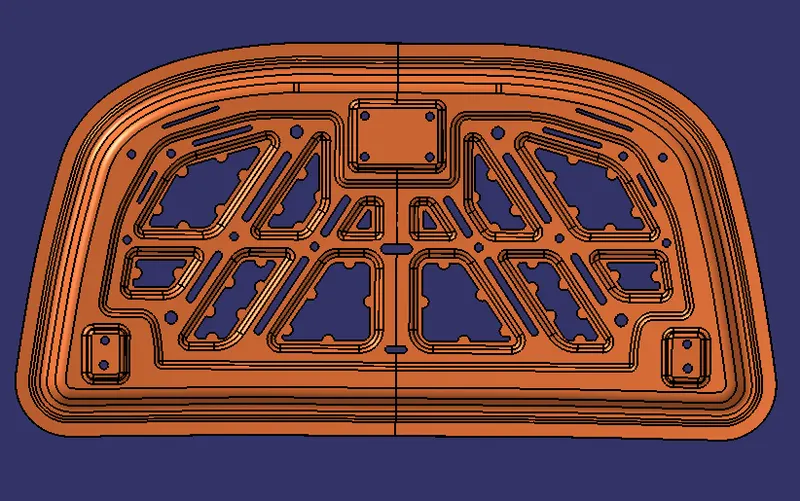
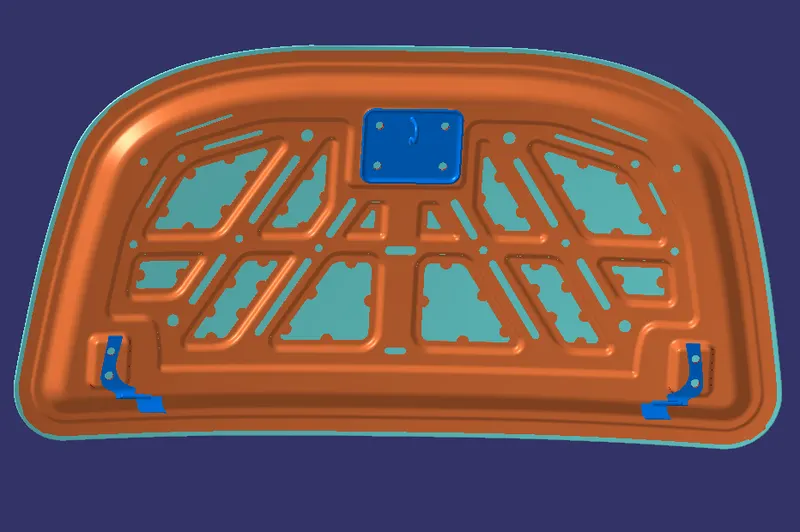
- The main part of the hood which gives support to the outer panel of the car and with its embossing shapes dissipates the force in different directions when the vehicle takes crashes to not to injure the men in the car.
Latch Trajectory
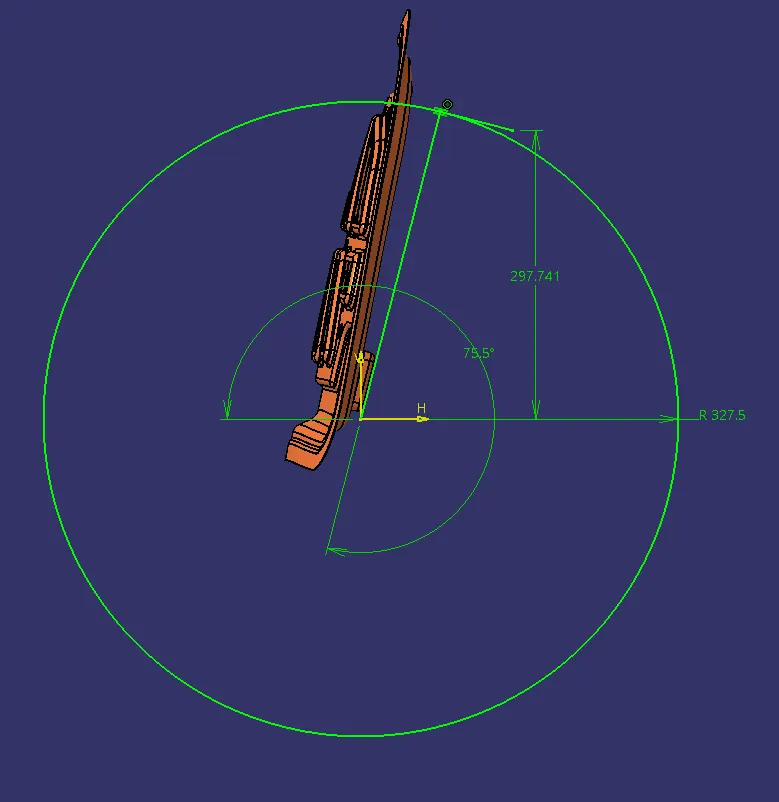
- Latch trajectory is given by the circle drawn from the hinge axis point.
- Hinge axis point is the centre point of the hinge axis. First, we can fix either the latch or the hinge.
- If we have fixed the hinge position then we should plot the Trajectory circle for the latch. For proper mating condition the striker axis through the tip of the striker should be tangential to the latch trajectory.
REINFORCEMENT
- Vehicle hood reinforcement structures as provided to reduce impact in collisions.
- In one embodiment, the structure is to include a lower reinforcement panel configured to mount to a vehicle chassis and an upper reinforcement panel welded to the lower reinforcement panel wherein the deflection of a front deformable wall of the upper reinforcement panel is configured to trigger deflection of rear deformable wall of the lower reinforcement panel.
DRAFT ANALLYSIS OF INNER PANEL
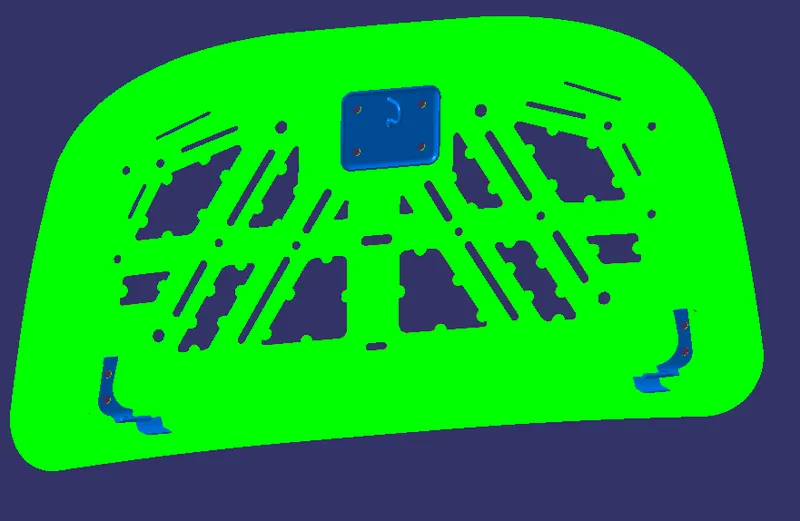
DRAFT ANALYSIS OF OUTER PANEL

FLOW CHART OF HOOD DESIGN
MANUFACTURING PROCESS
DEEP DRAWING
- Deep drawing is one of the most widely used processes in Sheet metal forming.
- Apart from its use in many other sectors, it is applied in the automotive industry for the manufacturing of car body parts.
Process definition:
The deep drawing process is a forming process which occurs under a combination of tensile and compressive conditions. A flat sheet metal blank is formed into a hollow body open on one side or a hollow body is formed into a hollow body with a smaller cross-section.
Deep drawing processes are divided into three types:
- Deep drawing with tools
- Deep drawing with active means
- Deep drawing with active energy
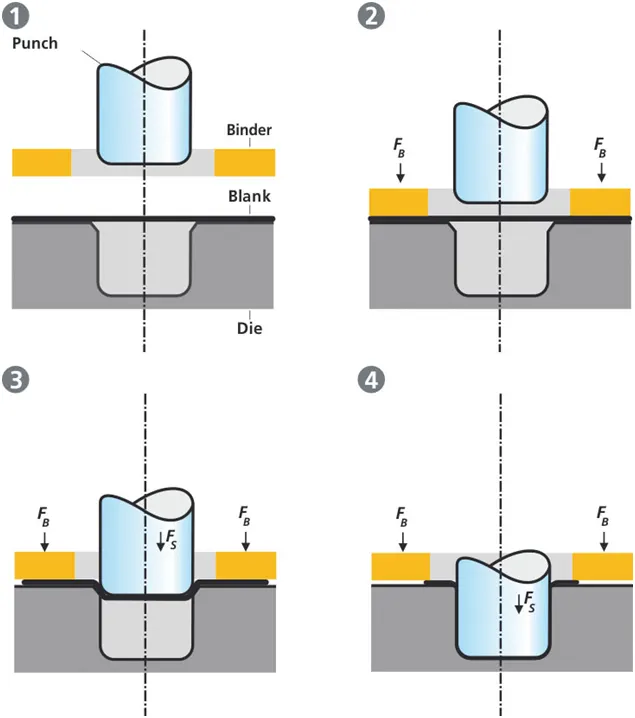
In the automotive industry, deep drawing is usually carried out using rigid tools.
Illustration of the deep drawing process
- The rigid tools consist of a punch, die and binder.
- In deep drawing, the plate holder closes after the metal sheet blank has been inserted.
- Next the sheet is clamped between the die and the binder.
- This process slows down the flow of the sheet while it is being drawn and thereby prevents wrinkles from forming under the binder.
- The punch stretches the sheet over the die radius and forms it in the die.
- The amount of punch force necessary for forming is thereby continually increased up to the lower dead center of the punch.
- Whereas in pure deep drawing there is no reduction of sheet metal thickness, forming is achieved in stretch forming purely as a result of a decrease in sheet metal thickness.
- Stretch forming is extensively used for the forming of only slightly curved parts with low depth of draw (e.g. roofs, doors).
- When drawing complex car body parts in practice, there is usually a combination of stretch and deep drawing involved.
- It is necessary that the sheet metal is stretched as well as possible without reaching the material’s limits (e.g. splits, wrinkles).
EMBOSSING
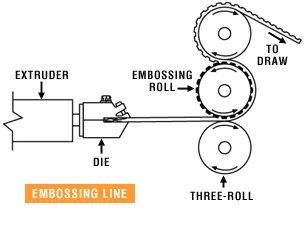
- embossing is a metal forming process for producing raised or sunken designs or relief in sheet material by means of matched male and female roller dies, theoretically with no change in metal thickness, or by passing sheet or a strip of metal between rolls of the desired pattern.
- Metal sheet is drawn through the male and female roller dies producing a pattern or design on the metal sheet.
- Depending on the roller dies used, different patterns can be produced on the metal sheet.
Characteristics of the metal embossing process include:
- Its ability to form ductile metals,
- Its use in medium to high production runs,
- The ability to maintain the same metal thickness before and after embossing,
- The ability to produce unlimited patterns, depending on the roll dies, and
- The ability to reproduce product with no variation.
MASTIC SEALANTS
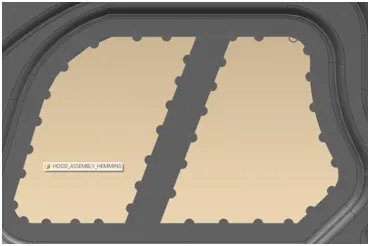
- A mastic sealant is a type of liquid sealant that cures in an elastic state, thus making it flexible while holding the bond of the surfaces that has attached together.
- It adheres to just about any material making an all purpose type of sealant.
- The main purpose of the outer panel is for the aesthetic looks.
- Thus we cannot use bolts or welding.
- This has to be done with the help of the hemming and mastic sealants.
- Mastic sealants are elastic compound that behaves like the rubber.
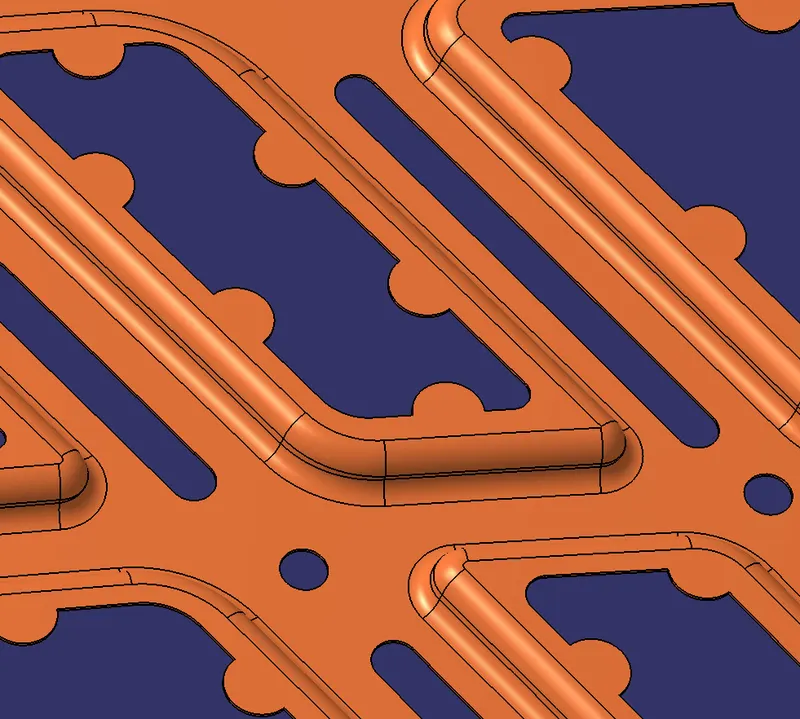
- It is placed between the outer and inner panel.
- Initially is it in paste form, but after the hot furnace bath it gets hardened thus joining the outer and inner panel.
- Mastic sealant has the tendency to increase the strength of the panel and has influence of 80mm diameter.
HEMMING
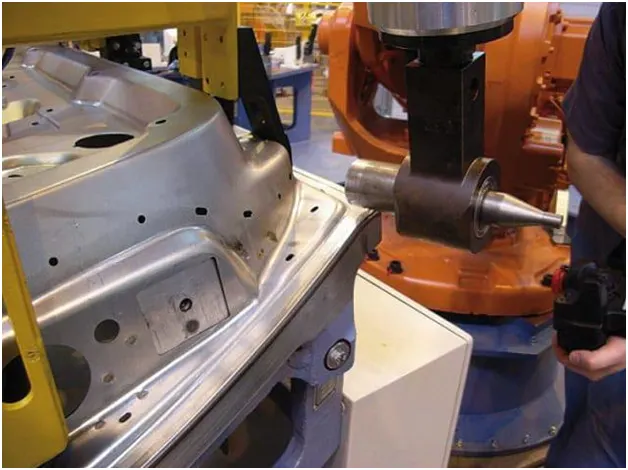
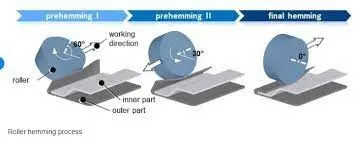
- Hemming in automotive manufacturing is a cold process of joining an inner and outer panel by folding the flanges of the outer panel onto the inner panel, permanently clamping the inner panel in place.
- This process is used in the manufacture of doors, hoods, and decklids and can be accomplished using a traditional press or with a robotically controlled roller.
TYPES OF HEMMING
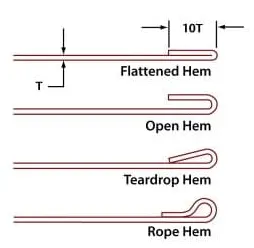
- Flattened/closed hemming
- Open hemming
- Tear drop hemming
- Rolled/rope hemming
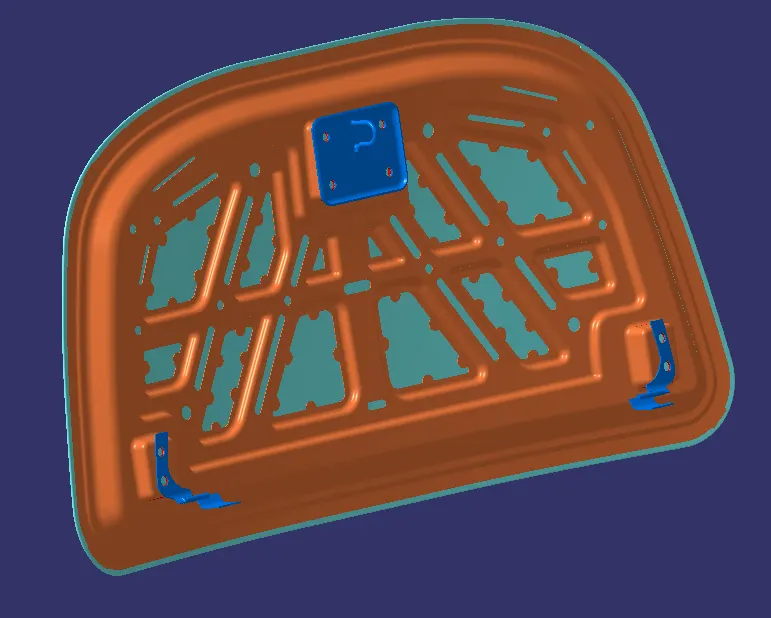
DIFFERENT VIEWS OF HOOD FINAL ASSEMBLY
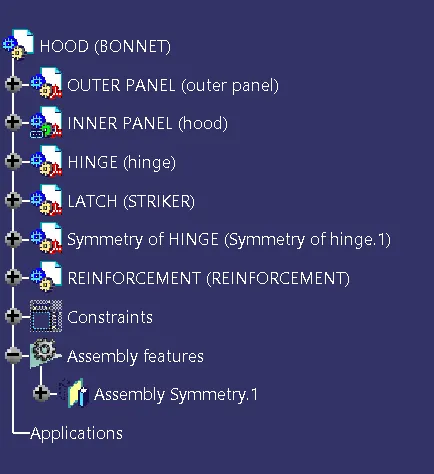
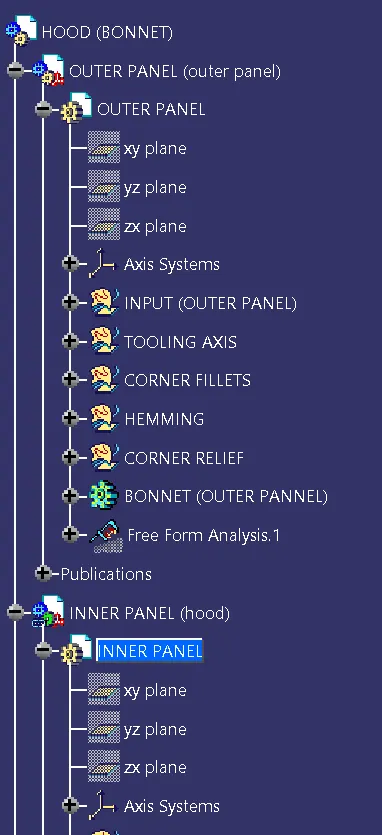
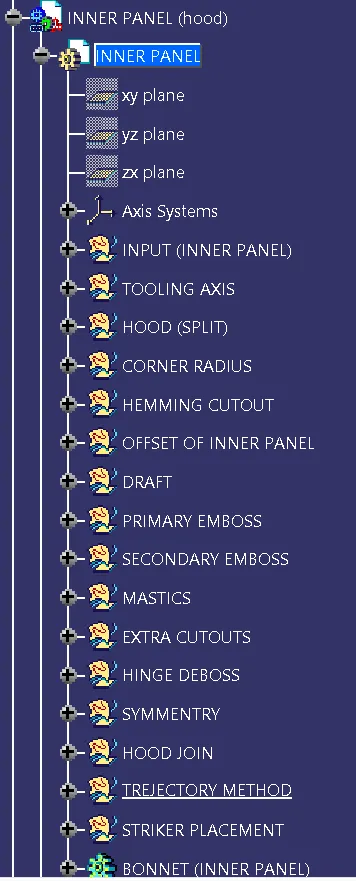
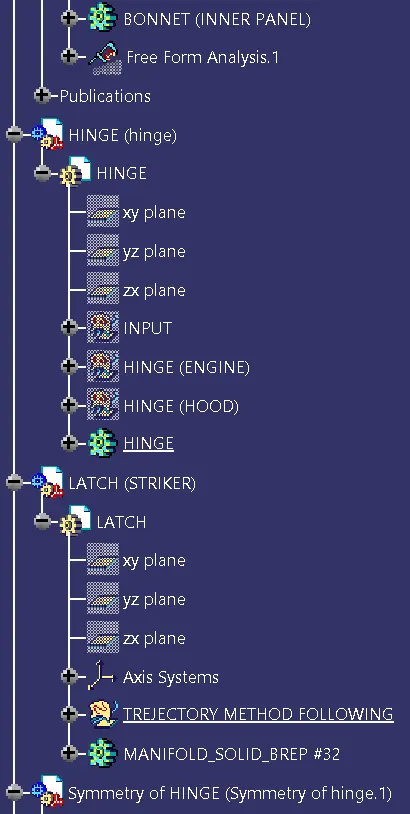
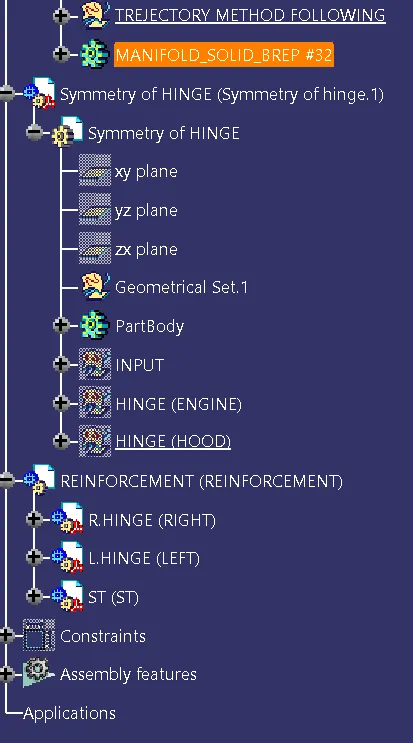
TREE STRUCTURE
CONCLUSION
- Thus the hood/bonnet of car has been designed and assembled by using CATIA V5.
- CREATION OF EMBOSS AND DEBOSS OF HINGE AND STRIKER.
- MASTIC POINTS HAS BEEN CREATED WITHE THE DESIGN CONSIDERATION.