Hood design-Week 2
REPORT FOR HOOD DESIGN
AIM:
- To understand the design strategy and consideration that goes under designing and developing a hood for vehicle.
- Create the design of Hood Outer Panel and Inner Panel.
- Create the necessary reinforcements by following the Master Section.
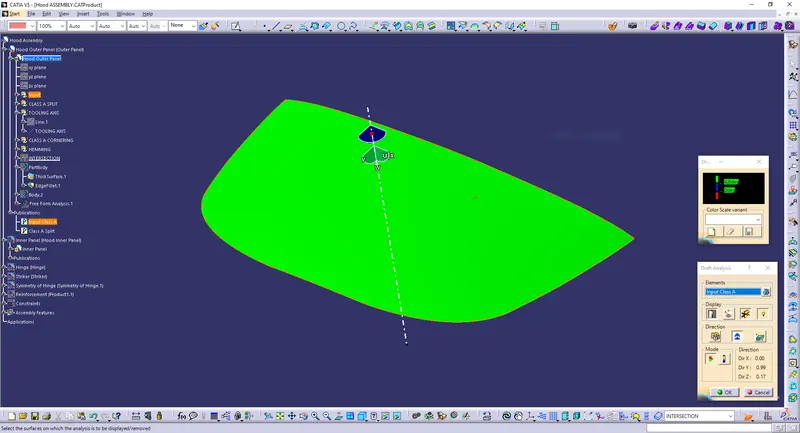
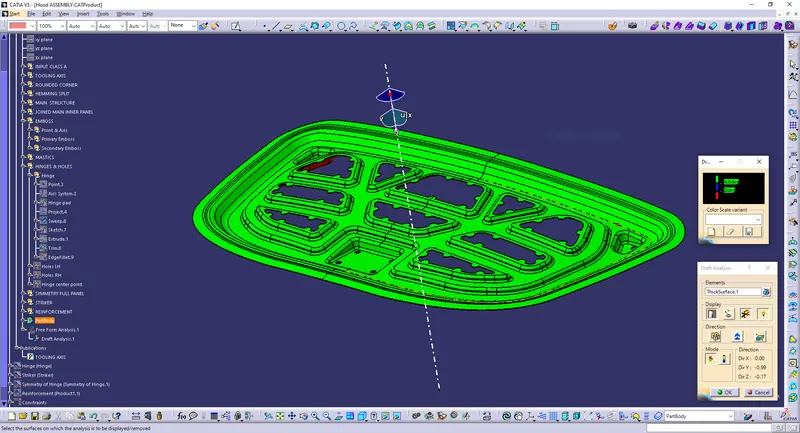
- To create the tooling axis for the given Input Surface meeting the requirements of the draft angle and at the end perform the Draft analysis on the final model.
Introduction:
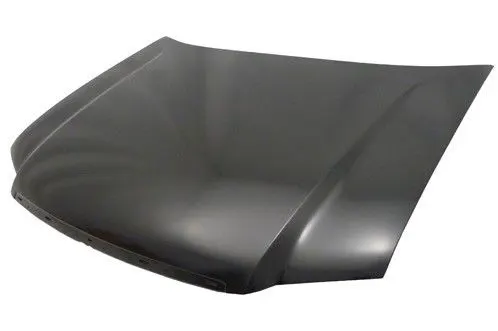
A car hood also referred to as a bonnet in some other countries is the hinged cover that rests over the engine of a front-engine vehicle. Its purpose is to provide access to the engine for repair and maintenance. Car hoods are typically constructed from steel and sometimes from aluminum. A concealed latch is typically used to lock the hood in place while driving. A release for the mechanism can be accessed from the dash below the steering wheel. On race cars and vehicles with an aftermarket hood, exposed pins may be used to secure the car hood. Hoods sometimes contain a hood scoop or a power bulge to allow for greater engine capacity and airflow to increase the car’s performance output.
Hood Category in BIW:
Hood is one of the other major closure systems in a vehicle BIW and is fundamentally a reinforced skin with many design quality and safety regulations. Hood may come with several subcomponents, but the two most important ones are the outer and inner panels. The inner panel serves as a structure for the vehicle to dissipate and channel shock waves at the event of a crash while the outer panel serves more as an aesthetic for the automobile’s overall presentation and to channel airflow over the vehicle. Hence, both require critical precision as well as a dedicated strategy right from the design conceptualization to the production step. The initial design goes through iterative design modification based on structural analysis such as fatigue analysis and crash analysis to name a few before it sees the light of the day.
Hood and it’s Components:
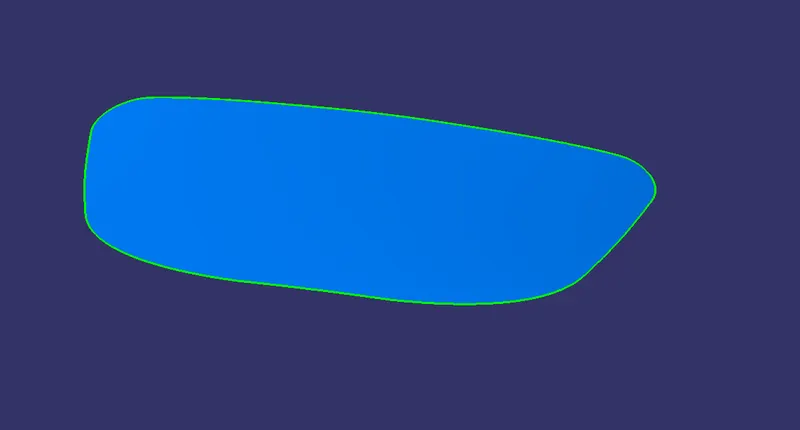
1) Hood Outer Panel : Outer panels are the aesthetic elements of a car. It is the styling team who provides the skin for the outer panel. The shape, position and size of the hood should satisfy the safety norms. So while designing the hood we should give more importance to pedestrian safety. The outer panel is attached to the inner panel by hemming. So, it is necessary to provide required hemming flange and reliefs for the hemming operation. We also provide mastic sealants between outer panel and inner panel to reduce vibration..
2) Hood Inner Panel : Inner panel is the part that gives strength and rigidity to the outer panel. The master section represents the initial emboss shape and size. Then we provide the emboss for the latch and hinge elements after fixing the location.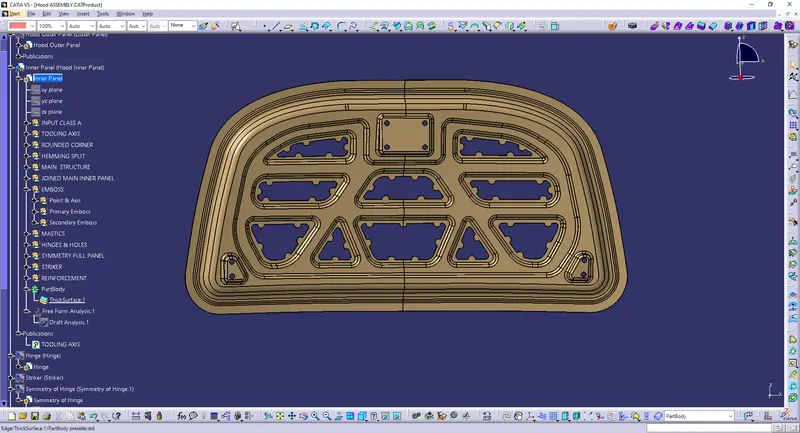
3) Hinges : Pivots permit the hood to turn around a decent hub for opening and shutting development. One piece of the pivot is fixed with the motor compartment, while other part is associated with hood.
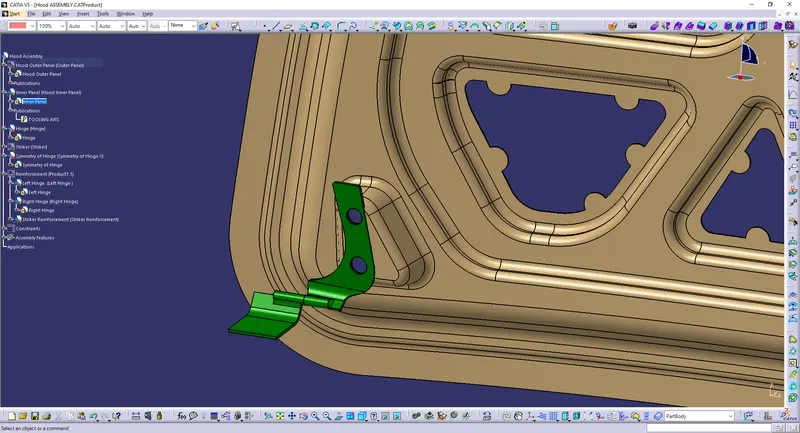
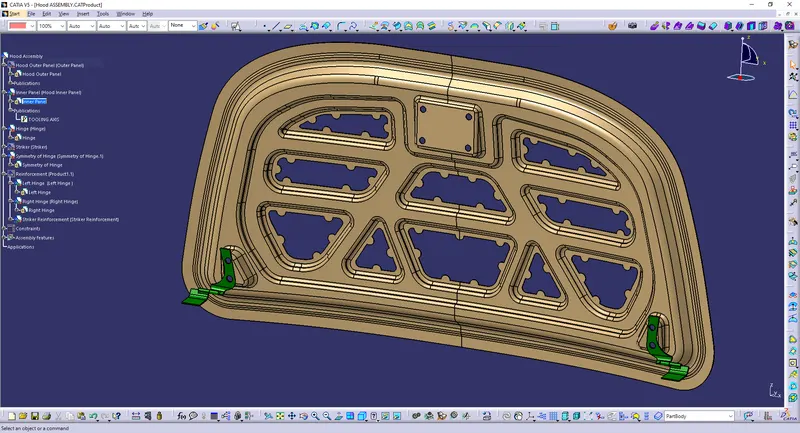
4) Striker : Striker component is given to lock the hood, to forestall unplanned opening of the hood during driving. The hook is available on the engine compartment while the striker is connected to internal piece of hood.
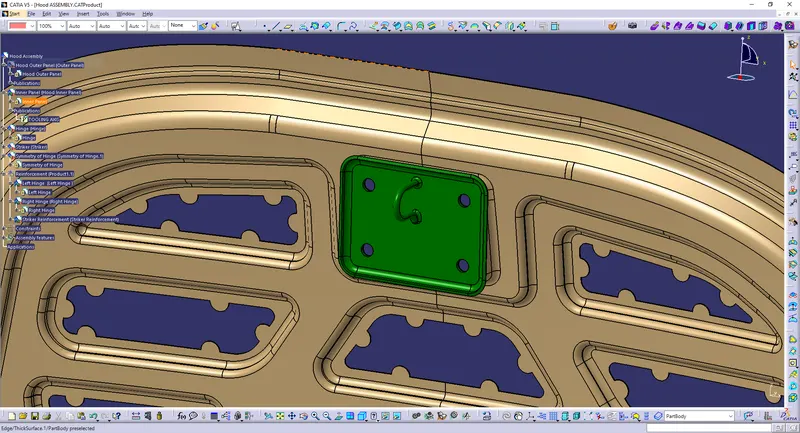
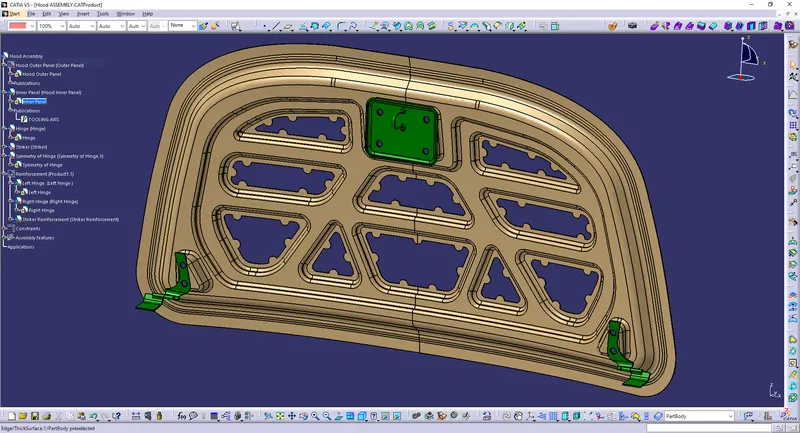
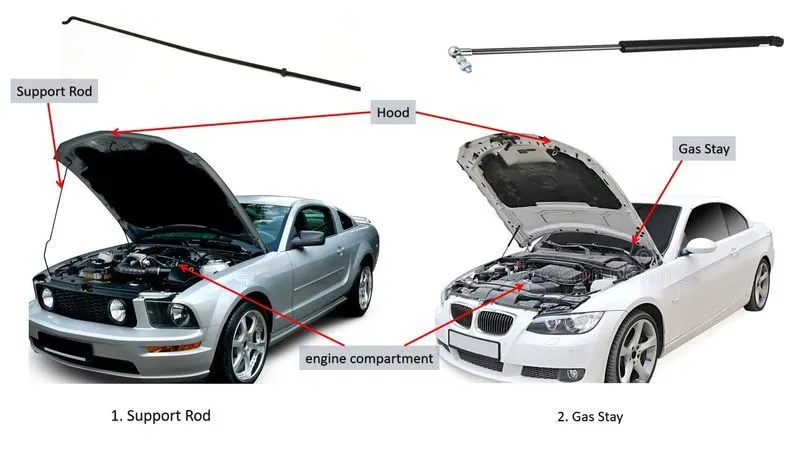
5) Gas Stay : It is a component that supports the hood in open position. It is also called as stay.
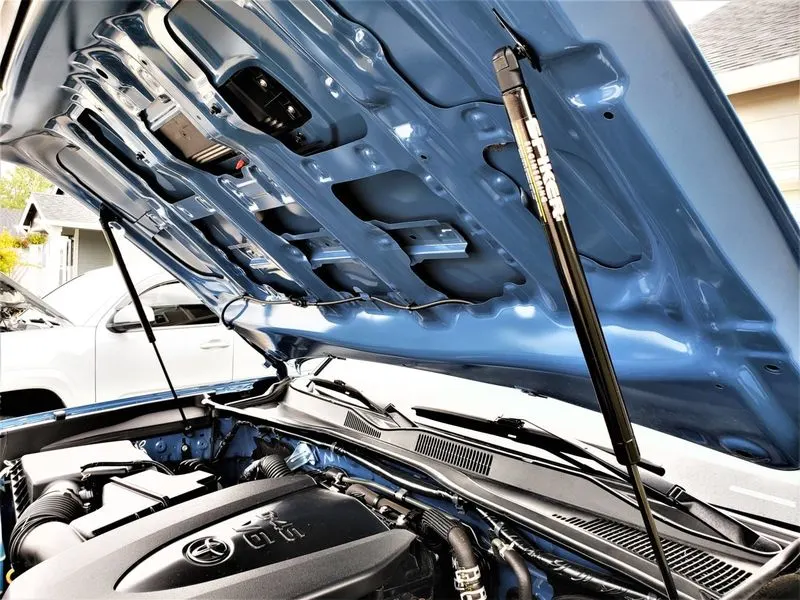
6) Reinforcements : Reinforcements are provided according to the design requirements. Mainly it is provided at the hinge and latch regions to improve the strength locally. Usually thickness of reinforcements will be higher than that of the inner panels and the value varies according to cost and requirement. According to the design requirement here it is given 1.5mm thickness to both hinge and latch reinforcements.

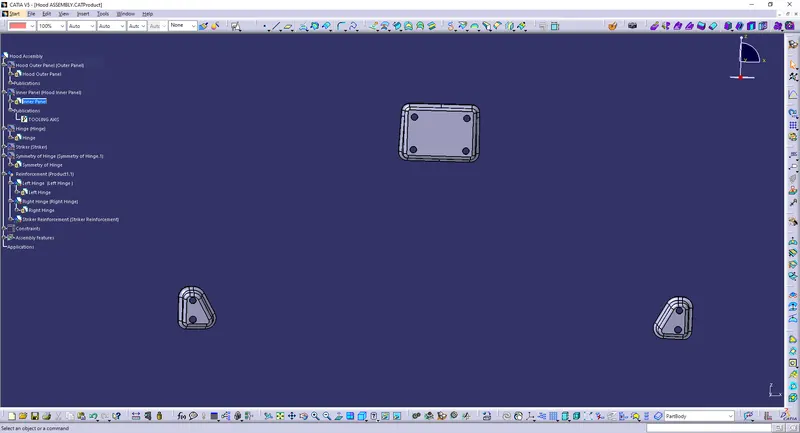
7) Latch Trajectory: It is the way along which the hood pivots during opening and shutting development. The striker on the hood follows a specific way while opening or shutting the hood, which is along perimeter of a circle with focus at the pivot hub. This way is only hook direction. It is a vital perspective in hood configuration, to choose pivot, hook and striker establishment focuses.
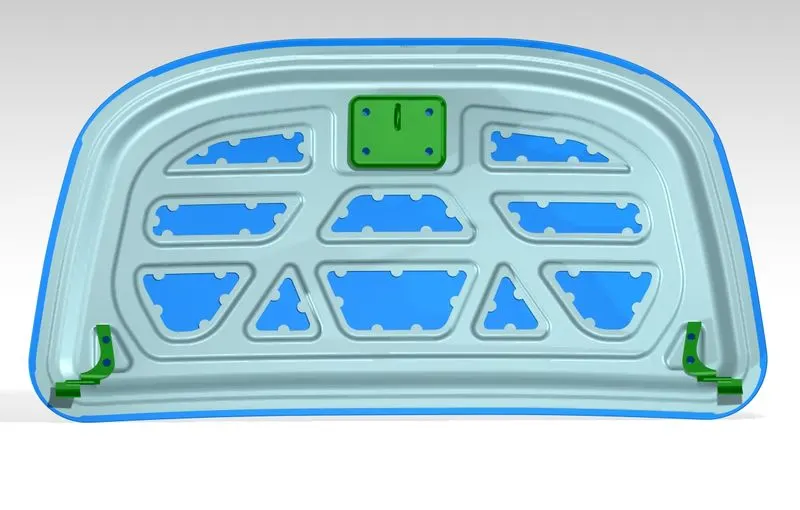
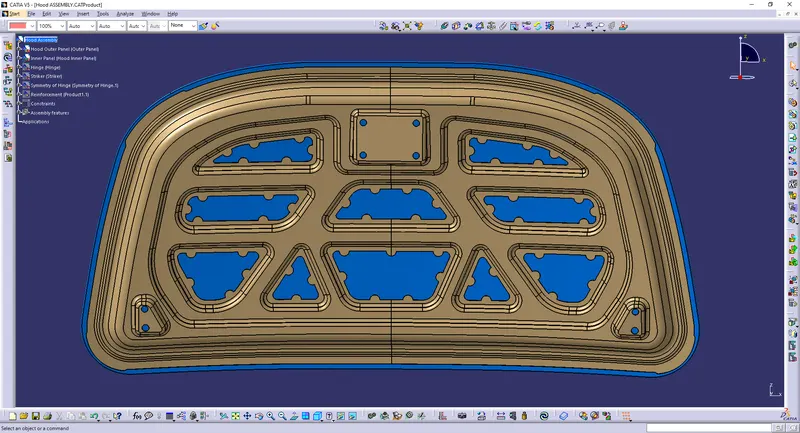
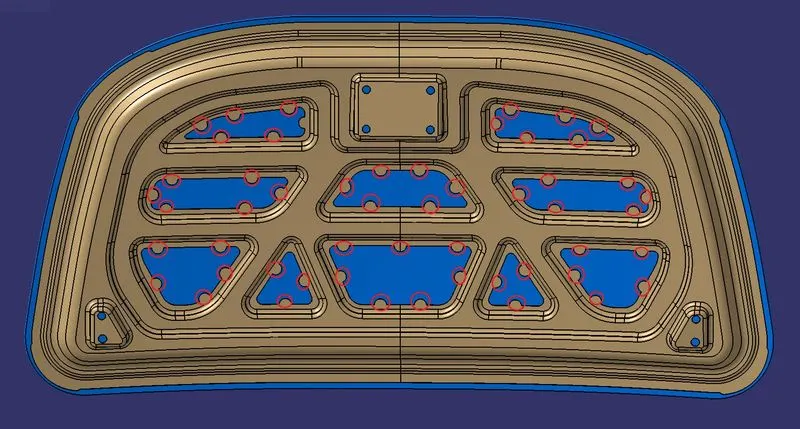
8) Mastic Sealant: Mastic sealant serves to further develop strength of the hood locally. It is by and large a hard elastic part, which is presented as an in the middle of among internal and external board of the hood, which will get solidified inside the heater. Each mastic sealant direct will have a propensity toward work on the nearby strength in around 80 mm width. Taking into account this, the mastic focuses are situated with the end goal that the greater part of the hood district is covered.
Mastics part highlighted in below image:
Design Methodology:
- Design Consideration
As discussed in the earlier section, the hood plays a critical safety function in an automobile, not only for the occupants of the vehicle but also for the pedestrian. Hence, a lot goes in while designing the hood and must be compliant with the standards and considerations. In this project, the European New Car Assessment Programme, popularly know as EuroNCAP, was followed to understand the consideration and standards one must follow while designing a hood. EuroNCAP plays an instrumental role in raising awareness on safe and effective design for the pedestrian. It programs and develops test series and rating systems for accessing design safety for pedestrian during impact with a vehicle. The tests are generally executed for vehicle hit speed at around 40 km/h and covers the pedestrian body interaction with the vehicle upon collision.
Below represented chart throws light on some of these considerations for the frontal crash of a vehicle with a pedestrian.
Fig. Pedestrian Crash Dummy Placement - Child (Left) & Adult (Right)
Fig. Head Impact Region
Fig. Impact Area for Child and Adult Head
Fig of Body-Bonnet Interaction:
As we could see the impact region, based on these impact regions the thickness of the hood at those regions are reduced to allow softer landing and lower impact. Upon impact of the pedestrian, the hood in those regions should absorb and dissipate the energy allowing deformation and hence collapsing, which in turn would result in a lower impact on the pedestrian.
At the same time, the impact on the vehicle should be channeled outside the vehicle to safeguard the occupants from severe injuries. Based on these considerations, the inner panel should be embossed with strategized channels and empty cut-outs to allow for maximum absorption of such impacts.
- Design Methodology:
The procedure followed for designing the hood and its components is as follows,
- First the inner panel is designed from the given master section using the various commands and features. We create the embossing using the offset surface from the original master section. Similarly, we create the cuts on the emboss by sketching and using trim surface option.
- Then the outer panel is designed from the same master section. Here we are supposed to provide the hemming to outer panel. The parameters of hemming are taken as per given values.
- Now, on the inner panel, the embossing for hinge and striker are produced by considering their respective dimensions and assembly positions. First the emboss for hinge is created and then by fixing the hinge into its position, we draw an axis passing through both side hinge axes to form a common axis. And then we position the striker such that it will move along circumference of a circle whose center is at midpoint of the common axis. Thus, position of striker is decided and we can create emboss for the same.
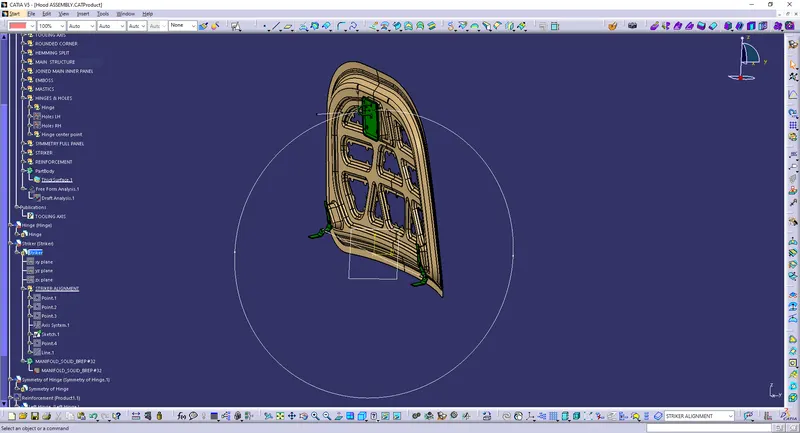
- Using the hinge emboss we created, we can create our hinge reinforcements by creating new parts in the assembly itself.
- Data Povided –
Outer Panel Thickness – 0.75mm
Inner Panel Thickness – 0.75mm
Reinforcement Thickness – 1.5mm
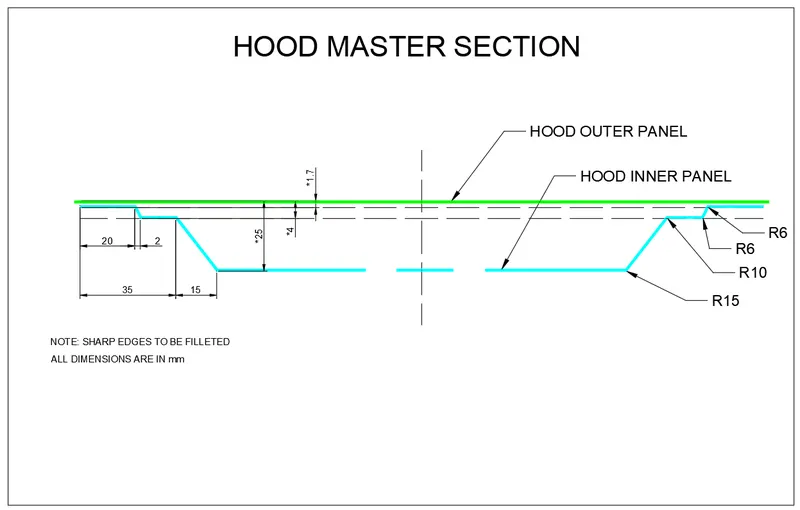
Emboss for Hood:
Primary Emboss Design Sketch Images:
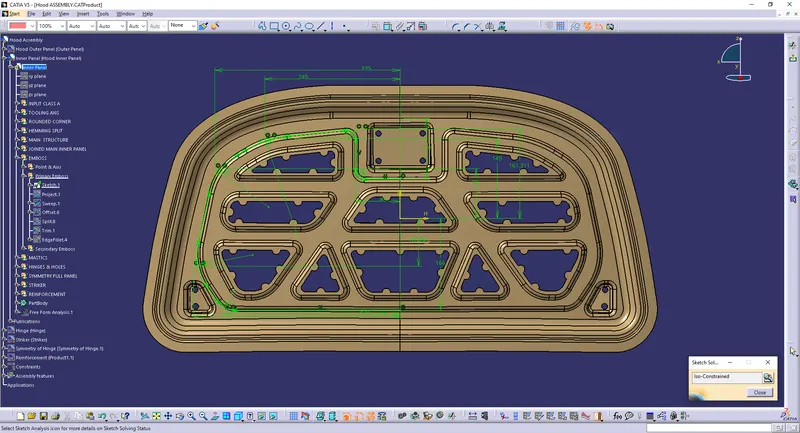
Secondary Emboss Design Sketch Images:
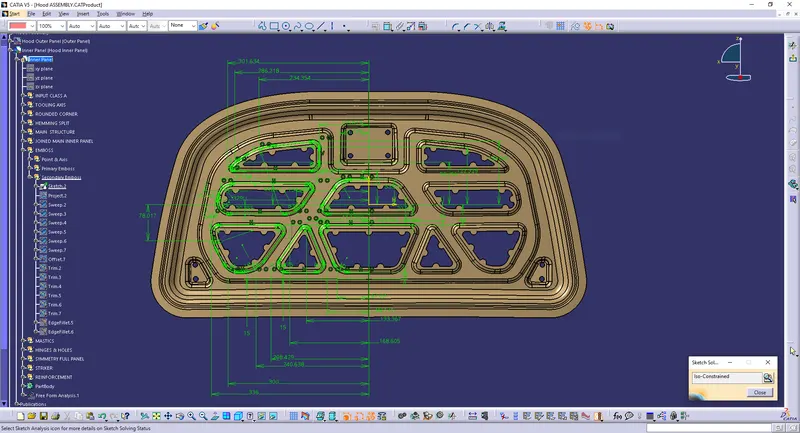
Hinge Design Sketch Images:
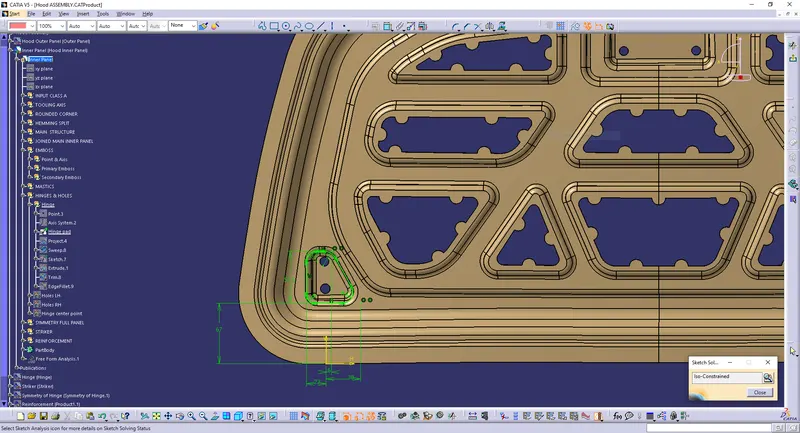
The manufacturing process of Hood Design:
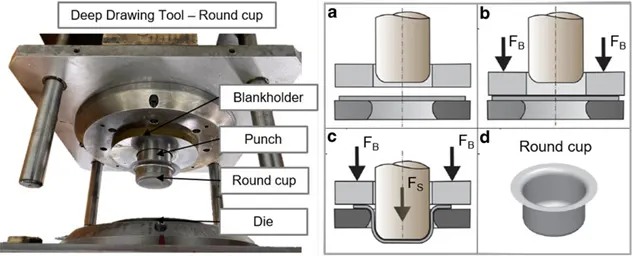
Deep Drawing:
- The deep drawing process is a forming process which occurs under a combination of tensile and compressive conditions.
- A flat sheet of the metal blank is formed into a hollow body open on one side or a hollow body is formed into a hollow body with a smaller cross-section.
- Forming is achieved in stretch forming purely as a result of a decrease in sheet metal thickness. Stretch forming is extensively used for the forming of only slightly curved parts with a low depth of draw.
Hemming:
- Hemming is a technology used by the automotive industry to join inner and outer closure panels together (hoods, doors, tailgates, etc.). It is the process of bending/folding the flange of the outer panel over the inner one.
- The accuracy of the operation affects significantly the appearance of the car’s outer surfaces and is, therefore, a critical factor in the final quality of a finished vehicle.
- Hemming is performed to:
- Achieve a better final geometry in the vehicle´s part
- Add resistance and rigidity to the part
- Allow safe handling of the part.
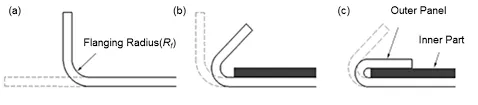
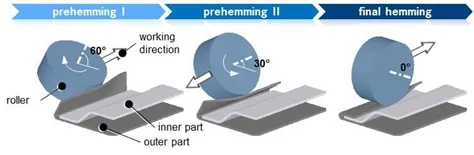
Fig.13 Roller Hemming process in 3 Stages
Embossing:
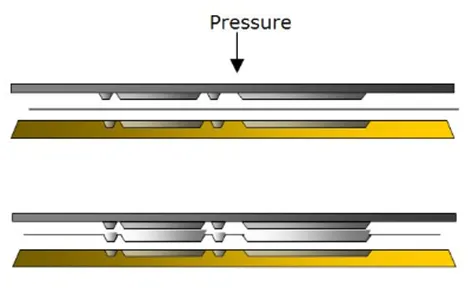
Embossing by definition is the process of giving a 3-dimensional look to a material or product. Pressure is applied to the surface of the material and results in an image remaining on the surface of the material. ‘Relief’ is another term used to encompass the process of embossing.
Piercing –
It is a shearing process in which raw sheet metal is pierced with a machining tool, resulting in the creation in a particular shape hole in the sheet. The major difference between blanking and piercing is that in blanking the cut out is the workpiece and outer part is scrap, while in piercing, the cut out is scrap and the outer sheet is the workpiece.
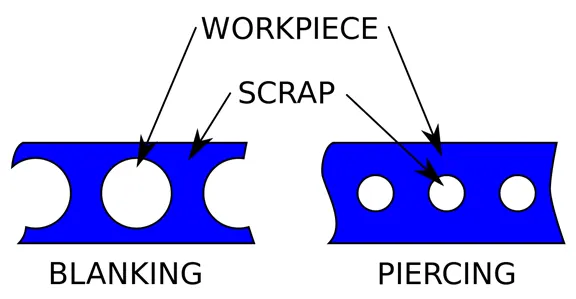
Fig.15 Piercing and Blanking
Features used in designing:
Emboss – Emboss command creates an embossing by modifying a body with faces created by projecting a curve/section along a direction. You can modify the emboss using options like endcap location and draft angle.
Master Section - Master sections are the guides for design requirements which decide the component packaging after technical (Styling, Concept or Class-A).
Mastic sealant : Mastic is a form of sealant or adhesive used to fill the joints or as a bond for different materials and gaps.
DRAFT ANALYSIS OF HOOD INNER PANEL & OUTER PANEL
Draft Analysis of Outer Panel:
Draft Analysis of Inner Panel:
ASSEMBLY OF CAR HOOD
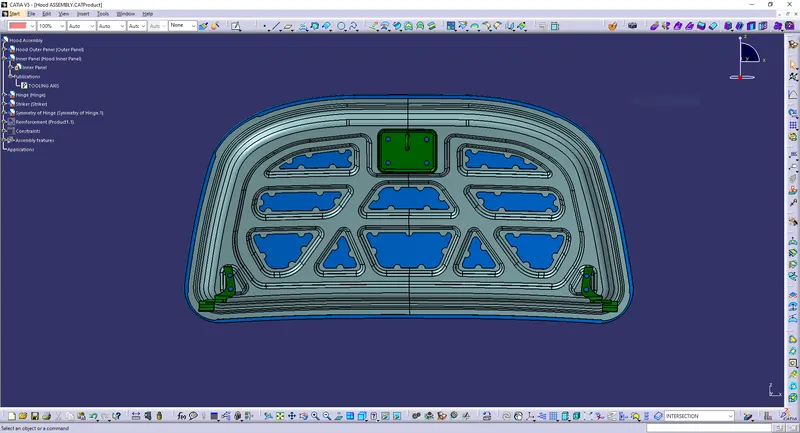
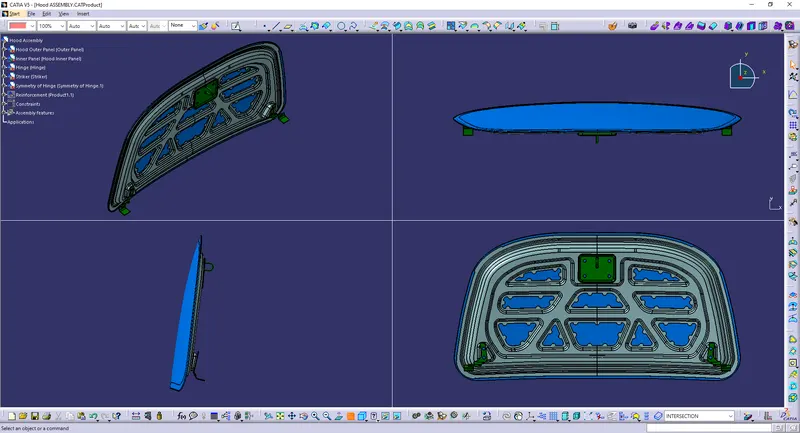
Multiple View of Assembled Hood