Hood design-Week 2
HOOD DESIGN
Here we need to design inner panel, outer panel , reinforcement from the given hood outer panel skin, master section and design parameters.
HOOD
Hood is a main closure of the vehicle body, which used to cover engine compartments and provide an asthetic look to the front portion of the vehicle. it consist of outer panel, inner panel, hinge assembly, striker and hood stay. in design consideration hood will meet pedastrian safety, latch and striker tragectory, manufacurability and force distribution when a collision happens.
Hood stay is used to support the hood when in open condition. two types of hood stay are commonly available. support rod and gas stay. support rod is widely used and it is simple. no man power needed for opening and closing of hood by using gas stay.
the openig angle required is related to the size of hood stay, the opening angle is related to the average height of the man. it varies in each countries. the purpose of providing hood for the front engine vehicle to fill coolant, lubricant, wiper water, maintanance of engine and other parts, for checking battery etc. blanking, deep drawing, hemming, piercing are the main manufacturing operations used to produce a hood.
here thickness for the outer panel and inner panel is 0.75 mm and thickness of reinforcment is 1.5.
OUTER PANEL
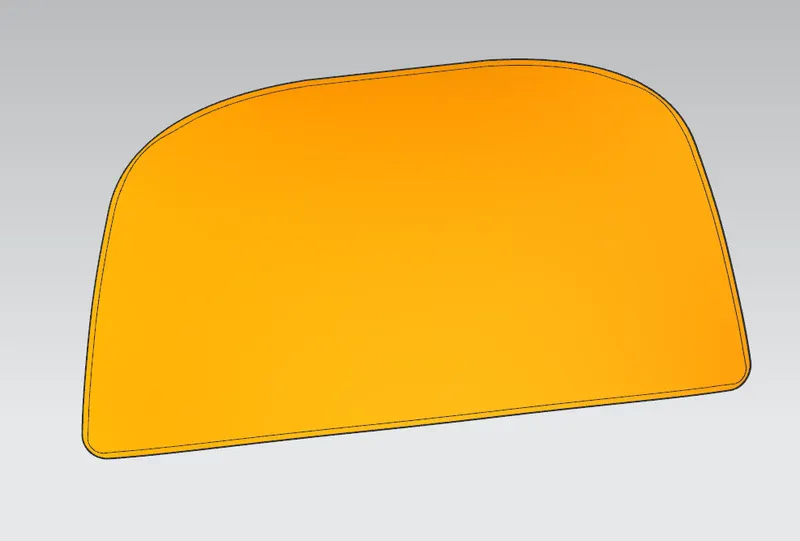
Outer panel is the aesthetic portion of the vehicle. the size and shape of the outer panel is designed by a styling team. they are considering some aerodynamis while designing outer panel. outer panel and inner panel are connected by using hemming process. so while design of outer panel we need to consider hemming and relief of some portion for the easy process of hemming. we providing some mastic points to reduce vibration in between outer panel and inner panel.
INNER PANEL
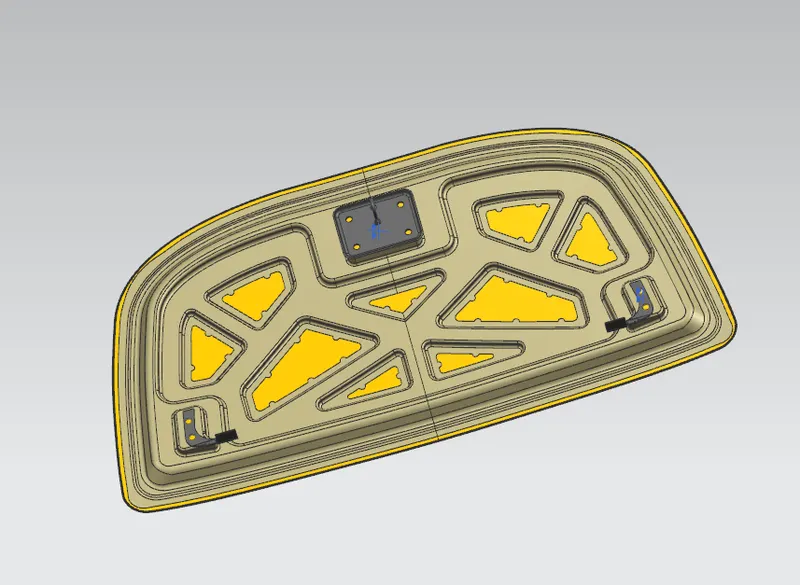
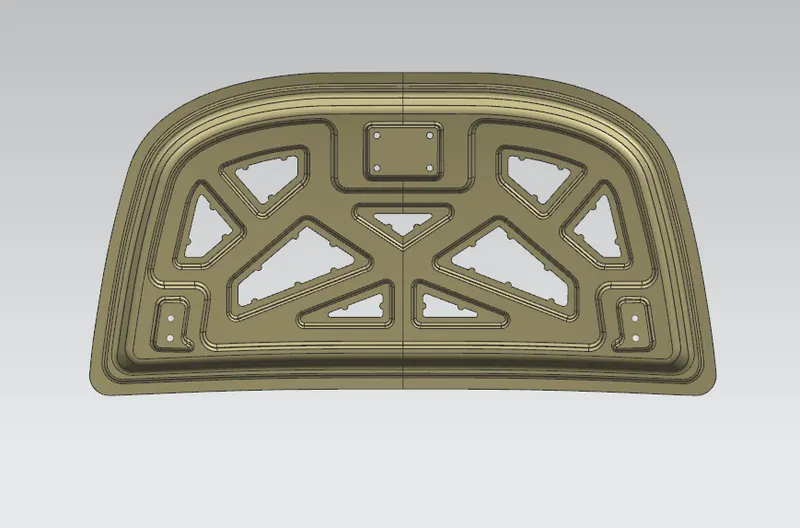
Inner panel is the bottom portion of the hood. it is provide strength and rigidity to the hood. and also it supports the reinforcements like hinges and striker. we must provide some embosses while the design of inner panel. these embosses helps to improve the stiffness of the inner panel and it plays a major role for the force distribution when frontal collision happens. when the frontal collision happens the force distribution should be from the center of the striker side to split into the outer side of two hinges. then the impact to the passenger compartment will be reduce. also we provide holes in this embosses to provide the pedestrian safety. it depends on the height of the pedastrian.
REINFORCEMENT
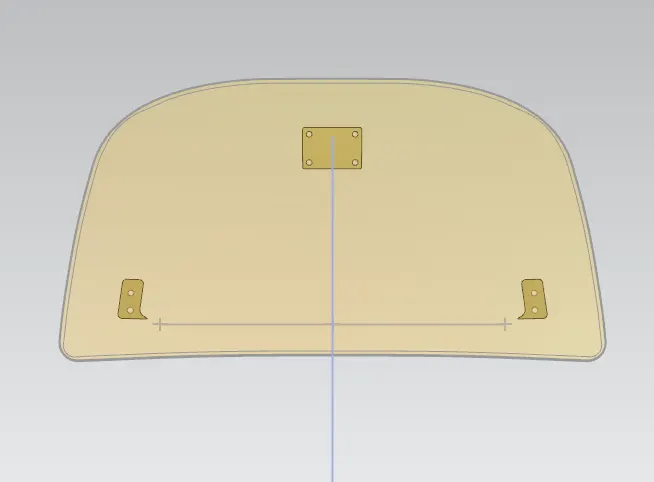
This is providing on the specific area that requires more strength like striker and hinges area. the thickness of reinforcement is larger than the thickness of the inner panel. here it is 1.5 mm.
LATCH AND STRIKER TRAGECTORY
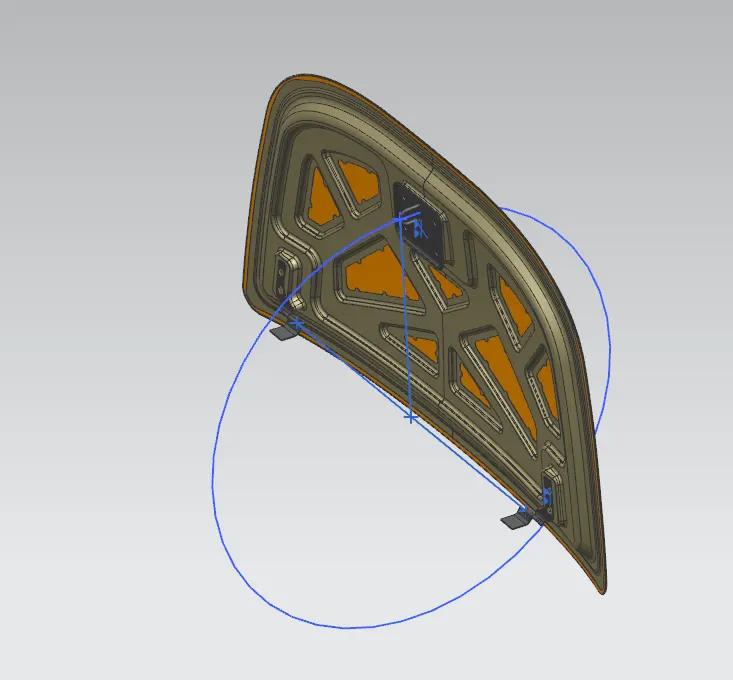
This is the circle drawn from the hinde axis center point. this point is lies in the middle of the hinge axis. for proper mating condition the tip of the striker should be tangential to the latch and striker tragectory.
MASTIC DATA
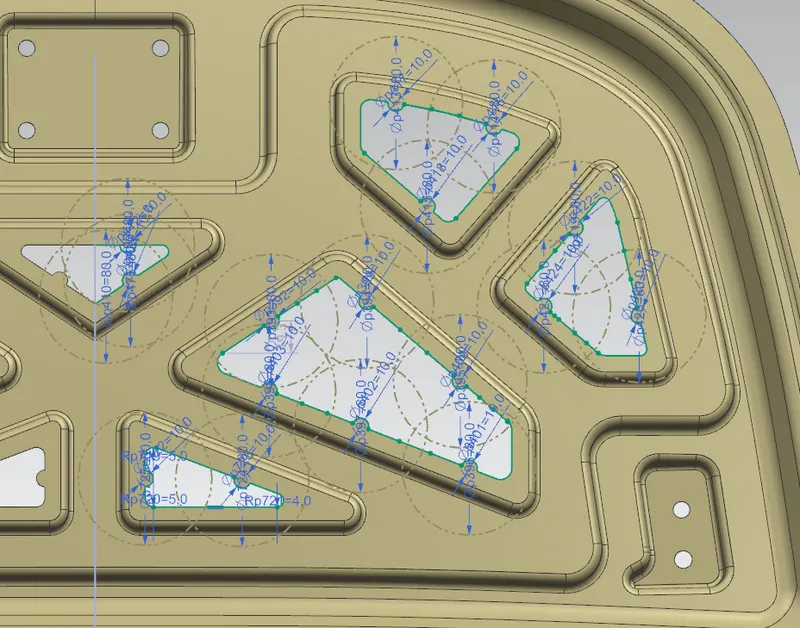
Hemming is used to connect inner panel and outer panel, while the joining occurs only in the outer most edges only. for the proper connection at the middle area we can use mastic sealant. it is rubber like glue substance which can stick between inner panel and outer panel. for that we provide some mastic points in the inner panel. commonly the the distance between mastic point and outer panel is 5mm for accomadating the expansion of mastic sealant. the effective area of each mastic point is around 80 mm. mastic point is also helps to reduce the vibration and it does not effect to the astheitic surface of the outer panel.
MANUFACTURING OF HOOD
DEEP DRAWING
The deep drawing process is a forming process which occurs under a combination of tensile and compressive conditions. A flat sheet metal blank is formed into a hollow body open on one side or a hollow body is formed into a hollow body with a smaller cross-section. The force for the forming is done by using by a punch. the whole process is done by a series of application of force. sometimes it also termed as stamping in automotive industry. some draft is providing for the easy removal of punches commonly it is 7 degree for sheetmetal operations
HEMMING
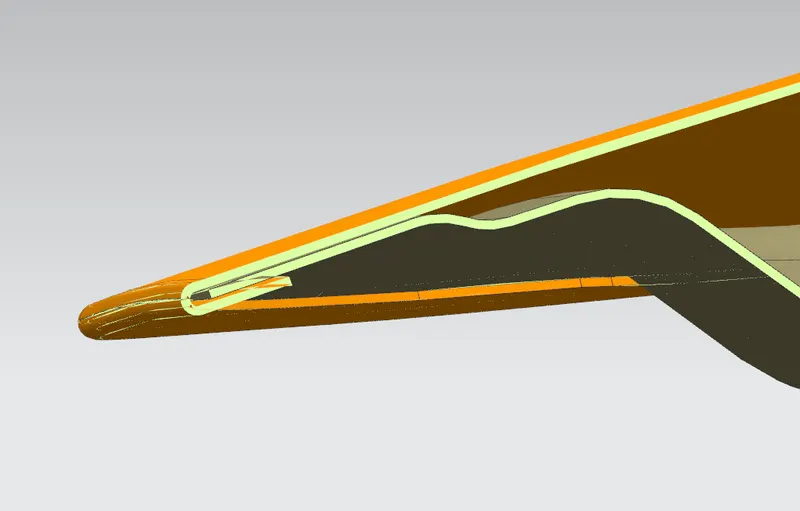
Hemming is a forming operation in which the edges of the sheet are folded or folded over another part in order to achieve a tight fit. Normally hemming operations are used to connect parts together, to improve the appearance of a part and to reinforce part edges. hemming is widely used in automotive production. in hood design inner panel and outer panel is joined by using hemming operation.
it can classify into conventional die hemming and roller hemming. In conventional die hemming, the flange is folded over the entire length with a hemming tool. Roll hemming is carried out incrementally with a hemming roller. An industrial robot guides the hemming roller and forms the flange. Roll hemming operation can also be divided into several pre-hemming and final hemming process steps. Roll hemming is very flexible to use and tool costs are significantly lower as compared to those of conventional die hemming. However, the cycle times are much higher since the hemming is realized using a hemming roller which follows a defined path
FINAL ASSEMBLY OF HOOD