Hood design-Week 2
Hood
A hood is a frontal BIW enclosure component. The purpose of the hood is to reduce air resistance as it flows around the vehicle. The aerodynamic flow around the vehicle is influenced by the hood design. Aside from that, it is intended to meet a variety of other requirements. Hood will play an important role in protecting both passengers and pedestrians in the event of an accident. It also functions as an engine cover. It is used to decorate the car, to add luxurious look. The Hood is a hinged cover over the engine of motor vehicles that allows access to the engine compartment for maintenance and repair.
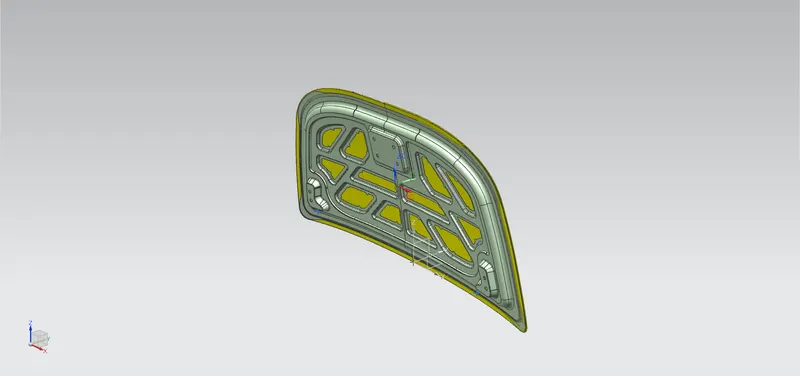
Hood and its components.
- Hood Outer Panel
- Hood Inner Panel
- Stricker & Stricker Reinforcement
- Hinge Assembly & Hinge Reinforcement
- Support Rod / Gas Stay
- Stiffnerpad
1. Hood Outer Panel
This is the hood or bonnet's exterior surface, and the aesthetic value of this panel is its primary requirement. The outer panel will give the car a luxurious aesthetic. The same surface data from the outer panel's surface will be used to design this skin to the hood's inner panel.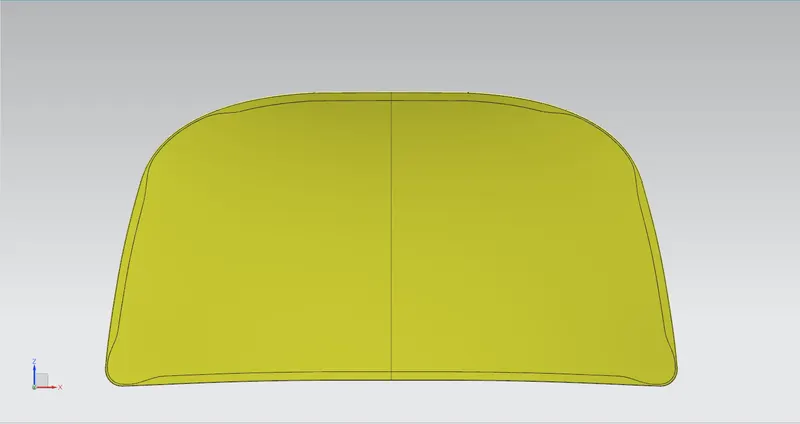
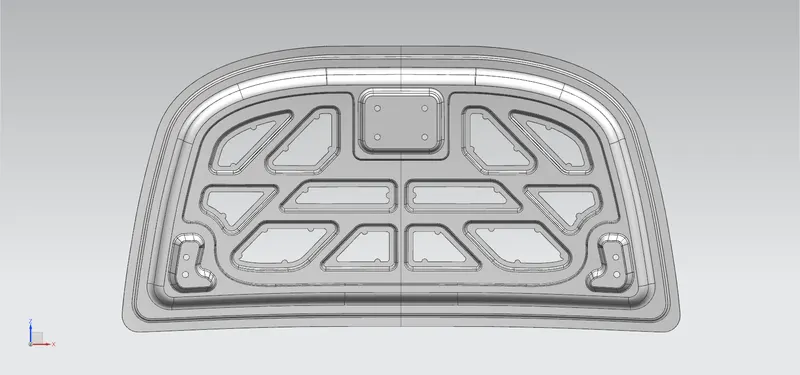
2. Hood Inner Panel
The hood inner panel acts as reinforcement for the hood outer panel, providing stiffness to it in the event of external load applied until the point of deformation. The primary function of this panel is to ensure passenger safety by directing forces in the event of an accident toward the hinges as intended. The hood inner panel is assembled with all of the other hood components, including the stiffener pad, mastic seal, hinge assembly, and Stricker.
3. Stricker & Hinge Assembly
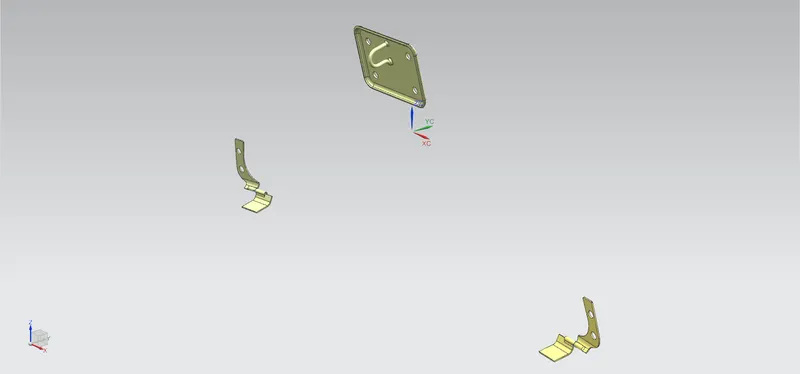
Stricker is the part which gets locked with latch ensuring the closure of the hood. This will ensure that the hood stays locked, therefore protecting the engine and the many other parts that reside within the hood of the car. Hinge Assembly acts as the link between the Hood and BIW. The primary function of hinge is to open the hood in pre-defined trajectory ensuring proper locking of Latch and Stricker.
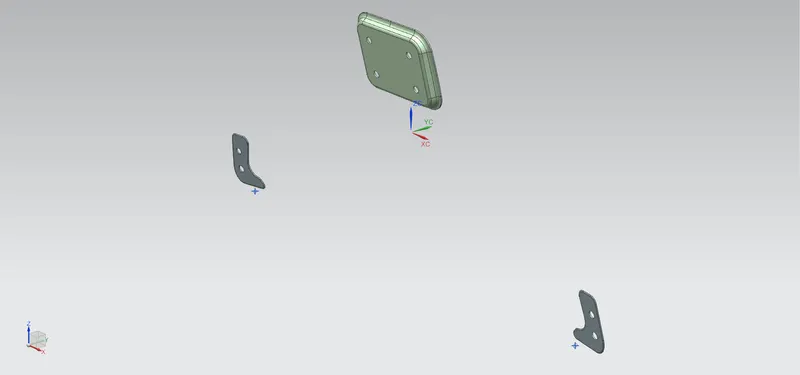
4. Stricker & Hinge Reinforcement
Stricker Reinforcement is the part which is assembled along Stricker to improve the strength locally. Hinge Reinforcement is the part which is assembled along the assembly to improve the strength locally.
5. Support Rod / Gas Stay
Two distinct Hood Stay devices that are used to keep the hood open are the Support Rod and Gas Stay. The support rod or gas stay can be selected based on the requirements. Support rods are frequently used in various designs, and gas stays are developed and used in accordance with the weight and length of the hood.
6. Stiffnerpad
The stiffener pad is made of highly durable sponge-like material. This will have no predefined shape or size. This is designed and incorporated between the outer and inner panels of the car to prevent weathering when automobile is in motion. This is an optional part that may be used as needed. This aids in giving the car a good NVH.
Latch Trajectory
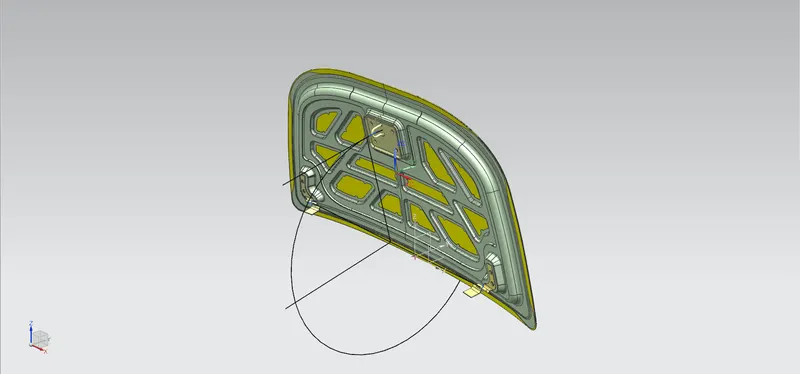
The proper opening and closing of the hood is checked using the Latch Trajectory. To draw this trajectory, we will fix the hinge tentatively and draw the hinge axis. A large circle is drawn with this hinge axis as the centre, allowing us to position the latch perpendicular to the trajectory of the hood.
Mastic Seal
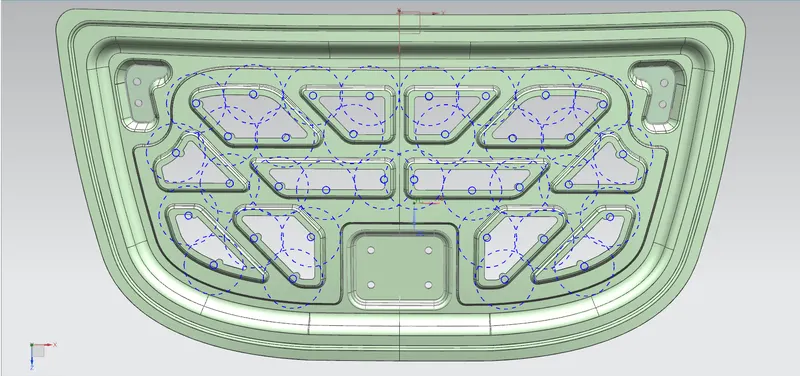
The mastic seal is a pasting that is incorporated between the hood's outer and inner panels, which later becomes hard rubber after the hot furnace bath. Every mastic seal has a tendency to improve the strength locally around 80mm Dia. The mastic seals are positioned in such a way that it covers entire region of hood.
Emboss Definitions
Deep Drawing
The deep drawing process is a forming process which occurs under a combination of tensile and compressive conditions. One of the most popular methods for sheet metal forming is deep drawing. In addition to being used in many other industries, it is applied in the automotive industry for the manufacturing of car body parts. Deep drawing processes are divided into three types:
- Deep drawing with tools
- Deep drawing with active means
- Deep drawing with active energy
In the automotive industry, deep drawing is usually carried out using rigid tools.
Hemming
Hemming is a forming operation in which the edges of the sheet are folded or folded over another part in order to achieve a tight fit. Normally hemming operations are used to connect parts together, to improve the appearance of a part and to reinforce part edges. The accuracy of the hemming operation is very important since it affects the appearance of the surface and surface quality.
There are various types of hemming operations:
- Conventional die hemming
- Roll hemming
Conventional die hemming
Conventional die hemming is suitable for mass production. In die hemming, the flange is folded over the entire length with a hemming tool.
Roll hemming
Roll hemming is carried out incrementally with a hemming roller. An industrial robot guides the hemming roller and forms the flange. Roll hemming operation can also be divided into several pre-hemming and final hemming process steps. Roll hemming is very flexible to use and tool costs are significantly lower as compared to those of conventional die hemming.