Fender Design - Wheel Arch Challenge
FENDER
The part of an automobile, motorcycle, or other vehicle body that frames a wheel well is referred to as a "fender" in American English (the fender underside). Its main objective is to stop the rotating tyre from launching debris like sand, mud, rocks, liquids, and other road spray into the air. enders are typically rigid and can be damaged by contact with the road surface. As the tyre rolls over the ground, sticky substances like mud may stick to the smooth outer tyre surface, while smooth, loose objects like stones may momentarily become embedded in the tread grooves. Given that the attached objects receive kinetic energy from the tyre, these materials can be ejected from the tire's surface at a high speed. For a vehicle moving forward, the top of the tire is rotating upward and forward, and can throw objects into the air at other vehicles or pedestrians in front of the vehicle.
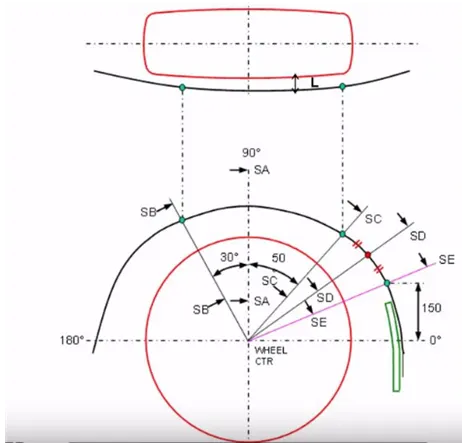
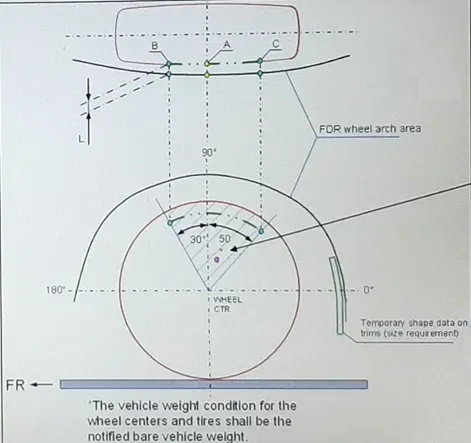
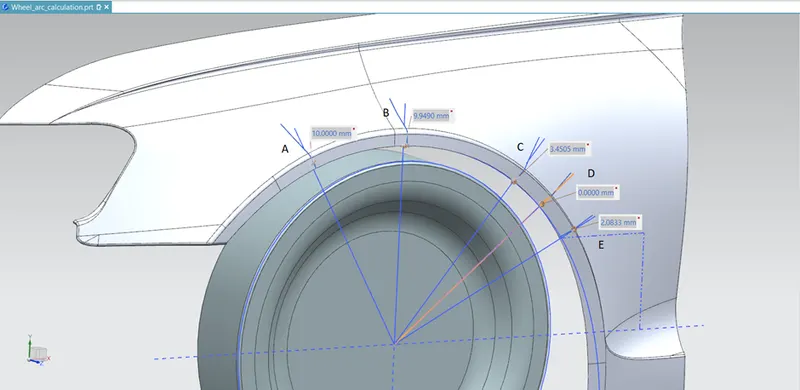
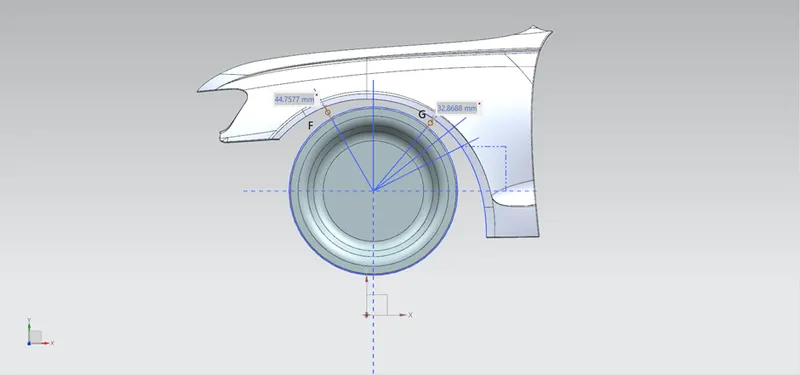
The governments of various nations have varying conditions or demands when it comes to fender design. The length between the wheel and wheel arch of the fender is typically the requirement. First, a circle is drawn while taking into account the diameter of the wheel. Then, lines are drawn from the centre of the circle for the necessary lengths, and the same will be projected as shown in Figures 1, 2, and 3. The distance between the wheel and the wheel arch is then measured at various points, and the results are tabulated. The results will be confirmed, and if necessary, the appropriate actions will be taken.
EUROPEAN REGULATIONS REQUIREMENT
- Measure CL L at sections SA-SA SB-SB SC-SC SD-SD SE-SE and produce CL check chart to validate.
- At all five sections the CL L value should be greater than 10 mm to satisfy the European regulations.
- Wheel guard reqmt: The value of 'a' shall be more than 5 mm at a line 30' forward and 50' rearward from the central vertical axis of axis of wheel
JAPAN REGULATIONS REQUIREMENT
- Measure clearance L of tire, hub, cap & fender in three different positions within area K and produce clearance check chart to validate.
- Clearance must be greater than 5 mm in all the three positions.
- Wheel guard reqmt the value of `a' shall be more than 5 mm at a line 30* forward and 50* rearward from the central vertical axis of axis of wheel.
AMERICAN REGULATIONS REQUIREMENT
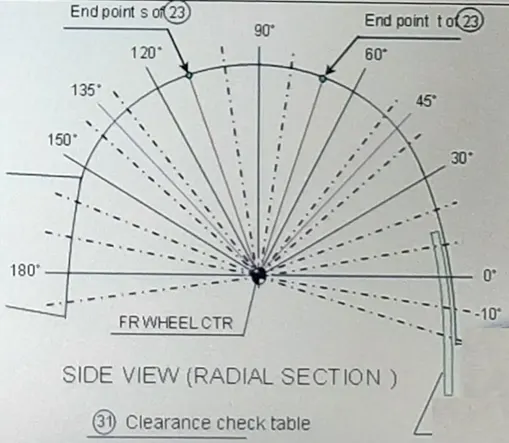
- Make clearance check details on all positions from -100* to 100* & make the clearance check table.
- All values should be greater than 5 mm to satisfy the regulations.
- The value of 'a' shall be more than 5 mm at a line 30* forward and 50* rearward from the central vertical axis of axis of wheel.
Given Case: Calculate the Wheel Arch gap at required points and check whether the car passes the European standard.
- Necessary drawings are drawn as per European regulation.
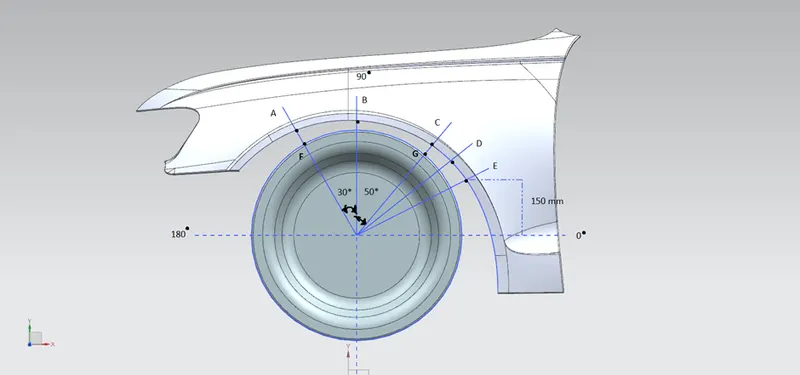
2. The clearance value between fender and tyre profile must be greater than 10mm. Same is measured and tabulated in the below table (Actual Length). The measurement took in five different positions of the wheel at point A, the clearance is acceptable. But at point B, C, D & E the values are less than 10mm and negative numbers which denoted the interference of wheel arch with a Tyre.

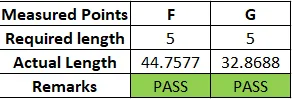
- The value is measured in projected point at an angle 30° forward and 50° rearward respectively for Wheel guard requirement. As the measured values are greater than 5mm the points G and G are meeting the requirements.
CONCLUSION
The European regulation requires a minimum of 10 mm clearance at the points A, B, C, D and E, Since the points B, C, D and E are not meeting the required values, the design of fender must be modified.