Hood design-Week 2
Objective:
Design and develop Hood and its respective components :-
Design of Hood Inner Panel, Outer Panel, Latch, Hinge and the Reinforcements are done in a single assembly folder and it will attached in the zip file below.
Report:
Hood:
The hood (American English) or bonnet (Commonwealth English) is the hinged cover over the engine of motor vehicles. Hoods can open to allow access to the engine compartment, or trunk (boot in Commonwealth English) on rear-engine and some mid-engine vehicles) for maintenance and repair.
Design considerations:
1) Styles and materials:
On front-engined cars, the hood may be hinged at either the front or the rear edge, or in earlier models (e.g. the Ford Model T) it may be split into two sections, one each side, each hinged along the centre line. A further variant combines the bonnet and wheel arches into one section and allows the entire front bodywork to tilt forwards around a pivot near the front of the vehicle (e.g. that of the Triumph Herald).
Hoods are typically made out of the same material as the rest of the body work. This may include steel, aluminum, fiberglass or carbon fiber. However, some aftermarket companies produce replacements for steel hoods in fiberglass or carbon fiber to make the vehicle lighter.
2) safety and security mechanisms:
The hood release system is common on most vehicles and usually consists of an interior hood latch handle, hood release cable and hood latch assembly. The hood latch handle is usually located below the steering wheel, beside the driver's seat or set into the door frame. On race cars or cars with aftermarket hoods (that do not use the factory latch system) the hood may be held down by hood pins. Some aftermarket hoods that have a latch system are still equipped with hood pins to hold the hood buttoned down if the latch fails.
3) Pedestrian safety:
In Japan and Europe, regulations have come into effect that place a limit on the severity of pedestrian head injury when struck by a motor vehicle. This is leading to more advanced hood designs, as evidenced by multicone hood inner panel designs as found on the Mazda RX-8 and other vehicles. Other changes are being made to use the hood as an active structure and push its surface several centimeters away from the hard motor components during a pedestrian crash. This may be achieved by mechanical (spring force) or pyrotechnic devices.
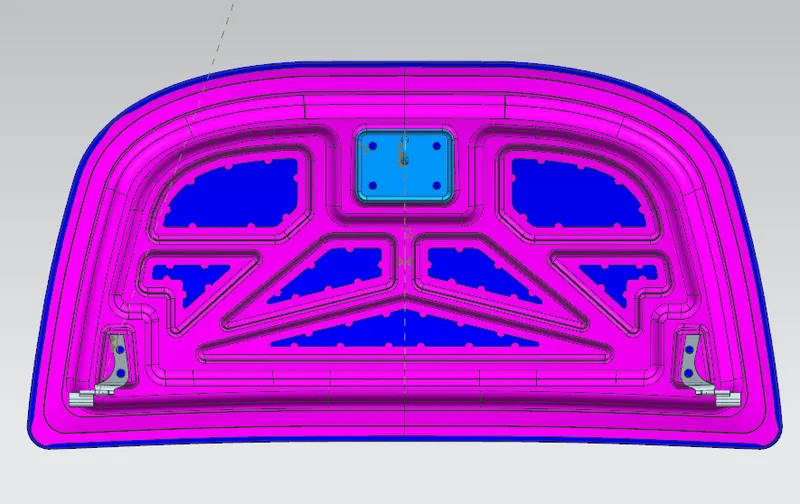
Components of Hood:
Inner panel:
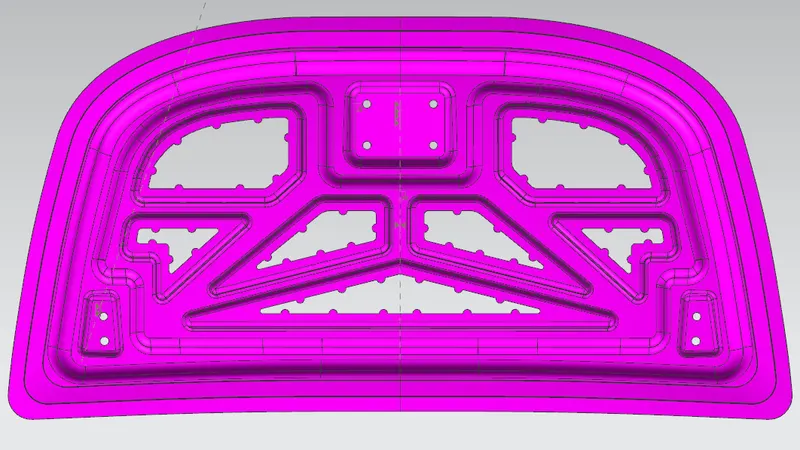
Inner panel created as per mastersection data.
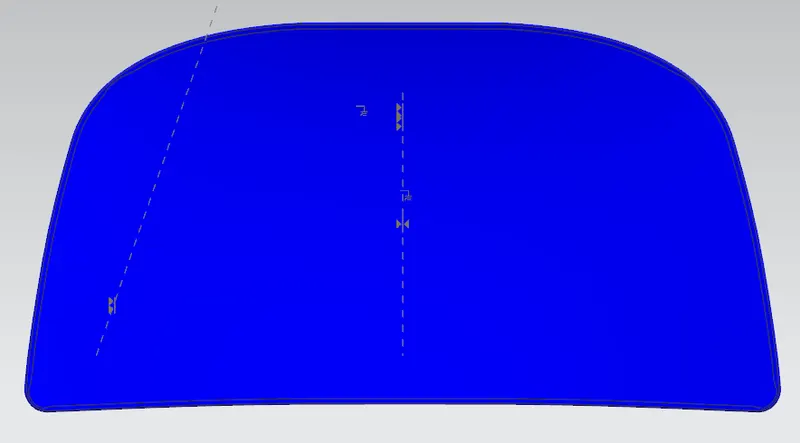
Outer panel:
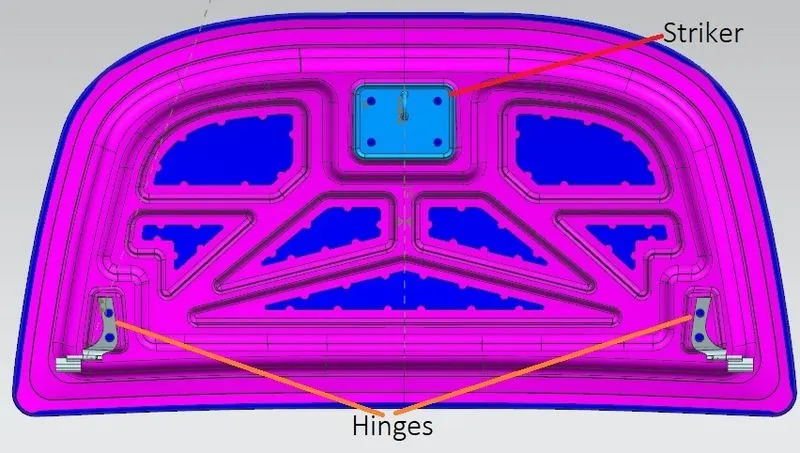
Hinges and striker:
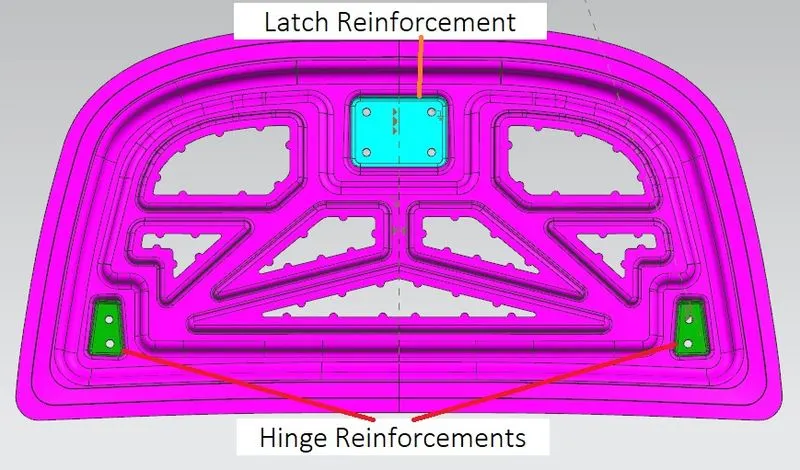
Reinforcements:
Latch trajectory:
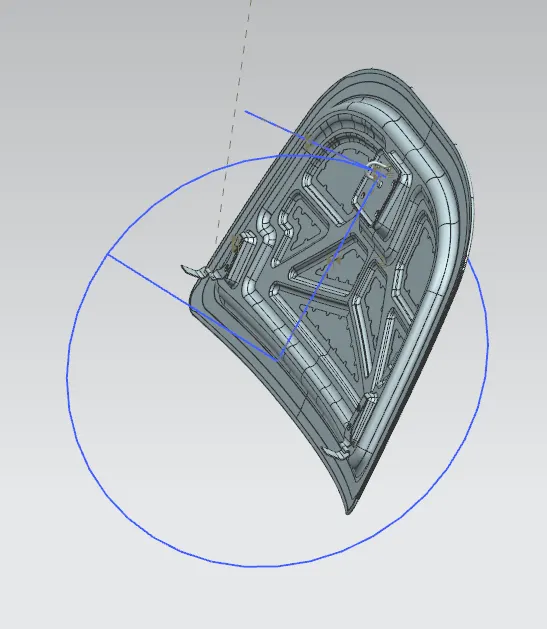
The above circle is the Trajectory of latch. It is constrained with hinges.
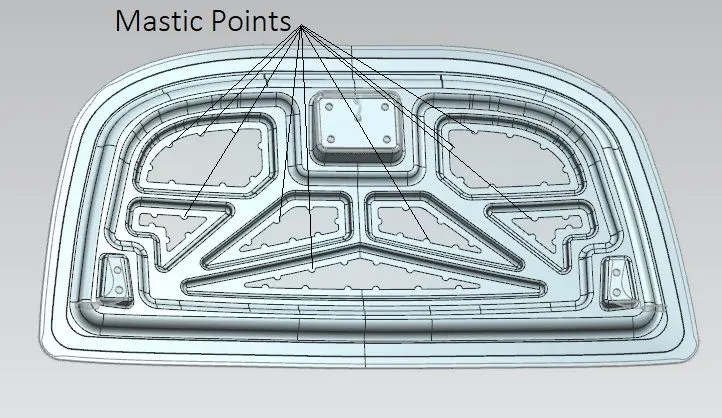
Mastic data:
A mastic sealent is used between the outer and the inner pannel of the bond the two pannels. The mastic also provides the strength for the hood outer pannel. This can be a glue or a rubber which is placed in between the inner and the outer panel at points known as 'mastic points
Emboss:
An emboss is a metal forming process in which a high pressure is applied on a die to make a imprint on the working surface. The imprint can be raised or sunken. In this process it is assumed that the metal thickness remains the same while embossing.
Deep Drawing:
Deep drawing is a sheet metal forming process in which a sheet metal blank is radially drawn into a forming die by the mechanical action of a punch. It is thus a shape transformation process with material retention. The process is considered "deep" drawing when the depth of the drawn part exceeds its diameter. This is achieved by redrawing the part through a series of dies. The flange region (sheet metal in the die shoulder area) experiences a radial drawing stress and a tangential compressive stress due to the material retention property. These compressive stresses (hoop stresses) result in flange wrinkles (wrinkles of the first order). Wrinkles can be prevented by using a blank holder, the function of which is to facilitate controlled material flow into the die radius. Deep drawing presses, especially in the Aerospace and Medical industries, require unparalleled accuracy and precision. sheet hydroforming presses for complex draw work. Bed size, tonnage, stroke, speed, and more can be tailored to your specific draw forming application.
Process:
- Beading: Material is displaced to create a larger, or smaller, diameter ring of material beyond the original body diameter of a part, often used to create O-ring seats.
- Bottom Piercing: A round or shaped portion of metal is cut from the drawn part.
- Bulging: In the bulging process a portion of the part's diameter is forced to protrude from the surrounding geometry.
- Coining: Material is displaced to form specific shapes in the part. Typically coining should not exceed a depth of 30% of the material thickness.
- Curling: Metal is rolled under a curling die to create a rolled edge.
- Extruding: After a pilot hole is pierced, a larger diameter punch is pushed through, causing the metal to expand and grow in length.
- Ironing / Wall Thinning: Ironing is a process to reduce the wall thickness of parts. Typically ironing should not exceed a depth of 30% of the material thickness.
- Necking: A portion of the part is reduced in diameter to less than the major diameter.
- Notching: A notch is cut into the open end of the part. This notch can be round, square, or shaped.
- Rib Forming: Rib forming involves creating an inward or outward protruding rib during the drawing process.
- Side Piercing: Holes are pierced in the side wall of the drawn part. The holes may be round or shaped according to specifications.
- Stamping / Marking: This process is typically used to put identification on a part, such as a part number or supplier identification.
- Threading: Using a wheel and arbor, threads are formed into a part. In this way threaded parts can be produced within the stamping press.
- Trimming: In the Trimming process, excess metal that is necessary to draw the part is cut away from the finished part.
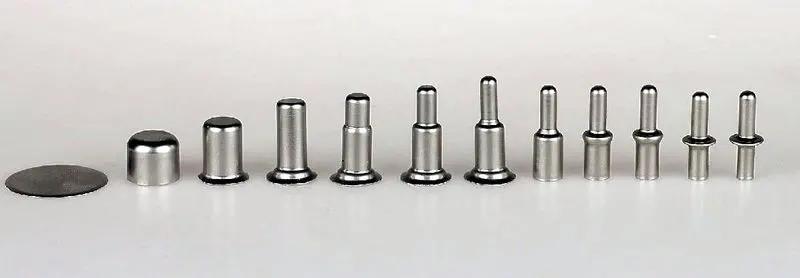
Example:
Hemming:
Hemming is a forming operation in which the edges of the sheet are folded or folded over another part in order to achieve a tight fit. Normally hemming operations are used to connect parts together, to improve the appearance of a part and to reinforce part edges.
In car part production, hemming is used in assembly as a secondary operation after deep drawing, trimming and flanging operations to join two sheet metal parts (outer and inner) together. Typical parts for this type of assembly are hoods, doors, trunk lids and fenders.
The accuracy of the hemming operation is very important since it affects the appearance of the surface and surface quality. Material deformations, which occur during the hemming process, can lead to dimensional variations and other defects in parts. Typical hemming defects are splits or wrinkles in the flange, material overlaps in the corner areas or material roll-in. This is why it is important to use simulation tools in order to, on the one hand, better understand the hemming process and, on the other hand, significantly reduce the number of “trial and error” loops during tryout und production.
There are various types of hemming operations:
- Conventional die hemming
- Roll hemming
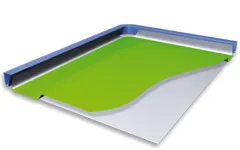
In conventional die hemming, the flange is folded over the entire length with a hemming tool.
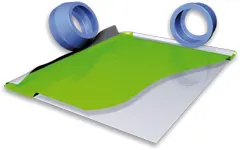
In roll hemming, the hemming roller is guided by an industrial robot to form the flange.
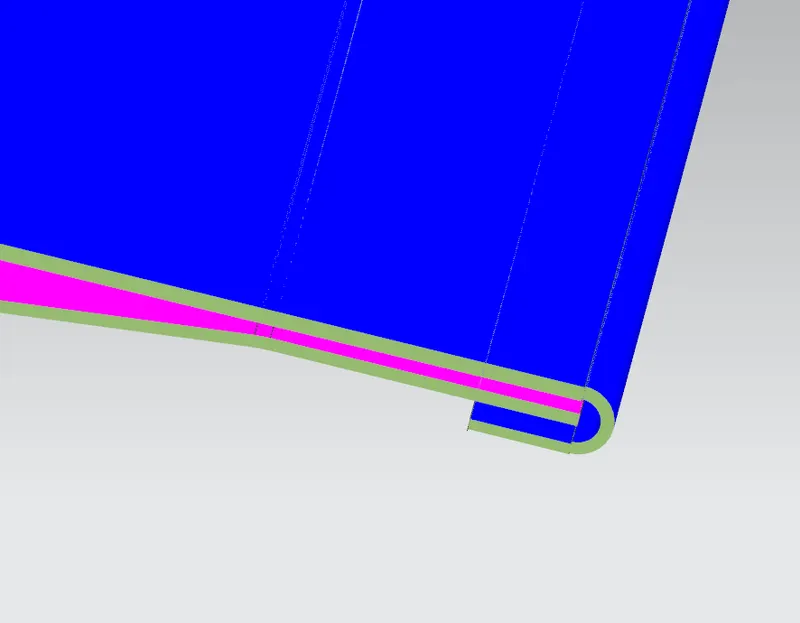
Rear side releif:
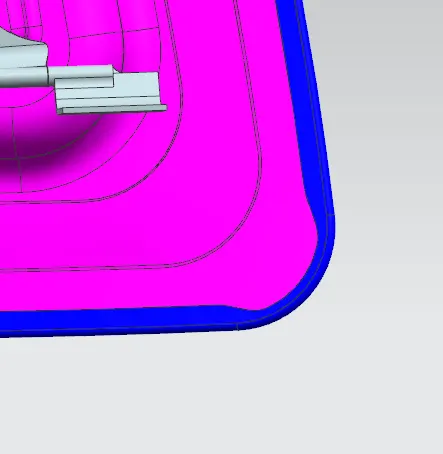
Front side releif:
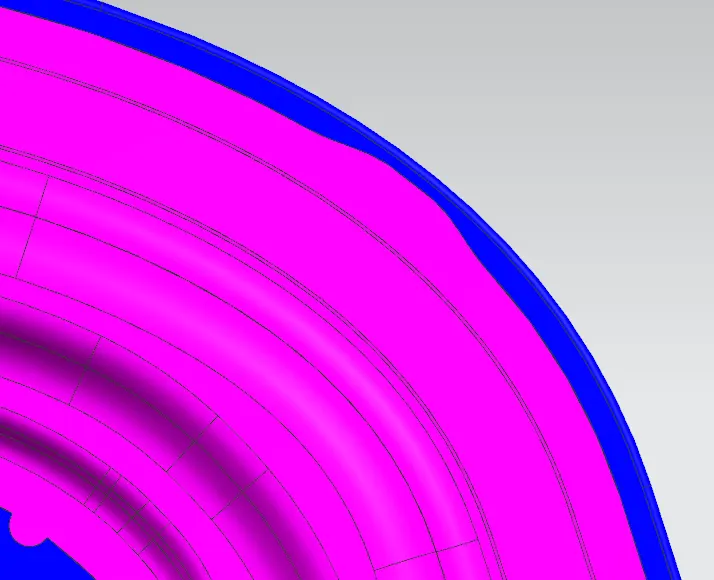
Side releifs are given for preventing sheets from shrinkage and breakage during roller hemming process.