Flow over a cylinder
Flow over a cylinder
Aim: To perform the flow simulation over a cylinder as per given conditions.
Introduction: The flow past a circular cylinder is a canonical case that is of relevance for many practical applications. In spite of its simple geometry, the presence of interesting flow features continues to make this problem the subject of many current studies. Since the governing equations for this analysis is depends upon a dimensionless no i.e. Reynolds no, therefore, a baseline simulation has been performed, and then after calculating the Reynolds no it has been varied by the factor of 20%, 40%, and 100%.
baseline case Reynolds number:
- Re = rho*U_inlet*D/mu
- D = cylinder diameter
- mu = dynamic viscosity
- rho = density
Calculation:
Diameter of the cylinder: 0.04m
Length of the cylinder: 0.05m
Inlet velocity of air: 10m/sec
Density of the air 1.225Kg/m3
Viscosity of the air: 1.81*10-5
Therefore Reynolds number= 1.225*10*0.04/1.81*10-5
=27071.823
Present analysis is time dependent therefore flow time can be calculated as follows:
Total analysis time =2*Length of computational domain/velocity
Length of computational domain along X axis=0.50m
Hence for baseline simulation total analysis time=2*0.5/10=0.1sec
|
Case |
Reynolds number |
Velocity of air |
Analysis Time |
|
1 |
27071.823 |
10 |
0.1 |
|
2 |
32486.1876 |
12 |
0.08333 |
|
3 |
37900.5522 |
14 |
0.071428 |
|
4 |
54143.646 |
20 |
0.05 |
As per the study Reynolds no has been varied by 20%,40%,100% for the case2,3and 4 respectively.
Study Setup:
Sketch of circle having diameter 0.04m is created in front plane then extruded up to 0.05m to create the model of cylinder.
Then created the flow simulation wizard and specifid the following-
- Flow as external and time dependent
- Fluid is air
- Flow analysis time is specified as per calculation for different cases
- velocity is specified as per calculation for different cases.
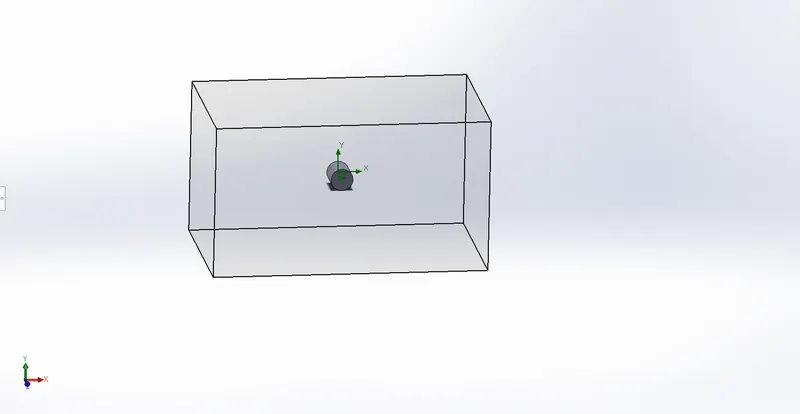
Computational domain has been crated of length 0.50 m along the X axis.Meshes are defaualt.
Result Plots:
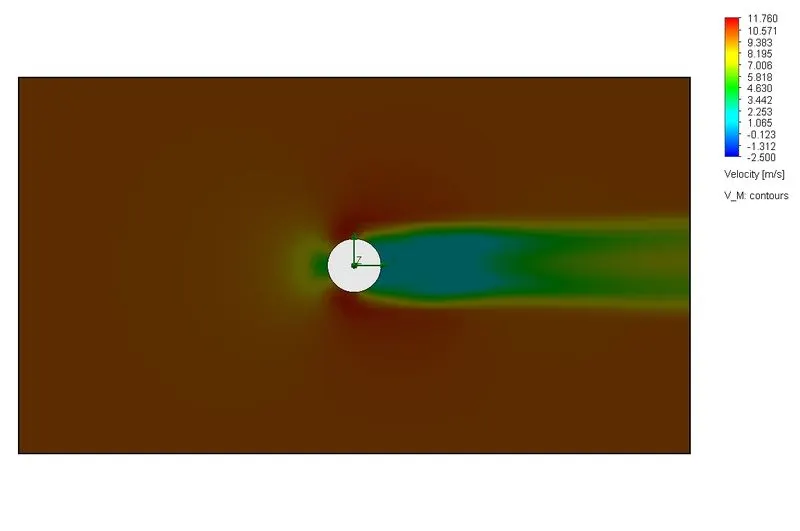
Case1:
Velocity
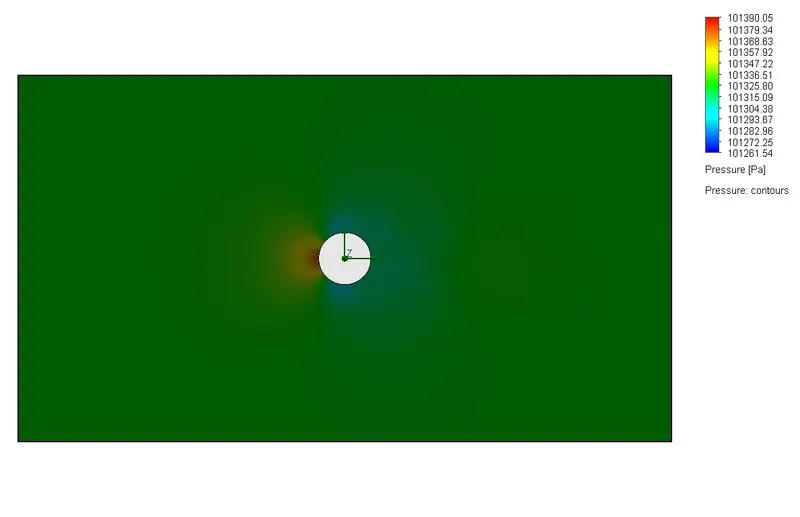
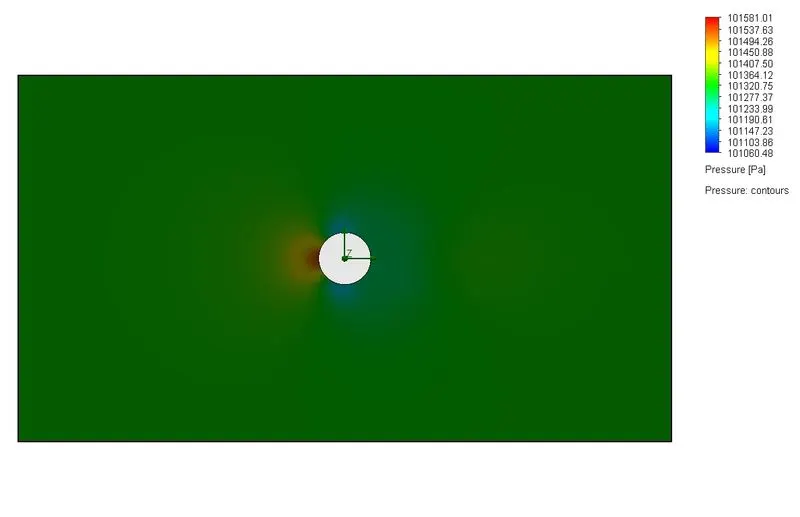
Pressure
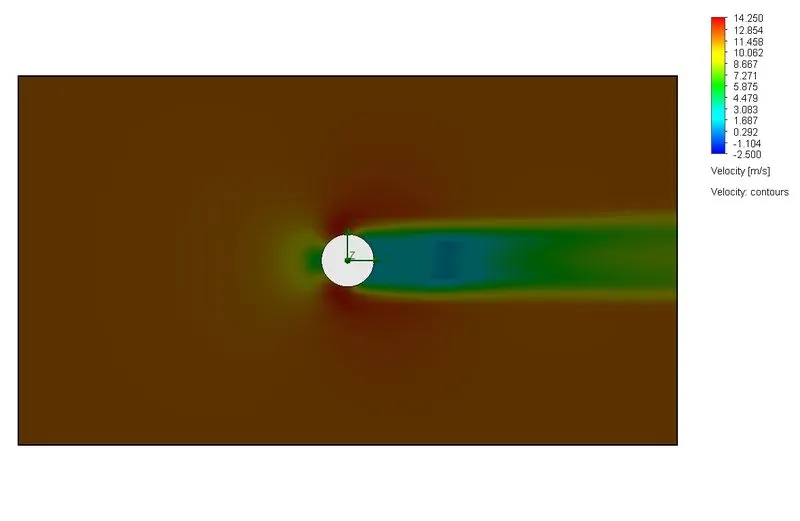
Case2
Velocity
Pressure
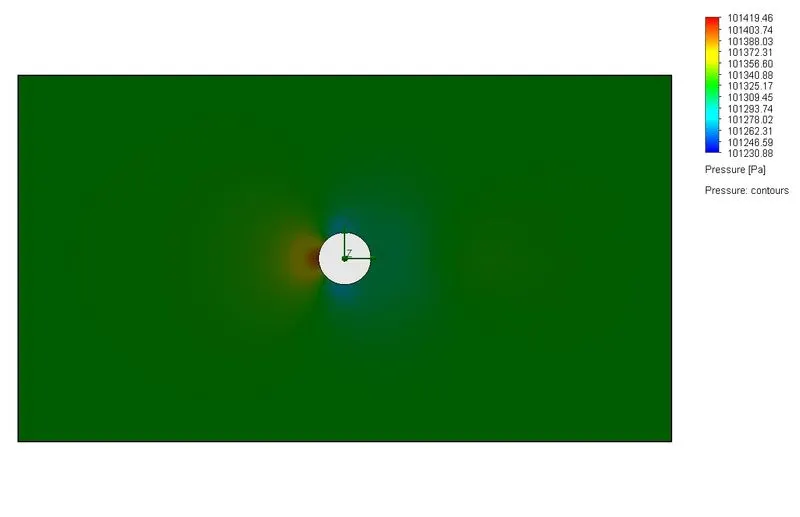
Case3
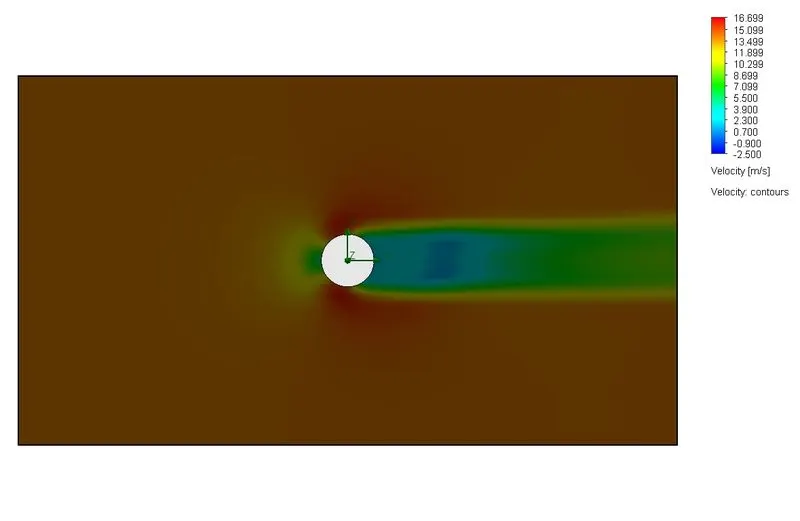
Velocity
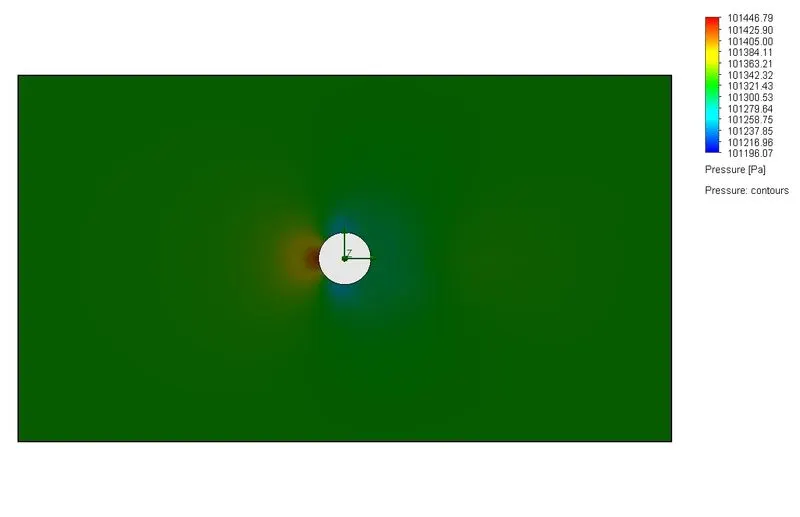
Pressure
Case4:
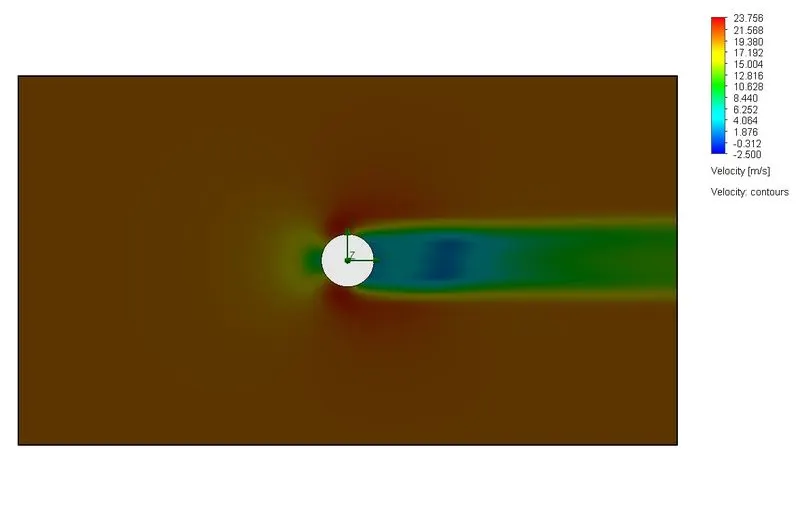
Velocity
Pressure
Observations:
After performing the simulation it has been observed that
- the flow is symmetrical about the X axis .
- In case 1 velocity is not approching to the negative value that means flow is not seprated but the velocity is significantly reduced in the wake region
- In case 2 there is a region where velocity is negative.
- In case 3 negative velocity region is more than that of the case 2 and in case 4 it is more than that of case 2 that shows flow sepration.
- Pressure countors are looking quite similar in all these cases.
- In all the cases flow is laminar.
Conclusion:
Flow depends upon the Reynolds number as the reynolds number increases flow sepration past the cylinder increases. Hence it is concluded that Reynolds number is an important parameter to determine the flow pattern , flow pattern changes significantly on changing the Reynolds number.
Animations for all cases:
https://drive.google.com/drive/folders/1bMRE_eip7NnPr1T9af1SDLREDiBbx1kb?usp=sharing
Reference
Skill lync course