FINAL TEST
Q1. What is the Compression ratio for the engine?
CR of engine is ratio of total volume to the clearance volume.
From volume graph we can calculate the CR.
Total volume – 5.74 x 10 ^-4 m3
Clearance volume- 5.723 x 10 ^-5 m3
CR- 5.741 x 10 ^-4 / 5.23 x 10 ^-5
CR- 10.02
Q2. Modify the compression ratio for this engine to 10.3 without changing geometrical parameters.
Given - CR-10.3
From volume plot Vmax – 0.000574 , V min = 0.000005723
CR= VS +VC / VC
Swept volume = 10.3 x VC – VC
New VS = 0.000532m3
New VC = New VS/10.3-1
New VC = .0000556 M3
For 10.3 CR new swept volume and clearance vol to be -
New VS = 0.000532m3
New VC = .0000556 M3
Q3. Calculate Volumetric Efficiency for this engine
Volumetric efficiency of engine is ratio of actual air drawn inside cylinder to volume of cylinder .
Volumetric efficiency = V actual /v swept
Swept volume = V max – V min
Swept volume = 0.000574 - 0.000005723
= 0.000517m3
PV= mrt
P=101325 , R=287 , T = 303 k
Va = 0.0004432
Volumteric efficiency = 0.0004432 / 0.000517 = .857
= 85.7 %
Q4. Measure the air mass flow rate for this engine in kg/s
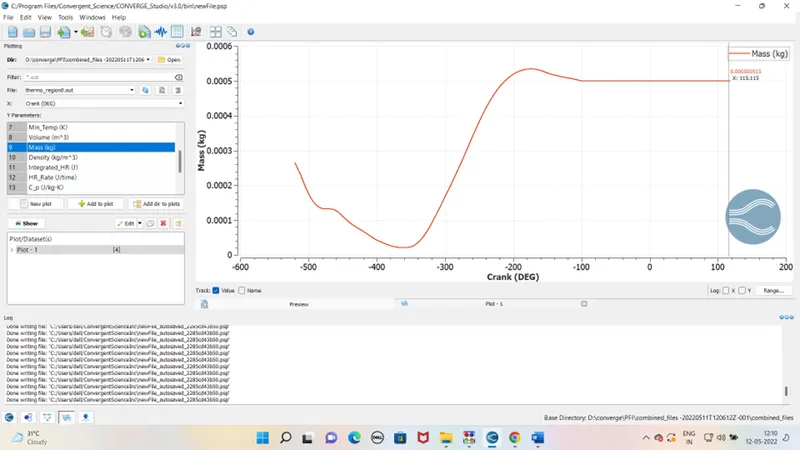
From graph mass flow rate is = 0.0005344 kg
Speed = 3000rpm
Rps = 3000/60 = 50 rps
Mass flow rate = mass x rps = 0.0005344 x 50 = .0267 kg /sec
Q5. Why is the cell count varying during the simulation?
Cell count is mainly varying dur to the AMR and Fixed embedding. Fixed embedding is refining the mesh at area where critical calculation to carried out.
Q6. In a real engine, valves are in contact with the cylinder head but while running simulation, there is a small gap WHY? What happens if this gap is big?
In real engine we have the cooling arrangement to remove the heat from system. But in simulation it is not like that , so gap is provided. If gap reduced the heat will entrap inside the cylinder and it will effect the other parameters like temp, emission etc .
Q7. How many seconds does combustion last in this case?
Speed = 3000rpm
Rps = 3000/60 = 50 rps
Combustion time - 240.199
Combustion time in seconds = 240.199 / 360 x 50 = .0133 sec
Questions based on DIESEL Engine:
Q1. What is an advantage of SECTOR Simulation?
In sector simulation we take the sector of cylinder than the full engine cylinder. Sector is created with help of piston bowl profile. This method reduced the computational time up to great extend as the no of cell is reduced.
Q2. When will the sector approach not work?
Sector approach not works for the open cycles. It only works for closed cycle. Where injectors are symmetrically arranged. And valve timing is defined.
Q3. How to choose Start Crank Angle (SCA) and End Crank Angle (ECA) for a sector simulation?
Sector simulation is simulated for 360 degrees. So, start of crank angle to be compression stroke starting and end of expansion stroke can be end crank angle for simulation.
Q4. Can we convert the PFI case into a SECTOR case? Explain your answer?
PFI can not be convert to the sector because it is open cycle. if we want to do we have to define the spark plug modelling and position is also has too symmetric. so, it is normally not advisable sector approach for the PFI engine.