Final Project: Electric Rickshaw modelling
Electric rickshaws (also known as electric tuk-tuks or e-rickshaws or totoor e-tricycles) have been becoming more popular in some cities since 2008 as an alternative to auto rickshaws and pulled rickshaws because of their low fuel cost, and less human effort compared to pulled rickshaws. They are being widely accepted as an alternative to petrol/diesel/CNG auto rickshaws. They are three-wheelers powered by an electric motor ranging from 650 to 1400 Watts. They are mostly manufactured in India and China, only a few other countries manufacture these vehicles. Battery-run rickshaws could be a low-emitter complementary transport for the low-income people, who suffer most from a lack of transport facility, if introduced in a systematic manner according to experts.
These rickshaws have a M.S(Mild Steel) tubular Chassis, consisting of three wheels with a differential mechanism at the rear wheels. The motor is brushless DC motor manufactured mostly in India and China. The electrical system used in Indian version is 48V and Bangladesh is 60V. The body design from most popular Chinese version is of very thin iron or aluminum sheets. Vehicles made in fiber are also popular because of their strength and durability, resulting in low maintenance, especially in India. Body design is varied from load carriers, passenger vehicles with no roof, to full body with windshield for drivers comfort. It consist of a controller unit.They are sold on the basis of voltage supplied and current output, also the number of mosfet (metal oxide field effect transistors) used. The battery used is mostly lead acid battery with life of 6–12 months. Deep cycle batteries designed for electric vehicles are rarely used. Weight of the electric car has also been a recurring design difficulty in them.
Basic design of electric vehicle
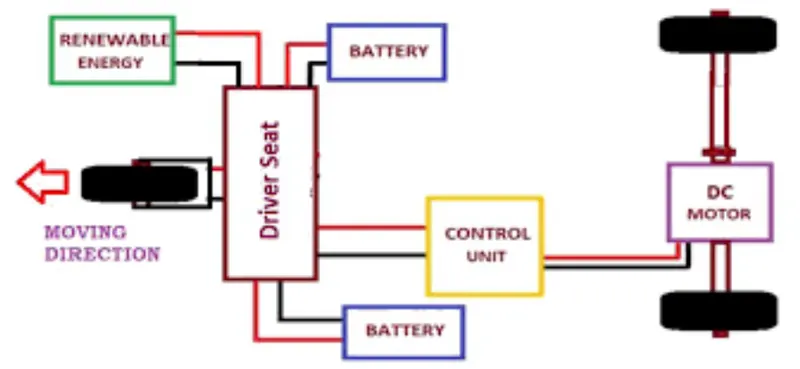
model:-
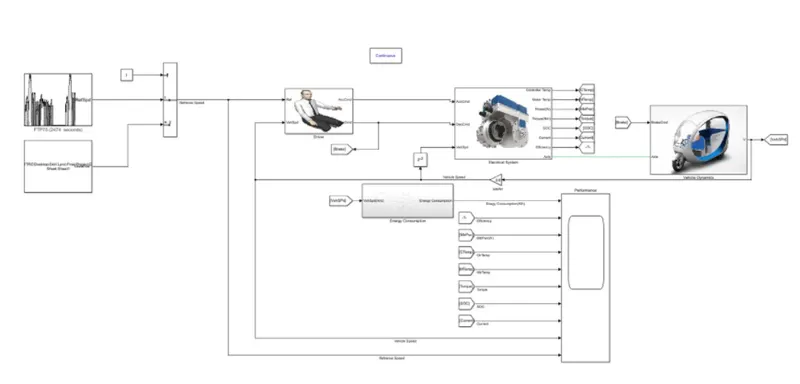
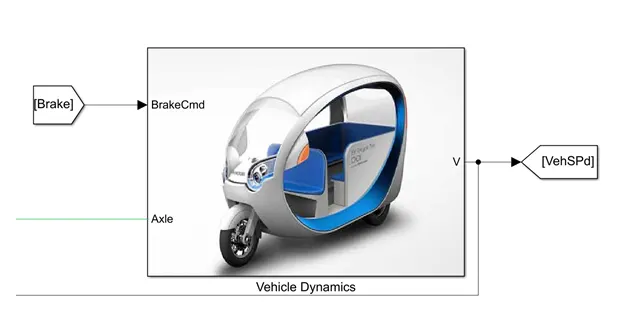
the block of vehicle dynamic is consist of vehicle body and wheels.
vehicle body:-
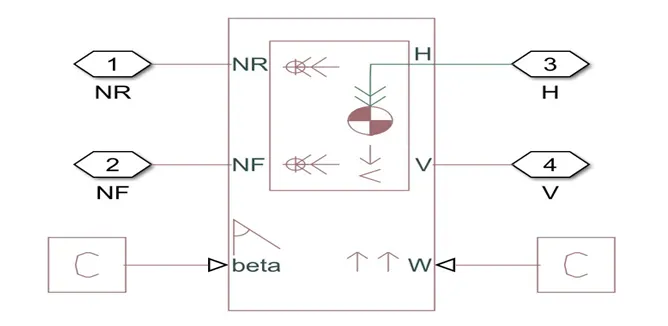
the body is consist of areodynamic drag force,vehicle mass, and weight distribution on the axle.
NR and NF is are normal forces acting on rear and front wheel v is velocity of vehicle H is a mechanical translation force acting in horizontal direction.
parameter of vehicle body
Mass 300kg
No. of wheels per axle 2
Frontal area 3m^2
Drag coffiencent 0.4
Air density 1.18kg/m^3
wheels":-
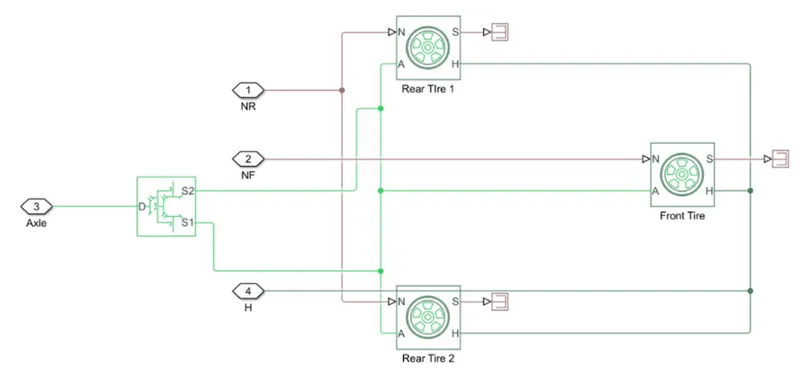
the vehicle is rear wheel driven by by a permanent magent dc motor is connected to rear axle.
port A reprenst the axle of the wheel S reprensts slip of tyre N is the normal forces and H is wheel hub.
parameter of wheels:-
Wheel radius 0.3m
Vertical load 3000N
Slip 10
Electrical System:-
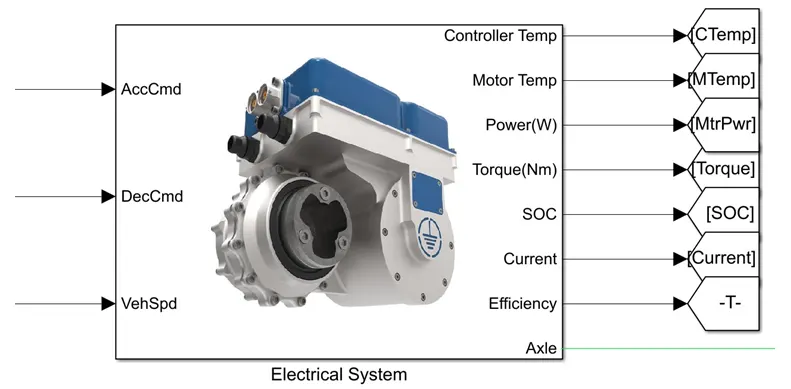
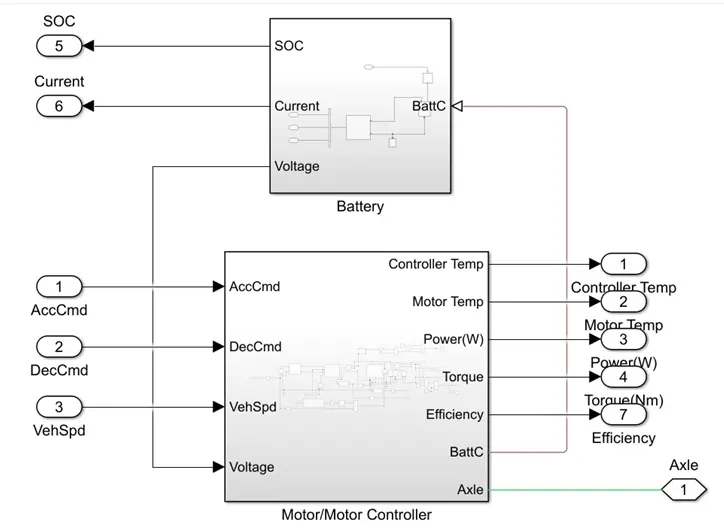
the block is consist of subsystem of motor/motorcontroller and battery system.
A brushed DC motor is made up of 4 basic components; the stator, the rotor (or armature), brushes, and commutator. The rotor, also known as the armature made up of one or more windings. When these windings are energized they produce a magnetic field. The magnetic poles of this rotor field will be attracted to the opposite poles generated by the stator, causing the rotor to turn. As the motor turns, the windings are constantly being energized in a different sequence so that the magnetic poles generated by the rotor do not overrun the poles generated in the stator. This switching of the field in the rotor windings is called Commutation. The rotation’s direction, clockwise and/or counter clockwise, can be reversed easily by reversing the polarity of the brushes, i.e., reversing the leads on the battery.
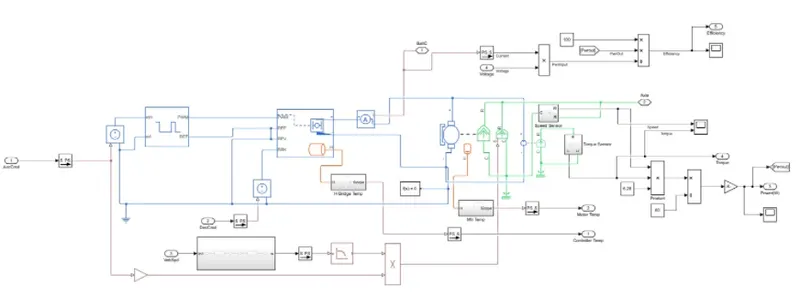
parameter of motor:-
Armature inductance 1e-3H
No load speed 5000rpm
Rated speed 2500rpm
Rated load 1200 w
Rated DC supply 12 V
Rotor interia 0.01
Parameter of motor controller:-
Threshold Voltage 2.5V
PWM amplitude 5V
Reverse Threshold 2.5V
Braking Voltage 2.5V
Output Voltage 12V
To calculate the output power of the system a mathematical expression:-
Pout = 2pi*N*T/60
N = speed (rpm)
T = torque(N*m)
the system efficency
Eff = Pout/Pin
where Pin = V*I
Battery model:-
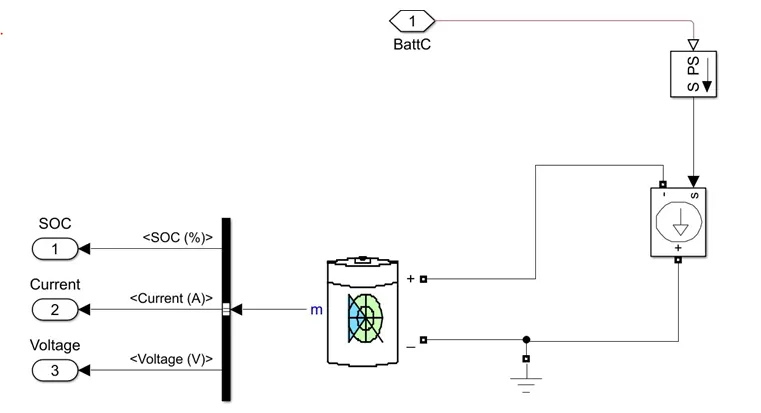
Li-ion batteries are able to be recharged hundreds of times and are more stable. They tend to have a higher energy density, voltage capacity and lower self-discharge rate than other rechargeable batteries. This makes for better power efficiency as a single cell has longer charge retention than other battery types.
parameter of battery:-
Nominal Voltage 12V
Rated Capacity 100Ah
Internal Resistance 0.0012 ohm
Driver:-
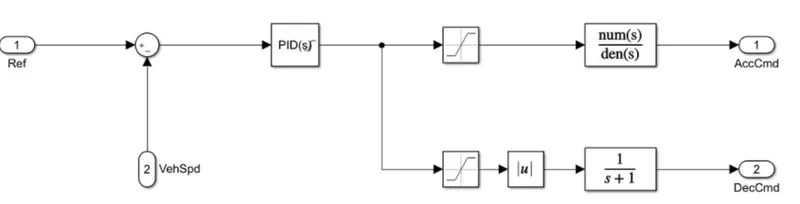
driver block takes input as a positive refrence speed and error is generated by a vehicle speed this error is corrected by PID controller and output is saturated usning upper and lower limt.
energy consumption:-
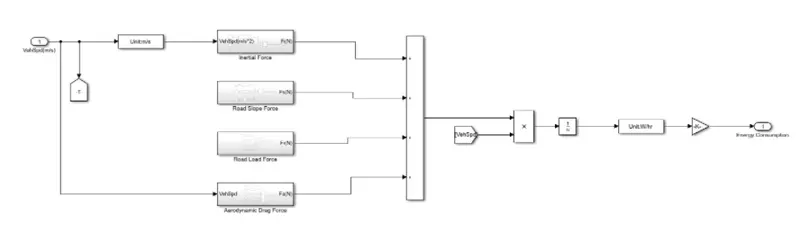
total force:-
Ttot = Fi+Fs+Fr+Fa
where
Fi = inertial force
Fs = Road slope force
Fr = Road load force
Fa = Aerodynamic drag force
1).Fi(N) = Mv*av;
where
mv = vehicle mass(kg)
av = vehicle acceleration
2).Fs(N) = mv*g*sin(alfa)
where
g =9.81m/s^2
alfa = road slope angle
3).Fr = mv*g*Crr*cos(alfas)
where
Crr = road rolling resistance cofficent
4).Fa= 0.5*phi*Cd*A*Vv^2
where'
phi = air density
Cd = drag cofficent
A = frontal area
Vv = vehicle speed
the total power is calculated as a product of total force and vehicle speed
Ptot = Ftot*Vv
by integrating the total power w.r.t time we get the total power consumtion
Etot = int(Ptot)dt
results:-
HWFET(highway fuel economy test cycle)
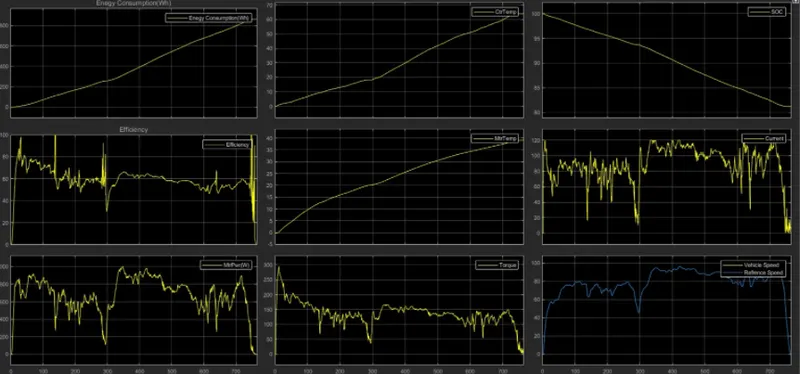
run the simulation for 765sec the motor temp rises to 40deg C for motor controller is 65degC. the motor torque is 300Nm Max power of 120A was consumed system efficency is 80-60 percent. the total energy consumption is 850watt hr.
EUDC(Extra ubran drive cycle)
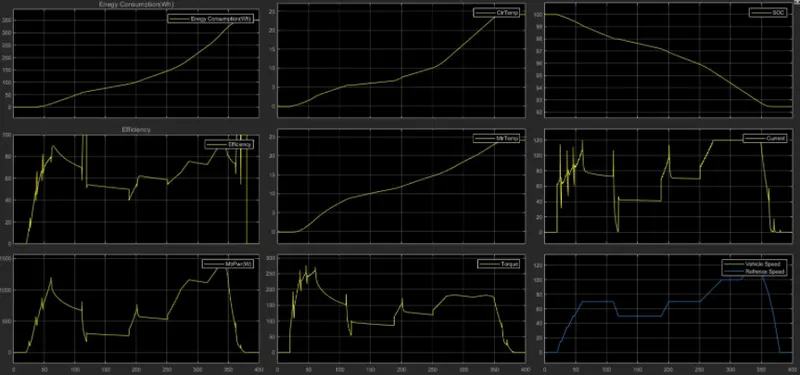
simulation run for 400 sec torque is 250Nm motor and contoller temp is 25 deg C max motor power is 1400watt and min power is 200 watt.efficency is about 80-60% enery consumtion is 350 watthr.