Final Project: Design of an Electric Vehicle
1.
Aim :- Create a MATLAB model of electric car which uses lithium ion battery and induction motor. Choose suitable blocks from Powertrain block set. Prepare a report about your model including following objectives.
Objectives
1. System level configurations
2. Model parameters
3. Results
4. Conclusion
A vehicle that employs an electric motor or traction motor for propulsion instead of a traditional internal combustion (IC) engine is known as an electric vehicle (EV). Electric vehicles, unlike traditional vehicles, run on electricity rather than gasoline, and as a result, they do not emit any pollutants or exhaust fumes (Zero emission). An electric vehicle's electricity can originate from a variety of sources, including batteries, generators, and a collector system.
MATLAB model of electric car which uses lithium ion battery and induction motor. Choose suitable blocks from
Powertrain block set :
To Model and Simulate an electric vehicle with SIMULINK.Let us consider a model in this report, an electric vehicle with a Induction motor and battery system using the SIMULINK . In modelling this EV for a drive cycle and to check performanceparameters : to measure speed, SOC , and the current characteristics of its battery system etc
Components
The main components of modelling an EV are:
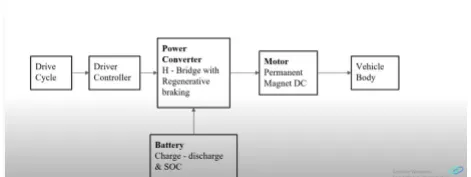
- Vehicle body
- Motor & motor controllers
- Power converters
- Batteries
- Drive cycle
BLOCK DIAGRAM:
MODEL STUDY IN DETAIL:
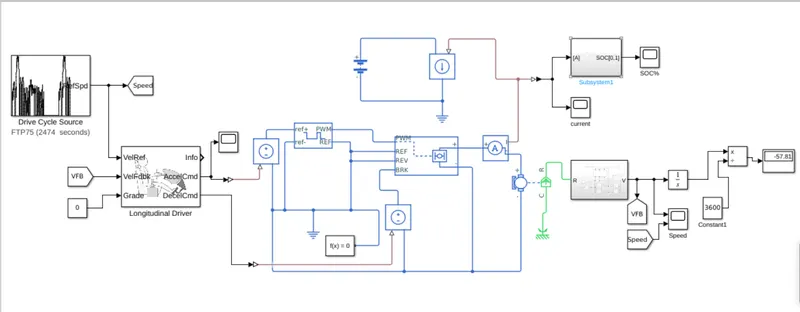
Subsystems:
1. Vehicle body
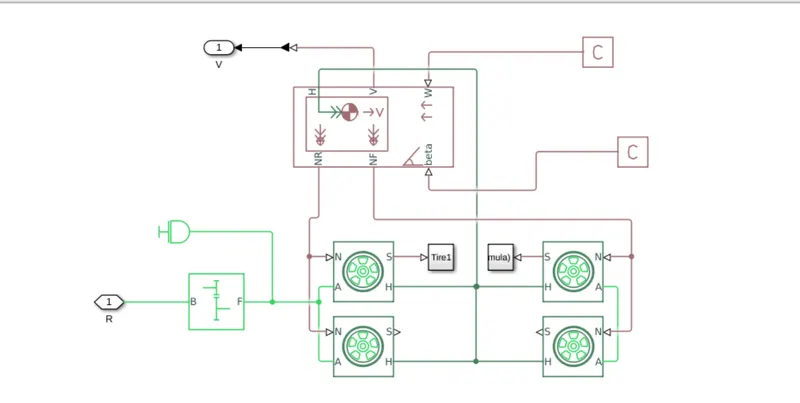
represents a two-axle vehicle body in motion and accounts for body mass, aerodynamic drag, grade,externally-defined mass and center of gravity of the vehicle body.
Input Ports:
W - Wind Velocity in m/s
beta - Grade angle in radians
Output Ports:
V - Velocity in m/s
NR - Normal force on Rear Axle (N)
NF - Normal Force on Front Axle (N)
Vehicle Body Parameters: Vehicle body mass, Centre of gravity distance values and aerodynamic drag variables are modified. Pitch dynamics are kept ON with other variable values as default values.
Tires:

used to model a tire with longitudinal behavior given by equation based on four fitting coefficients.
The block can model tire dynamics under constant or variable contact surface conditions
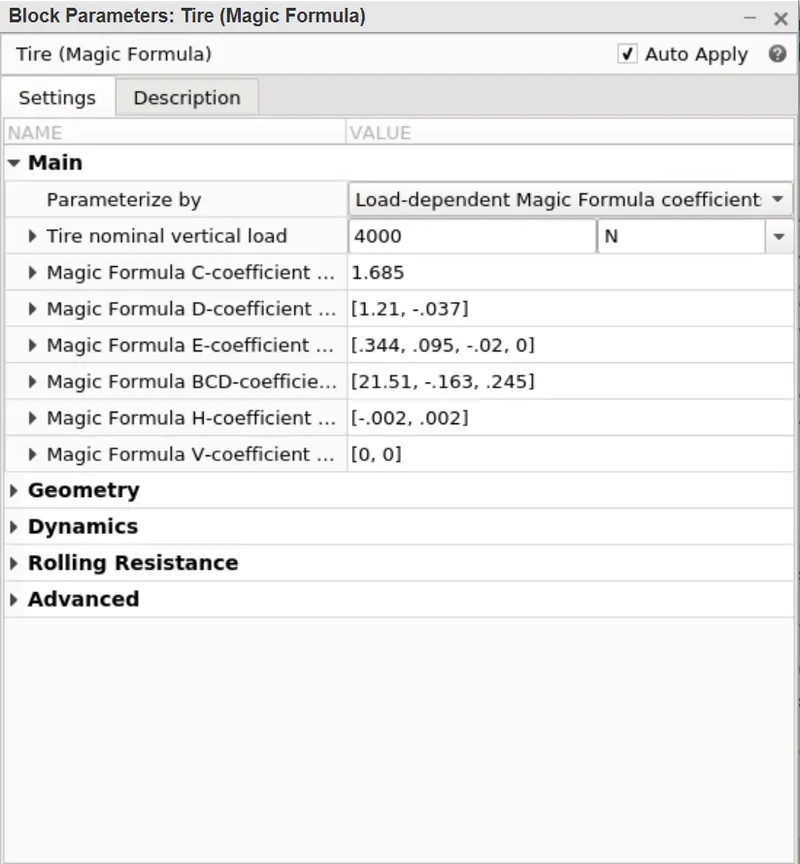
Input Port:
N - Normal force acting on tire, positive when force is acting downwards/towards the contact surface.
Output Port:
S - Slip value relative to tire and surface of contact.
Conserving Ports:
H - represents wheel hub which transmits thrust generated by the wheel to the body of the vehicle.
A - represents axle on which the tires are mounted.
Gear:

A simple gear block is used to connect the motor to the rear axle of the vehicle.
It represents the gearbox which connects the input shaft to the base gear and ouput from the foller gear.
Conserving Ports:
B - port associated with input shaft (motor shaft)
F - port associated with ouput shaft (axle / differential)
Simple Gear Parameters:
Gear ratio and output direction is modified. Meshing loss is kept constant and gear is having a constant efficiency throughout the simulation. Viscous losses and faluts are kept at default conditions.
2. MOTOR & POWER CONVERTER:
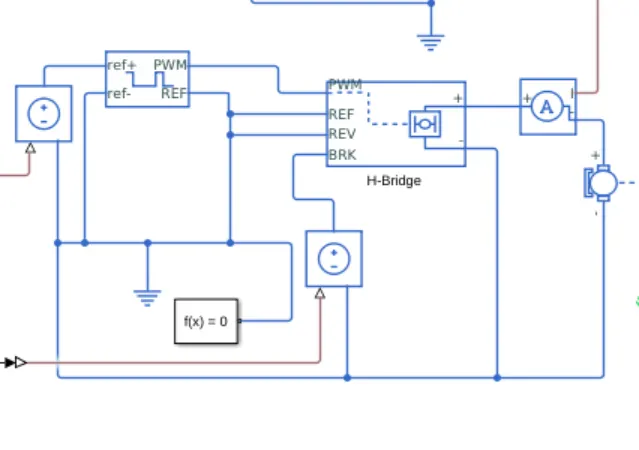
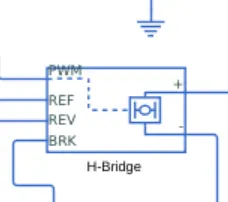
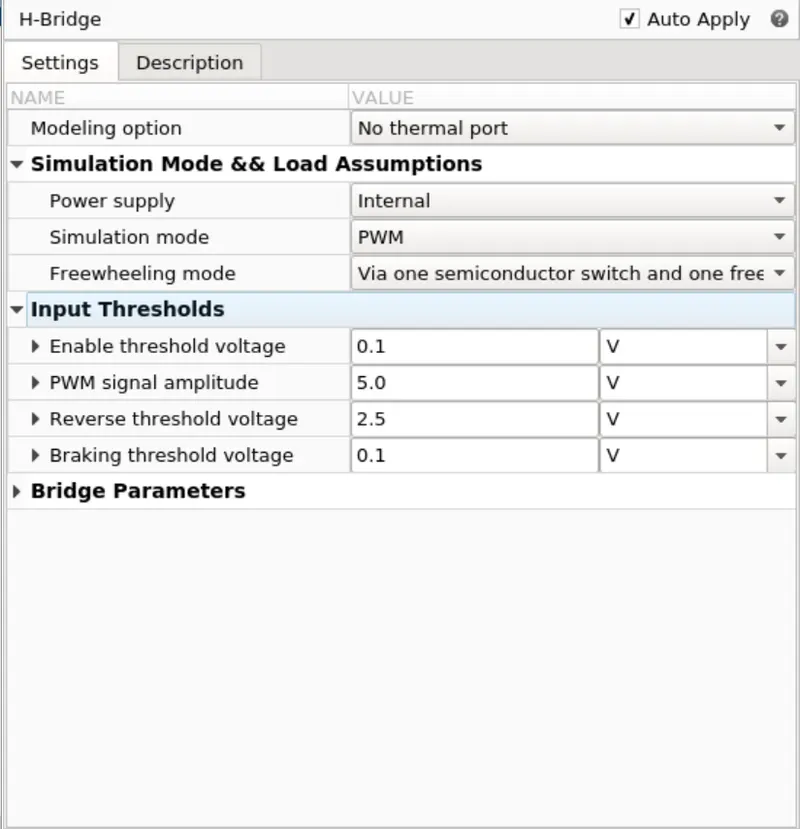
The H-Bridge aids in the regulation of power input according to requirements. The voltage output is transformed according to the set parameters.
3. DC MOTOR
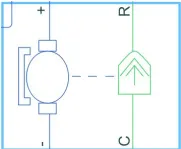
This is the DC Motor which would give the rotational power to the wheels and become the sole power generation
source. The DC Motors terminals are connected as mentioned below,
+ = Electrical signal to the motor Positive Terminal
- = Electrical signal to the motor Negative Terminal
R = Casing of the Motor connected with the Mechanical Rotational Reference Block
C = Rotor Case connected to the Mechanical Rotational reference
The parameter considered are, The Armature inductance is as default, varied the changes in the No-Load Speed @
8000 rpm, the rated speed @ 5000 rpm, the Rated Load at 50kW, and the Rated DC Supply Voltage @ 300 V. All other parameters are as default.
4. Controlled PWM Voltage
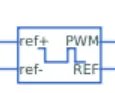
The Modulated Pulses are kept in sync with the needed pulses thanks to the Controlled PWM Voltage Block. So that the processes go smoothly and there are no significant changes.
The Ports are connected as follows,
ref+ = Reference Positive connected with the Acceleration Commands from the Driver Model
ref- = Reference Negative connected with the Deceleration Commands from the Driver Model
PWM = PWM connected directly to the H-Block
REF = REF connected directly to the H-Block
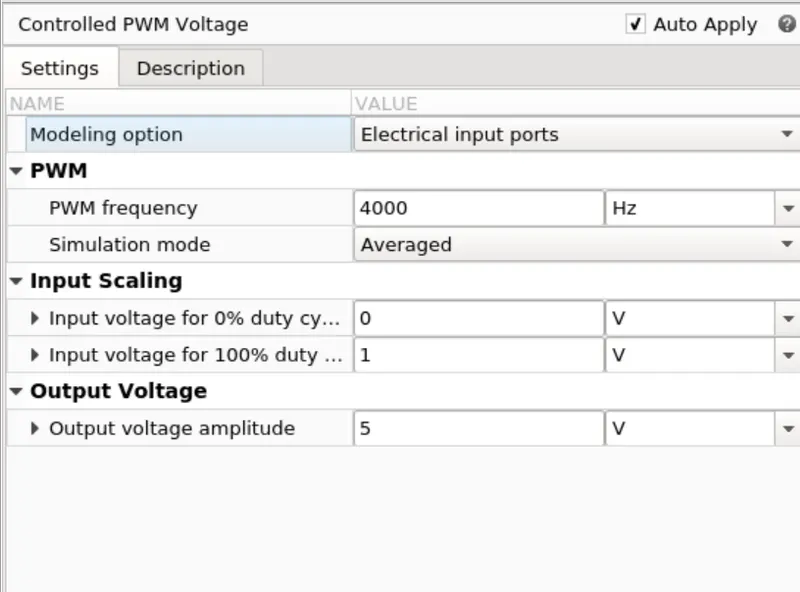
5. Battery Source
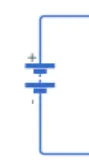
The battery is attached to the model as a power source, allowing power to be created and distributed to all working sources. The terminals connected are to,
+ = The positive terminal of the operating sources
- = The negative terminal of the operating sources.
Components connected battery block is depicted below:
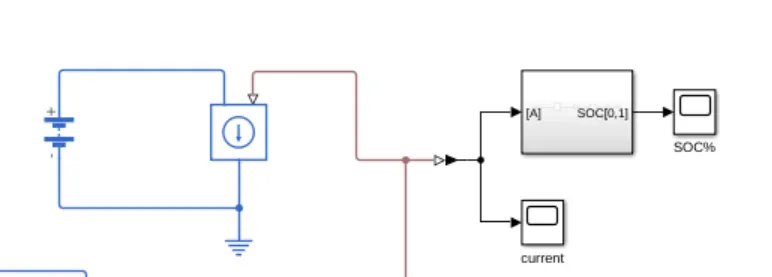
The paramters considered of the battery are -
The battery Nominal Voltage is rated as per 300 Volts, the internal resistance is as per 0.5 Ohms and others set as default.
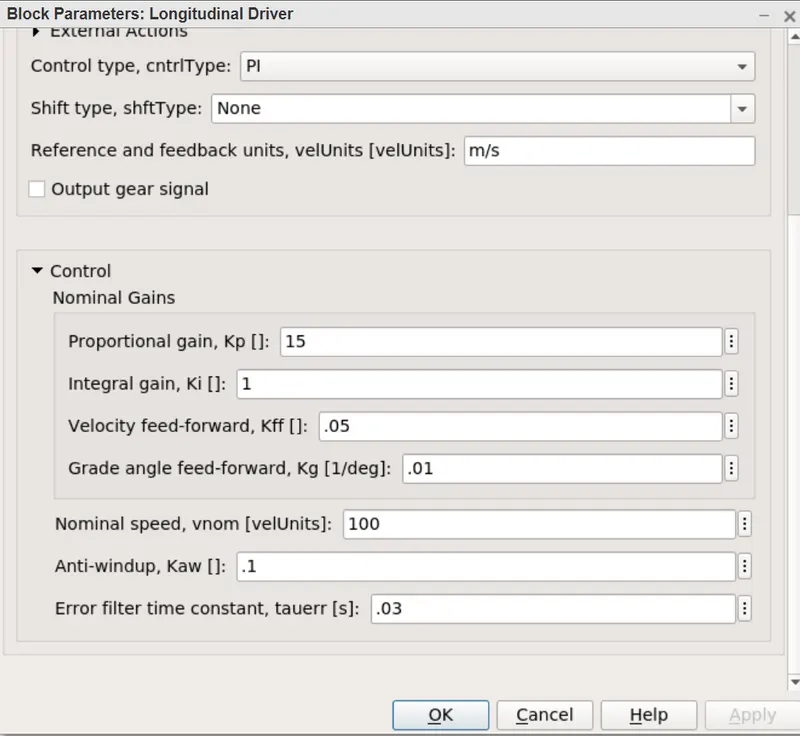
6. Driver Model
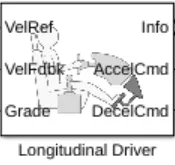
The Driver Model has the Input and Output Ports which are connected to the following,
Velocity Reference - Drive Cycle
Velocity Feedback - Distance Calculation
Grade - Constant 0
Info - Not Connected
Acceleration Command - Controlled PWM Source
Deceleration Command - Brake in H-Bridge to maintain the speed according to the Drive Cycle.
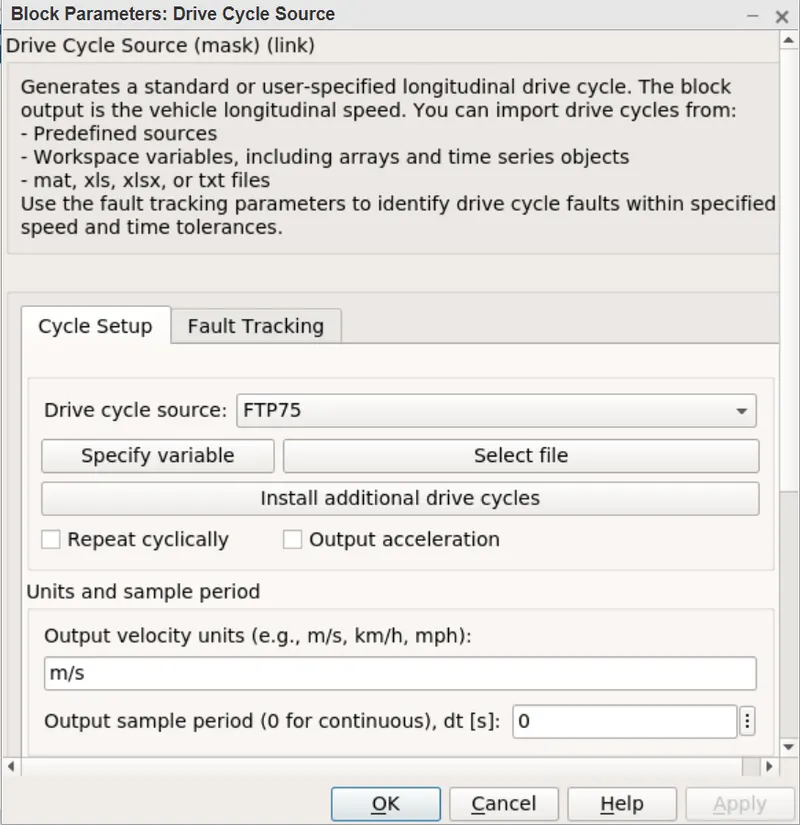
7. Drive Cycle : Drive cycle is used to give reference spped for the simulation.it generates an standard user inputs to longitudinal drive cycle.
Results:
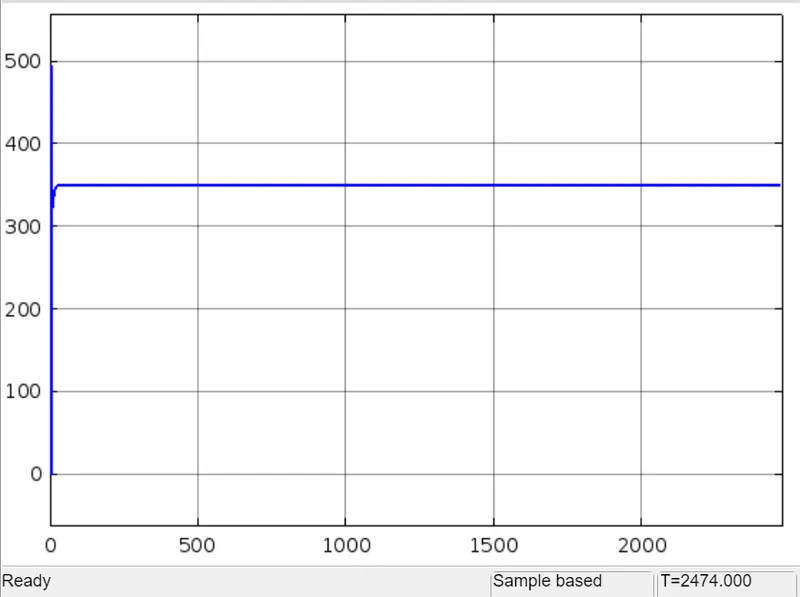
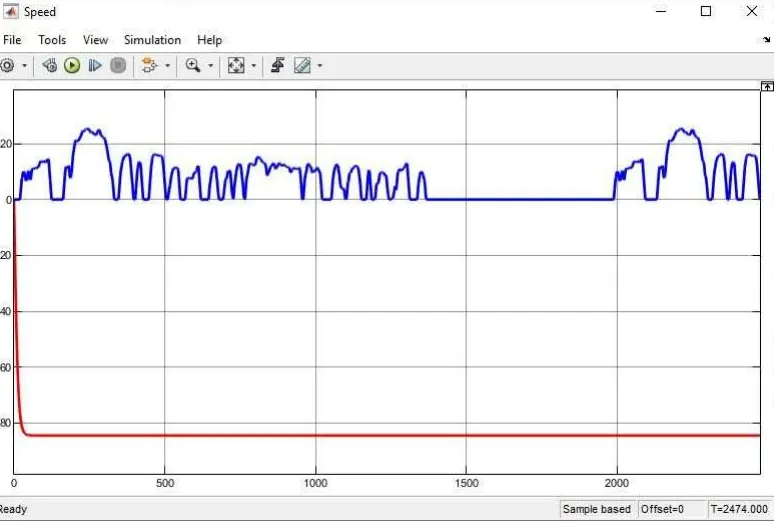
The model with the above details is simulated and the results are as follows :-
Battery SOC: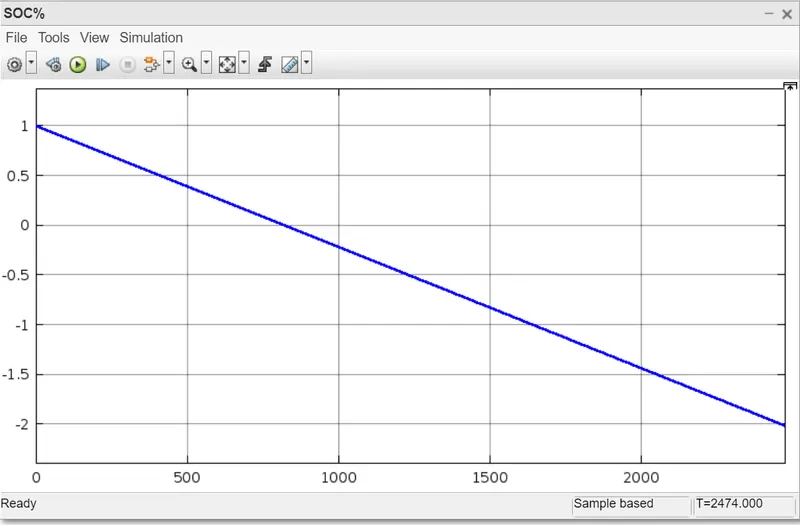
Current:
Speed
Conclusion:
The simulink model of electric car which uses a battery and a DC motor has been simulated succesfully with
FTP75 drivecycle