FINAL INDEPENDENT PROJECT
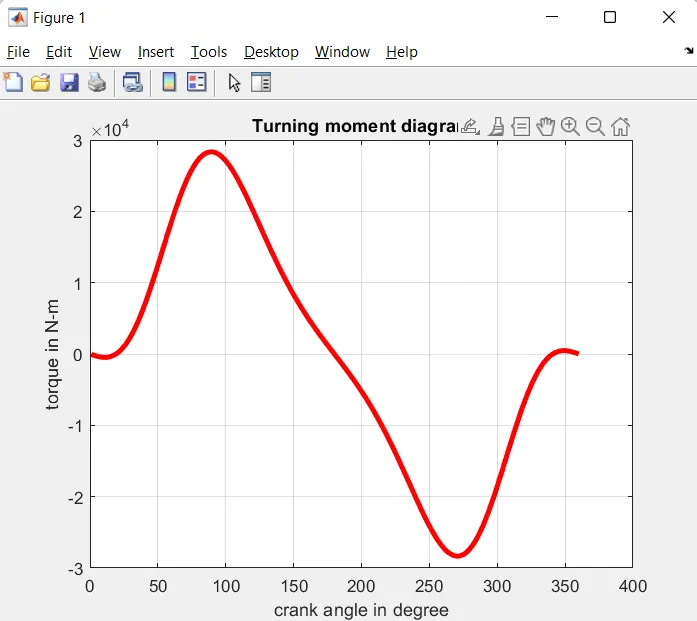
AIM : write a program in matlab to calculate the torque and plot curve of turning moment diagram.
objective : To calculate torque of a crank shaft.
and plote between crank angle and torque.
Theory:
Turning moment: The turning effect of a force is known as the moment. It is the product of the force multiplied by the perpendicular distance from the line of action of the force to the pivot or point where the object will turn.
The SI unit of moment of a force is Newton-metre (Nm). It is a vector quantity.
𝝉= F×dF×d
where 𝝉 is the moment of force/torque
F is the force
d is the perpendicular distance from the line of action of the force to the pivot
Inertia force: The force of inertia is the property common to all bodies that remain in their state, either at rest or in motion unless some external cause is introduced to make them alter this state.
Turning moment diagram : The turning moment diagram (also known as crank-effort diagram) is the graphical representation of the turning moment or crank-effort for various positions of the crank. It is plotted on cartesian co-ordinates, in which the turning moment is taken as the ordinate and crank angle as abscissa.
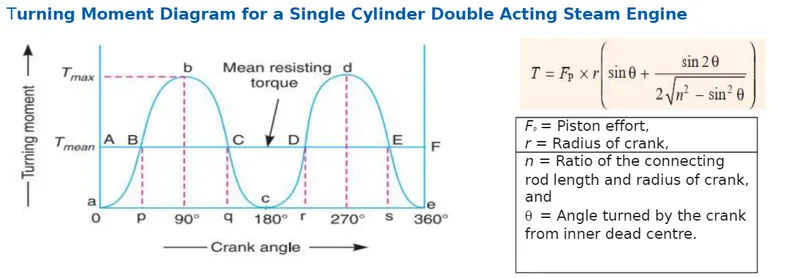
Piston effort : The net force acting on the piston along the line of stroke is called as piston effort. In case of horizontal engine,it will be the algebric sum of inertia force,F(i) and net load on piston,F(l).
F(p)= F(l)-+F(i)
(-) negative sign is used when piston is accelerated & (+) positive sign is used when it is retarded.
If Friction resistance (Rf) is also considered then above equation becomes
F(p)= F(l)-+F(i)-R(f).
In case of vertical engine,the weight of reciprocating parts (Wr)helps piston during downward stroke and opposes during upward stroke.Then,
F(p)=F(l)-+F(I)+-Wr-Rf
Inertia force is given by,
F(i)= M(r)*a(r)=M(r)*W^2*r[cos$+(cos2$÷n)]
where,
M(r)- Mass os Reciprocating engine
a(r)- Acceleration of RE
W-Omega- Angular velocity
r- Length of crank
$ - Crank Angle
n- ratio of length of connecting rod(l) & length of crank.
Net load on piston,F(l) is given by
F(l)=P*(π/4)(D^2)
P- net pressure of gas on the piston
D- Diameter of the piston
Thrust force: Thrust is a force or a push. When a system pushes or accelerates mass in one direction, there is a thrust (force) just as large in the opposite direction.
Explaination:
crank pin circle radius of a horizontal engine in m
r = 0.3;
mass of reciprocating parts in kg
m = 250;
net load on the piston in N
fl = 68730;
connecting rod length between centers in m
l = 0.6;
engine rpm
N = 250;
inputs are provided to find other parameters.
n the ratio of connecting rod length to crank pin circle radius
n = 0.6/r
omega = ((2*pi*N)/60) after definnig the inputs
for loop is used for defining theta
fi = 250*omega^2*r*((cos(theta))+((cos(2*theta))/n))
to find the interia force.
from that we got piston force
fp = fl-fi
phi = asin((sin(theta))/n) finding phi to put on to get thrust force
fq = fp/cos(phi)
by getting thrust force we can geyt the tangentical force
ft = fq*sin(theta+phi)
from that we can ditermine the torque
t = ft*r
after that we can use plot command to plot the turning moment diagram.
code :
clear all
close all
clc

%inputs
%crank pin circle radius of a horizontal engine in m
r = 0.3;
%mass of reciprocating parts in kg
m = 250;
%net load on the piston in N
fl = 68730;
%connecting rod length between centers in m
l = 0.6;
%engine rpm
N = 250;

%is the ratio of connecting rod length to crank pin circle radius
n = 0.6/r;

omega = ((2*pi*N)/60);

%for loop for defining theta
 for d = 1:360
    theta = ((pi*d)/180);
    %interia force
    fi = 250*omega^2*r*((cos(theta))+((cos(2*theta))/n));

    %piston effort
    fp = fl-fi;

    phi = asin((sin(theta))/n);

    %thrust force
    fq = fp/cos(phi);

     %tangential force
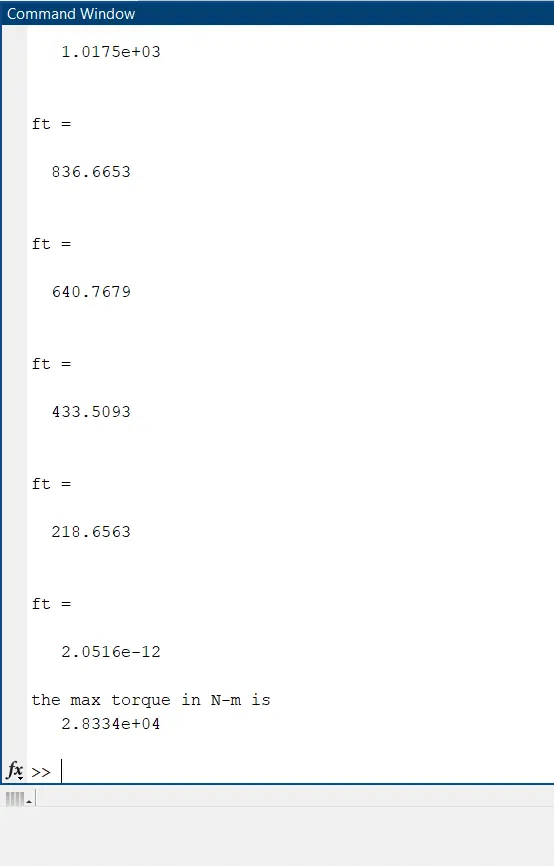
     ft = fq*sin(theta+phi)

     % torque
     t = ft*r;
     torque(:,d) = t;
 end

     %ploitting
 plot(1:360,torque,'LineWidth',3,'Color','r')
 xlabel('crank angle in degree')
 ylabel('torque in N-m')
 title('Turning moment diagram')
 grid on
 disp('the max torque in N-m is')
 disp(max(torque));
Output :