Fender Design - Wheel Arch Challenge
Aim:
Calculate the Wheel Arch gap at required points and check whether the car passes the European standard.
Introduction:
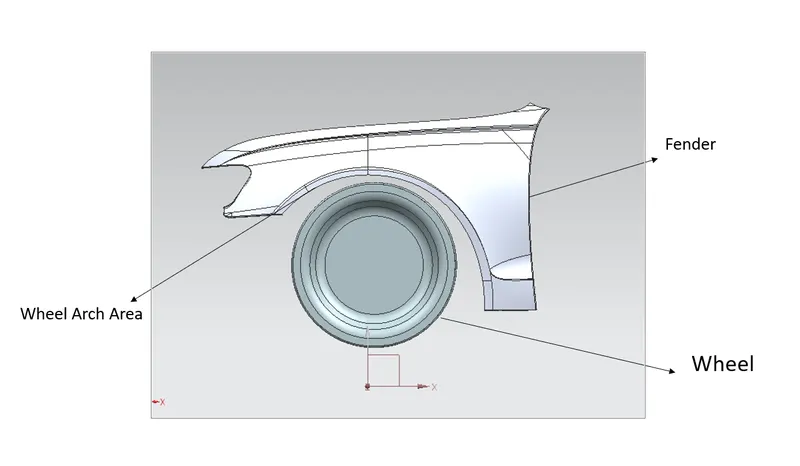
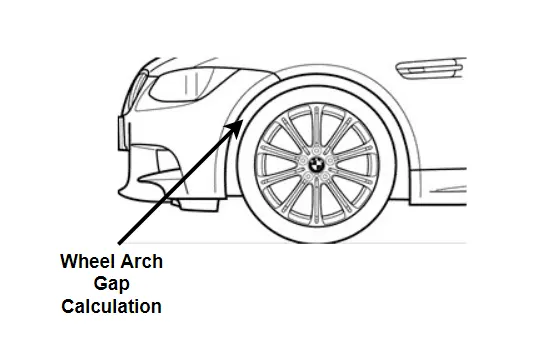
Wheel Arch is the semi-circular part of the fender positioned above the wheel of the vehicle. The design of Wheel arch of a fender should be such that it must shield wheels and protect both the passenger compartments and pedestrians from projection of water, mud and stones. The wheel Arch area of the fender is usually designed as a cover or shield over the tyre.
Sectional modulus optimization of hood:
Sectional Modulus is the ratio of moment of inertia and distance between the neutral axis and extreme end.It gives the idea of how much the material is deformed. As the moment of inertia increases the sectional modulus increases and hence more is resistant to the bend. Change is made in the design to improve the sectional modulus by varying the Y. For this emboss were given to reduce the distance between the inner and outer panel, as the distance decreases the sectional modulus increases.
Wheel Arc Verification Using European Standards:
Wheel Arc is the part of the fender and semicircular part positioned above the wheel. It protects the wheel from unwanted particles and entering of those particles into the engine compartment and even provides safety for pedestrians. Requirements have been proposed by vehicle and road safety community to the minimum requirement of wheel arc distance
from the wheel for safety.
Rules –
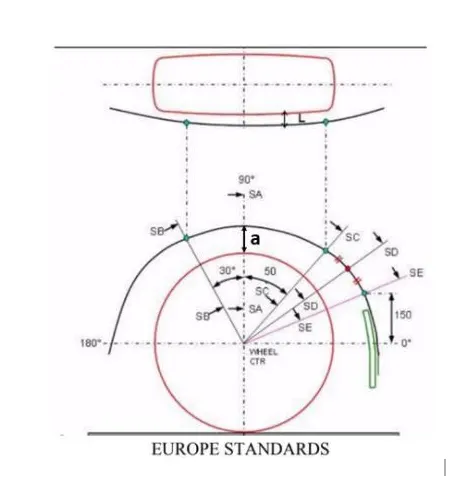
Measure of CL L is done on sections SA, SB , SC, SD, SE.
At all sections the value of CL L should be greater than 10mm.
Wheel guard requirement : The value of a shall be more that 5 mm at 300 forward and 500 rearward from the central axis of wheel.
European Standards
Wheel Arc
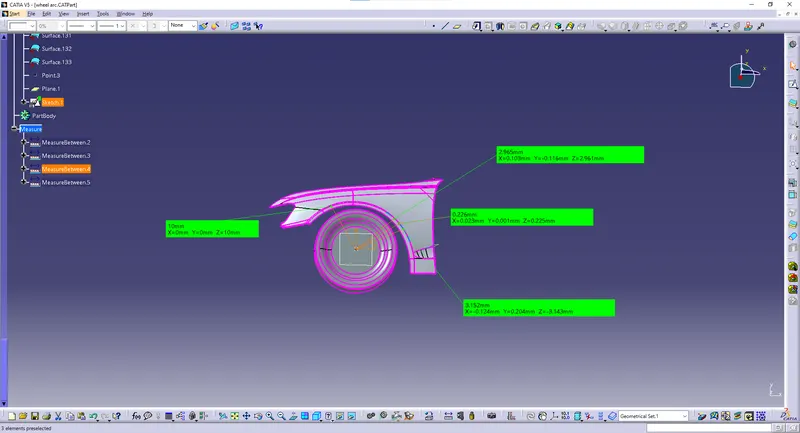
Section Clearance Measured(mm) Comments
SA- 10 Pass & SB- 10 Pass are
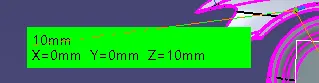
SC- 2.965 Fail

SD- 0.226 Fail
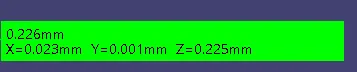
SE- 3.152 Fail

Negative sign indicates that the wheel arc is behind the wheel.
All the sections don\'t have the CL L value at least 10mm, only SA and SB are seen to have value 10mm.
Therefore the wheel arch does not satisfy the requirements as per the European standards. So the styling team needs to work at the section of SC, SD, and SE. For safety purposes the wheel arc should be outside the wheel and the value greater than 10mm and the SD, SE part should come outside the wheel.
Japan Regulations Requirement:
- Measure clearance L of tire, hub, cap and fender in three different positions within area K and produce clearance check chart to validate.
- Clearance must be greater than 5 mm in all the three positions.
- Wheel guard requirement: The value of ‘a’ shall be more than 5 mm at a line 30deg forward and 50 deg rearward from the central vertical axis of the wheel.
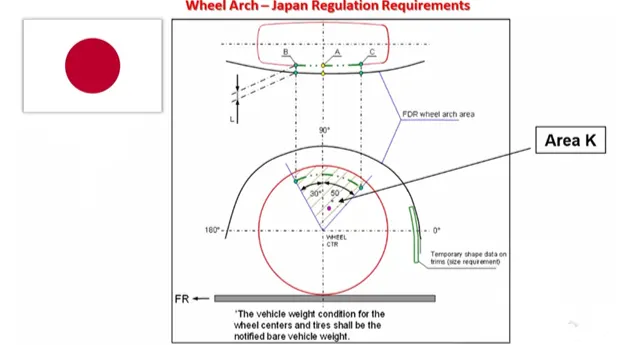
Japan Regulation on Wheel arch
For the Japan requirement, we take 50 deg on the right of the wheel and 30 deg on the left of the wheel and in this region, when we project the we will have to have a gap of minimum 5mm.
Why this requirement changes from region to region is, this regulation is fixed with respect to the region’s road condition. Japan’s government fixes this 5 mm value. Like ARAI (in India), there is a regulation team in Japan and they will be fixing this value. So, once we get our fender from the wheel data, we define the wheel center and we create a perpendicular line and that point is A, from top view and from the side view. WE project the side view line on top view. We take a 50 deg line and we project the value and we mark it. Then we take a 30 deg line towards the front. All these points should have a minimum clearance of 5 mm and this is the region or regulation for Japan. We will have to do this study and see whether our fender is matching this requirement. If it is not matching, we will have to again go tour styling colleagues and ask them to change the curvature of the fender.
European Regulations Requirement:
Measure CL L at sections SA-SA SB-SB SC-SC SD-SD SE-SE and produce CK check chart to validate.
- At all five sections the CL L value should be greater than 10 mm to satisfy the European regulations.
- Wheel guard requirement: the value of ‘a’ shall be more than 5mm at a line 30deg forward and 50 rearward from the central vertical axis of axis of wheel.
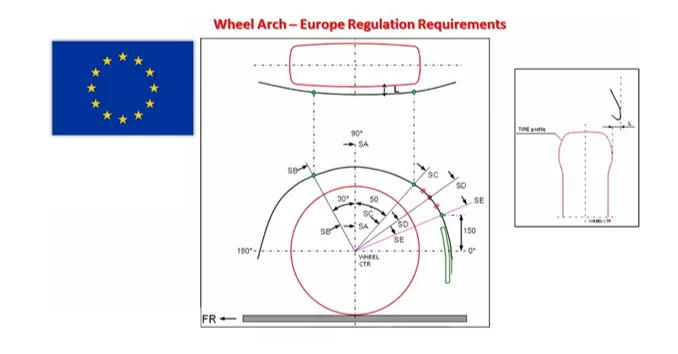
Europe Regulation on Wheel Arch
When it comes to European regulations, we will have to again take the wheel center and mark the 30 deg line and 50 deg line like what we did for Japan. We have got two pints now additionally we will have to take a 150mm intersection point from the wheel center which touches the fender edge (i.e. wheel arc) and draw a line which intersects through that point and that line will be SE. and in between 50 deg line and 150mm line we will take a midpoint and draw a line from the wheel center. And in all these regions the length should be 10 mm and this study we will be doing for European regulations. If our car is addressed to various markets, say for Japan, Europe, and US also then we will have to take one major requirement and see the maximum value of what the clearance has to be. So that we don’t prepare variations in fenders. We cannot have two different fenders for one model car. so we take the maximum deviation value and use the same for all the cars.
US Regulations Requirement:
- Make clearance check details on all positions from – 100 deg to 100 deg and make the clearance check table.
- All values should be greater than 5mm to satisfy the regulations.
- The value of ‘a’ shall be more than 5mm at a line 30deg forward and 50 deg rearward from the central vertical axis of the wheel.
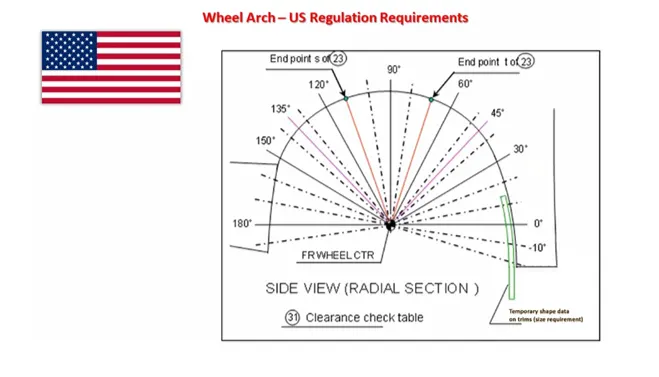
US Regulation on Wheel Arch
In the United States, we have to do the same check for every 10 deg from -20deg to 0. When we do this, we should have 5mm clearance from the length. So, if our car is prepared for three different markets, say Japan, US and Europe, we basically keep 10mm for all regions so that we satisfy all the requirements. And for Europe also checking on all the regions. So as a styling feedback, we will be giving a drip area and wheel arch area. These two are important feedback that a fender engineer gives to the styling team.
Conclusion:
From the above results, we can conclude that the given fender does not pass the European standards for wheel arch area.