Fender Design - Wheel Arch Challenge
STUDY REPORT ON FENDER WHEEL ARC
AIM:
To create a report on fender regulations, calculate the wheel arc area, and prove whether the car will pass the standards by using European standards.
A fender is the curved portion of the car's body that sits over and houses the wheels.
What Is The Purpose Of A Fender On A Car?
The purpose of a fender is pretty simple. Its purpose is to keep mud, rocks, and other road debris from being thrown around by the tires. In other words, the fender is a housing for the wheels that keeps road debris contained. If nothing was covering the wheels, the rotating tires would kick all kinds of debris.
What Is The Difference Between A Fender And A Bumper?
If you're unfamiliar with automotive terminology, there might be some confusion about the difference between a fender and a bumper. Let's clear up any confusion.
A bumper is located on the front and rear of a vehicle. The purpose of a bumper is to absorb the impact of minor collisions.
In the early days of the automobile, bumpers were a more distinct component that was noticeably separate from the rest of the car's body. But as automotive technology advanced, bumpers became more integrated with the rest of the car's body. The purpose of the modern bumper remains the same, but the bumpers on many vehicles (namely sedans and crossovers) are less visually noticeable than they once were.
As mentioned, a fender is merely a housing for the wheels that prevent road debris from being thrown up by the rotating tires. However, fenders are also able to absorb impact from minor collisions. In this way, the fender can act as an extension of the bumper in terms of its ability to absorb the energy from a collision.
Types of fender:
The type of fender is based upon the area covered i.e. full fender type and half fender type.
Full bumper type :
Half bumper type :
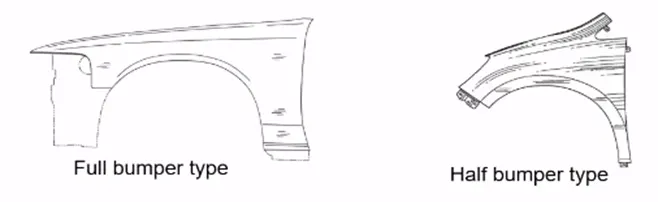
Many factors need to be considered during designing the fenders of the vehicle. One of them is the wheel arch area.
In a fender, the wheel arch is the semicircular part that is positioned above the wheel of the vehicle. While designing the fender care must be taken that the wheel arch of the fender meets the required standards.
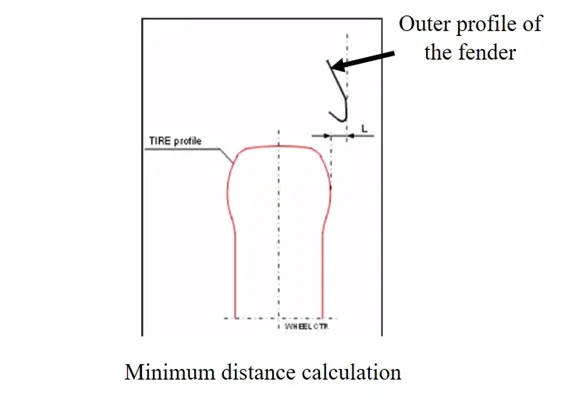
Different standards of the wheel arch area requirements:
- The wheel should be placed inside the fender or in other words, there should be a minimum distance between the outer surface of the fender and the outer surface of the wheel.
- This helps to reduce the chance of chipping of the wheel with outer particles.
- It helps in increasing pedestrian safety.
- The distance ‘L’ as mentioned in the above figure should be a minimum value, which varies as per standards followed by different countries
Wheel arch:
It is the semi-circular edge of the fender which houses the wheel well. The wheel arch gives access to the wheel and other components attached to it. Also, it allows the tilting of wheels while steering to both sides without causing any interference between the wheel and body. The wheel arch is designed to allow any possible kind of motion that the wheel can have and to prevent any materials that could fly out from the wheel during the motion. Thus it has a crucial role in pedestrian safety and the safety of other vehicles.
Need of Regulations:
To ensure safety, the designs of the passenger car fenders are constrained by implementing regulations that control the wheel arch area.
Some of the different standards followed are:
- Japanese standards.
- European standards.
- US standards.
There are 5 checkpoints on the sections SA, SB, SC, SD & SE as shown.
In all these checkpoints the clearance “L” should be greater than 10 mm.
Given Model:
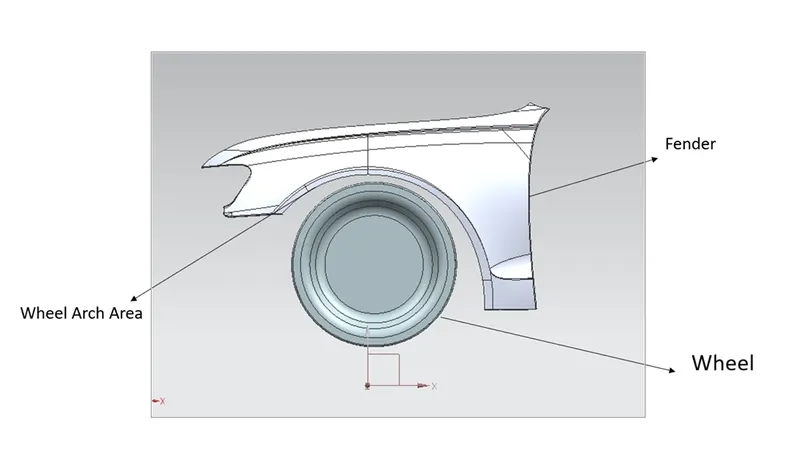
Wheel guard should meet the above-mentioned requirement when the vehicle is in running condition and the wheels are in a dead ahead position.
Why do they have different requirements?
- This is because of the road condition and also due to population density in the particular country.
- As in japan population density is high means the speed limit will be low due to which at low speed the mud particle will spread slowly so it has less distance ( 5mm).
- While in Europe population density is less means the speed limit will be high due to which at high speed the mud particles will spread fast so it has more distance (10mm ).
How I calculated.:
- We will start by constructing the points of measurement for the wheel arch area.
- first I used the point command to get the center point of the outermost wheel.
- then created data from that point.
- then I sketched the required specification according to the European standard and marked the point where the wheel arch and wheel line intersect.
- then used the measure command to measure the distance.
Section SA:
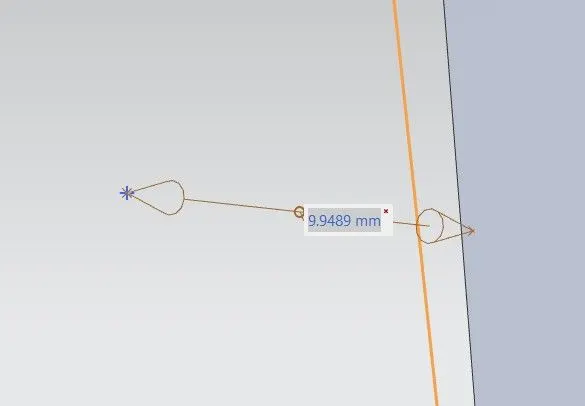
CLEARANCE L at sections SA is 9.948 mm WHICH IS =10 mm from wheel to wheel archer.
Section SB:
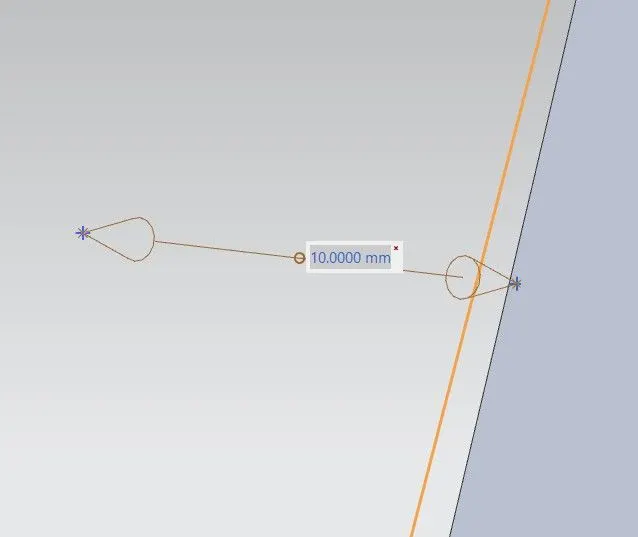
CLEARANCE L at sections SB is 10 mm from wheel to wheel archer.
Section SC:
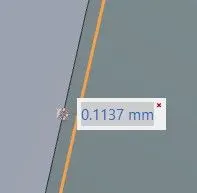
CLEARANCE L at sections SC is 0.1137mm from wheel to wheel archer.
Section SD
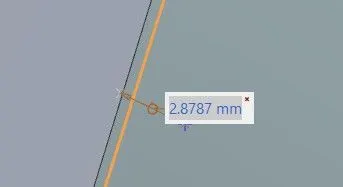
CLEARANCE L at sections SD is 2.878 mm from wheel to wheel archer.
Section SE:
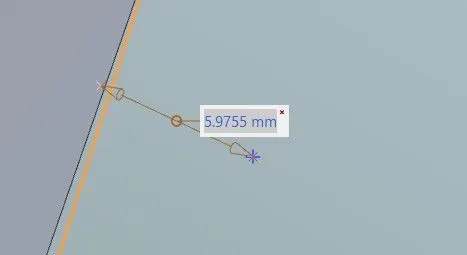
CLEARANCE L at section SE is 5.975mm from wheel to wheel archer.
Checking whether the front fender wheel arch meets the standards:
Comparing the above-observed values with the required values
| Position/Section | Observed Clearance Value (mm) | Required Clearance Value (mm) | Passes the Requirement |
| SA | 9.94 | 10 | Fail |
| SB | 10.00 | 10 | Pass |
| SC | 0.1137 | 10 | Fail |
| SD | -2.878 | 10 | Fail |
| SE | -5.975 | 10 | Fail |
Conclusion: As the obtained data is different from the regulation's criterion. FENDER FAILS AS THE VALUES DO NOT LIE IN BETWEEN THE VALUES OF THE EUROPEAN STANDARD.