Fender Design - Wheel Arch Challenge
AIM :
Calculate the Wheel Arch gap at required points and check whether the car passes the European standard.
WHAT IS WHEEL ARCH?
The wheel arch is an arch-shaped cavity in the body of a vehicle, which houses a wheel. It has two important functions. It serves for the safety of pedestrians and other cars because the wheel is situated in the body of a vehicle. The second function is to protect the car from the sticky materials, such as mud, may adhere to the smooth outer tire surface, while smooth loose objects, such as stones, can become temporarily embedded in the tread grooves as the tire rolls over the ground. These materials can be ejected from the surface of the tire at high velocity as the tire imparts kinetic energy to the attached objects. For a vehicle moving forward, the top of the tire is rotating upward and forward and can throw objects into the air at other vehicles or pedestrians in front of the vehicle.
To satisfy the wheel arc radius in the fender design we have to follow different standards for different regions . Some of the standards available are :
1.JAPAN REGULATIONS:
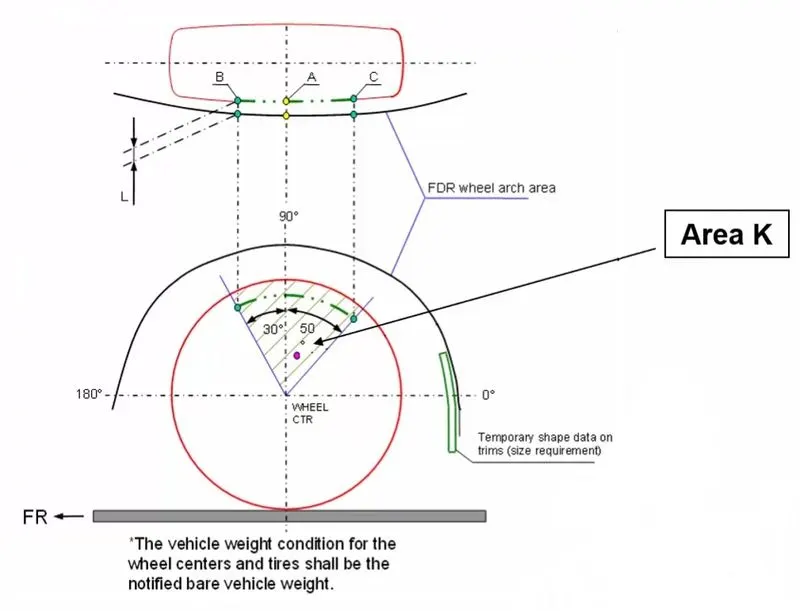
- Measure clearance L of tire ,hub, cap & fender in three different positions within area K and produce clearance check chart to validate.
- Clearance must be greater than 5 mm in all the three positions.
- Wheel guard reqmt: The value of a shall be more than 5 mim at a line 30" forward and 50 rearward from the central vertical axis of axis of wheel.
- 2.EUROPEAN REGULATIONS:
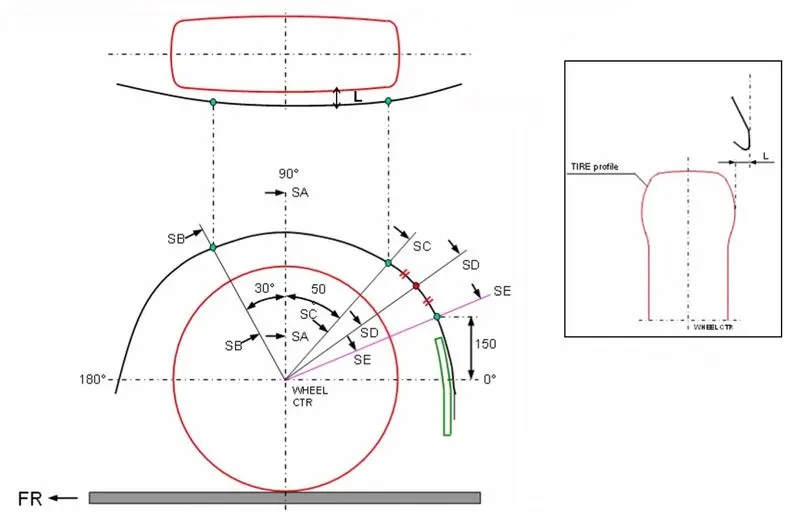
- Measure CL L at sections SA-SA SB-SB SC-SC SD-SD SE-SE and produce CL check chart to validate.
- At all five sections the CL L value should be greater than 10 mm to satisfy the European regulations.
- Wheel guard regmt: The value of 'a shall be more than 5 mm at a line 30* forward and 50* rearward from the central vertical axis of axis of wheel.
- US REGULATIONS:
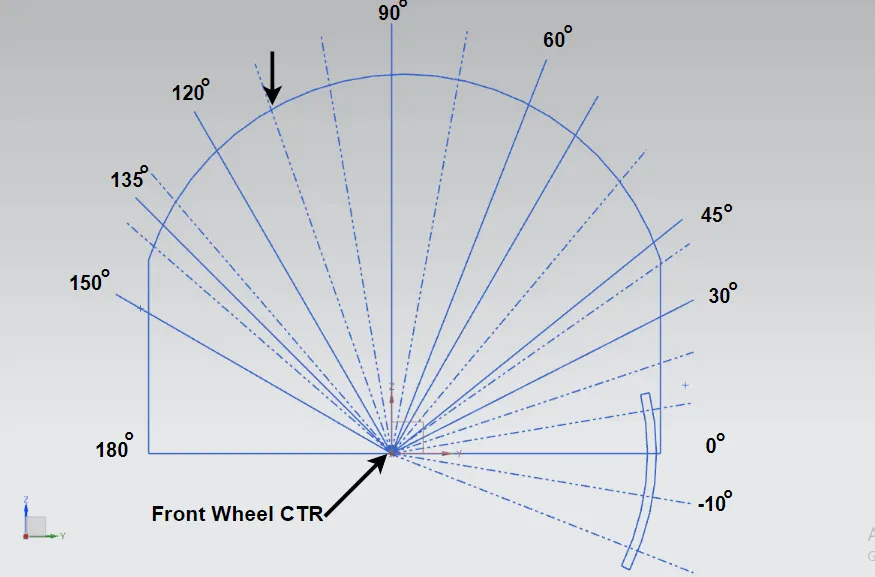
- Make clearance check details on all positions from -100* to 100* & make the clearance check table.
- All values should be greater than 5 mm to satisfy the regulations. The value of 'a' shall be more than 5 mm at a line 30* forward and 50*.
- rearward from the central vertical axis of axis of wheel.
As per European Standard, The clearance L should not be less than 10 mm at all the 5 points SB, SA, SC, SD, SE
Now let us see if the given Fender & wheel model will pass the European standard or not.
DESIGN ANALYSIS:
1) Take a plane on the face of the wheel and create a vertical straight line SA from the centre of the wheel
2) Create two similar lines SB & SC at 30 degree and 50 degree angle respectively from the line SA taken from the centre
3) Create a horizontal line passing from the centre on the wheel and offset it to 150 mm upwards, and mark its point of intersection with the edge of the wheel
4) Draw a line passing throgh centre of the wheel and intersection point. Create angle bisector using bisecting lines and name the two new lines created as SD & SE
5) Exit the sketch and measure the distance between the Fender outer edge and the lines drawn on the wheel.
Here
for SA region the clearance is 10.00 mm
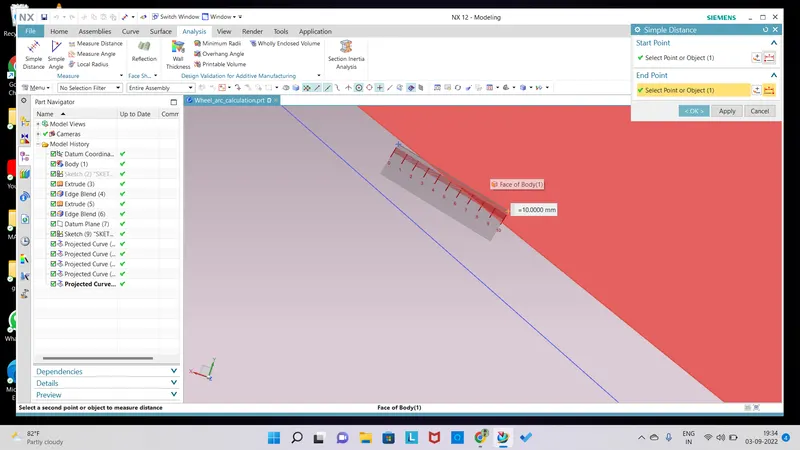
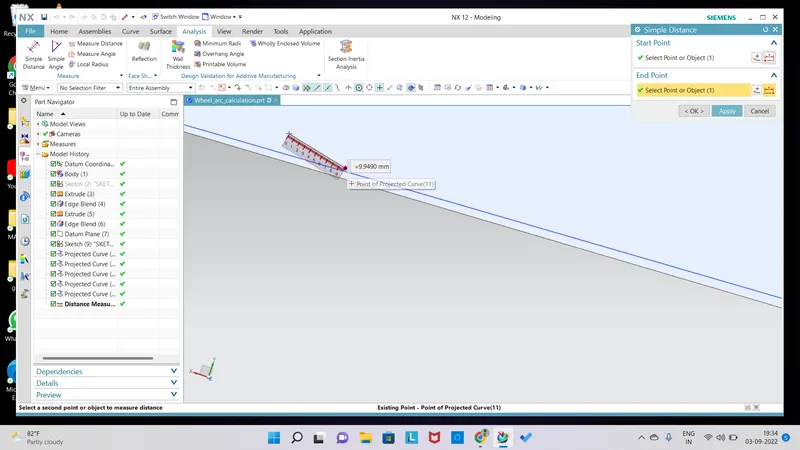
SB region the clearance is 9.949mm
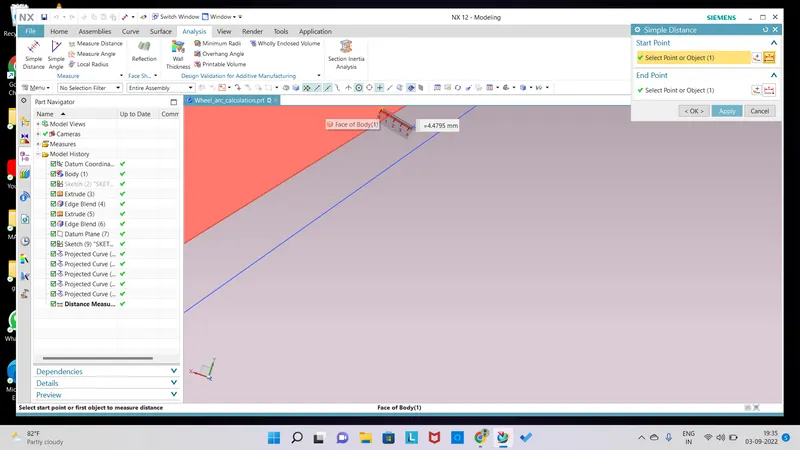
SC region the clearance is 4.475 mm
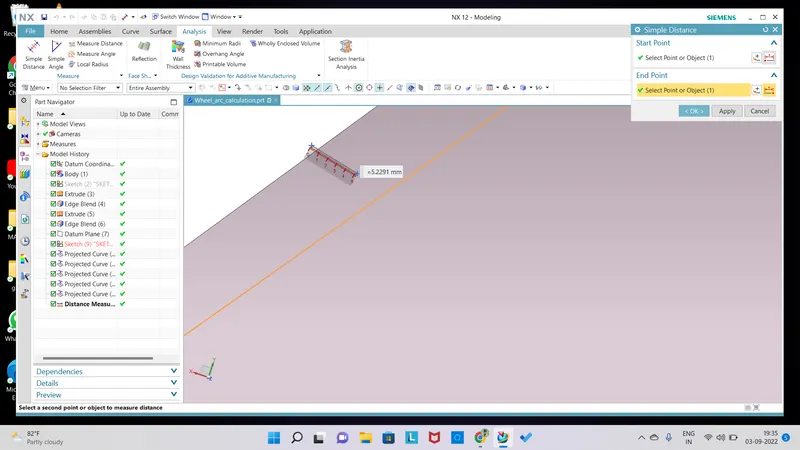
SD region the clearance is 5.2291mm
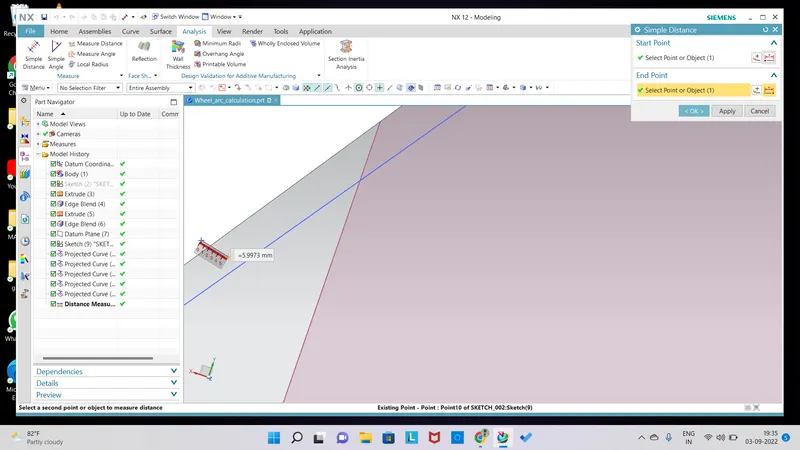
SE region the clearance is 5.9973 mm
- The clearance value 'L' was measured and found to be as follows:
-
Section
Required Clearance (mm)
Measured Clearance ‘L’ (mm)
Remarks
SB
10
10
Pass
SA
10
9.95
Fail
SC
10
4.475
Fail
SD
10
5.22
Fail
SE
10
5.98
Fail
CONCLUISON:
From the above observations the positions SB SC SD SE are less than 10mm which is necessary to pass the European standards. Hence, the front fender wheel arch does not pass the European standard.
And when we calculate the vertical clearance between wheel outer edge and fender edge we are getting below shown values
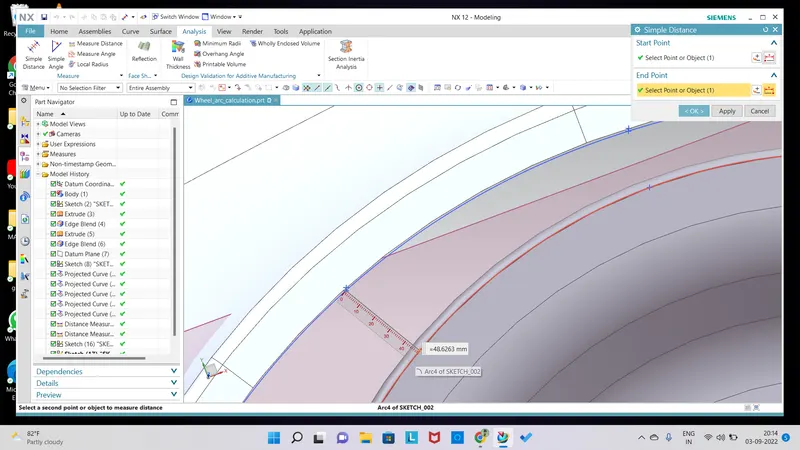
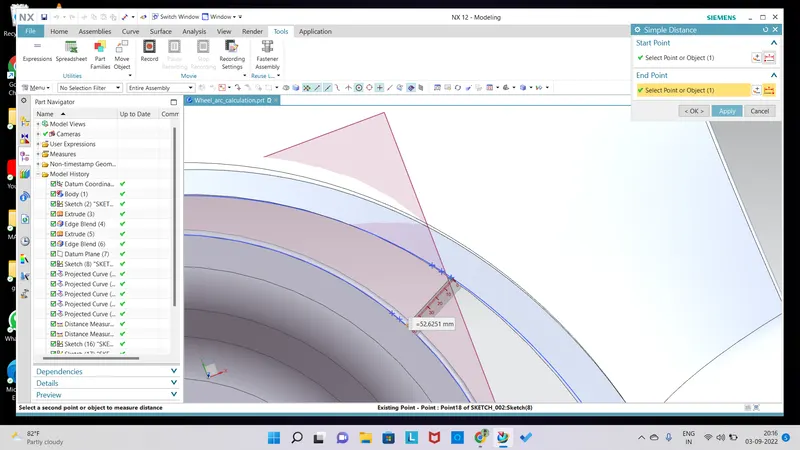
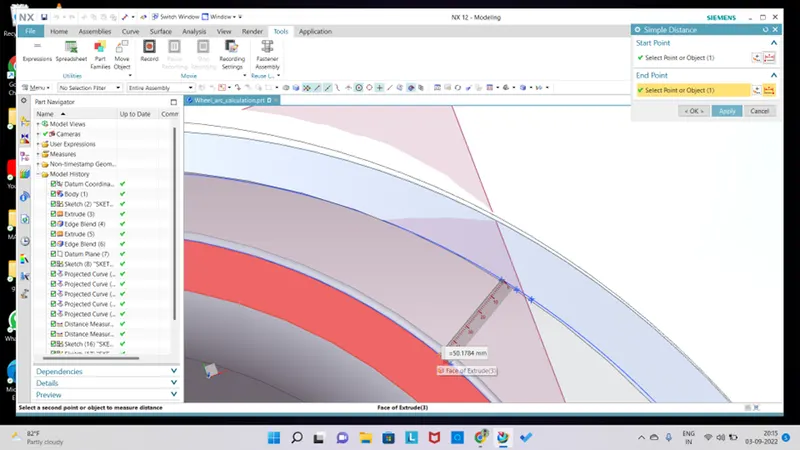
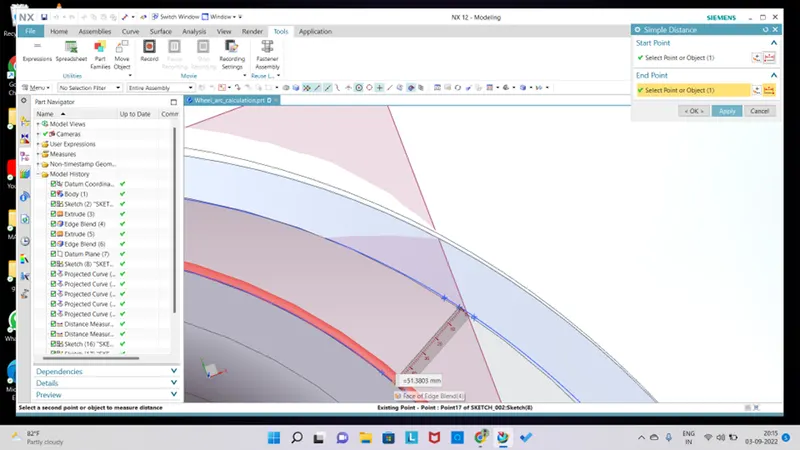
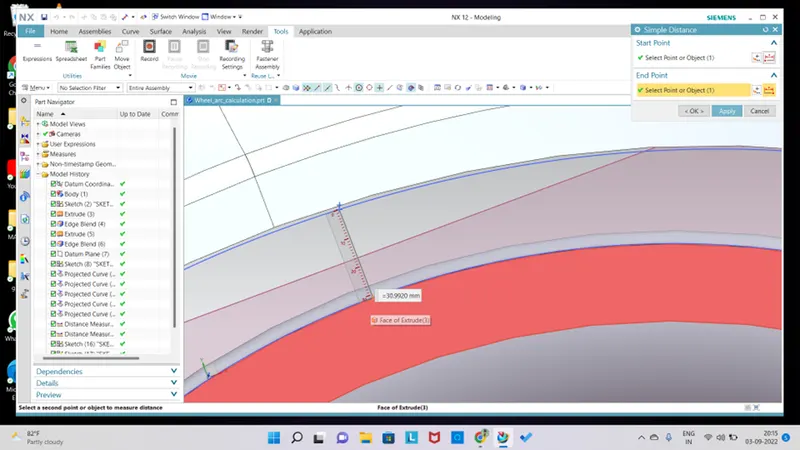
all the values are above 10 mm so this design passes the european standards.