Fender Design - Wheel Arch Challenge
Aim:
To calculate the Fender Wheel Arch area , to pass the European standards.
Objective:
- Create the intersection point according to given degree angle.
- Follow the European standards to prove the design is valid.
- Tabulate the result to conculde the final result.
Introduction:
Fender is the American English term for the part of an automobile, motorcycle or other vehicle body that frames a wheel well (the fender underside). Its primary purpose is to prevent sand, mud, rocks, liquids, and other road spray from being thrown into the air by the rotating tire. Fenders are typically rigid and can be damaged by contact with the road surface.

Sticky materials, such as mud, may adhere to the smooth outer tire surface, while smooth loose objects, such as stones, can become temporarily embedded in the tread grooves as the tire rolls over the ground. These materials can be ejected from the surface of the tire at high velocity as the tire imparts kinetic energy to the attached objects. For a vehicle moving forward, the top of the tire is rotating upward and forward, and can throw objects into the air at other vehicles or pedestrians in front of the vehicle.
Fender Wheel Arch Area:
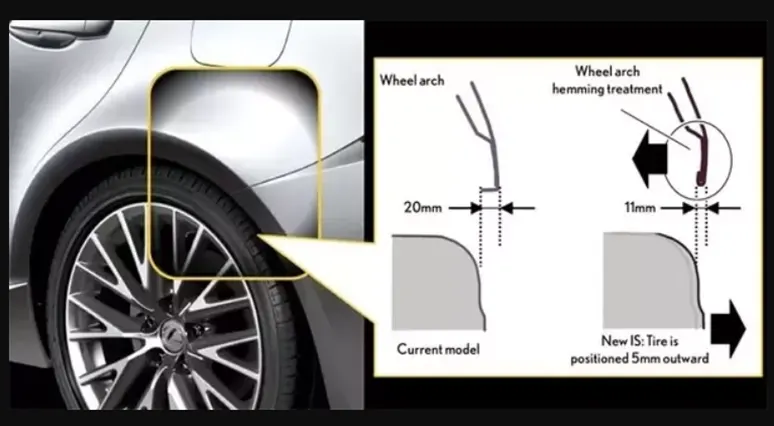
The wheel arch is the semicircular part positioned above the wheel of a vehicle. It is an integrated part of a fender assembly. The wheel arch area have some standard specification to measure the clearance between the tire and fender. If the tire lies outside the fender, it does more chipping cause a damage to pedestrian and also to car. To have a pedestrian safety in mind, we need to position the tire inside the fender. For that we have certain standard regulations.
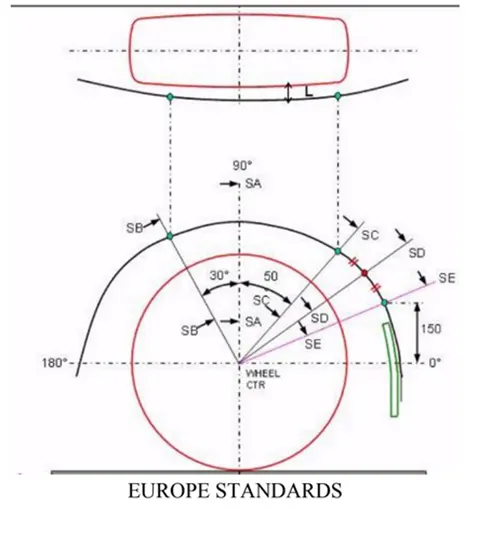
- European regulation
The value will be more than 10mm at 30 degree at forward and 50 degree at line above150 mm.
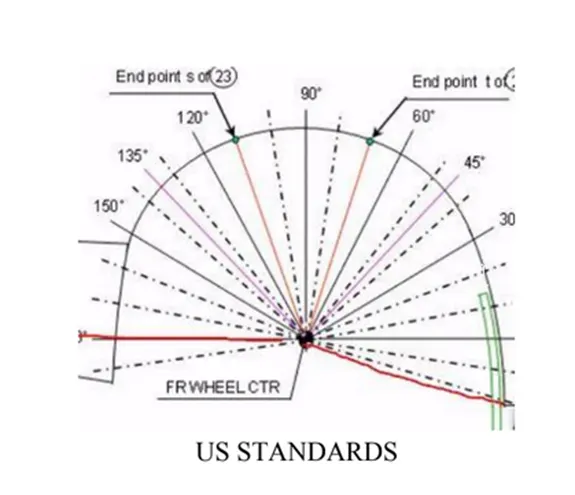
- US Regulation
The value will be more than 5mm at line 30 degree forward and 50 degree central vertical axis.
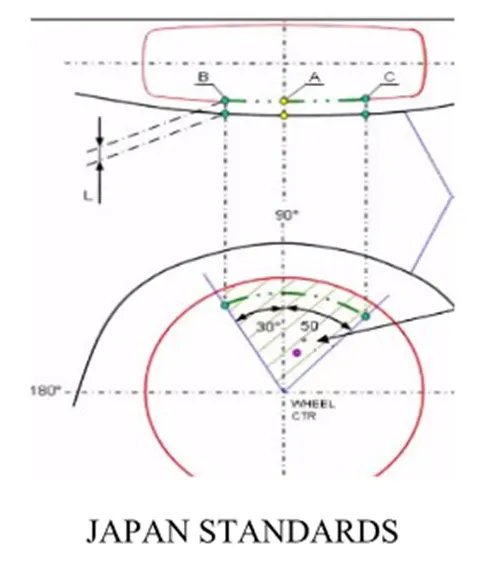
- Japan Regulation
The value will be more than 5mm at 30 degree at forward and 50 degree at the central vertical line.
Here the main objective of the challenge is to test whether the give tire and fender is eligible to qualify with European regulations of Fender design or not.
Design Criteria has been followed as follows,
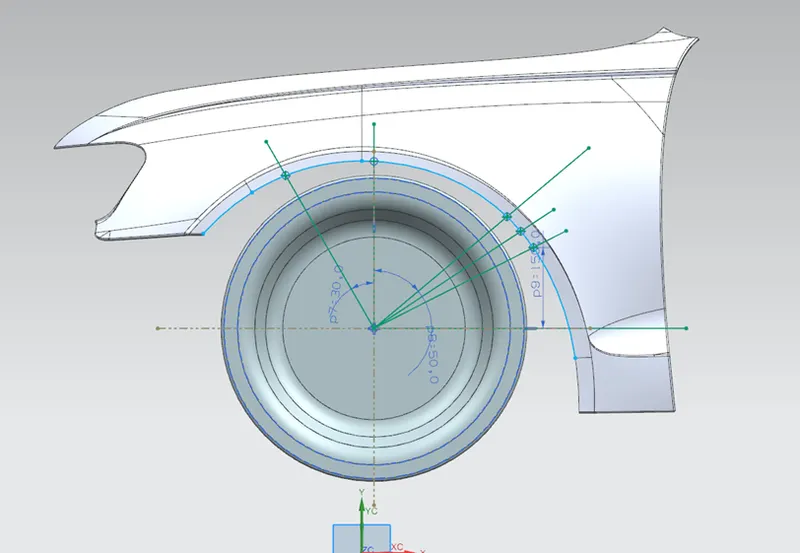
- A sketch is created on the datum plane which is at the outer most portion of the wheel.
- Create the intersection points on the line which are intersecting at the fender outermost portion.
- Project those points on to the fender part.
- Measure the distance between sketch intersection points and the project point. Then we get the each section.
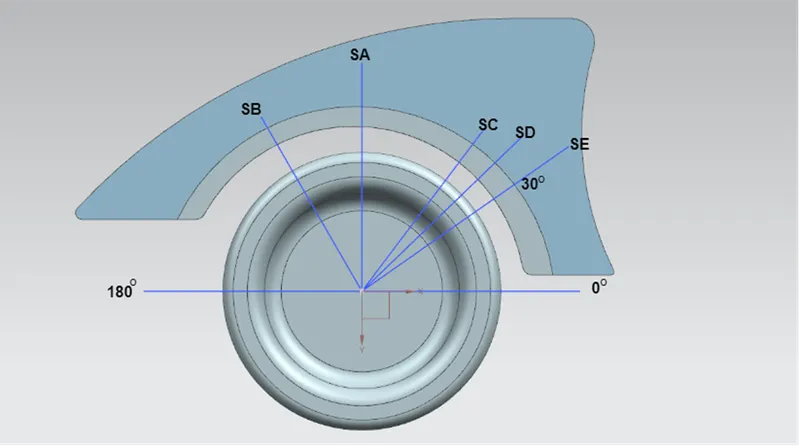
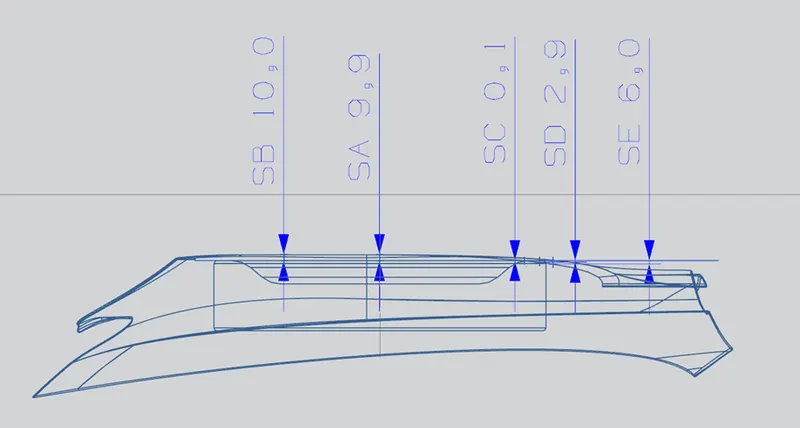
|
Section |
Clearance |
Result |
|
|
SA |
9.94 < 10 |
Fail |
|
|
SB |
10 >10 |
Pass |
|
|
SC |
0.11 < 10 |
Fail |
|
|
SD |
2.9 < 10 |
Fail |
|
|
SE |
6.0 < 10 |
Fail |
Conclusion:
The value of Clearance (L) is measured at all five location and tabulated. The table shows that only a section SB have 10 mm clearance and at remaining four section value will not have more than 10mm with the help of measure data, the given fender does not qualify the European standard for wheel arc area.