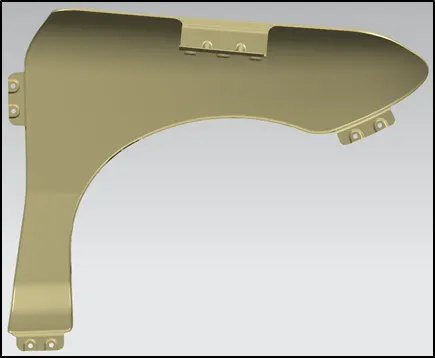
Fender Design Challenge
Introduction:
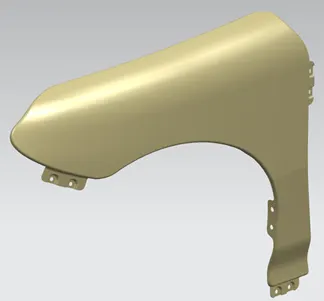
- Fenders are part of body panel installed on left and right side over and around each wheel of a vehicle, rear fenders are commonly called quarter panels.
- Its basic function is to protect the engine compartment, occupants, pedestrians, and other alongside vehicles and road users from mud, Pebbles, and liquids which is thrown by rotating wheels while driving.
- They are designed to minimize air resistance and improve the aesthetics of vehicle.
Fender types
- Full Bumper type fender
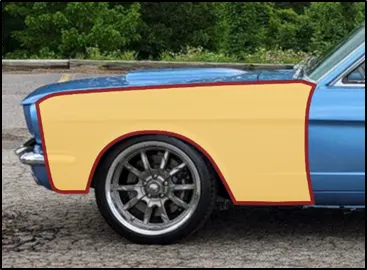
- Material used for making full bumper type fender is more, hence it produces high wastages/scrap to make a single bumper when compared to half bumper type fender.
2. Half Bumper Type
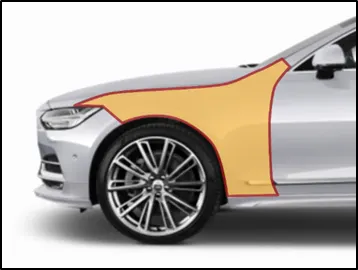
- A single sheet can be used to make two fenders, hence less amount of scrap is generated.
- This method allows less material (i.e.: Steel sheet) consumption which affects positively on Cost and Weight of the manufactured final part.
Fender Design Considerations
Material Used
- Most of the steels used in automotive applications are aluminum-killed steels of about 0.7 to 0.9 mm thickness.
- For outer panels requiring deep drawing such as fenders, hoods, oil pans, etc. Non-aging extra deep drawing steels such as SPCEN (JIS G 3141), A620 (ASTM), CR1 (Bs 1449), and St 14 (DIN 1623), are used.
- Bake hardening steels are used especially for the external panels that possess sufficiently high formability and provide an increase in strength after the paint baking.
Design considerations and master section – Drip Area
- Fender is to be mounted on various regions on the car body, one of the most important region is drip area
- While designing mounting on drip area there are some factors that need to be considered such as
- Overall dimensions
- Strength
- Ease of Assembly
- Aesthetics
- Height of drip area is maintained at around 40mm and should not exceed 60mm due to manufacturing limitations.
- Usually, length of drip area mounting is calculated by keeping 150mm away from the Headlight mounting and 200mm away from Cowl (Wiper Mechanism).
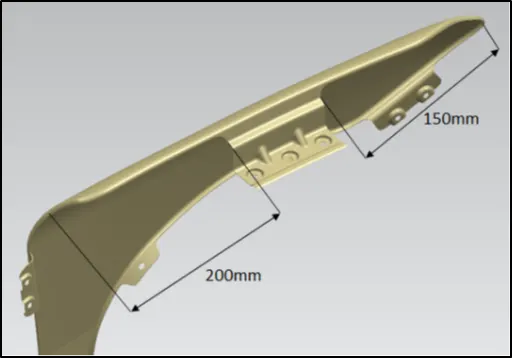
- Dimension at cross-section
- Minimum 9mm from top is drawn at 3˚
- 7mm is extended at 30˚ from horizontal, it will improve the appearance at parting gap between Hood and Fender.
- Another 25mm to 30mm is drawn below at 5˚ from vertical.
- Further, at least 25mm is extended parallel to horizontal to provide access for tools to assemble fender on engine compartment through fasteners.
- At last, bead is provided to increase strength.
- Flange should be kept at least 10mm apart from engine room component.
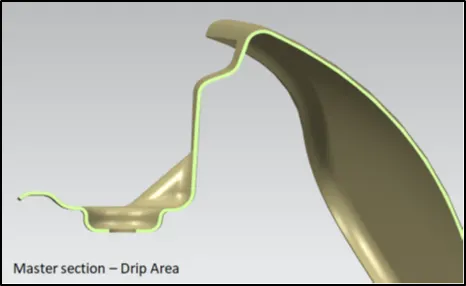
- Bending radius of a minimum 3mm + Thickness (0.75mm) should be provided for ease of manufacturing and it will avoid cracking of sheet metal on bends.
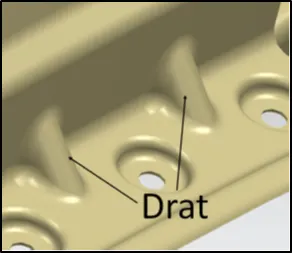
- Darts are provided to improve the strength and rigidity of extended flange.
- Remove sharp corners/edges to avoid injury and it eliminates stress concentration.
Manufacturing process
Sheet Metal Operations
- Cutting Operation
- In cutting operations the sheet metal is stressed beyond its ultimate strength and metal is sheared hence also called as shearing operations. Some of them are listed below,
- Blanking
- Punching
- Notching
- Shaving
- Slitting
Forming Operations
- In metal forming operations, the sheet metal is stressed below the ultimate strength of the metal, In this operation, no material is removed hence there is no wastage.
- Metal forming operations include following process,
- Bending
- Drawing
- Embossing
- Forming
- Coining
Weld Nut
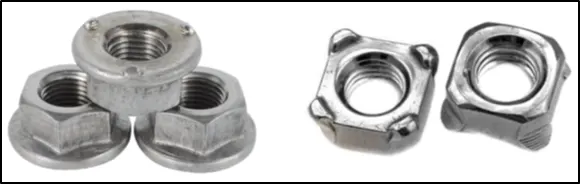
- Weld nuts are designed and engineered to be welded to another metallic object, providing high-strength fastening capabilities in restricted or limited space areas such as drip area.
- Weld nuts are available in numerous sizes, shapes, thicknesses, and configurations.
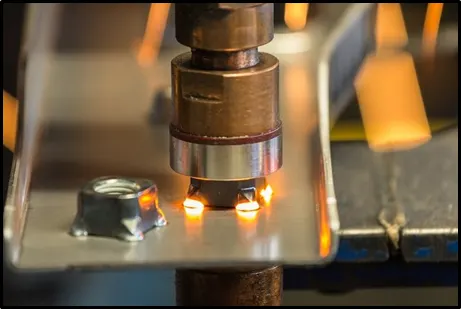
- However due to the necessary welding process, welding nuts are not plated for corrosion protection; subsequent painting or plating processes would be required to protect the assembly from corrosion after the welding process has been completed.
Spring back effect
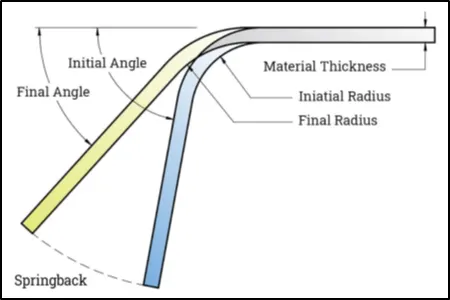
- Springback is when the material tries to return to its original shape after being bent, which will affect the final shape of the part.
Mounting regions
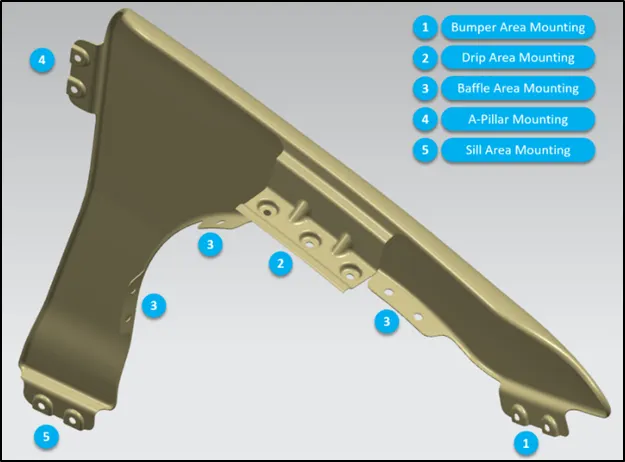
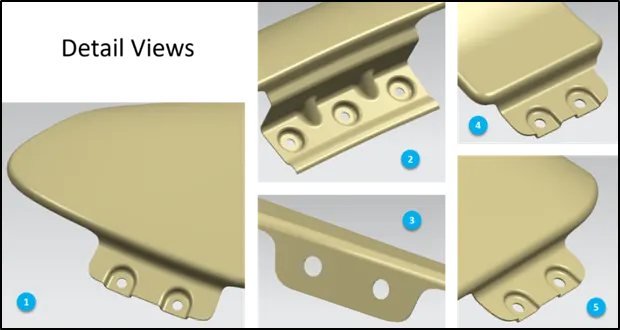
- Fasteners are used to mount fender on different regions of car body such as the Bumper, Drip Area, Sill, and A-Piller.
- Sufficient, and flat head resting area for fasteners needs to be provided.
- It is necessary to maintain a flat area on mounting regions to achieve surface contact with mating surface.
- Baffle is mounted under Wheel arch above wheels and covers engine compartment using fasteners or plastic clips.
Fender Side View (Outter)
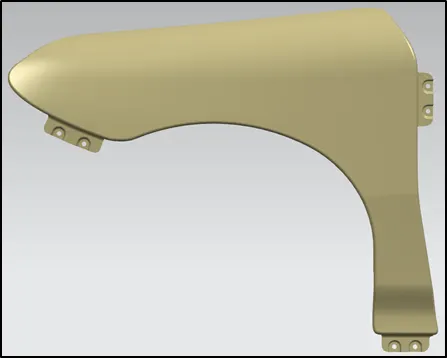
Fender Side View (Inner)