Fender Design Challenge
FENDER DESIGN:
1. FENDER:
- The main purpose of fender is to prevent sand, mud, rocks, liquids, and other external entities from being thrown into the air by the rotating tire.
- Fender is the American English term for the part of an automobile, motorcycle or other vehicle body that frames a wheel well (the fender underside).
- Fenders are typically rigid and can be damaged by contact with ground surface. Therefore ground clearance plays big roll in these designs.
- Sticky materials, such as mud, may adhere to the smooth outer tire surface, while smooth loose objects, such as stones, can become temporarily embedded in the tread grooves as the tire rolls over the ground.
- These materials can be ejected from the surface of the tire at high velocity as the tire imparts kinetic energy to the attached objects.
- For a vehicle moving forward, the top of the tire is rotating upward and forward, and can throw objects into the air at other vehicles or pedestrians surrounding of vehicle.
- As Fender is the body part which is visible from outside we can not use welding or any other method which will going to affect the aesthetic of the car.
- So we have to position it using bolts, fasteners, retailer clip or any other packing method which does not affect aesthetic.
- The embosses are provided on the mounting region to avoid NVH issues & proper fitting of components.
2. TYPES OF FENDER DESIGN:
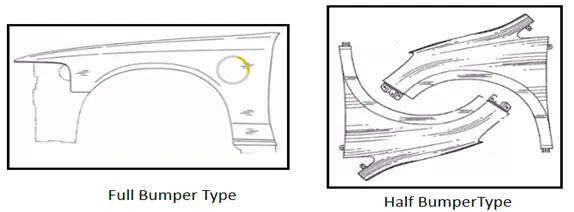
Fig:-1_Fender Types Depending On Bumpers
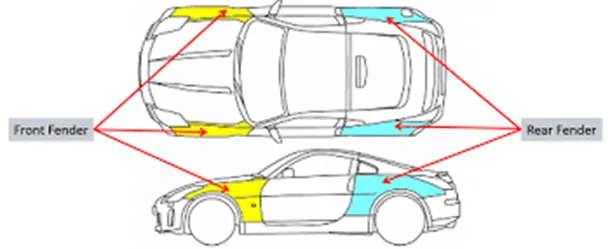
Fig:-2_ Front & Rear Fender of Car
Full Bumper Type Fender:
- These design are used in the initial days for avoiding the external entities such as stone, mud, dust, etc.
- Full bumper type fenders results in more amount of scrap as compared to half bumper.
- We can get cutout of single fender from sheet metal which can give two half bumper type fender.
Half Bumper Type Fender:
- These type of fenders are mostly used in todays car models.
- Half bumper type fenders required less material & cost efficient.
3. GIVEN DESIGN DATA:
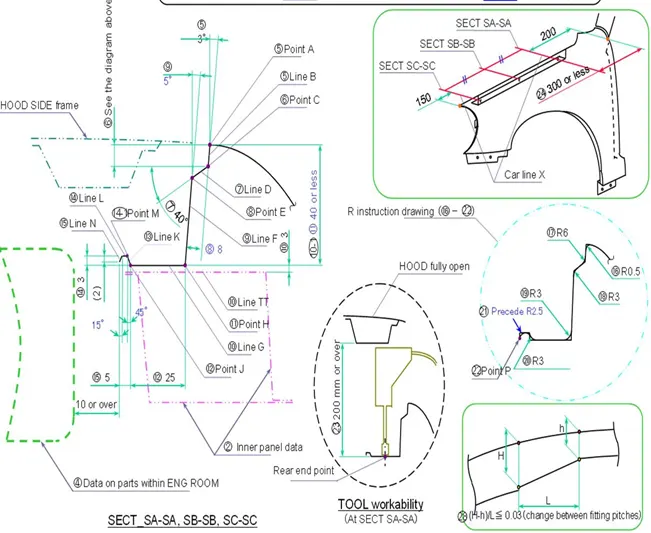
Fig:3_ Master Sketch of Fender Design
- Embosses are provided for the proper fitting, good stress distribution, increasing the strength of component.
- The corner flanges are blended, opening angle should be 3 degree for ease of manufacturability & workability.
- Fillets are applied to the corners & edges of fender of 2-4 mm.
- Uniform wall thickness of 0.75 mm is applied to the fender.
- Opening area & flange provision assures the visibility should not their to people about bad area or fasteners.
- If hood length more than 60 mm the springback effect occurs.
- The wheels should be inside the fender to avoid chipping issue.
- Darts are provided to required flanges for increasing the stiffness of the component & reducing NVH problems.
- Baffles are provided to reduce NVH in india only on diesel cars in other countries on every car.
- Fenders are provided with indicator positioning at high version cars.
4. DESIGN OF FENDER:
The task in this project to design fender major mountings:
1] Drip Area Mounting
2] A-Pillar Mounting
3] Splash Cover Mounting
4] Sill Mounting
5] Body Mounting
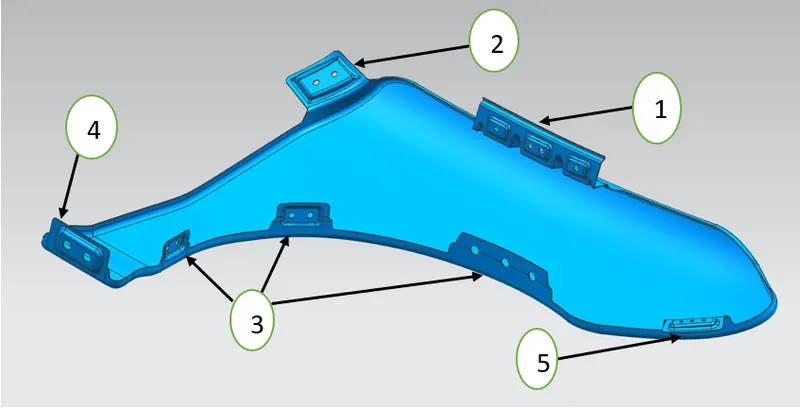
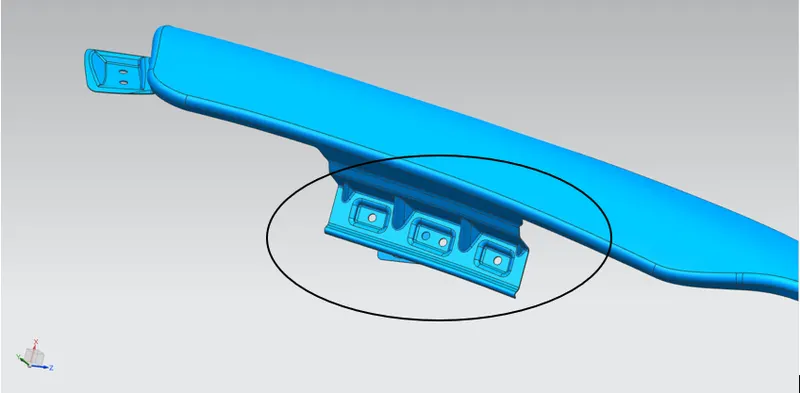
1] DRIP AREA:-
- This region is mounted below the hood inner panel which needs to be in flush when hood is in the closed condition and also there is very less gap.
- The drip area is fastened or self tapping screws or spot welding.
- The Darts are provided on flanges for the better stress distribution, reducing NVH, increasing stiffness of drip area mounting.
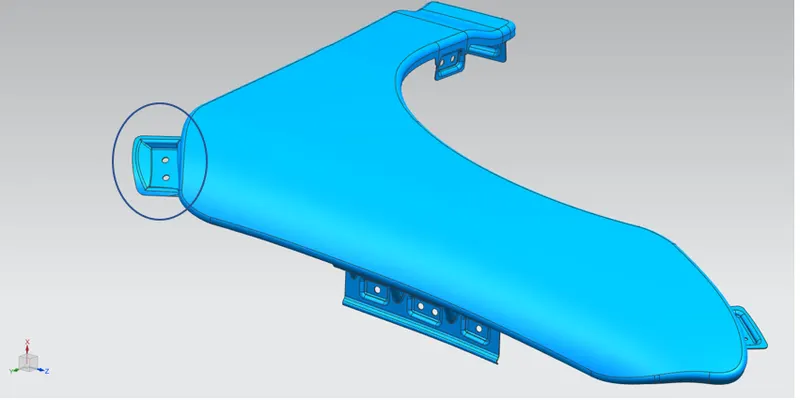
2] A-Pillar Mounting:-
Mounting region for the A-pillar frame of the chasis so it is neatly & rigidly attached to the vehicle body parts.
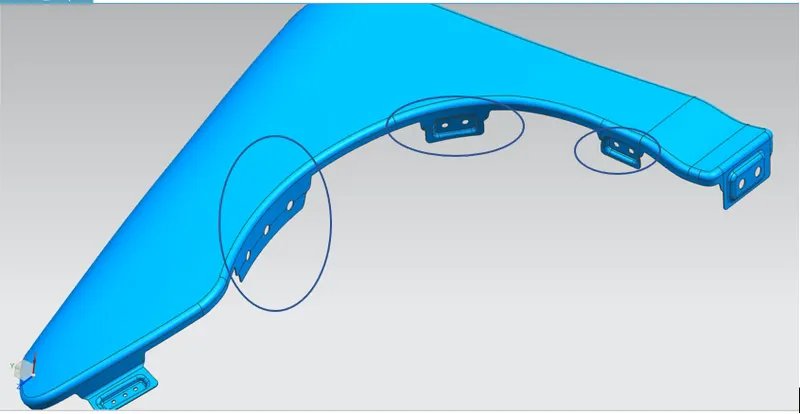
3] Splash Cover Mounting:-
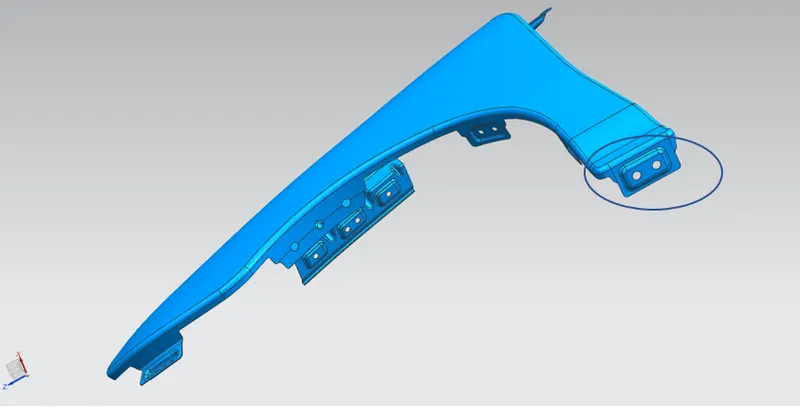
4] Sill Mounting:-
5] Body Mounting:-
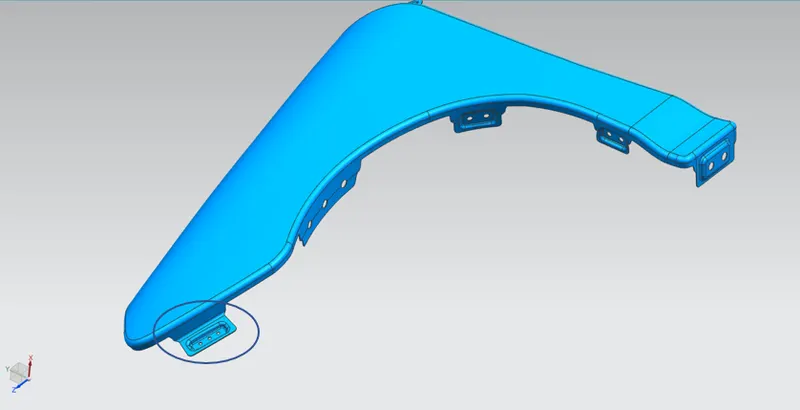
6] Indicator Mounting region:-
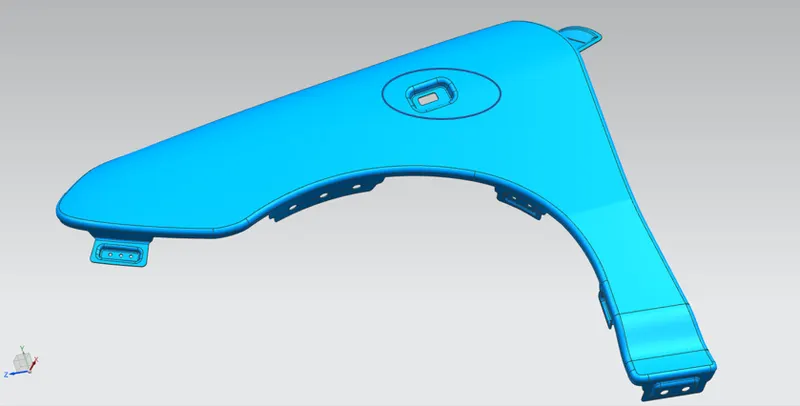
5. CONCLUSION:-
In this way we can conclude that the design of a vehicle fender is completed using the all rules & regulations of safety, manufacturability, workability in Siemens NX CAD software.