Fender Design
FENDER
It is an aesthetic part of the automobile that frames the wheel well. Its Primary purpose is to prevent sand, mud, rocks, liquids and other road spray from being thrown into the air by rotating tires. It also helps those sand and other particles from entering engine compartment. Fenders are basically present to prevent any injuries to pedestrians and to contain the motion of particles that are thrown by tires.
TYPES OF FENDERS
- Full Bumper Type
- Half Bumper Type
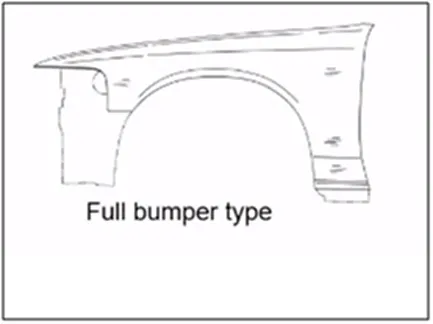
FULL BUMPER TYPE
Full Bumper Type design was used in the early models of the Car. As we can see in the image the fender is extending till headlamp region. By only covering the front headlamps in relation to the bumper area, they significantly increase the steel weight. With this type of fender, there is a lot of wastage/scrape in the blank.
HALF BUMPER TYPE
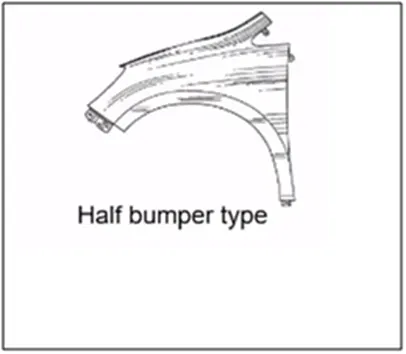
The current design, known as the Half Bumper Type, is utilized in cars today. This design is being used by OEMs to cut down on scrap. Full bumper types produce more scrap than half bumper types, which allows us to produce two fenders by enlarging the blank. The body of the automobile will be significantly lighter as a result, improving fuel efficiency. Additionally, this kind of fenders are produced at a low cost, saving enormous amounts of money.
DESIGN CONSIDERATIONS
The front fender has basically five mounting positions with respect to the other components. The mounting positions are as follows:
- Drip Area Mounting.
- A-Pillar Mounting.
- Sill Mounting.
- Bumper Mounting.
- Baffle Mounting.
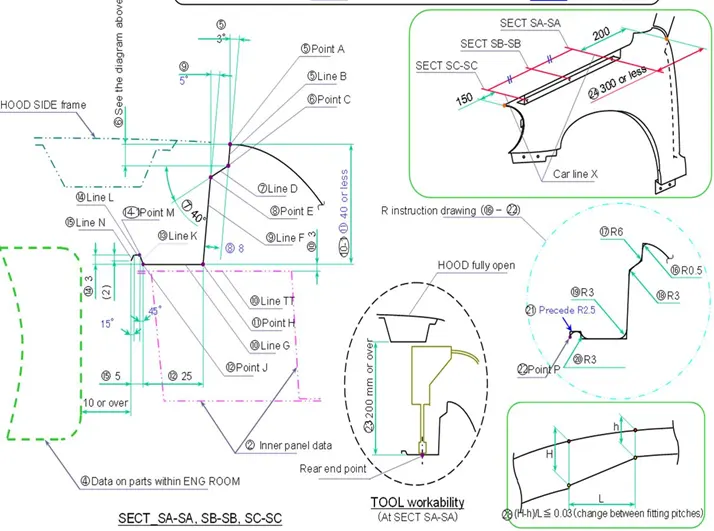
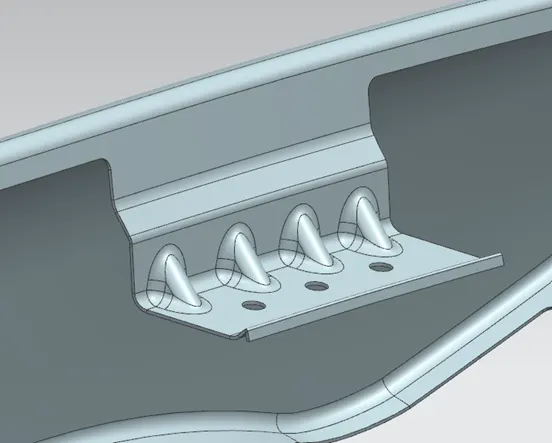
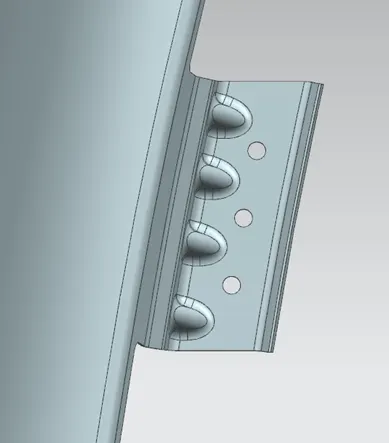
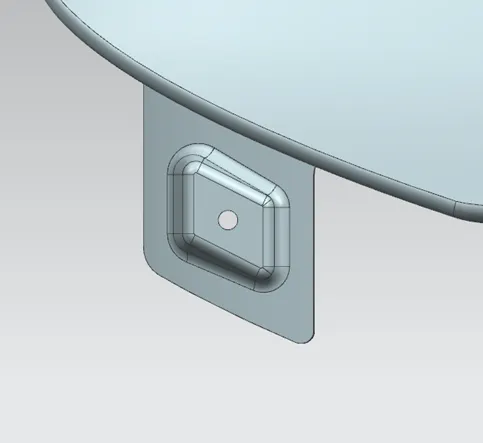
For the creation of the Drip Area Mounting, the given Master Section is followed, and the other mounting points are created by assuming appropriate positions with the respected components. Also, minimum distance of 6mm is maintained between the embosses and blend radius as 3mm. Sufficient clearance is also given between the features in order to achieve easy mounting during assembly.
1. Drip Area Mounting
To create a drip area for the Fender, front clearance and rear clearance should be taken into account. We should leave at least 200mm at the rate end because the Cowal will be mounted there. We should leave 150 mm at the front end since a headlight will be mounted there. There is no fixed length of drip area that depends on the fender length. If the Cowal portion is less than 200 mm, we can reduce the rear clearance further.
2. A-Pillar Mounting
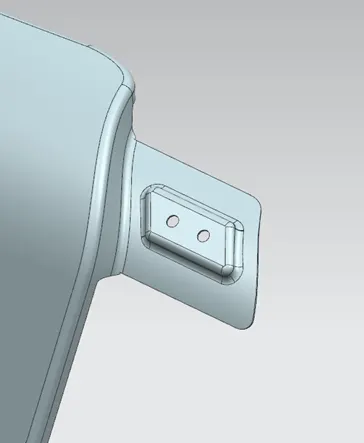
This mounting area is located near the ORVM (Outside Rear View Mirror) of the car, where it will be fastened.
3. Sill Mounting
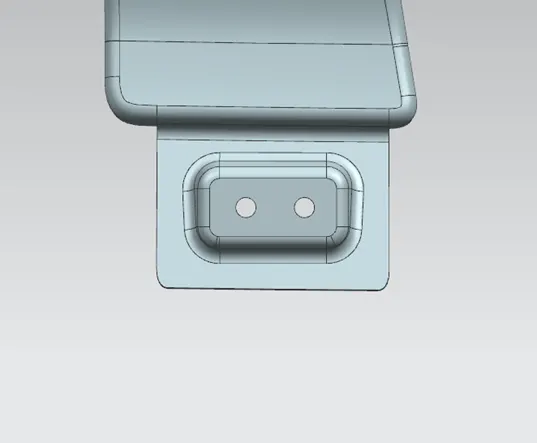
Sill mounting is created on the bottom portion of the fender to attach the sill.
4. Baffle Mounting
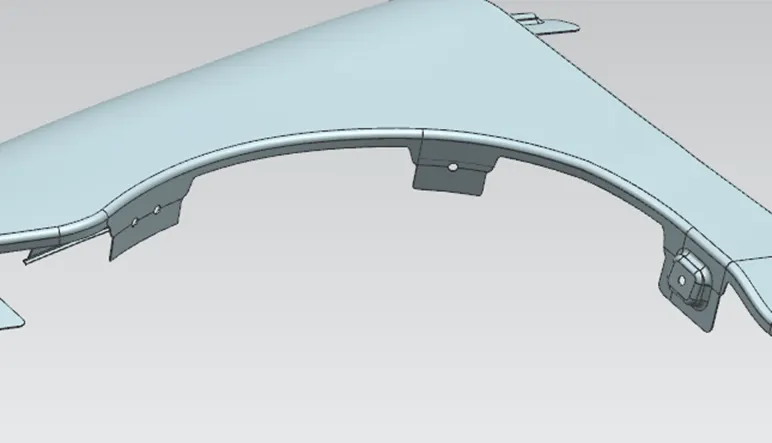
These mounting points are created for attaching plastic components i.e baffle which prevents chipping inside the engine compartment.
Bumper Mounting
This mounting point is created for attaching the bumper to the fender. It should have enough strength to hold the bumper steadily.
MANUFACTURING PROCESSES OF FENDER
Manufacturing of the fender takes place in 3 Stages namely, Deep Drawing, piercing and Hemming.
Deep Drawing
The deep drawing process is a forming process which occurs under a combination of tensile and compressive conditions. One of the most popular methods for sheet metal forming is deep drawing. In addition to being used in many other industries, it is applied in the automotive industry for the manufacturing of car body parts.
Piercing
Piercing is a shearing process in which raw metal is pierced with a machining tool, resulting in the creation of a circular or other shaped hole. As the raw metal is pierced, the metal from the newly created hole is considered scrap.
Hemming
Hemming is a forming operation in which the edges of the sheet are folded or folded over another part in order to achieve a tight fit. Normally hemming operations are used to connect parts together, to improve the appearance of a part and to reinforce part edges. The accuracy of the hemming operation is very important since it affects the appearance of the surface and surface quality.
CONCLUSION
The front fender is designed according to the given master section as per Standards.