Fender Design
- What is a Fender?
A Fender is a requirements for all automobiles. These fenders are there for more important reasons & not just for coverings. What is a fender of car.
A Fender is a part of a car or other vehicles that covers the wheel area well. The "Fender" typically refers to the front panel that covers wheel that also include the roof pillar. The "bumper" is the front & rear end of a Vehicle to absorb impact in a minor collision.
The below images shows a fender & quarter panel of a car. The top half of the image is the fender or "front fender". The bottom half of the image shows the quarter panel or "rear fender".
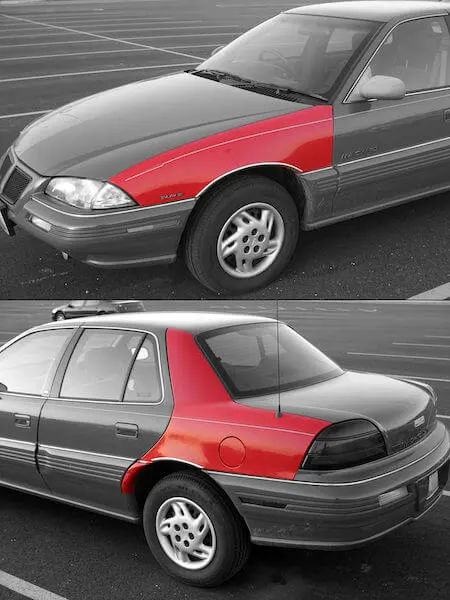
Front Fender & Rear Fender (Quarter Panel)
The Fender car part is the body kit or body part installed on the left & right sides of the vehicle. Manufacturers usually attach fenders to the wheel arches. There are differents reasons why they are a requirement in vehicle. One obvious reason is to improve the asthetics of the vehicle.
Fenders also enhance the aerodynamics of the vehicle. They also prevent mud, sand, rock, debris, etc. being thrown in the air while driving the vehicle.
- Functions of a Fender:-
The main function of the fender on a car is they shield the wheels & they protect the passengers, the pedestrians & other vehicles from stones, mud, liquid & other debris that can fly in the air because of the speeding rotating wheels while the car is running.
Fenders should have a firm & rigid material
To provide this kind of protection, fenders should have rigid type of material such as steel. If you use your car everyday on road, it will experience a continuous "attack" of all kind of debris. In this case you"ll end up a damaged fender after a while.
Mud and other sticky dirt can also adhere to the smooth rubber surface of the tires. Other loose debris, such as stones, can temporarily embed themselves in tire treads or grooves as the tire rotates while driving your car.
As you drive your car, these foreign materials will be ejected from the tire surface and tread at high velocity as the tire imparts kinetic energy to them. While your car is running, the tires rotate forward and upward.
These rotary motions, especially at high speeds, will throw these foreign objects into the air. They may fly into the path of pedestrians on the roadside or at the front, or other vehicles on the road or the inner sections and components of your car.
Housings for wheels
So, the primary purpose of the fender car part is to keep road debris of all kinds from being thrown around by the tires of your car. You can say that fenders are housings for wheels that contain or control road debris. If there is nothing that covers your wheels, road debris will always fly around when you drive your car.
This is why vehicles with big oversized tires are required by law to install not just fenders but fender flares. Fender flares are body kits that you can attach over the fenders of your vehicle.
- Manufacturing Process of a car Fender:
The manufacturing process includes the following steps that firstly, unfolding & shearing are carried out on a plate, wherein a proper cold roll specification is selected at first, a cold roll is unfolded, & then the unfolded cold roll is sheared to an iron plate of the corresponding size according to production material specifications.
Secondly oil pressing & punching are carried out, wherein the iron plate is extended at first, then side shearing & punching are conducted on the iron plate, folding & shaping are carried out on the iron plate, & finally reshaping is carried out on the iron plate.
Thirdly, small first parts of the fender are machined, wherein first of all, the iron plate is punched to a needed outer contour blank, then the iron plate completing the outer contour blank is further shaped, & the iron plate is punched at last.
Fourthly, installation & welding of a metal plate are conducted.
--------------------------------------------------------------------------------------------------------------------------------------------------------------------
Fender Designing Process
Step -1: Offset the edge to 5mm (approx) using "offset in face" command. As shown in fig. 1.
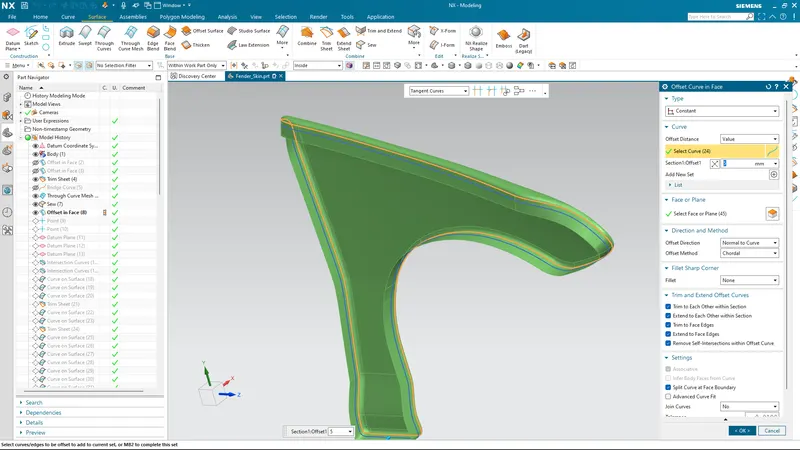
Fig. 1
Step -2: Create the boundary for the mounting flanges like sill mount, A-pillar mount, Bumper mount & Baffle mount. Use the "curve on surface" command to create the desired shape for the cutout. Then use the trim surface command to trim the undesired surface. As shown in fig. 2
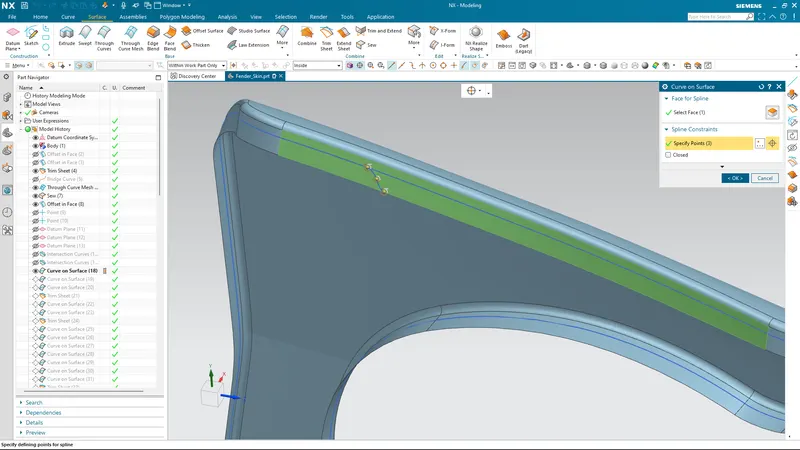
Fig. 2
Step -3: To mount the fender to the car we need to create the flanges. After creating the curves for the flanges. we use the "Law extension" command to create the area for the sill mount. As shown in fig. 3.
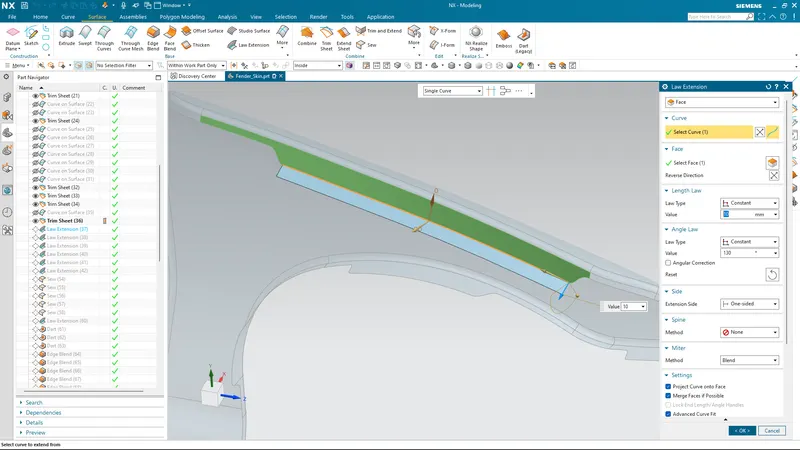
Fig. 3
Step -4: Sew the 2 sheets together for creating the dart 'for strength'. As shown in fig. 4.
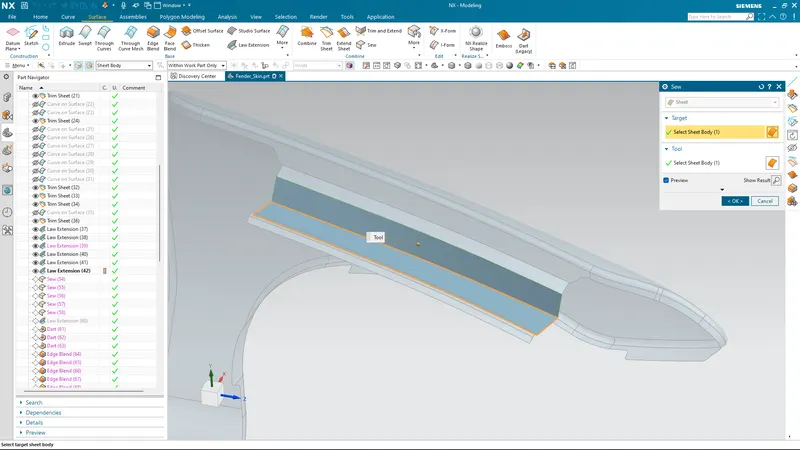
Fig. 4
Step -5: Create the dart to provide strength to the sheet body, as the flange is long in the dimension. Choose the dart legacy command, choose the first face then second, after that specify the dart position on the edge & provide the dart dimensions according to the need. As shown in fig. 5.
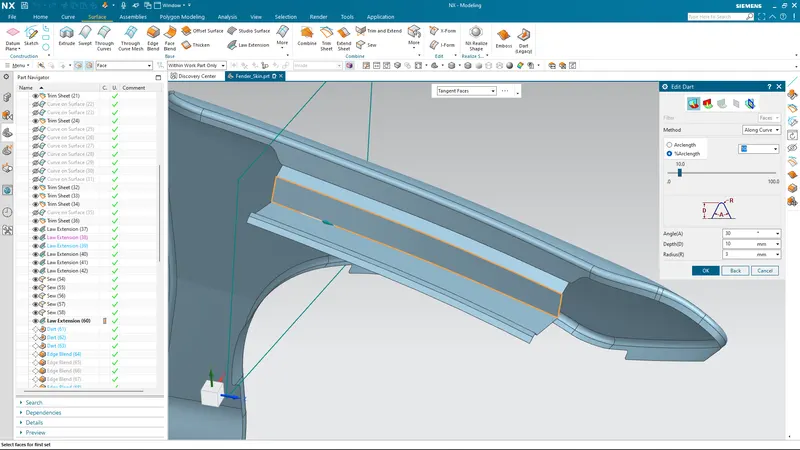
Fig. 5
Step -6: Create the embosses for fixing the fender by mechanical fasteners. The emboss surface should be flat to the mounting suface for better grip & hold. If the emboss face is not flat to the mounting surface it won't hold properly.
Create the plane using 3 point of the flange surface, specify the offset distance from the surface on which you want to create the emboss. Do apply edge blend on every sharp edge. As shown in fig. 6.
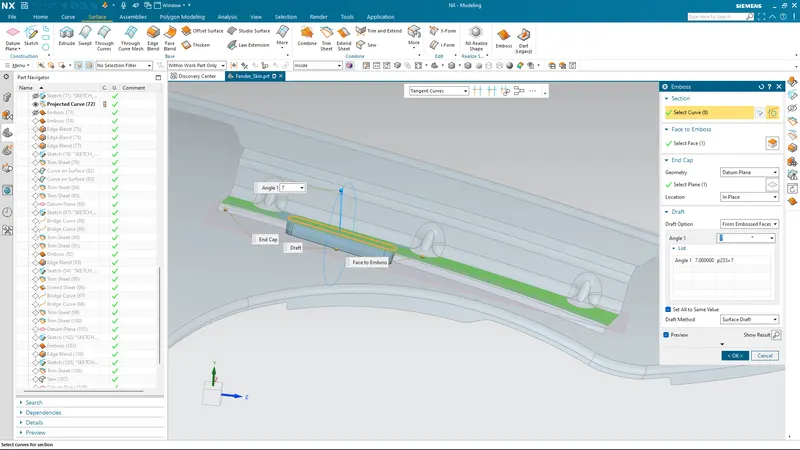
Fig. -6
Step -7: For Baffle mount create the holes for mounting plastic parts. A special type of rivets are use to mount the "Baffle" (used to prevent splashing mud, water, debris, etc.). It's upto the engineer that how many & how are the holes are to by provide for the baffle mount. As shown in fig. 7.
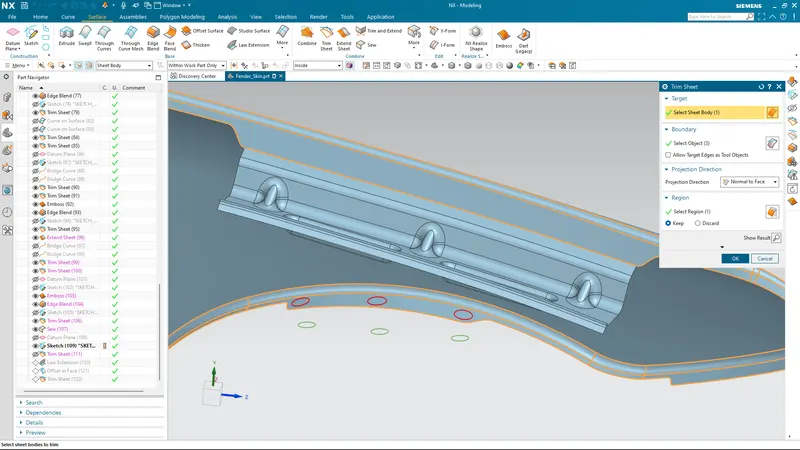
Fig -7
The Method are same for all the mounting areas. One should design the fender in such a way that it matches the design considerations & easy to manufacture the parts.