Fender Design
FENDER DESIGN
The fenders of a car are the parts of the body over the wheels.
Early automobile fenders set over the wheels to prevent mud, sand and dust being thrown on to the body and the occupants.Fenders typically became a more integral part of overall auto bodies by the mid-1930s. In contrast to the slab-sided cars, the Volkswagen Beetle had real bolt-on fenders over both its front and rear wheels.
Sticky materials, such as mud, may adhere to the smooth outer tire surface, while smooth loose objects, such as stones, can become temporarily embedded in the tread grooves as the tire rolls over the ground. These materials can be ejected from the surface of the tire at high velocity as the tire imparts kinetic energy to the attached objects. For a vehicle moving forward, the top of the tire is rotating upward and forward, and can throw objects into the air at other vehicles or pedestrians in front of the vehicle.
FENDERS TYPE:
Hollow cylindrical (diametrically loaded) fenders
Cylindrical floating (diametrically loaded) fenders
V-shaped fenders
Buckling column fenders
Rectangular or square section solid strips and D bore fenders
Fender piles
Floating pneumatic fenders
Foam filled floating fenders
Fixed pneumatic fenders
EV vehicles Fender with charging port
Sports car Fender : Aerodynamic shape for high performance design
Truck Fender : Truck use for heavy load carrier with strong support for heavy bump & off road driving
Fender advantage
- To add styling to a stock car
- To comply with the law if the client has huge tires
- To hide rust or body dents around the wheel well
- To replace damaged flares on the car fenders
Europe standard for fender design
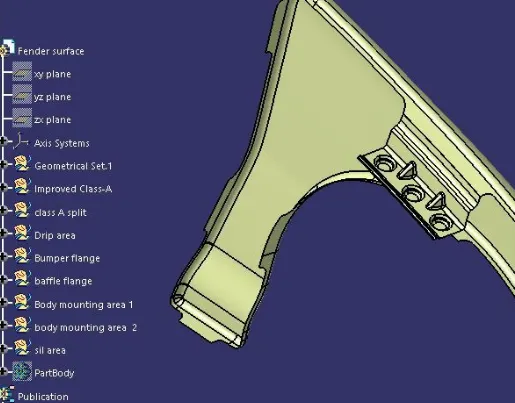
CATIA V5 Design
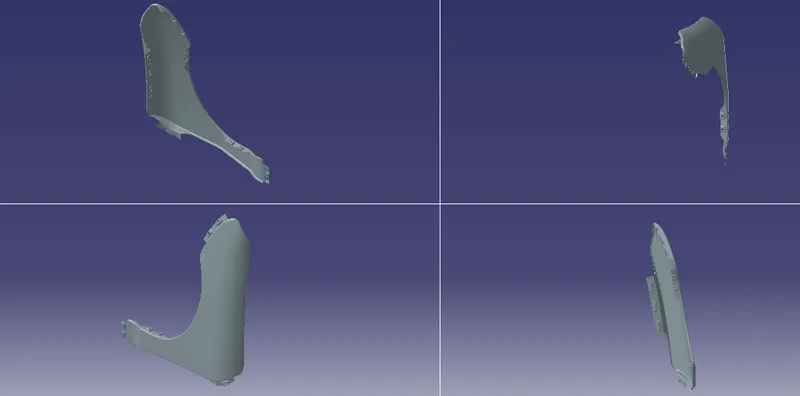
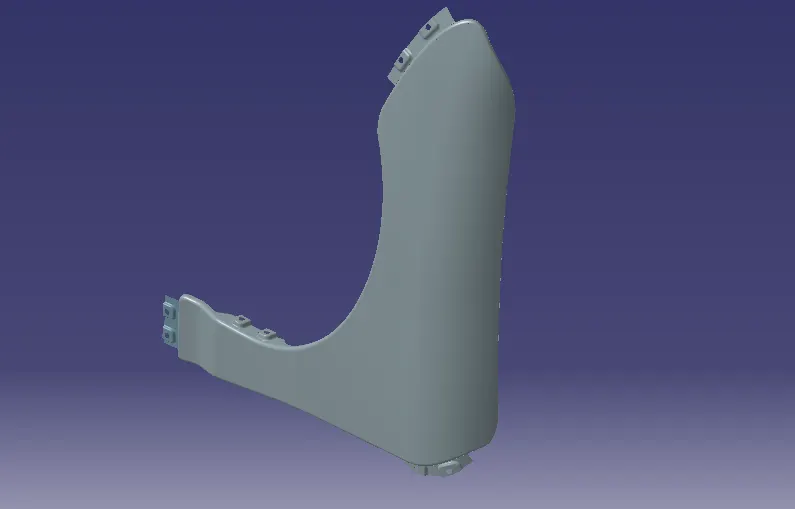
ISOMETRIC VIEW OF FENDER
TRIMATRIC VIEW OF PRODUCT
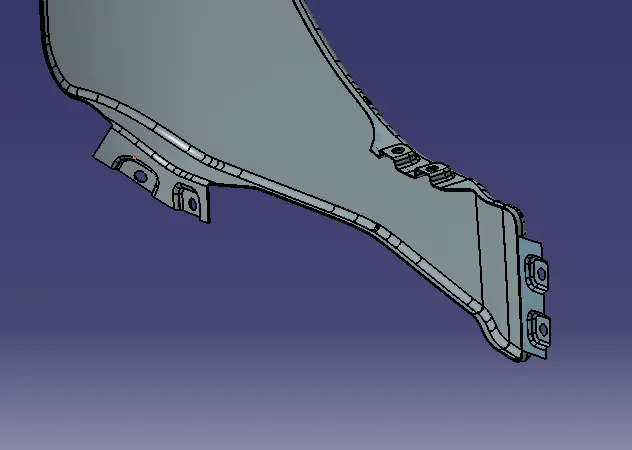
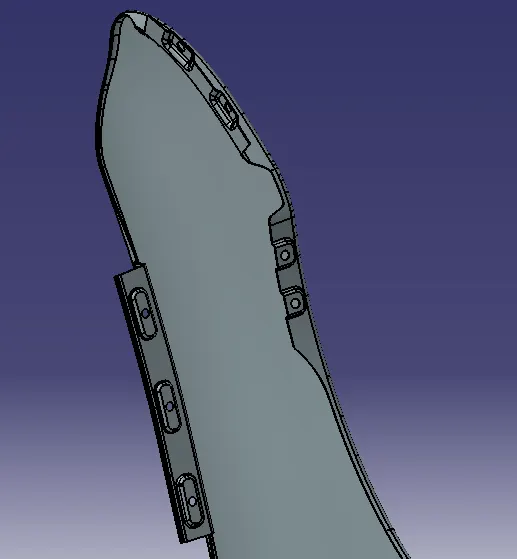
BACK PART Assembly bolting area PART
FRONT PART Assembly bolting area PART
Conclusion :
The Fender is designed from the input data and thickness value is applied to that by the design rules.