Door Trim Lower
Door trim lower:
REPORT:
Tooling Axis creation and Draft Analysis on a given Class-A Surface – DOOR TRIM LOWER
OBJECTIVE
The objective of the project is to carry out a Draft Analysis by creating the Tooling Direction for the given Class-A surface.
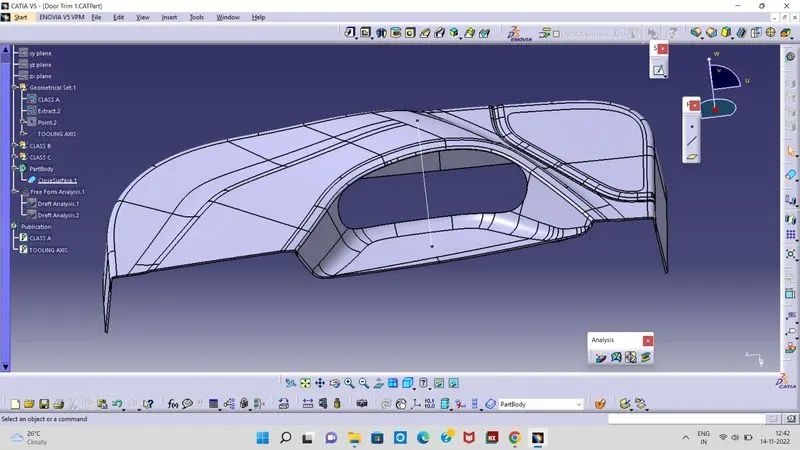
- First, the given styling surface was imported into CATIA and checked for irregularities by using Join, Boundary and Disassemble option.
- By using the boundary option the boundary of the Surface was created and the centre point was marked.
- Then a dummy tooling axis was created with the normal to the surface and the point created on the surface.
PUBLICATIONS
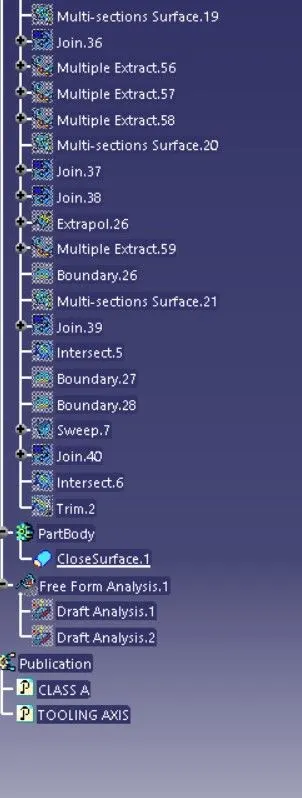
The tooling axis and class-A surface were published for further easy reference, from Tools – Publications.
PERFORMING DRAFT ANALYSIS
- For plastic parts, the nominal angle value for draft analysis is 3 degree but even a 0.5-degree angle can be created for sub-assemblies like ribs and slots. (For Sheet Metal 7 degree angle is the nominal value)
- Insert – Analysis – Feature Draft Analysis
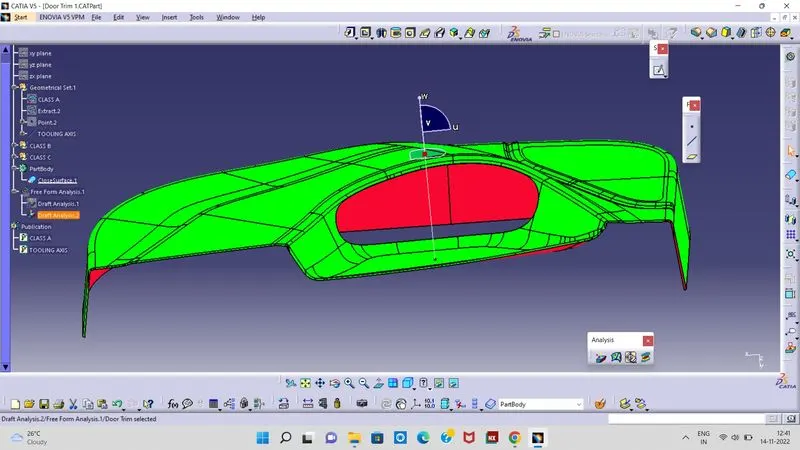
- Draft analysis was carried out by pulling the compass to the tooling axis and an inverse draft axis was carried out if required.
- After setting the compass over the tooling axis the compass must be locked to a specific direction.
- If the surface was in green then the model passes or else further operations need to be carried out.
- By using full analysis mode detailed analysis can be carried out for complicated assemblies.
- By using the analysis under the running point complicated parts and surface were checked in detail.
CONCLUSION
Thus the draft analysis for door trim was carried out by creating the perfect tooling direction and the given class-A surface was ready to move on for further operations.