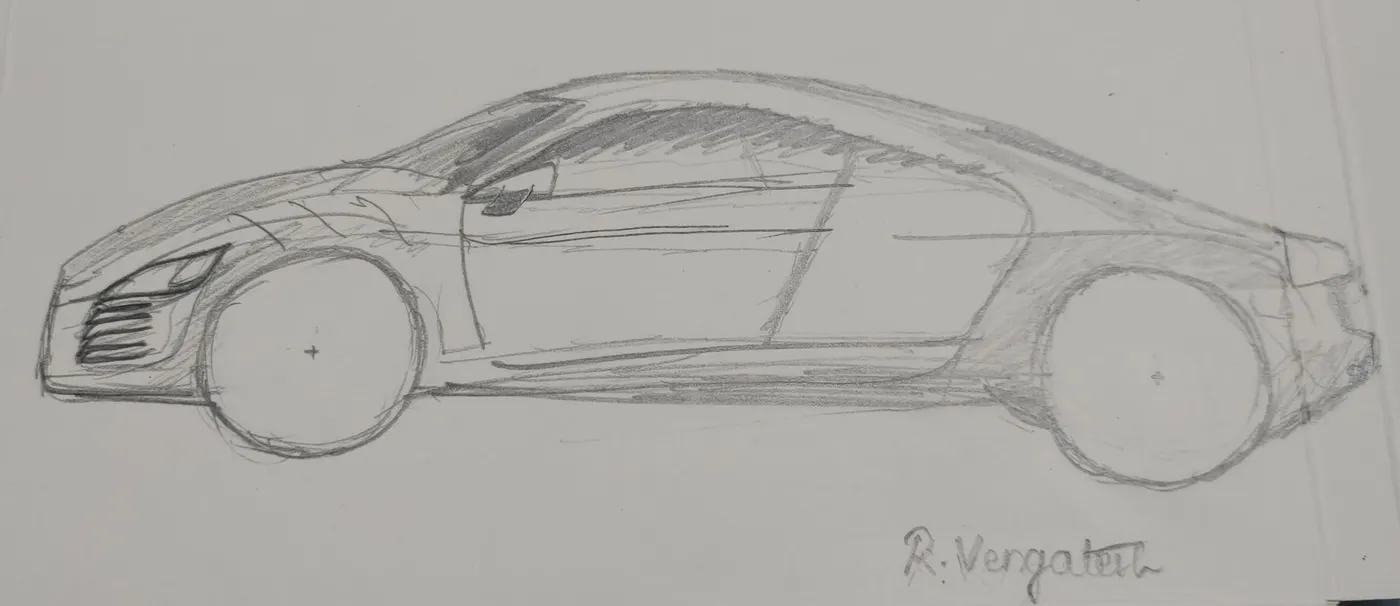
Design Overview In Automotive Industry - Challenge 1
1) Product Life Cycle:
Stage 1: Concept Sketch
A concept sketch helps to convey the look, feel, and mood of a design idea. It is used to capture and convey the overall design vision of a project before anything goes into production.
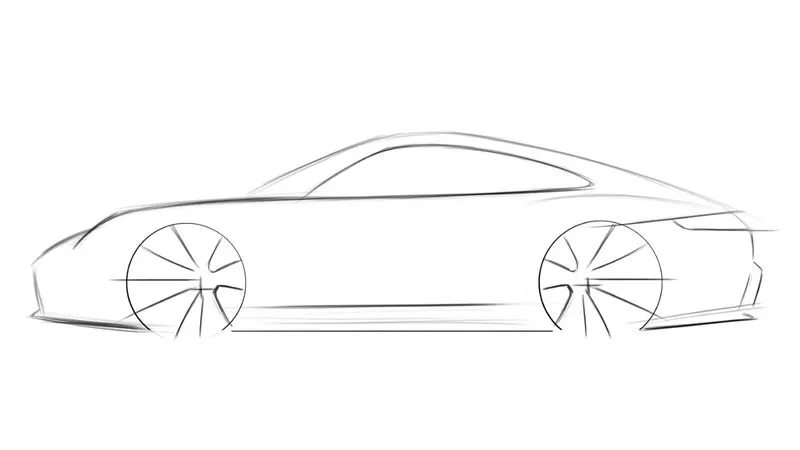
Stage 2: Styling Class-A
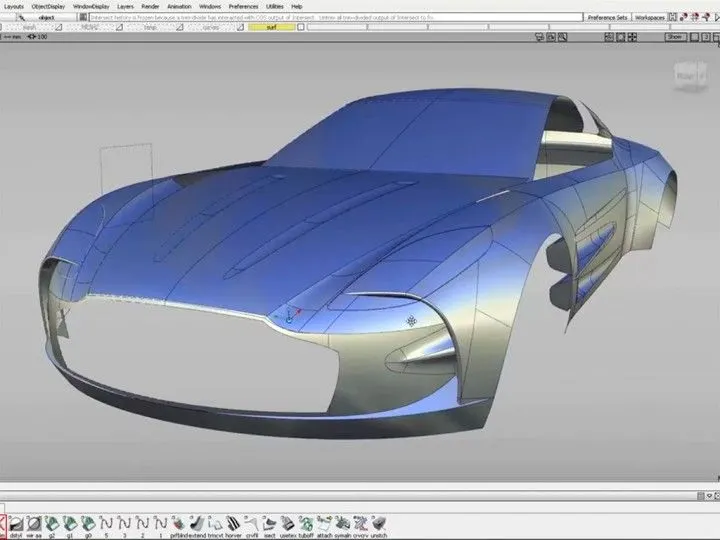
Class-A is a term used specifically in automotive design. It describes the final production surface data for the aesthetic parts of the car. Class-A represents the ‘craftwork’ end of the design process. Creating the main surface shapes to describe the vehicle is the primary design activity.
Stage 3: Feasibility Check
Feasibility check enables the quick and easy evaluation of part and process feasibility. Even with the first design of part geometry, fundamental process capability should be checked for future series production. Feedback on feasibility which is delivered in an early, timely, reliable, and comprehensive manner is crucial for balanced part design. The ever-increasing demands on costs, quality, and time must be taken into account. Problems which arise during the manufacturing of parts which have already been released for production are very expensive to correct- in terms of both time and cost. The feasibility check makes it possible to not only reduce development and manufacturing costs but also to shorten the time to market.
Stage 4: Concept Validation
Concept validation helps you assess the viability of your product ideas before they enter the real world. Whether you’re at the early product development stage or want to rejig your existing product concept for a specific target audience, concept validation is the best way to accurately predict the performance of your new idea in the market.
Stage 5: New Product Design
Concepts and ideas are obtained from the customers as feedback and sent as input to the feasibility check team and the concept will be validated. The task of a new product engineer would be to develop the concept. Ensure the component is designed for manufacturing and assembly. Ensure the component follows tooling design rules and design the components which can be manufactured.
Stage 6: Development
The basis for the successful development of a product is the product development cycle. This includes all core processes and phases, beginning with pre-development up to mass production. Acts as a bridge between the Design team and the Manufacturing team. They work with the designer, tool maker, mold expert and come up with the Proto Built.
Stage 7: Proto Built
Before an automotive part goes into production, a prototype must be developed for manufacturing validation. Prototypes play vital roles throughout the ongoing process of developing automotive parts and assemblies. They are constantly refined until a consensus is reached regarding both the product design and the manufacturing methods that will be used to create it. The prototyping process is important because it allows the manufacturers to test their designs before they are mass-produced. This ensures that the cars meet all safety standards and perform well in different driving conditions.
Stage 8: Design Validation
Design validation is a testing process that aims to ensure that the design of a product or system is really working in life, and parallel fulfills the customer's needs by meeting the specified requirements. So basically design validation means physical testing activities must be performed on prototypes or concepts. It is highly mandatory in safety-relevant sectors(e.g. automotive, aerospace, etc.).Design validation must be performed, finished, and evaluated before product launch.
Stage 9: Pilot Production
Prototypes are useful in confirming the details of the product to manufacture. However, they are usually not made with the same components, methods, equipment, people, etc. as mass production. It means prototypes alone are insufficient for defining and testing the manufacturing process. This is where the pilot production becomes very important and useful.
There are always risks when launching the production of a new product. Defining the process is the next phase, before mass production. This is why a short, limited production(pilot production) is made to test the line and assure that any major kinks are ironed out. We do not skip pilot production as they help assure that the production line and its processes work properly and can deliver products correctly once real mass production begins.
Stage 10: Mass Production
Mass production is defined as the manufacturing of goods on a large scale without compromising on quality. Compared to other methods, bulk manufacturing can produce more units per day at lower costs. It utilizes the benefits of economies of scale. Assembly lines used in the automobile industry is a very good example of mass production.
2) Stages that need the involvement of the Automotive Designer:
> Feasibility check
> Concept Validation
> New Product Design
3) Software used for Class-A Design:
The Class-A modeling process typically starts with a fully developed design, either as a scanned clay model or an Alias model. Because the design isn't changing, the modeler has the time to build surfaces to the highest quality standards, ready for production.
AUTODESK ALIAS is the software majorly used by top OEMs.
4) Feasibility Check:
- Feasibility check enables the quick and easy evaluation of part and process feasibility.
- Even with the first design of part geometry, fundamental process capability should be checked for future series production.
- Feedback on feasibility which is delivered in an early, timely, reliable and comprehensive manner is crucial for balanced part design.
- The ever-increasing demands on costs, quality, and time must be taken into account.
- Problems which arise during the manufacturing of parts which have already been released for production are very expensive to correct- in terms of both time and cost.
- The feasibility check makes it possible to not only reduce development and manufacturing costs but also to shorten the time to market.
Example: A feasibility study on the Implementation of Inherent Safety:
It is now generally recognized that in order to make significant advances in accident prevention, the focus of industrial firms must shift from assessing the risks of existing production and manufacturing systems to discovering technological alternatives, i.e. from the identification of problems to the identification of solutions.
Inherent Safety is increasingly recognized as an excellent concept for designing chemical plants. It is, however, often regarded as for engineers only. In this research, we have explored ways to overcome the gap between inherent safety and safety management.
We feel the inherent safety concept can also be used in existing facilities, and the use of the concept is still too limited because it is seen as only an engineering function and because of both conceptual and institutional barriers for the adoption of Inherently Safer Technologies. Inspired by the successful development and dissemination of Cleaner Production or Pollution Prevention we undertook a feasibility study for a similar development towards Inherently Safer Production.
5) Stages of the Design Life Cycle:
Stage 1: Concept Sketch
Concept sketch helps to convey the look, feel, and mood of a design idea. It is used to capture and convey the overall design vision of a project before anything goes into production.
Stage 2: Class-A Creation
Class-A is a term used specifically in automotive design. It describes the final production surface data for the aesthetic parts of the car. Class-A represents the ‘craftwork’ end of the design process. Creating the main surface shapes to describe the vehicle is the primary design activity.
Stage 3: Clay Modeling:
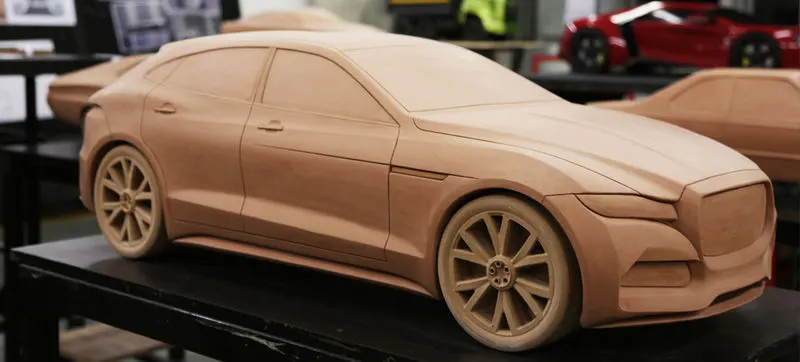
Automotive clay modeling help translates a designer’s vision into a tangible reality. Clay modeling is still commonly used by OEMs in the automotive and product design industry. This is a way to pre-visualize concepts which helps in decision-making before taking the products further for manufacturing.
Stage 4: NPD CAD
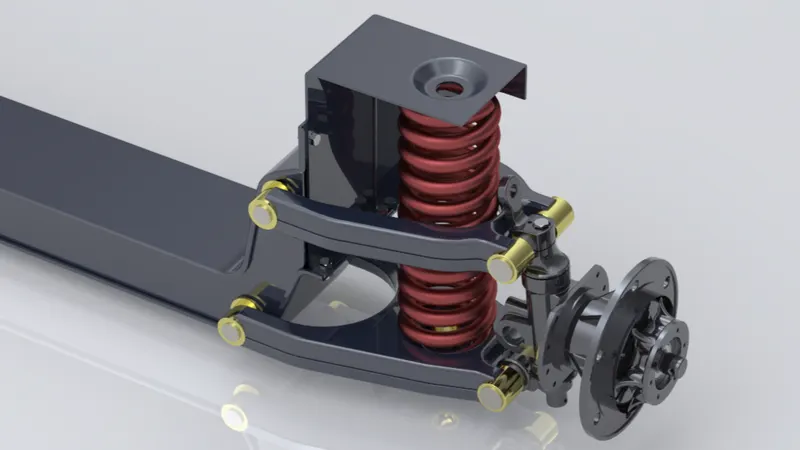
Computer-Aided Design (CAD) is an effective software tool for designing and modeling products in the automotive industry. The software has helped industries with ease and precision to revolutionize their work processes and to improve their product designs for business growth.
Uses of CAD for the automotive industry include the process of creating, analyzing, modifying, optimizing, and drafting product data, so as to achieve its design goal efficiently and effectively. We take input data for use of graphics product design, and product model and drive the peripherals for product presentation.
CAD is extensively applied in automotive engineering processes and 3D designs. It offers a widespread working field for geometry creation as well as for the linkage of numerous simulation procedures, customer demands, and legislation tasks.
CAD designing and modeling are broadly segmented into the passenger vehicle industry and commercial vehicle industry. In the passenger vehicle industry, it is further segmented into two/three-wheelers and four-wheelers. Whereas the commercial vehicle industry is segmented into trucks, vans, buses, and trailers. We used CAD to create, modify, analyze, and optimize product design, drive innovation, slash costs and get incredible new products.
6) Concurrent Engineering
Concurrent engineering, also known as simultaneous engineering, is a method of designing and developing products, in which the different stages run simultaneously, rather than consecutively. It decreases product development time and also the time to market, leading to improved productivity and reduced costs.
The notable business benefits of concurrent engineering make it a compelling strategy to adopt. Introducing concurrent engineering can lead to:
- Competitive Advantage: reduction in time to market means that businesses gain an edge over their competitors.
- Enhanced Productivity: earlier discoveries of design problems means potential issues can be corrected soon, rather than at a later stage in the development process.
- Decrease Design and Development Time: make products that match their customer’s needs, in less time and at a reduced cost.
7) Clay Modeling:
A clay modeling is a 3D sculpture that allows the designer to search for the desired surfaces directly on the model. Using sketches, tapes, and CAD information, the modeler and the designer are working together in order to create a new design.
Significance:
- Automotive clay modeling help translates a designer’s vision into a tangible reality.
- Clay modeling is still commonly used by OEMs in the automotive and product design industry. This is a way to pre-visualize concepts which helps in decision-making before taking the products further for manufacturing.
8) Functional requirement and functional reliability:
Functional Requirement: Provide a required functionality or service of technical automotive systems. Functional requirements are qualitative. An automotive function is generated through mechanical or electric/electronic artifacts.
Example: In an Automotive ADAS project, a surround-view system functional requirement could be “Rear Camera should detect a threat or object”.
Functional Reliability: The complex physical systems developed for automotive and transportation combine software, electrical-electronics, and mechanical components. These exponentially complex systems make it difficult to identify and manage potential risks and hazards.
OEMs need to manage risk and hazards from hundreds of physical systems on a vehicle, across organizational domains (chassis, body, powertrain, etc.), each with high cross-dependencies and multiple failure modes. In addition, OEMs and major suppliers are shifting design responsibility to partners and lower-tier suppliers while they focus on systems engineering and integration. OEMs must be able to effectively use design and failure data generated by partners and suppliers as the basis for analyzing overall product reliability and diagnostic capabilities.
9) Design for Manufacturing and Design for Assembly:
DFMA is a combination of two methodologies, Design for Manufacturing (DFM) and Design for Assembly (DFA). This combination enables a product design to be efficiently manufactured and easily assembled with minimum labor cost. Through the use of DFM/DFA, a company can prevent, detect, quantify and eliminate waste and manufacturing inefficiency within a product design. With DFM/DFA, the Design and Manufacturing Engineers work together as a team in developing the product’s manufacturing and assembly methods simultaneously with the design. Conventionally, the design engineer designs the product and then hands the drawings to manufacturing who then determine the manufacturing and assembly processes.
Example: Minimizing Part Count
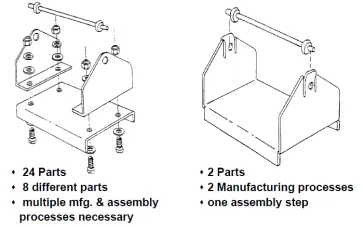
The total number of parts in a product is a key indicator of design quality. Good products actually have fewer parts and they usually end up being more durable and easier to manufacture and repair. Keeping your part inventory as low as possible will help to cut down on assembly time and therefore on assembly costs. Less different components will prevent confusion resulting in fewer assembly problems.
But keep in mind that overly complex components might also have an undesired effect on manufacturing costs. When implementing Design for Assembly principles, communication between designers and other departments is the key to determining the most cost-effective alternative.
10) Economic Factor of Design:
- The material should be the cheapest and the minimum amount of material being used in making each component part.
- Waste during production should be minimized.
- Product design should be such as it makes the best use of the factory layout and the project needs to complete with the available labor.
- Does the product design allow the maximum possible tolerance?
- The design needs to be simple, and keep the type, and variety of parts to a minimum.
- Right finish being used consistent with cost, endurance, and appearance requirements.
Example: Automatic Transmission
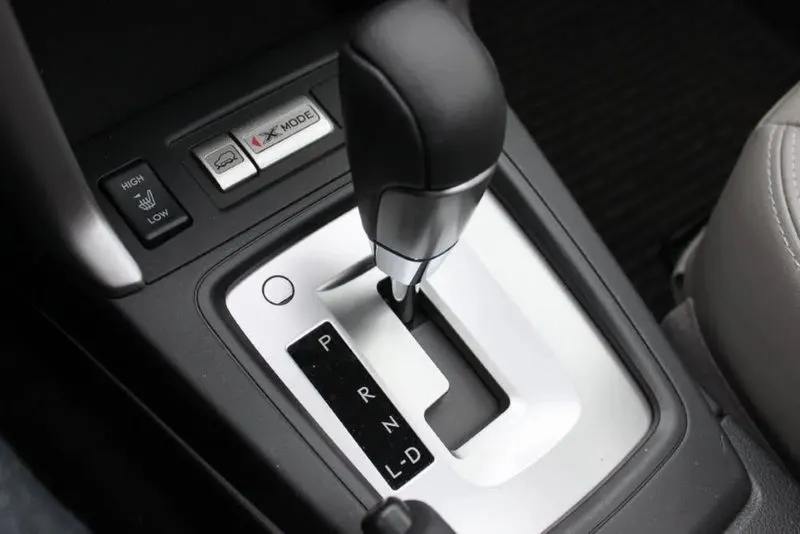
One of the most essential, yet most appreciated engineering designs. The design of the automatic transmission revolutionized fuel economy and implanted the foundation from which automatic transmissions vehicle would be designed and built.
Automotive Free Hand Sketch