Design of backdoor
AIM:
To Design the outer upper and lower panel, inner panel with the necessary reinforcements by following the design parameter for the given class A surface.
INTRODUCTION:
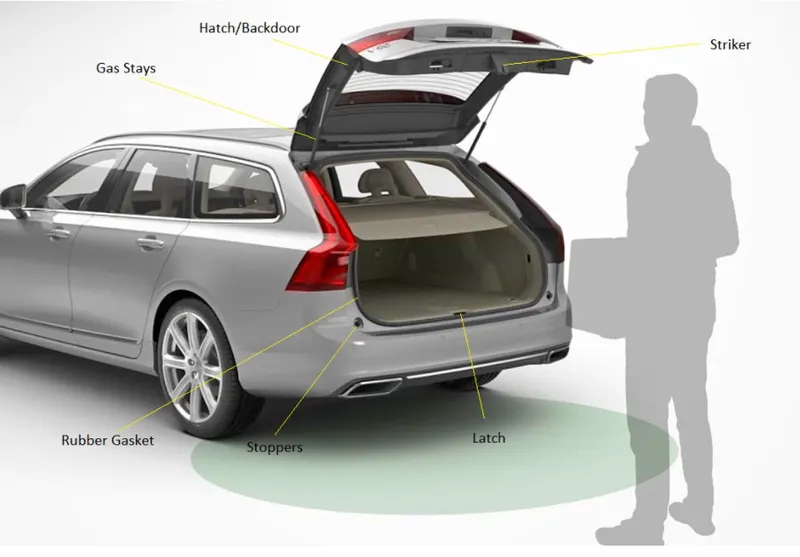
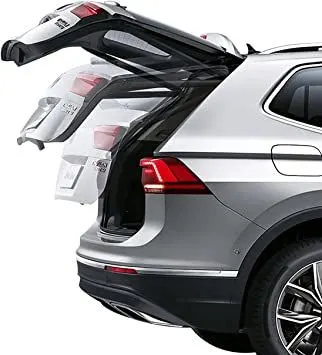
A door is a hinged part which is used for entry and exit of the vehicles. Back doors are one of the type doors of the vehicle which are located next to the passenger seat which provides access to the luggage compartment. In most of the cars, these back doors are operated with the help of gas stay which in turn reduces the effort required to lift open the door. Some luxury cars have powered backdoor which in turn is driven by an electric motor. This kind of system is also called a powered trunk lid system. Hatchback or station wagons are sold as 3 door or 5 door models. In this case, the rear hatch is classified as door this is because it enters the passenger compartment. The naming is mainly used in Europe countries. In case of safety, the back door designed should meet the safety requirement for the rear collision.
Types of the back door
Top-Mounted :
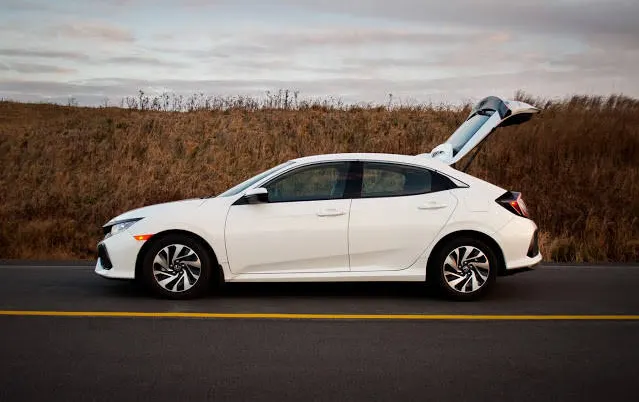
This type of back doors is used in a station wagon, pickup truck and some of the sport utility vehicles. Today’s modern cars use top-mounted tailgating systems which are both powered and also gas stay supported. These top mounted tailgates provide greater rear visibility compared to side-mounted or bar doors which have canter pillars in it.
Side Mounted Doors :
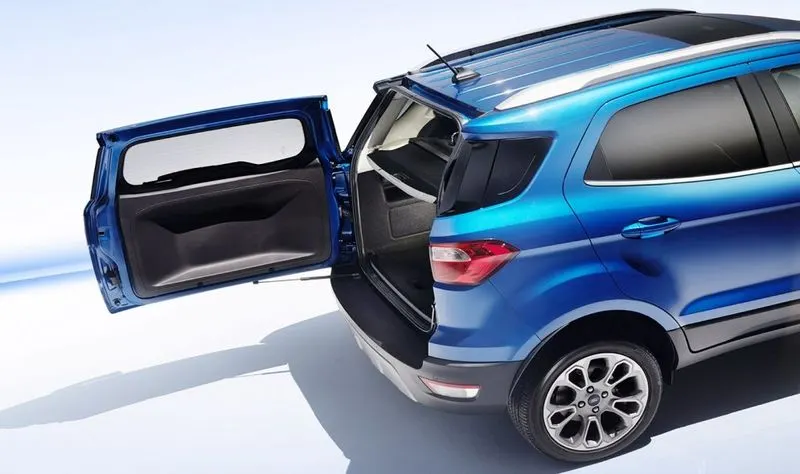
As the name signifies side-mounted doors are the one which is used in the van type MPVs, SUVs, pickup truck vehicles. These side-mounted doors or barn doors are a lot easier compared to top-mounted doors. These doors are generally smaller in size and can be easily accessed.
Types of support rod mechanisms for Rear Door:
Gas stays:
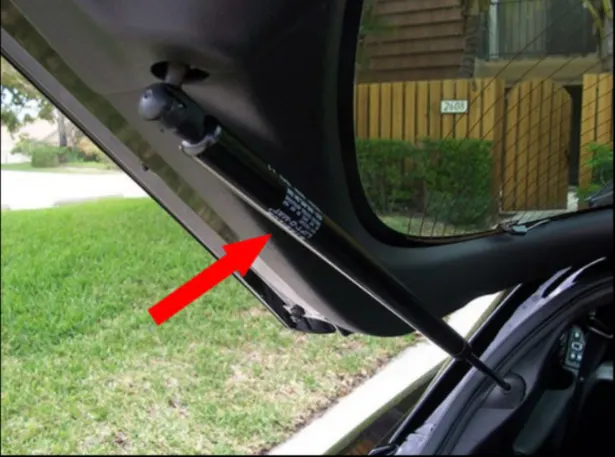
Gas stay types backdoor/liftgate/tailgate is an ideal and most commonly used tailgate mechanism from lower segment car to luxury car segment. The ideal components of tailgate consist of a hinge, door, gas stay and some rubber beadings for sealing of door.
Powered lift system:
Power trunk lid system is another sophisticated way of trunk/liftgate opening mechanism which is to automatically open and close of the trunk/liftgate and release of the latch by the touch of a button.
Design Cosiderations :
- Rear Visibility for safety and functionality.
- Support Structures like Hinge and Gasstay/ Power lifter.
- Rear Crash regulations.
- Boot Space.
- Mounts for wiper motor and lights.
- Strength criteria.
- Draft Analysis.
Material Selection:
The selection of material plays a major role in determining the overall weight of the back door. The common materials used are Steel & Aluminum. The density of Steel is higher than Aluminum thus adding more weight to the door. The material used in the manufacturing of the backdoor depends upon the budget of the car, most low cost vehicles use steel as it is cheaper compared to Aluminium. Another aspect to be noted is that, if casted Aluminum parts are used instead of deep drawn steel parts there is no need of reinforcements and the overall weight of the car is reduced by approximately 5-10kg thus increasing the performance of the vehicle. Also the draft angle for casted parts is around 3 degrees while for deep drawn parts is around 7-10 degrees which helps in increasing the luggage/ cabin space.
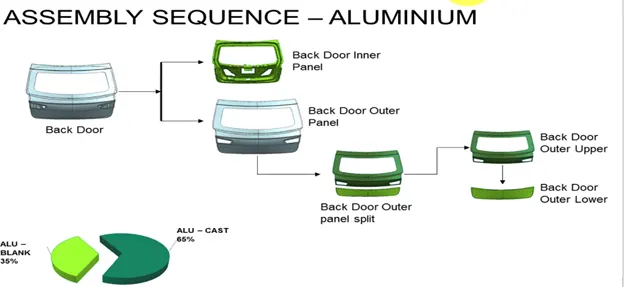
Fig. above shows possible no. of parts in aluminium backdoor
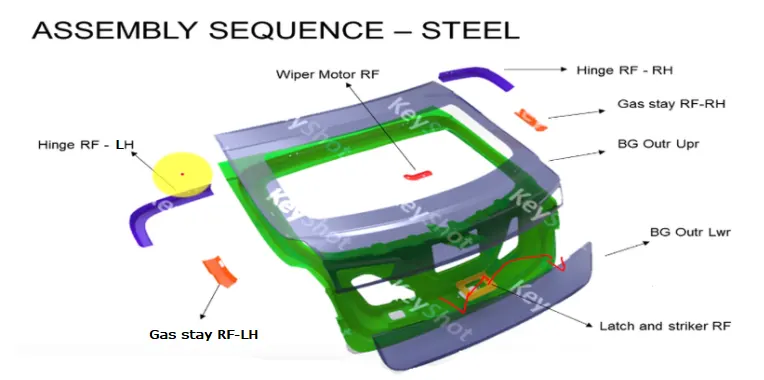
Fig. above shows possible no. of parts in Steel backdoor
The below table gives a comparative information about Steel and Aluminium.
| Aluminium | Steel | |
| Parts | Parts are casted | Parts are stamped |
| Reinforcements | Reinforcements can be neglected | Reinforcements are necessary |
| Thickness | Thickness can be varied | Thickness should be uniform |
| Weight | Lighter in weight | heavier in weight |
| Cost | Costly as compared to Steel | Cheap as compared to Aluminium |
| No. Of components | Less No. of components | More No. of components |
Manufacturing Process :
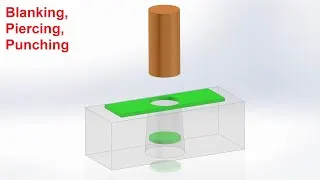
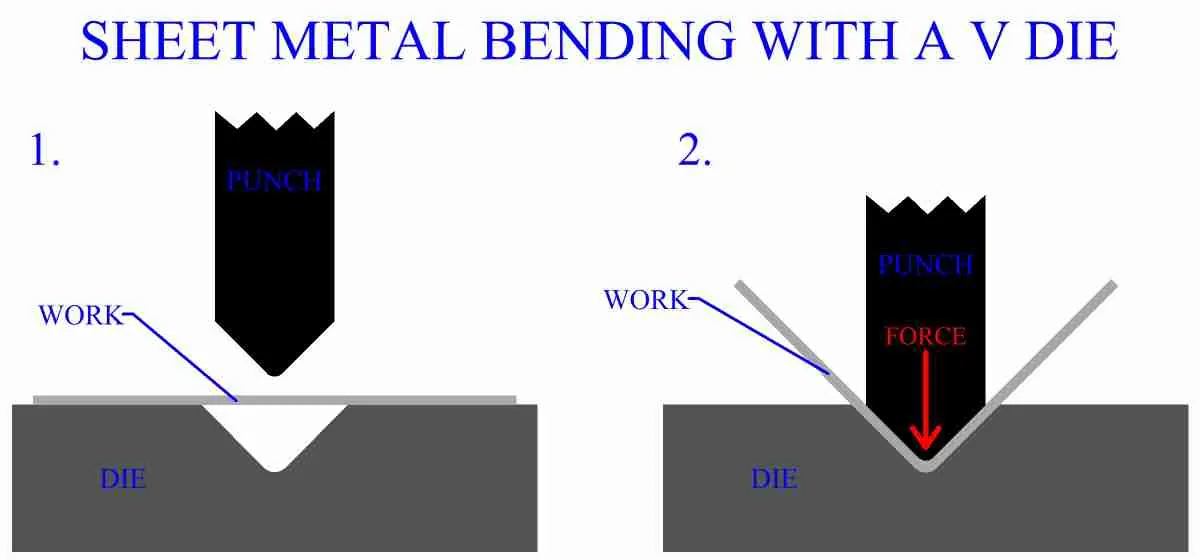
- As we know that backdoor is a BIW component that is basically manufactured using a metal forming process. There are different types of metal forming processes that are used for manufacturing automotive parts they are bending,piercing forming, stamping, forging, extruding, etc.
- From which the stamping is the methodology used to produce the door panels, basically, a die and punch are used in a press machine to stamped out the complete door panel in a single or multiple presses.
- This method is used because it does not require separate tools to manufacture the component also it is less time consuming and requires less material for the part which is to be produced with precision and accuracy.
Joining Process :
There are different joining processes that are used in the assembly of backdoor such as heming, spot welding and mastic sealants etc.
Hemming:-
- It is a forming operation in which the edges of the sheet are folded or folded over another part in order to achieve a tight fit. Normally hemming operations are used to connect parts together, to improve the appearance of a part and to reinforce part edges.
-
In-car part production, hemming is used in assembly as a secondary operation after deep drawing, trimming and flanging operations to join two sheet metal parts (outer and inner) together. Typical parts for this type of assembly are hoods, doors, trunk lids and fenders.
3.2 Heming Operation
Spot Welding:-
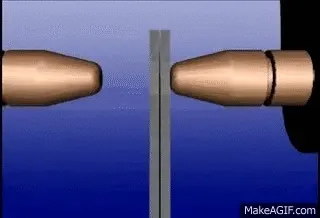
Spot welding is a type of electric resistance welding used to weld various sheet metal products, through a process in which contacting metal surface points are joined by the heat obtained from resistance to electric current
3.3 Spot welding demonstration
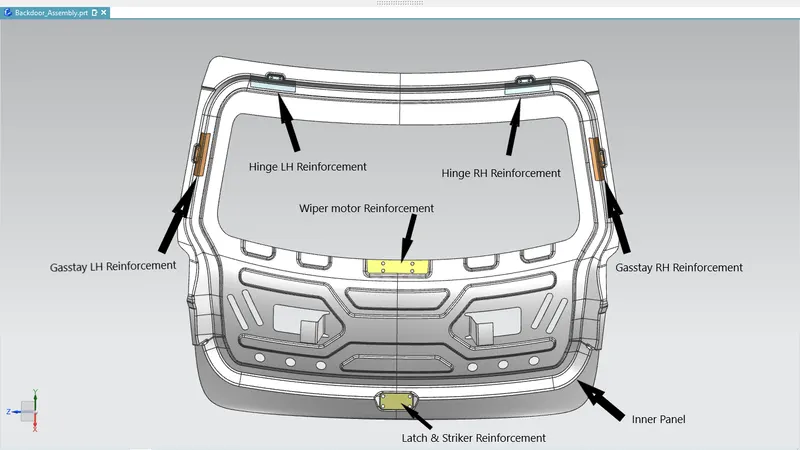
Designed Parts of Backdoor :
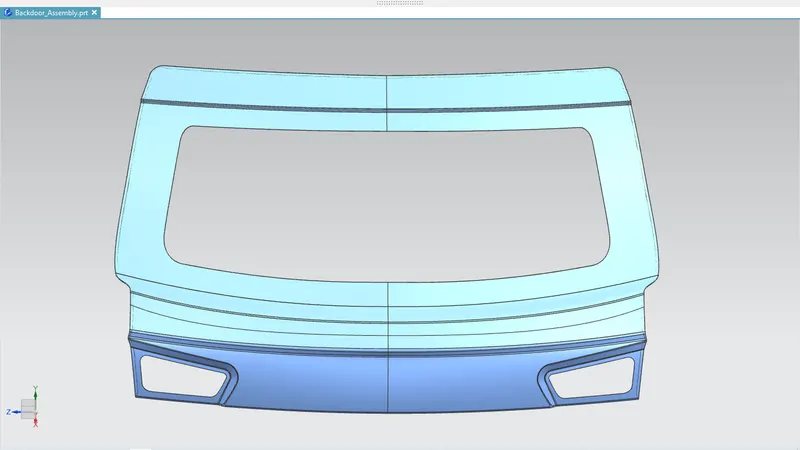
- Outer Upper Panel.
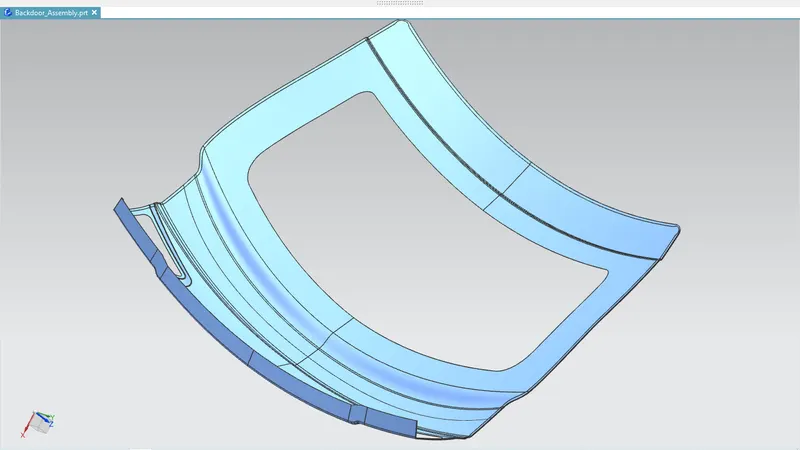
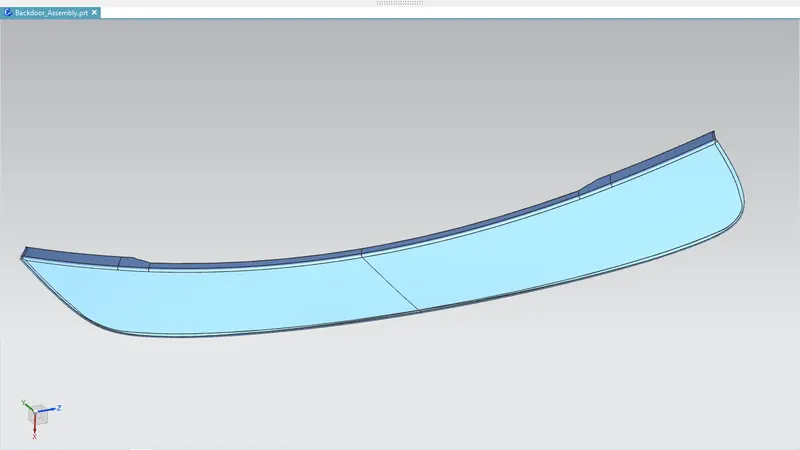
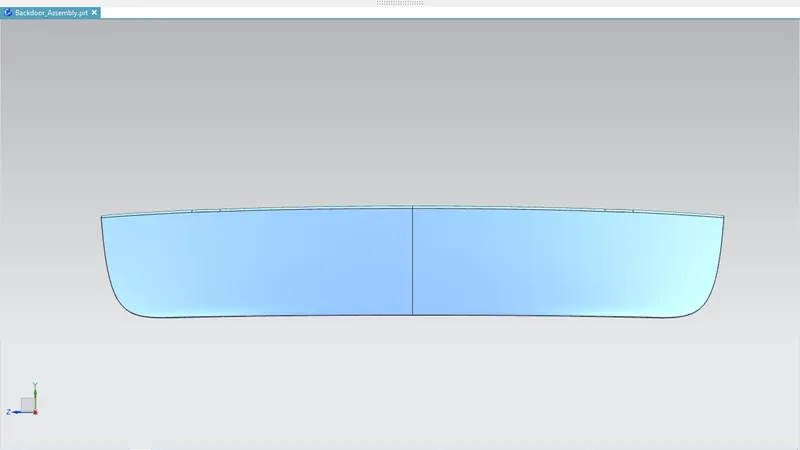
- Outer Lower Panel.
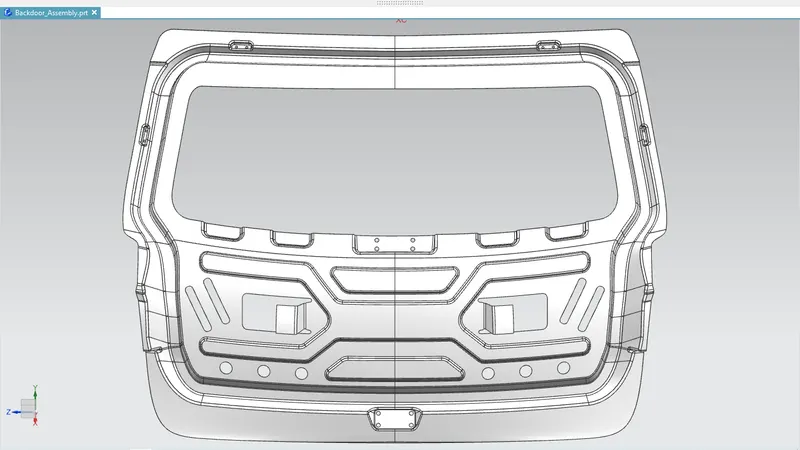
- Inner Panel.
- Hinge Reinforcements.
- Gasstay Reinforcements.
- Wiper Motor Reinforcements.
- Latch & Striker Reinforcements.
Outer Upper Panel :
Outer Lower Panel :
Inner Panel :
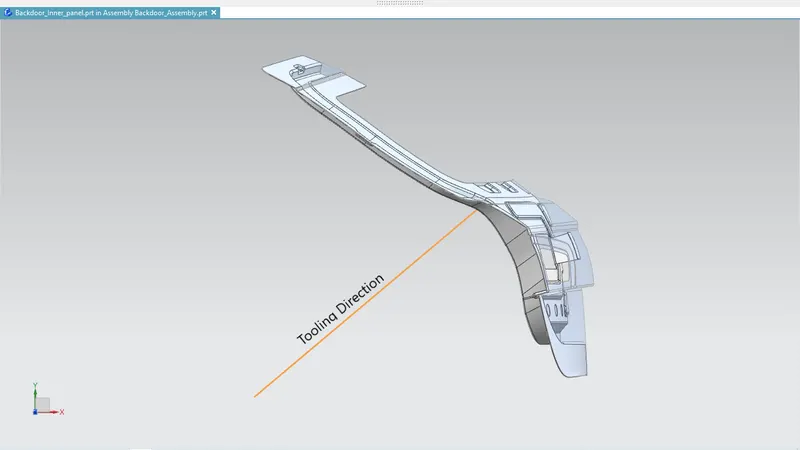
Tooling Direction :
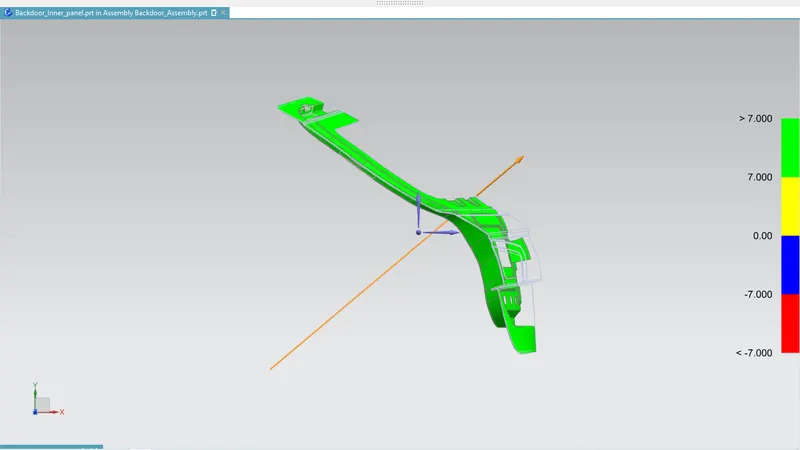
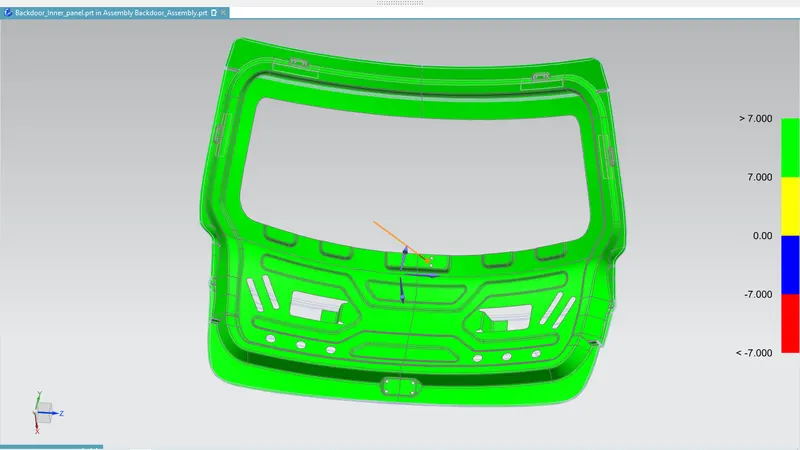
Draft Analysis :
Draft analysis is done with a open angle of 7deg minimum along tooling direction axis.
Conclusion :
- The back door outer and inner panel were designed with the help of the styling surface along the tooling direction under provided design regulations.
- Draft analysis was performed on the inner panel and All the reinforcements were designed and placed at appropriate positions.