Hood design-Week 2
Question :
A detailed report about the Hood Design which includes a detailed explanation about hood and its components, Latch Trajectory, Mastic Data, Emboss Definitions, Manufacturing process like Deep-Drawing and Hemming, and all the parameters followed in the design.And design Hood Outer Panel, Inner Panel and the necessary reinforcements by following the Master Section mentioned with the Design parameters explained in the videos.
Solution :
To design a hood panel,first let us know about Hood and its parts and manufacturing processes and design considerations of Hood.
Let us know what are the parts that contains in a Hood.Basically the hood is a assembly of Hood outer panel, Hood inner panel,Hinges,Hood stay, Latch and Striker.
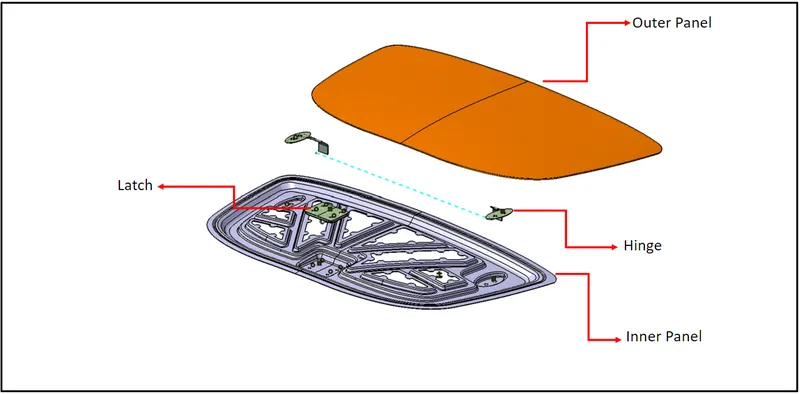
A) 1. Hood :
- The hood is also known as "bonnet". It is the hinged cover over the engine of motor vehicles. Hoods can open to allow access to the engine compartment (or trunk on rear-engine and some mid-engine vehicles) for maintenance and repair. The purpose of opening the engine hood is for inspecting engine room, replenishing cooling water and engine oil, changing parts and making repairs etc.
- Hood are typically made out of the same material as the rest of the bodywork. This may include steel and aluminium.
- Deep drawing, hemming, blanking and piercing are the common sheet metal operations that are used in manufacturing hoods in automotive industries.
1.1 Importance of Hood :
- Save and safety of purposes inside the car.
- Cover all engine parts and radiators.
- Reduce the Air effect due to design aerodynamic shape.
- provide access to the engine for repair and maintenance.
- reduces engine noise, providing you with a quieter drive.
- It can also help keep the paint underhood last longer.
- it can give motorists more time to get out of the car before the fire blazes out of the hood.
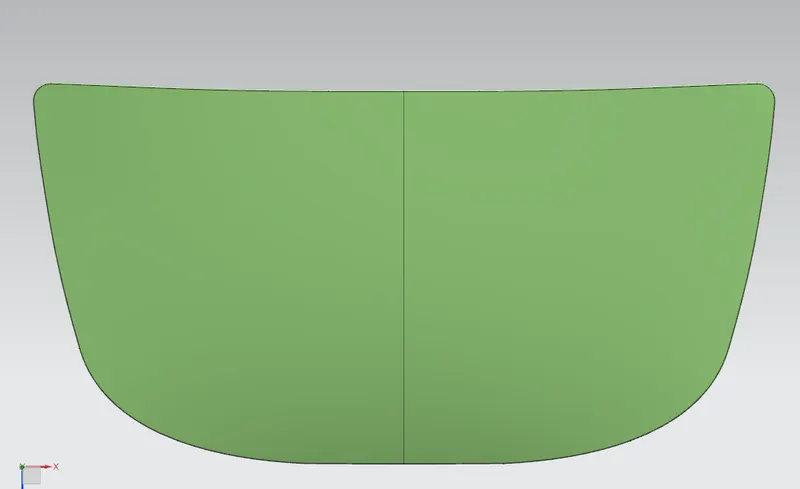
2. Hood Outer Panel : ( Classy Surface )
- Outer panels are the aesthetic elements of a car. It is the styling team who provides the skin for the outer panel.
- In design perspective the shape, position and size of the hood should meet some specific conditions like pedestrian safety, hood head zone for the lock striker, force distribution when subjected to frontal collision (occupant safety), manufacturability etc. So while designing the hood we should give more importance to pedestrian safety.
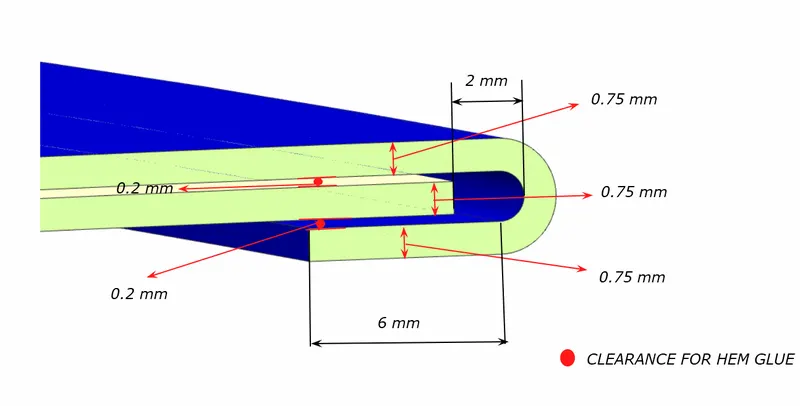
- The outer panel is attached to the inner panel by hemming. So, it is necessary to provide required hemming flange and reliefs for the hemming operation. We also provide mastic sealants between outer panel and inner panel to reduce vibrations.
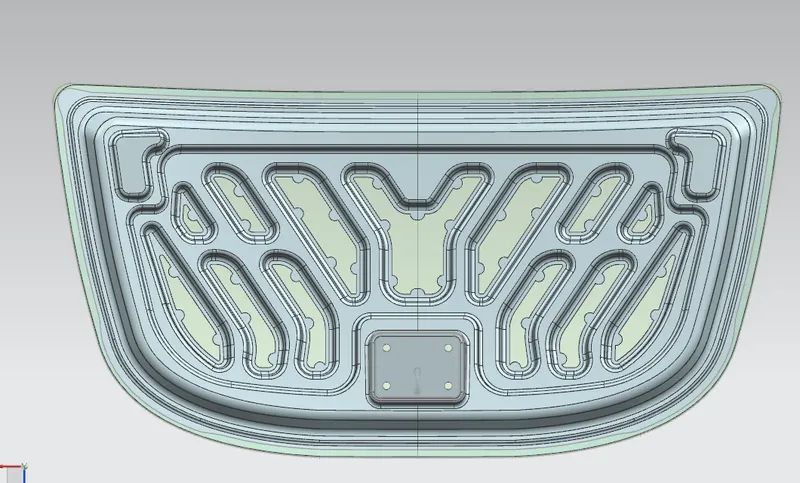
3. Hood Inner Panel :
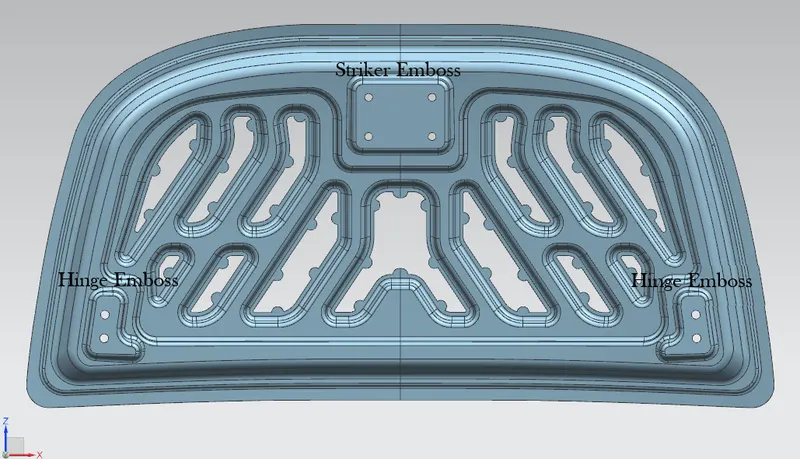
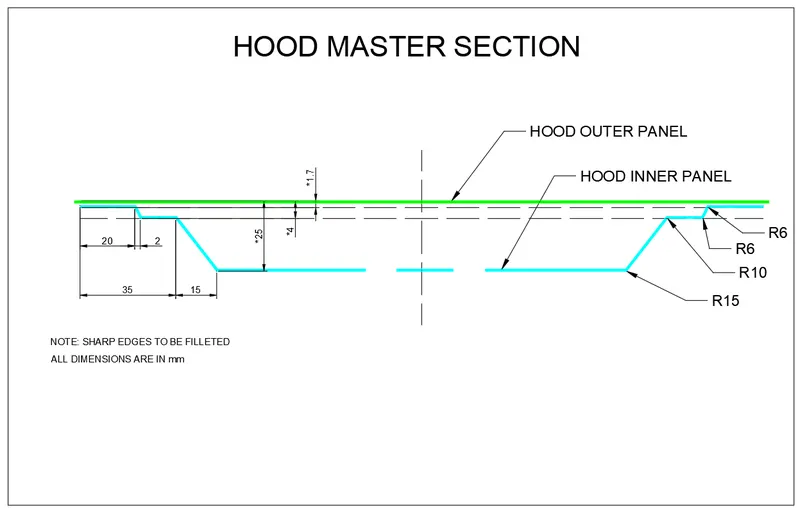
- Inner panel is the part that gives strength and rigidity to the outer panel. The master section represents the initial emboss shape and size. Then we provide the emboss for the latch and hinge elements after fixing the location.
- It also directs the force of the collision outwards instead of into the engine compartment of the car.
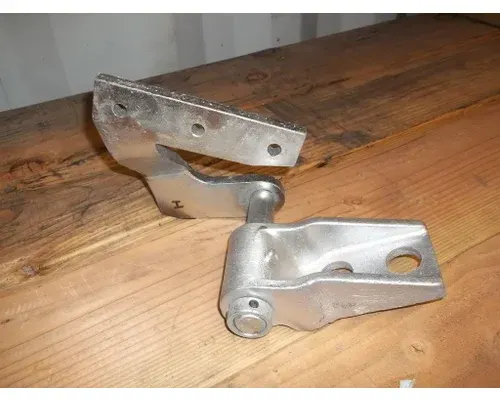
4. Hinge :
- The hood hinge is a pivot and bracket mechanism that makes it possible for you to open and close your hood. Each car typically has a pair of hood hinges installed in the front of the vehicle.
5. Hood Stay :
There are two types of hood stays.
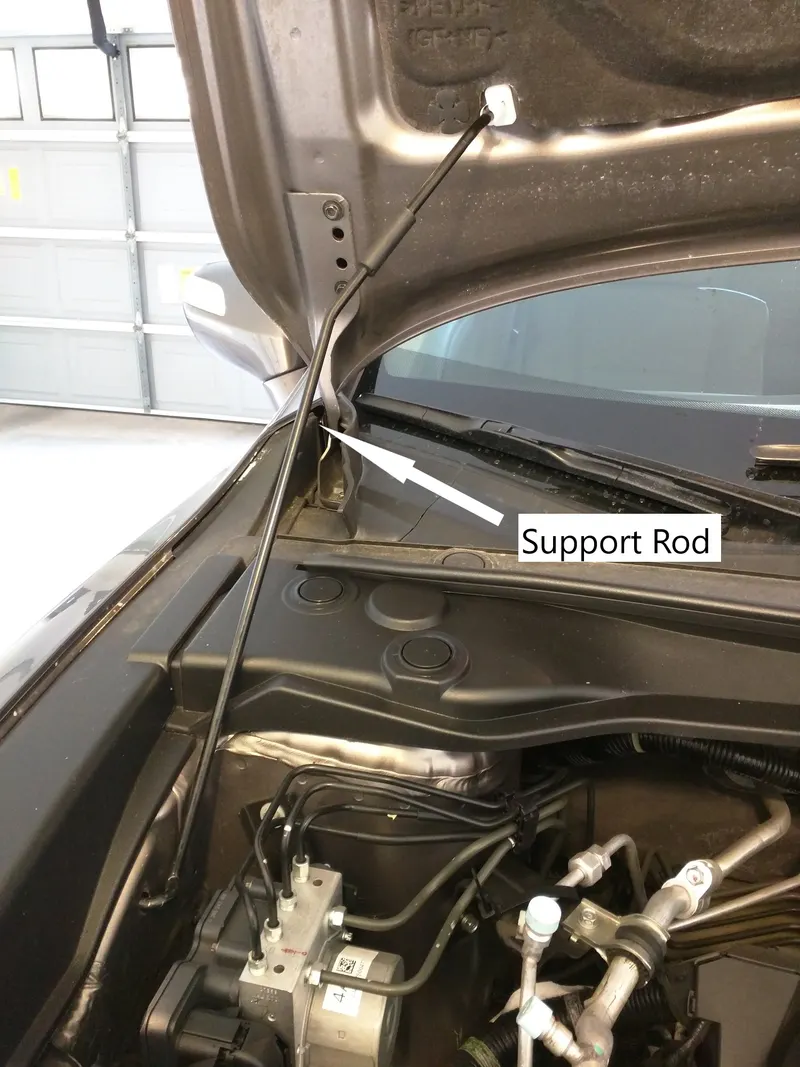
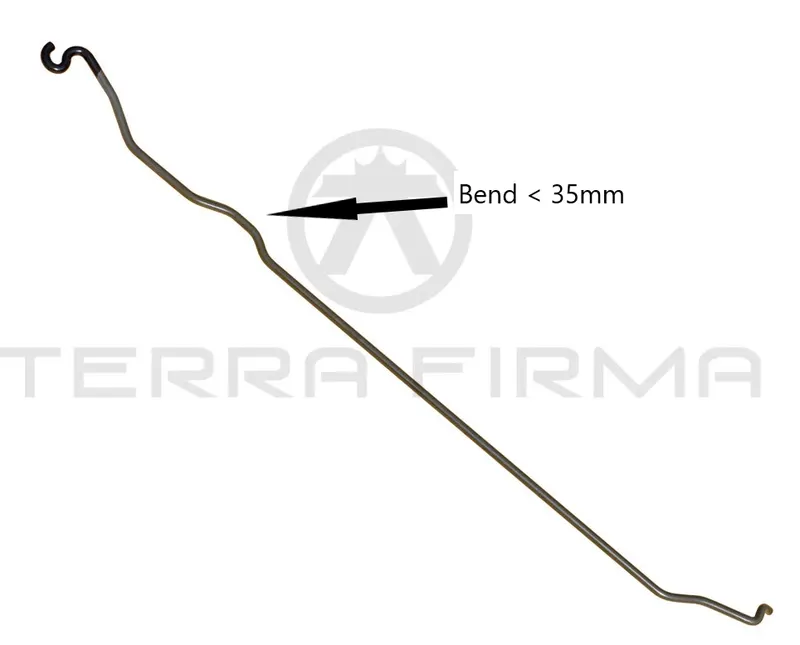
5.1 Support Rod :
- The support rod function is to hold the hood in a open position like shown in below Fig.
- It should operate manually to lift the hood until the support rod locks.
- Support rods length is decided based on the opening angle of the hood. In the support rod maximum bend of 35mm is given in order to strengthen the support rod to bear all the load of the hood.
- Support rods can either mounted on the hood or on the body of the car.
- The another important thing that should be considered while designing the rod is , the rod should be mounted on the opposite side of the battery because , this rod should not produce any interface while installing the battery.
5.1.1 Pros & Cons of Support Rod :
- It is a cheaper in cost as a advantage.
- Disadvantage is human effort is needed.
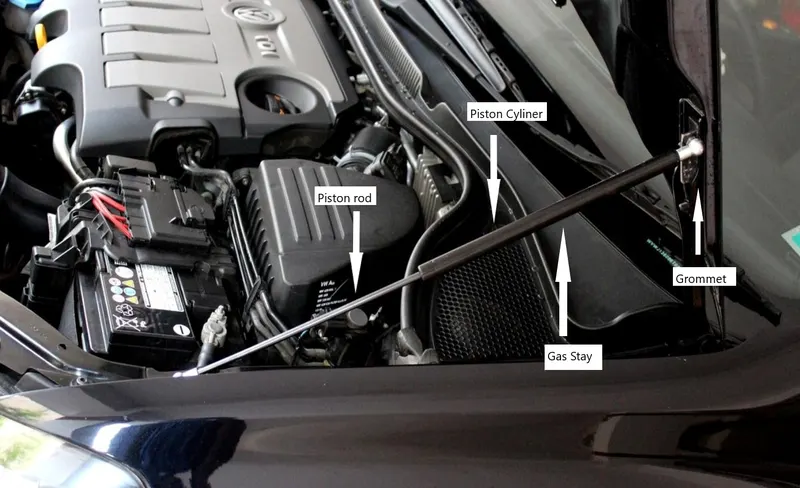
5.2 Gas Stay :
- Gas stay helps in easily lifting the heavy hood and holding the hood in the open position. There is no human effort needed for gas stay.
- Gas Stay is a mini version of the bicycle pump in which the compressed nitrogen is stored in the pump with oil and tightly sealed so that the gas can't escape. The gas allows to store energy which produced by the force acting on the piston and oil damps the movement of the piston and also lubricates it. When force is acted upon the piston, it compresses the gas, and energy is stored and when force is stopped acting on the piston, the stored energy is released moving the piston to its free state position.
- Since gas stay supports the weight of the hood reinforcements should be given at the mounting points of the gas stay and grommets are used to attach the gas stay to the hood inner panel. It rotates with a pivoting point at grommets.
5.2.1 Pros & Cons of Gas Stay :
- As a advantage it is an automatic part
- No man power is needed.
- Holds heavy wieght for long length hoods.
- The main disadvantage is much costlier as compared to support rod.
6. Latch and Striker :
- A catch that holds the hood of a car shut is knows as Latch.
- Latch and striker mechanism is provided to lock the hood, in order to prevent accidental opening of the hood during driving.
- The latch is present on the engine compartment while the striker is attached to inner part of hood.
6.1 Latch Trajectory :
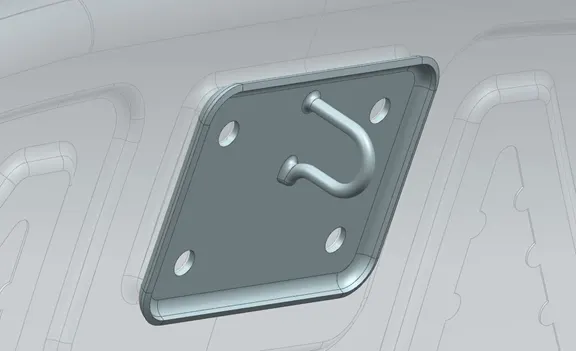
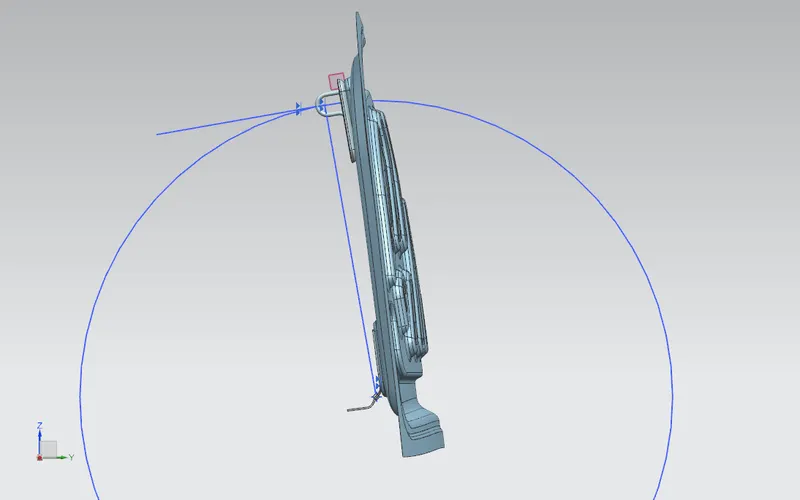
- While assembling the latch with the hood panel it is strictly recommended that the position of latch striker should be placed such that the latch striker exactly fit into the lock hole in the engine compartment. Keeping this in mind, the latch striker is placed on the inner hood panel using latch trajectory path. This path is created using the the hinge axis taken as reference to draw a big trajectory path.
7. Mastic Data :
- Mastic Sealants are used to Join Inner and outer Panel. If we welded both the inner panel an douter panel that will neglect the elegent look of outer panel. So the joining of both the panels is done by Hemming and Mastic sealant.
- Mastic sealants are elastic compound that behaves like rubber. It is placed between the outer and inner panel. Initially it is in paste form but after the hot furnace bath it gets hardened thus joining the outer and inner panel.
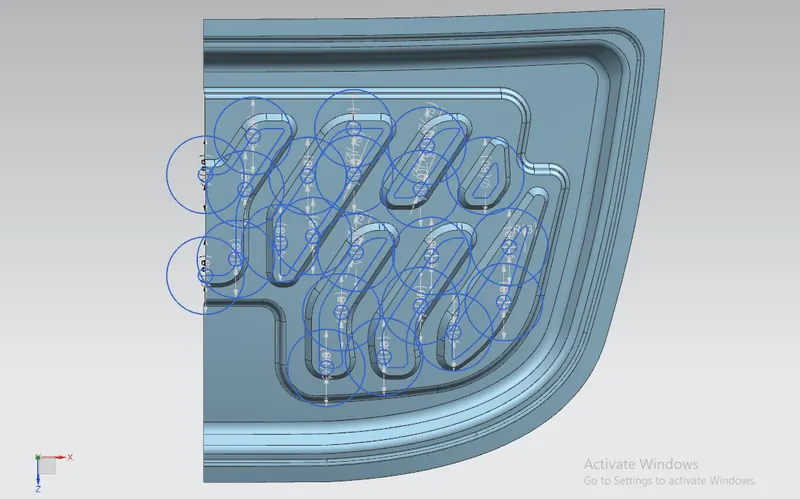
- Each Mastic Sealant can hold strength upto 80 mm Diameter. For safe design the strength Diameter must overlap each other.
- In below shown figure the blue circles are the mastic points that covers 80mm diameter each.
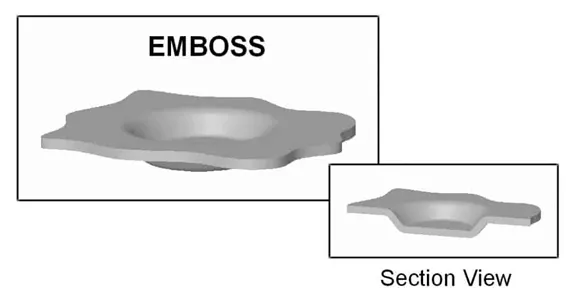
8. Emboss Definition :
- To decorate a surface with a raised pattern or design usually used as (be) embossed.
- The brief explanation of emboss manufacturing will be explained in manufacturing process.
B) 9.Sheet metal operations in car hood Manufacturing Process like :
9.1 Deep Drawing :
- Deep drawing is a sheet metal forming process in which a sheet metal blank is radially drawn into a forming die by the mechanical action of a punch. It is thus a shape transformation process with material retention. The process is considered "deep" drawing when the depth of the drawn part exceeds its diameter.
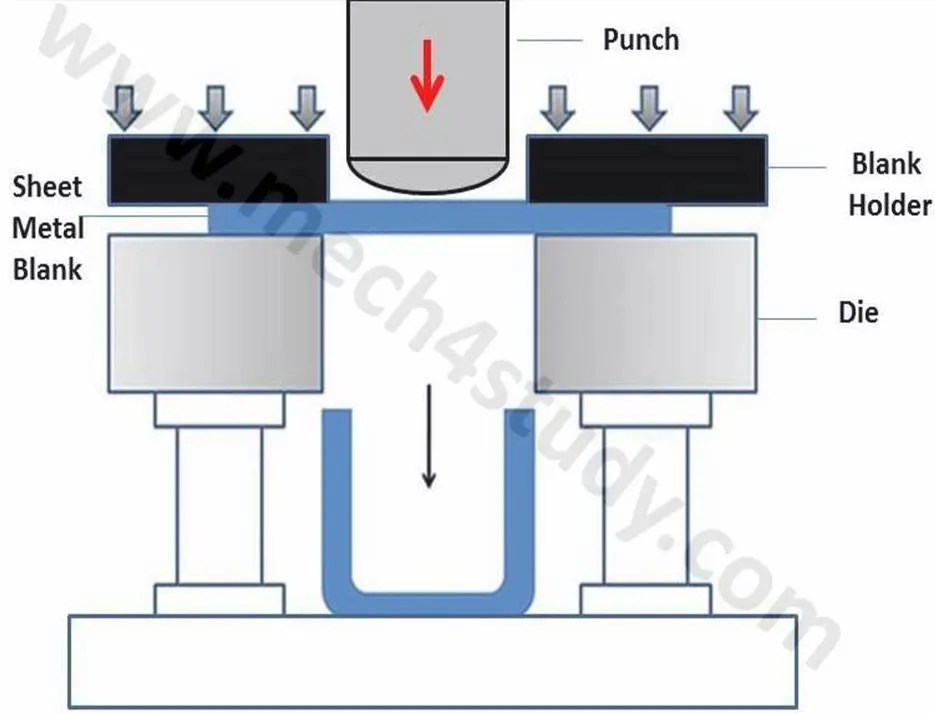
- The process involves a punch with a round comer and a die with a large radius. The punch-die clearance is slightly larger than the thickness of the sheet metal to be deep drawn.
- As the load applied through the punch, the sheet metal is forced to flow radially and sink into the die cavity to form a cup. The process is best suitable for complex shaped problems. The process of deep drawing is shown in Fig. 6.39.
a. Process :
- Deep drawing of sheet metal is performed with a punch and die.
- The punch is the desired shape of the base of the part, once drawn. The die cavity matches the punch and is a little wider to allow for its passage, as well as clearance.
- This setup is similar to sheet metal cutting operations. As in cutting, clearance is the lateral distance between the die edge and the punch edge.
- The sheet metal work piece, called a blank, is placed over the die opening. A blankholder, that surrounds the punch, applies pressure to the entire surface of the blank, (except the area under the punch), holding the sheet metal work flat against the die. The punch travels towards the blank. After contacting the work, the punch forces the sheet metal into the die cavity, forming its shape.
10. Hemming :
- Hemming is a forming operation in which the edges of the sheet are folded or folded over another part in order to achieve a tight fit. Normally hemming operations are used to connect parts together, to improve the appearance of a part and to reinforce part edges.
- In car part production, hemming is used in assembly as a secondary operation after deep drawing, trimming and flanging operations to join two sheet metal parts (outer and inner) together. Typical parts for this type of assembly are hoods, doors, trunk lids and fenders.
- The accuracy of the hemming operation is very important since it affects the appearance of the surface and surface quality. Material deformations, which occur during the hemming process, can lead to dimensional variations and other defects in parts. Typical hemming defects are splits or wrinkles in the flange, material overlaps in the corner areas or material roll-in. This is why it is important to use simulation tools in order to, on the one hand, better understand the hemming process and, on the other hand, significantly reduce the number of “trial and error” loops during tryout und production.
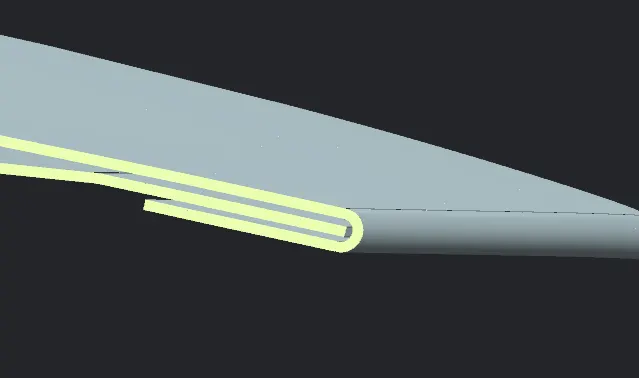
- There are various types of hemming operations
- Conventional die hemming
- Roll hemming
10.1 Conventional die hemming
- Conventional die hemming is suitable for mass production. In die hemming, the flange is folded over the entire length with a hemming tool. Normally the actual hemming is a result of a forming operation in which the flange is formed with a hemming tool after the drawing and trimming operations have been completed. The formed flange is then hemmed in several process steps. These steps include, for example, the pre-hemming and final hemming depending on the respective opening angle of the flange. Production plants for conventional die hemming are very expensive, but the cycle times are very low.
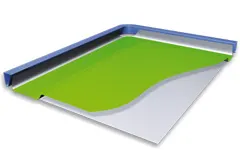
In conventional die hemming, the flange is folded over the entire length with a hemming tool.
10.2 Roll hemming
- Roll hemming is carried out incrementally with a hemming roller. An industrial robot guides the hemming roller and forms the flange. Roll hemming operation can also be divided into several pre-hemming and final hemming process steps. Roll hemming is very flexible to use and tool costs are significantly lower as compared to those of conventional die hemming. However, the cycle times are much higher since the hemming is realized using a hemming roller which follows a defined path.

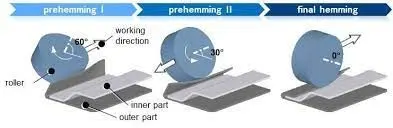
In roll hemming, the hemming roller is guided by an industrial robot to form the flange.
10.3 Embossing
- Sheet metal embossing is a stamping process for producing raised or sunken designs or relief in sheet metal. This process is carried out by means of matched male and female roller dies, or by passing the sheet or rolls of metal between rolls of desired pattern.
C) 11. Design considerations and Standards of Hood :
- Hood head zone criteria,
- EURO N-CAP Rating,
- Wrap around distance,
- NVH ( noise , vibration , harshness).
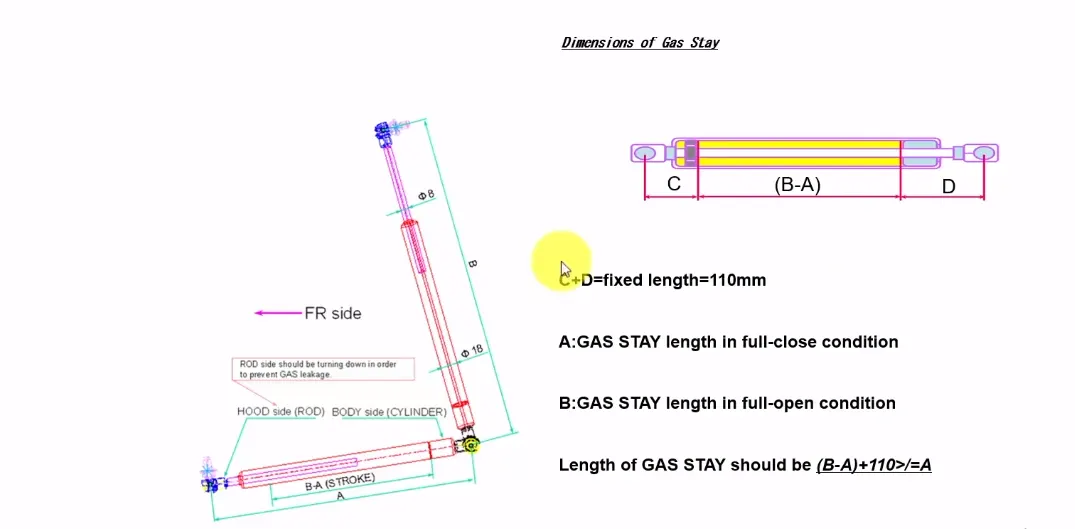
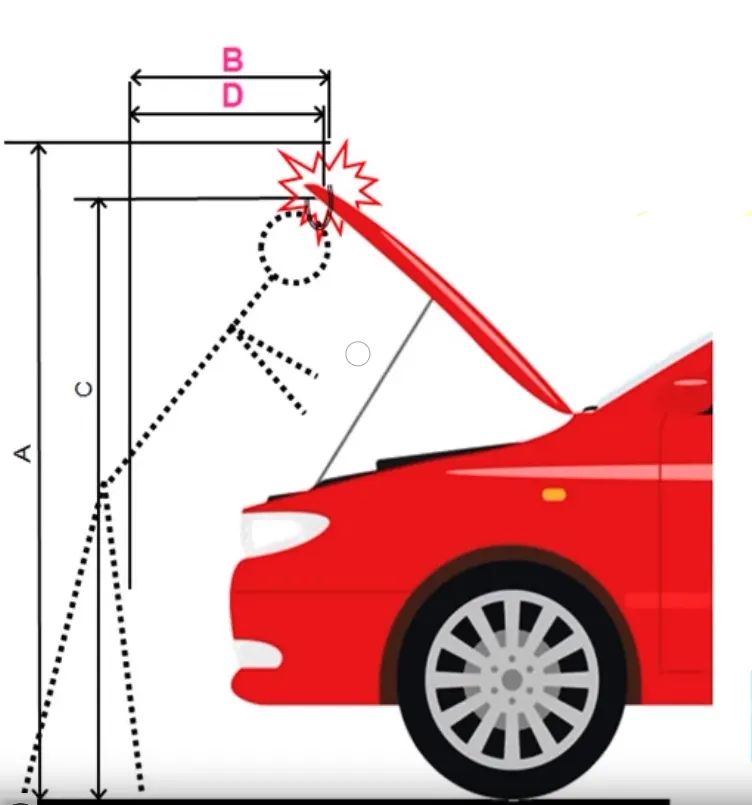
11.1 The first important criterion for designing the hood is the opening angle of the hood.
- This criterion is considered as a average height of the humans in the region. For example, the average height of a human being in India is 5.8 feet whereas in European countries the average height of a human being is 6 feet. Hence the opening angle of the hood greatly depends on the height of the human which can be controlled by the support rod or gas stay.
- The opening angle is considered important criteria because when the opening angle is less there is a chance of head injury to the human.
- By varying the length of the support rod the opening angle can be varied.
- If the same car is made for different country will have different opening angle depending on the country or region.
- The distance C and D shown in the image is represented as graph in the upper right corner of the image. Choosing the right head zone position will decide upon the angle of the hood opening.
11.2 Euro NCAP Rating:
- The European New Car Assessment Programme (Euro NCAP) is a European voluntary car safety performance assessment programme based in leuven(Belgium) formed in 1996.They publish safety reports on new cars, and awards 'star ratings' based on the performance of the vehicles in a variety of crash tests, including front, side and pole impacts, and impacts with pedestrians.
- Euro NCAP ratings take into account three factors of protection — for adults, children and pedestrians — plus the level of safety technology on-board a car.
- It serves as a truly independent testbed for new cars on the market. It’s not a legal requirement for cars to have a Euro NCAP test. Such is the status of the ratings though, it can and has had an effect on sales.
- Euro NCAP Ratings Calculated by : Several tests are undertaken to determine a score in each category.
- Adult Occupant Protection : Adult occupant protection is calculated by impacts at the front, side and rear of the car as well as the ease of rescue and extrication.
- Child Occupant Protection : Safety for children is determined by the capabilities of child restraint systems and the provisions a car has for child seats.
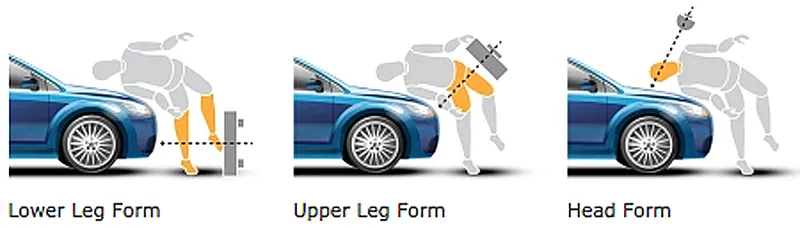
- Pedestrain Protection : Impacts on the head plus both lower and upper sections of the legs are tested to determine pedestrian safety. The effectiveness of automatic emergency braking on both pedestrians and cyclists is tested too.
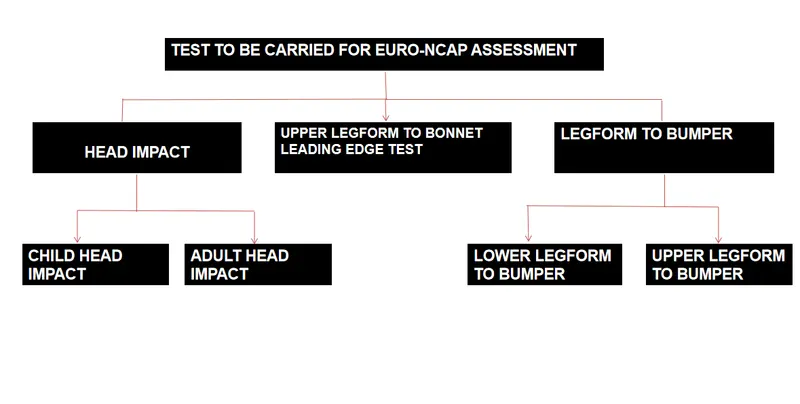
- TESTS CARRIED OUT FOR EURO NCAP ASSESSMENT :
- Pedestrain Impact Zone :
11.3 Wrap Around Distance :
- When a car crashes the pedestrian , the whole human body wraps around the front shape of the car and head impacts either on the bonnet or on the wind screen . The distance at which the head impacts the car from the ground is called wrap around distance
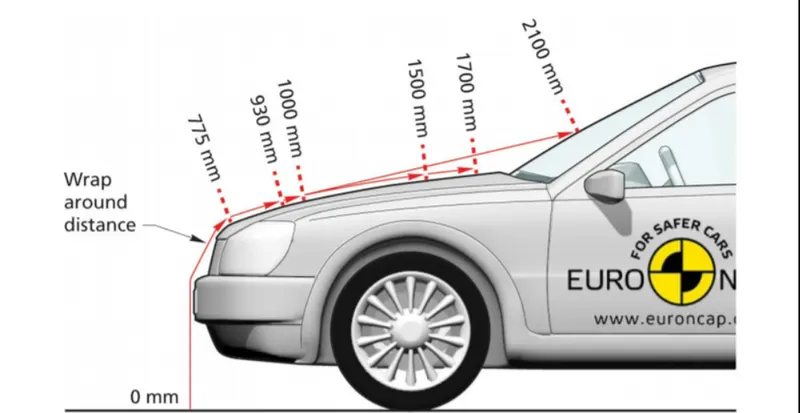
The severity of the injury caused by the frontal crash analysis depends on the
- Shape of the vehicle
- Speed of the vehicle
- Movement of the pedestrian relative to the vehicle
During the crash analysis test based on the wrap around distance two test areas are created , namely
- Child head impact zone
- Adult impact zone
- Wrap around distance for child head impact zone is 1000-1500 mm
- Wrap around distance for adult head impact zone is 1500-2100 mm
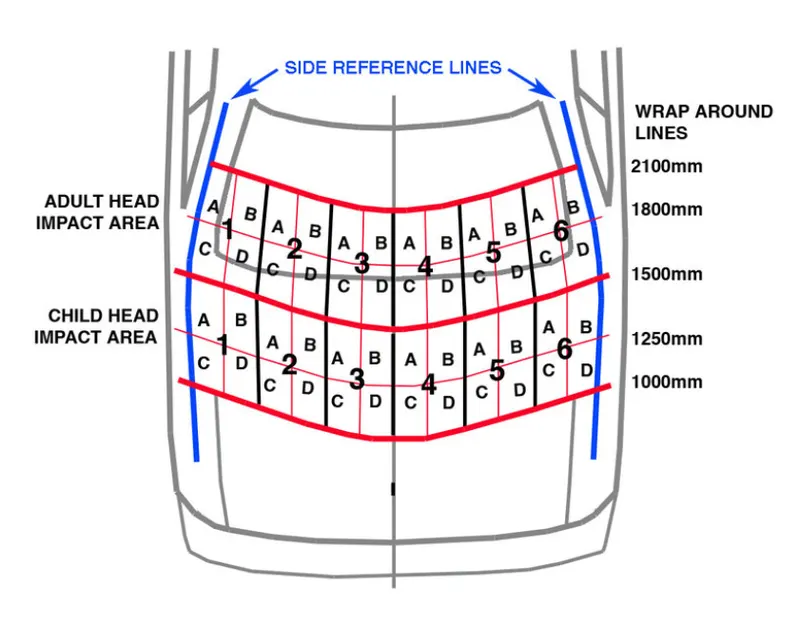
- This study helps the designer to design the outer surface panel in a softer and to remove the material from the inner panel at specific portions at child head impact area and adult head impact area so that even though the car hits ,the pedestrian may not get effected worse and causes the minimum damage .
11.4 NVH ( Noise , Vibration and Harshness ) :
- Noise, vibration, and harshness (NVH), also known as noise and vibration (N&V), is the study and modification of the noise and vibration characteristics of vehicles, particularly in cars and trucks.
- Interior NVH deals with noise and vibration experienced by the occupants of the cabin, while exterior NVH is largely concerned with the noise radiated by the vehicle, and includes drive-by noise testing.
- Hood also causes the NVH in the car body , this can reduced by using the stiffener pad.
- These pad is introduced between the hood inner panel and outer panel to increase the strength locally . During the motion of the car the hood will wobble and causes the noise . To avoid these vibration and reduce NVH stiffener pad is introduced.
These are the considerations and safety standards to design a Hood.
Here to design a hood we have some given data following
Master Section :
Hemming Data :
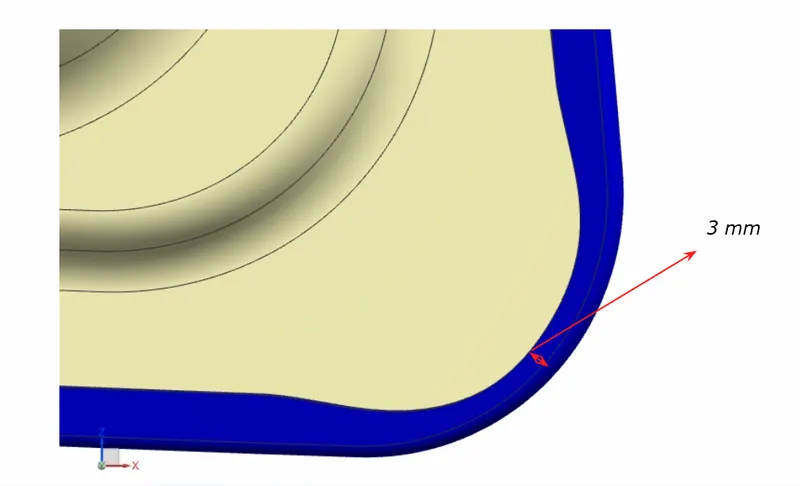
Rear Edge Relief :
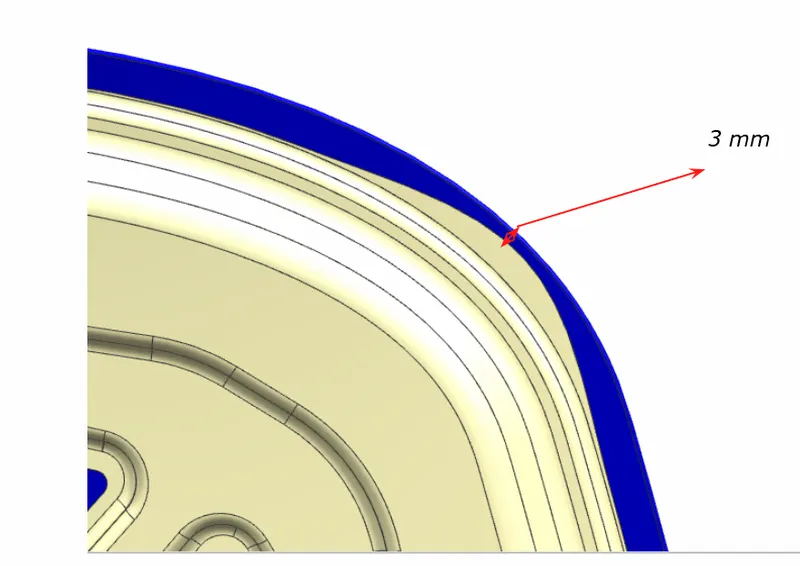
Front Edge Relief :
By considering the given data we designed the hood assembly with all parts and submitted below.
Conclusion :
- In this project I have learnt to design the model & assembly of car hood panel & the basic surface commands on NX cad model software.
- I have also learnt about the pedestrian safety requirements used in car, so that driver is left with no harm during frontal collision.
- Along with this, I have also learnt about the manufacturing process used in the car hood panel i.e. hemming & deep drawing process.