Design of backdoor using nx
DESIGN OF BACK DOOR
INTRODUCTION:
- Introduction on backdoor
- Types of backdoor
- Components of backdoor
- Manufacturing techniques
- Design of backdoor
Introduction on backdoor:
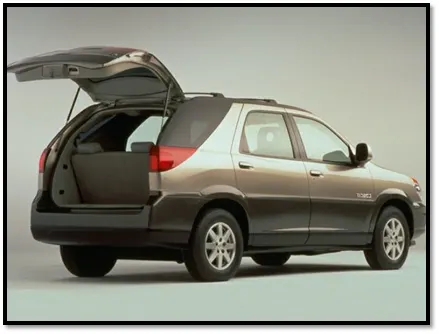
- The backdoor or tailgate is the rearmost part of the automobile which opens upwards, downwards, and sideways to give access to the luggage space or seating.
- In most automobiles, the backdoor opens upwards. It is hinged to the roof and a gas stay support fixed at the body side outer for keeping the backdoor in the open position.
- In case of some big cars there is a seating arrangement in place of boot space for which back door becomes the entry gate.
Types of backdoor:
According to opening of backdoor has differentiated in three major types. They are,
- Top mounted backdoor
- Side mounted backdoor
- Bottom mounted backdoor
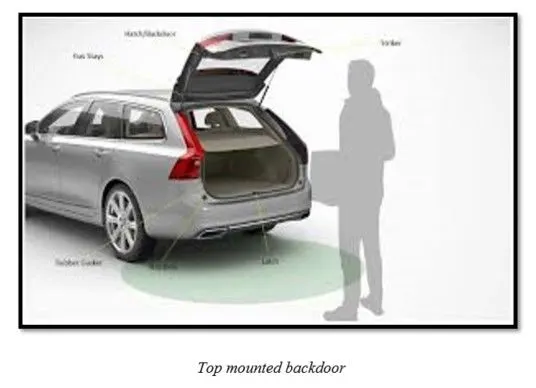
- Top mounted backdoor
This type of back doors is used in a station wagon, pickup trunk and some of the spot utility vehicles. Today's modern cars use top mounted tailgating system which are both powered and also gas stay supported. These top mounted tailgates provide greater rear visibility compared to side mounted or backdoor which have center pillars in it.
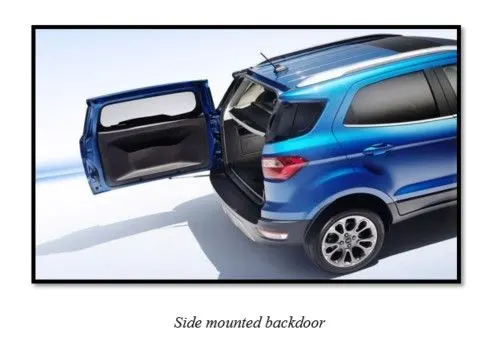
2. Side mounted backdoor
As the name signifies the side mounted doors are the one which is used in the van type MPVs, SUVs, pickup truck vehicles. These side mounted doors or barn doors are a lot easier compare to top mounted doors. These doors are generally smaller in size and can be easily accessed. These doors are more convenient for the goods handlers for long pipe and lengthy components where one door is kept open. These door also save accidental head impacts. It is a lot easier to load and unload items in the side mounted doors.
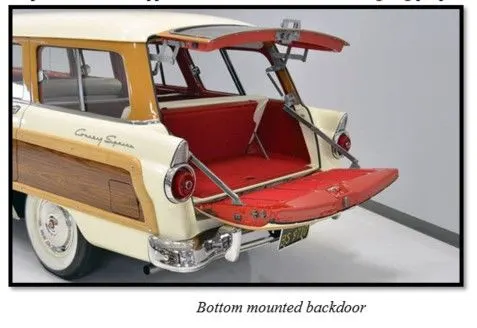
3. Bottom mounted backdoor
This bottom type backdoor system are used in the car type such as car, pickup truck and some luxury SUVs. These are the most convenient type of back door in which the bottom split is used as a support or even as a table for the tour going people.
Components of Backdoor:
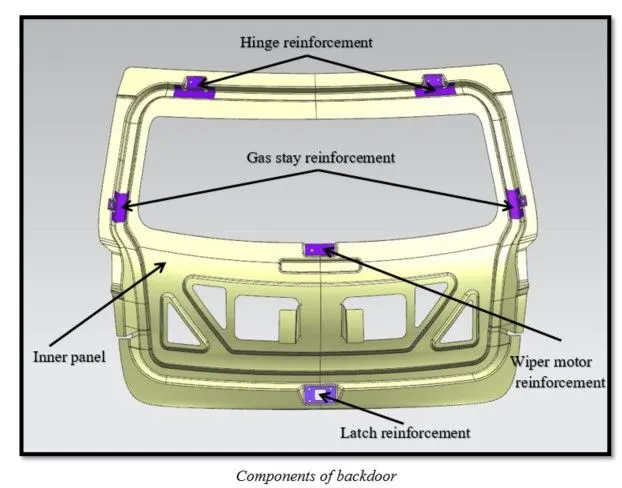
- Inner panel
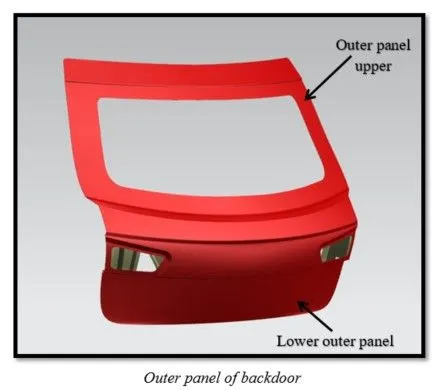
- Outer panel upper
- Outer panel lower
- Hinge reinforcement LH & RH
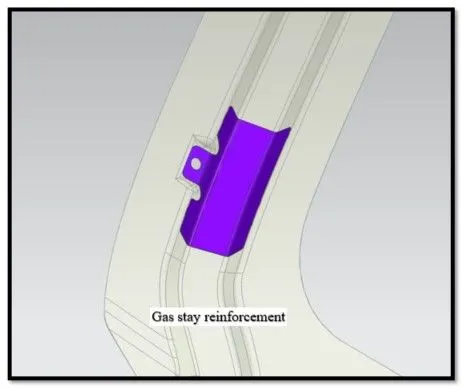
- Gas stays reinforcement LH & RH
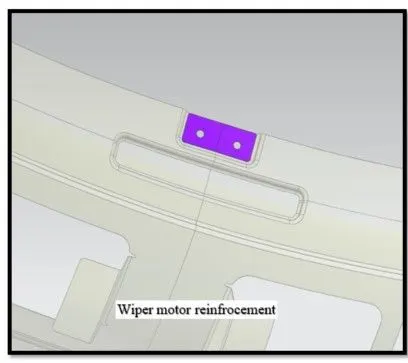
- Wiper motor reinforcement
- Latch reinforcement
Material selection:
The material selection plays a major role in determining the overall weight of the back door. The materials generally used are Steel and Aluminium. The Density of Steel is higher than Aluminium thus it results in adding more weight to the door. Basically the material is used based on the budget of the car, because the cost of steel is much cheaper than Aluminium. If aluminium is used instead of steel there is no need for many parts like Reinforcements for each mounting and the overall weight gets reduced by 6-10 kg approximately. But the drawback is Aluminium is much costlier than Steel. Hence based on the budget of the car aluminium is used. In higher end models like Benz, Audi, Porsche and BMW we can find aluminium is used instead of steel resulting in reduced weight and increased performance of the vehicle.
Manufacturing techniques:
Different processes used for manufacturing the Back Door:
Deep Drawing:
The metal deep drawing process is an effective method of manufacturing cups, cans, and other similar deep drawing products. The deep drawings having 2 main categories.
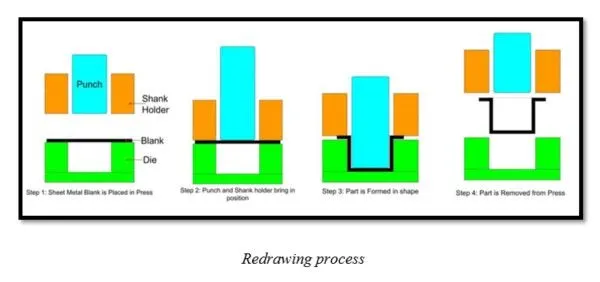
- First-stage drawing: The blank shape of metal is placed on the die and in contact with the punch. When the metal specimen is a flat piece of sheet metal is used in forming and finish the product. Initially, the punch moves in a downward direction. The outer rim of the blank is subjected to pure radial drawing (drawing toward vertical axes) between the die and blank metal. The metal becomes a bend and slides over the die and is also stretched between die and punch. The metal in the vicinity of the punch head and contact with it bend and slide over the radii and stretch over the punch head.
- Redrawing: The components drawn from the first stage again it is redrawn convert into more depth to form a cup shape in the die and punch. The second stage of drawing is called redrawing.
Hemming:
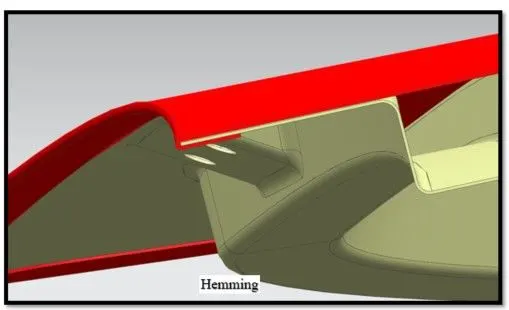
The inner & outer panels are joined by the process of hemming.
Hemming is a forming operation in which the edges of the sheet are folded over other parts in order to achieve a tight fit. Usually, hemming operations are used to connect parts together, to improve the appearance of a part, and to reinforce part edges.
In car part production, hemming is used in assembly as a secondary operation after deep drawing, trimming & flanging operations to join two sheet metal parts together. Typical parts for this type of assembly are hoods, doors, trunk lids & fenders.
The accuracy of the hemming operation is very important since it affects the appearance of the surface & surface quality. Material deformations, which occur while the hemming process, can lead to dimensional variations & other defects in parts. Typical hemming defects are splits and wrinkles in the flange, material overlaps in the corner areas. So, it is very important to use simulation software tools to better understand the hemming process and minimize the number of “trial & error” during the try-out.
There are different types of hemming operations:
- Conventional die hemming
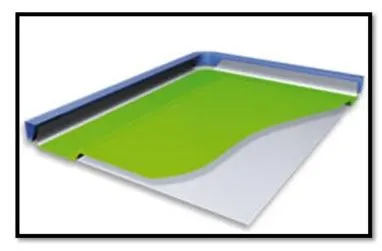
In conventional die hemming, the flange is folded over the total length with a hemming tool.
- Roll Hemming
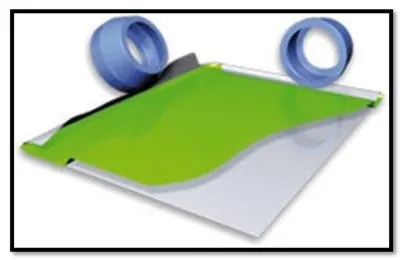
In roll hemming, the hemming roller is guided by an industrial robot to make the flange.
BLANKING:
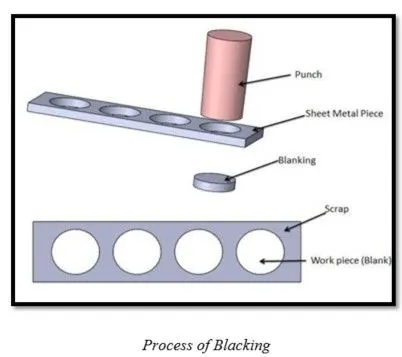
Blanking is a cutting operation of a flat metal sheet and the article punched out is known as blank. Blank is the required product of the operation and the metal left behind is considered as a waste.
PUNCHING:
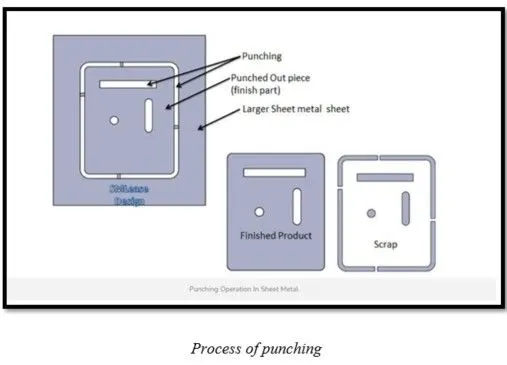
It is similar to blanking only the main difference is that the hole in the required product and the material punched out from the hole is considered as waste.
Design of backdoor
Aim:
To design an assembly BIW of Back Door which includes inner panel, and required reinforcements for gas stay, hinge and latch, wiper motor mountings using given Class A Surfacing.
Software used:
- Siemens NX 12
Design consideration:
- Rear Visibility.
- Support structures like hinges and gas stays.
- Mounts for wiper motor tail lamps and other wiring loops.
- Fit and clearances.
- Boot space
- Rear crash regulations and requirements.
- Sealing and its functions.
- Joining techniques like hemming, spot welding etc.
Design parameters of the components of backdoor:
- Outer panel – 0.75mm thickness
- Inner panel – 0.75mm thickness
- Reinforcements – 1.5mm thickness
Featuresfunctions used:
- WAVE GEOMETRY LINKER: It allows the designer to reference existing part geometry when designing a new part in existing assemblies
- EXTRACTED GEOMETRY: Creates an associative copy of bodies, surfaces, curves, points, etc.
- OFFSET SURFACE: This command is used to create a surface by offsetting a set of faces.
- OFFSET CURVE IN FACE: It is used to offset curves along a selected face or surface.
- TRIM SHEET: It is used to cut off a portion of the surface.
- BRIDGE CURVES: Creates a tangent blend curve between two objects.
- THROUGH CURVES: Creates a surface through multiple sections where the shape changes to pass through each section.
- THROUGH CURVE MESH: Creates a body through a mesh of sections in one direction and guides in another direction where the shape fits through the mesh of curves.
- SWEPT: Creates a body by sweeping a section along one or more guides using various options to control the shape along with the guide.
- STUDIO SURFACE: Creates a surface using any number of sections and guide strings.
- FACE BLEND: Add tangent blend faces between a selected set of faces with a specified radius.
- PROJECTED CURVE: Using this command we can project curves, sketches, or points onto the selected face or plane.
- LAW EXTENSION: It creates a law-controlled extension from the base sheet, dynamically or based on laws for distance and angle.
- EXTEND SHEET: Extends the sheet body by distance or to the intersection with another body.
- EDGE BLEND: Rounds the sharp edges of the faces with a specified radius.
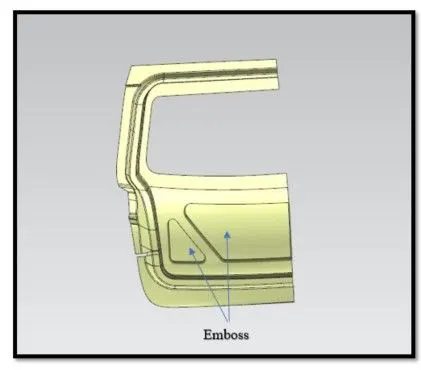
- EMBOSS: This command modifies the surface by projecting a section along a vector, with options for end cap location and shape.
- CURVE ON SURFACE: It is used for sketching a spline on the face or surface.
- MIRROR GEOMETRY: Copies the geometry and mirrors them across a plane.
- SEW: Sew is used to combine sheet bodies by sewing their edges together.
- THICKEN: It gives thickness to the surface body.
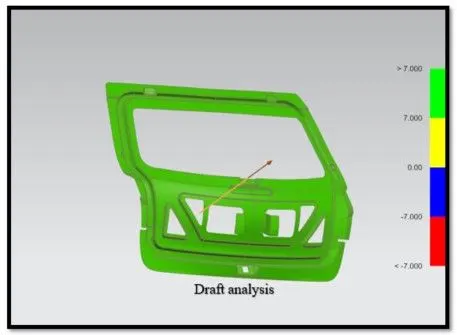
- DRAFT ANALYSIS: Draft analysis lets you check parts and/or molds, to make sure they will separate. Hopefully avoiding "locking" the part in the mold.
Procedure:
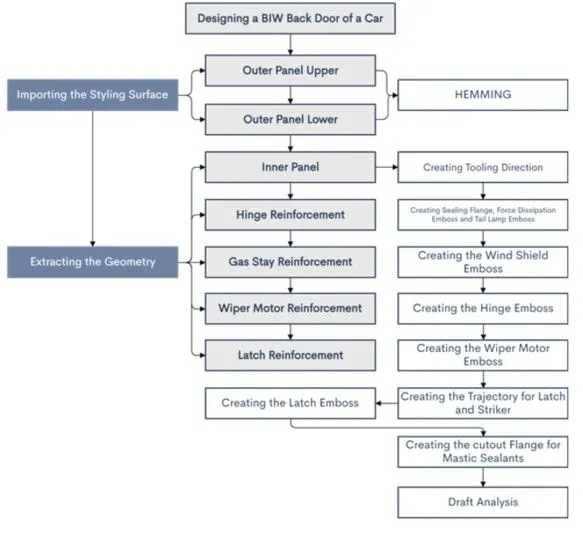
Method:
Repairing the Styling Surface:
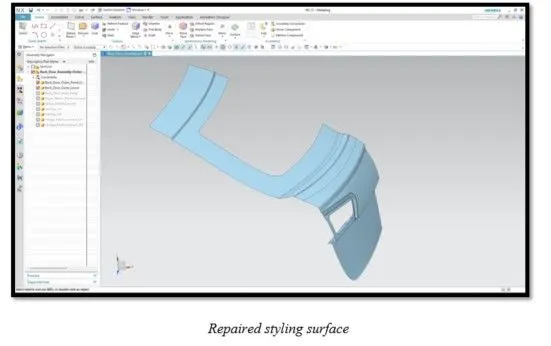
There were some irregularities in the given surface therefore, the surface was repaired and smoothen up. The final surface of the backdoor is as shown in the figure.
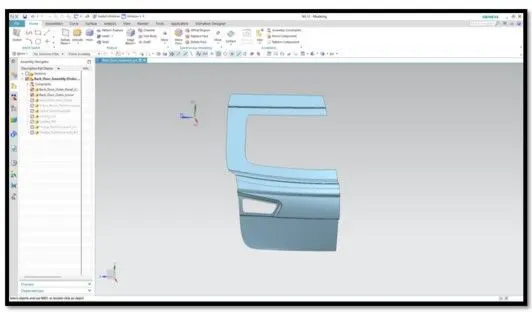
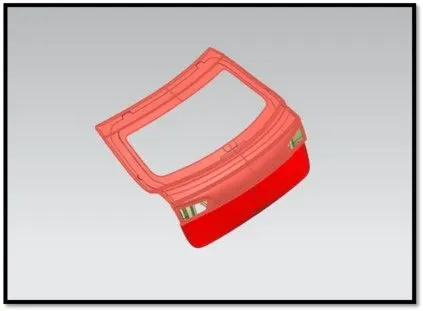
After repairing the surfaces, the door is divided into two parts viz. Door Outer Upper and Door Outer Lower.
Tooling direction:
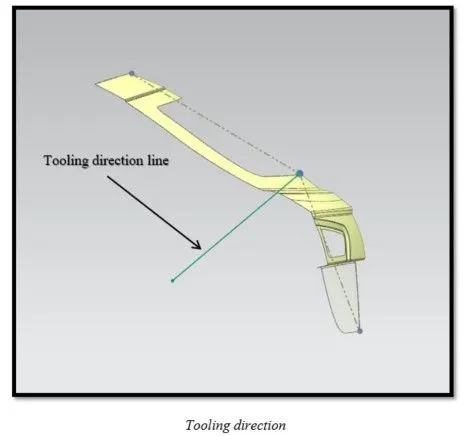
A tooling direction was set for the deep drawing operation as shown in the figure. It is desirable in drawing operations to maximize material flow in the plane of the sheet and to minimize the material flow in a direction perpendicular to the plane of the sheet.
Creating sealing flange:
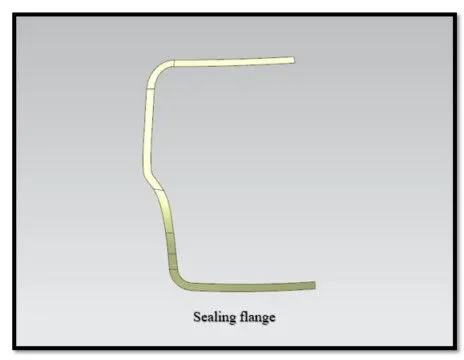
A Sealing flange was created by offsetting the outer panel to specific distance. The width of the flange is 25mm.
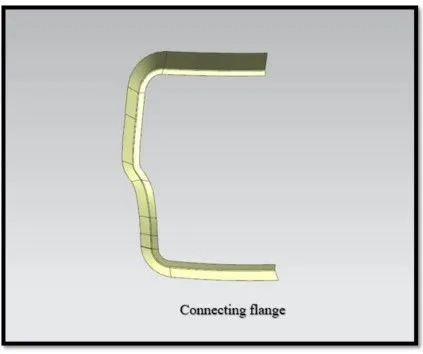
Connecting Flange:
A connecting Flange is created between the sealing flange and inner panel flange as shown in the figure.
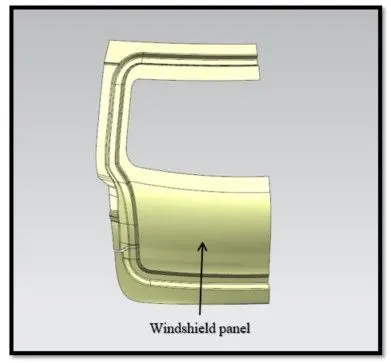
Creating windshield panel and attaching to connecting flange:
Creating Emboss:
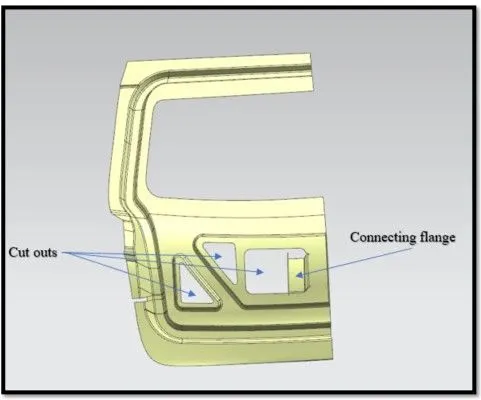
Creating Mastic flange and cut outs:
This mastic flange is created by punching the inner panel during manufacturing.
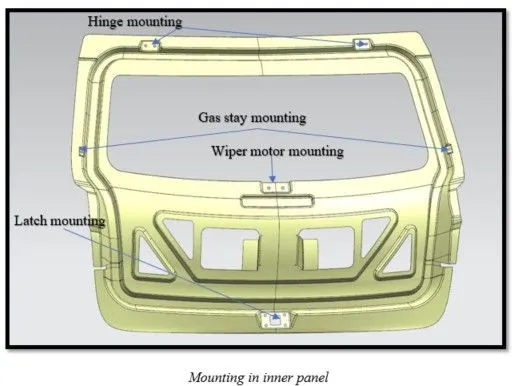
Creating necessary mounting in inner panel:
Mountings for gas stay, wiper motor, and for hinge and latch assembly are shown in below figure. Hinge and latch assembly mounting are done according to trajectory circle.
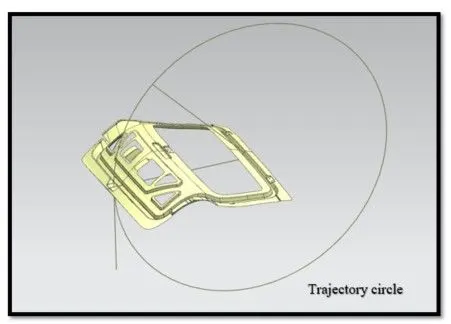
The positioning of latch and striker are done using sketching a circle with the center as the axis of the hinge which passes through the center of the striker. The latch striker must be perpendicular to the circle to get the correct orientation of the latch which enables it to close the backdoor perfectly.
Creating reinforcement:
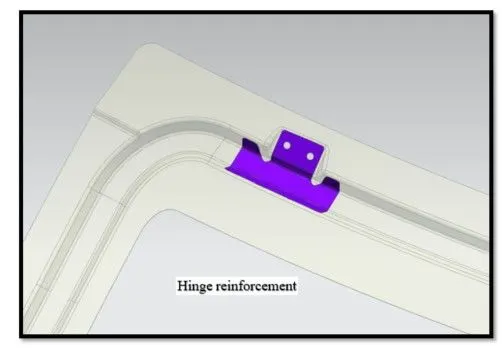
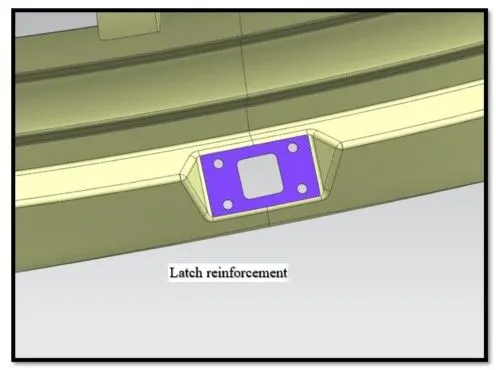
These are the parts that provides additional strengths to the structure locally. Emboss alone is not enough to handle the weight of the gas stay, wiper motor, hinges, etc. therefore these reinforcements are provided to increase its strengths on that area.
Following are all the reinforcements provided to the car backdoor:
Hinge reinforcement:
Latch reinforcement:
Gas stay reinforcement:
Wiper motor reinforcement:
Hemming:
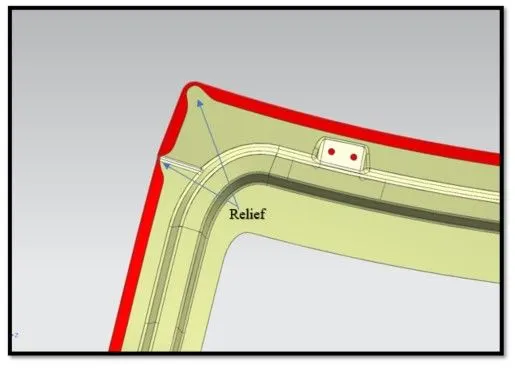
Creating relief at necessary areas:
Draft analysis:
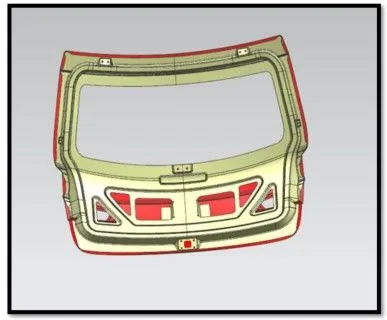
Draft Analysis is a method of checking the draft angle on various faces of a part in a particular direction. The draft angle should be positive for the feasibility of manufacturing the part. Generally, we take draft angle 7 degrees or greater than 7degrees for steel. The draft analysis was conducted for the following sections considering tooling direction as the vector.
OUTPUT:
CONCLUSION:
Hence, the backdoor is designed with all the necessary reinforcements and embosses along with considering all the important design criteria.