Design of backdoor
BACK DOOR DESIGN REPORT
INTRODUCTION
An essential component of a car's Body-in-White (BIW) structure, the tailgate or rear door offers access to the trunk or cargo area while also enhancing aerodynamics, safety, and appearance. I was given a base model for the outer panel in this assignment, which I had to tweak suitably while fully developing the interior panel in accordance with automotive standards and sound design principles.
This design task's primary goals were to create an inner panel with both structural and functional elements.
To design the inner panel to the final assembly as needed.
To use draft analysis to guarantee manufacturability.
To use design techniques like mastic seal cuts, embossing, and the right thickness.
DESIGN METHDOLOGY
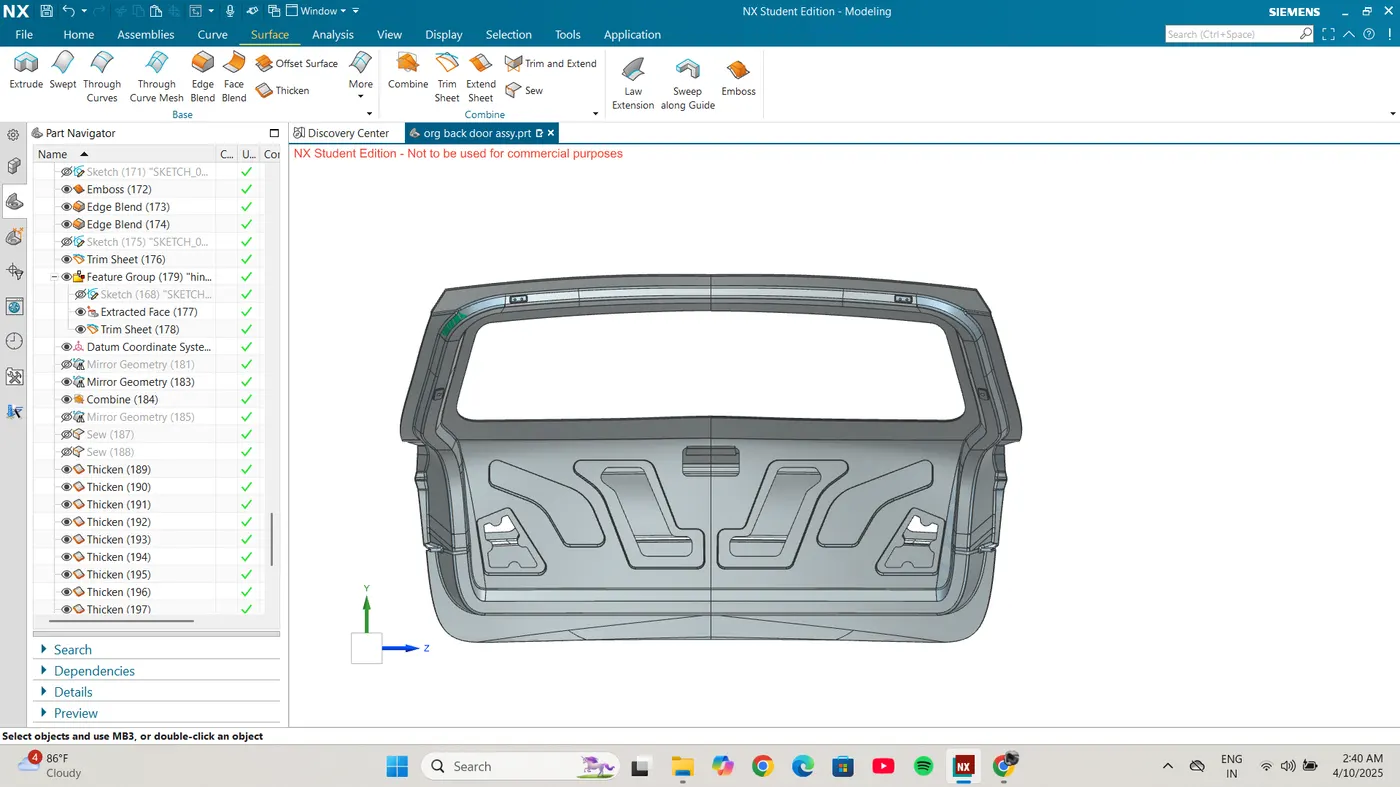
Outer Panel (Edited)
- The base file for the outer panel was provided. It was my responsibility to make small adjustments to it so that it supported accurate assembly and lined up with the inside panel.
Changes made included:
Verifying and improving the mounting locations so that the inner panel can be joined.
Ensuring symmetry and smooth curvature.
Verifying surface continuity and manufacturing viability.
- Following normal sheet metal design procedures, the outer panel's thickness was uniformly maintained and typically ranged 0.75 mm
Inner Panel (original design)
The majority of the structural loads are supported by the inner panel, which also has to hold the wiper motor, gas stays, hinges, and mastic areas for bonding with the outer panel. Important aspects of the design includeEmbosses - Added in the right places to increase stiffness and stop panel deformation from external forces or vibrations.
To prevent oil-canning, they are positioned strategically around mounting positions and expansive flat surfaces.
Mastic Seal Cutouts - Cutouts were positioned where adhesive materials called mastic sealants are used to join inner and exterior panels.
These non-welded regions offer stiffness and damping without significantly increasing weight.
Provisions for Mounting
Bosses and flanges were designed to support the following:
Hinges (upper corners)
Gas stay brackets
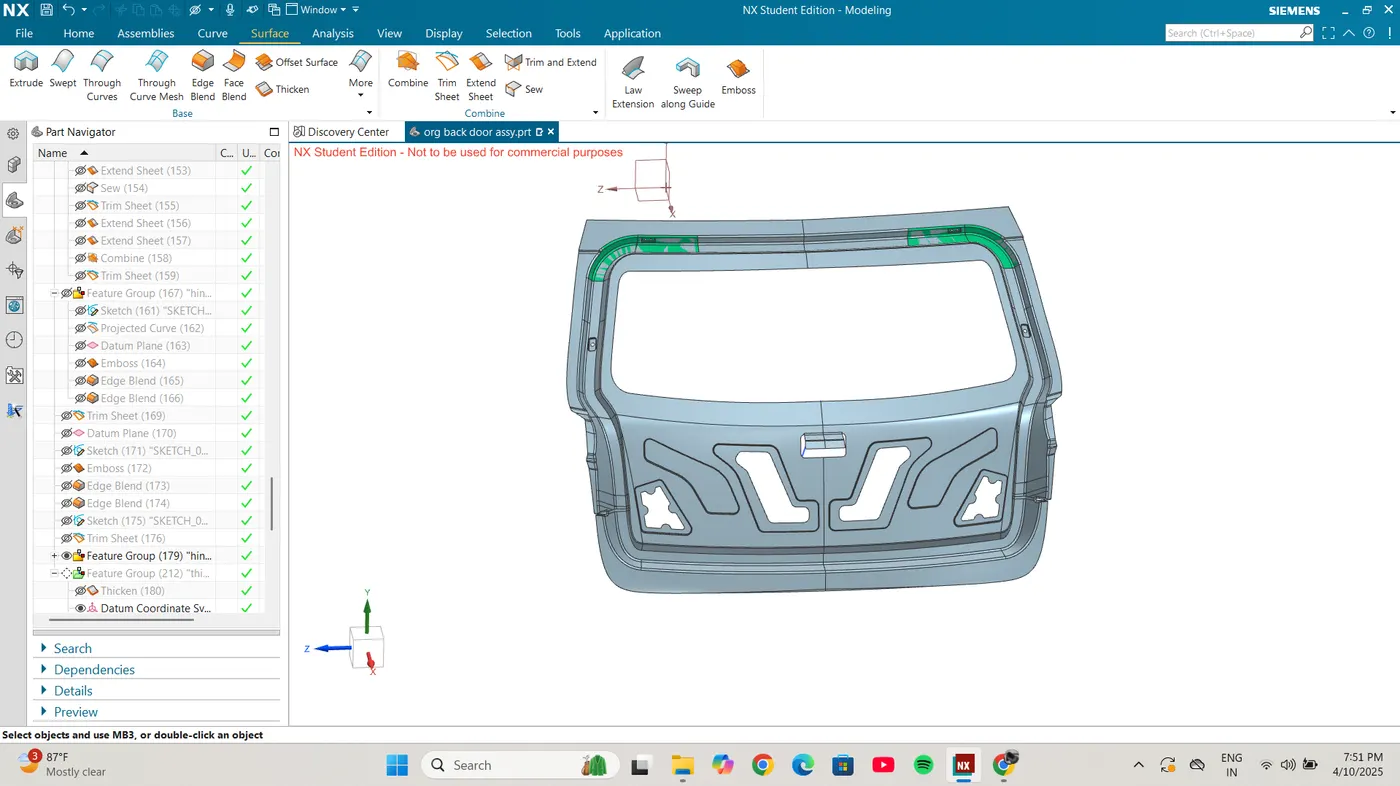
Thickness Application - Using the thickening tool, standard panel thickness is applied in accordance with the general automotive norm:
Inner panel: ~0.75—Features such as bosses and embosses were made sure to preserve tooling viability and material flow.
Analysis of the Draft
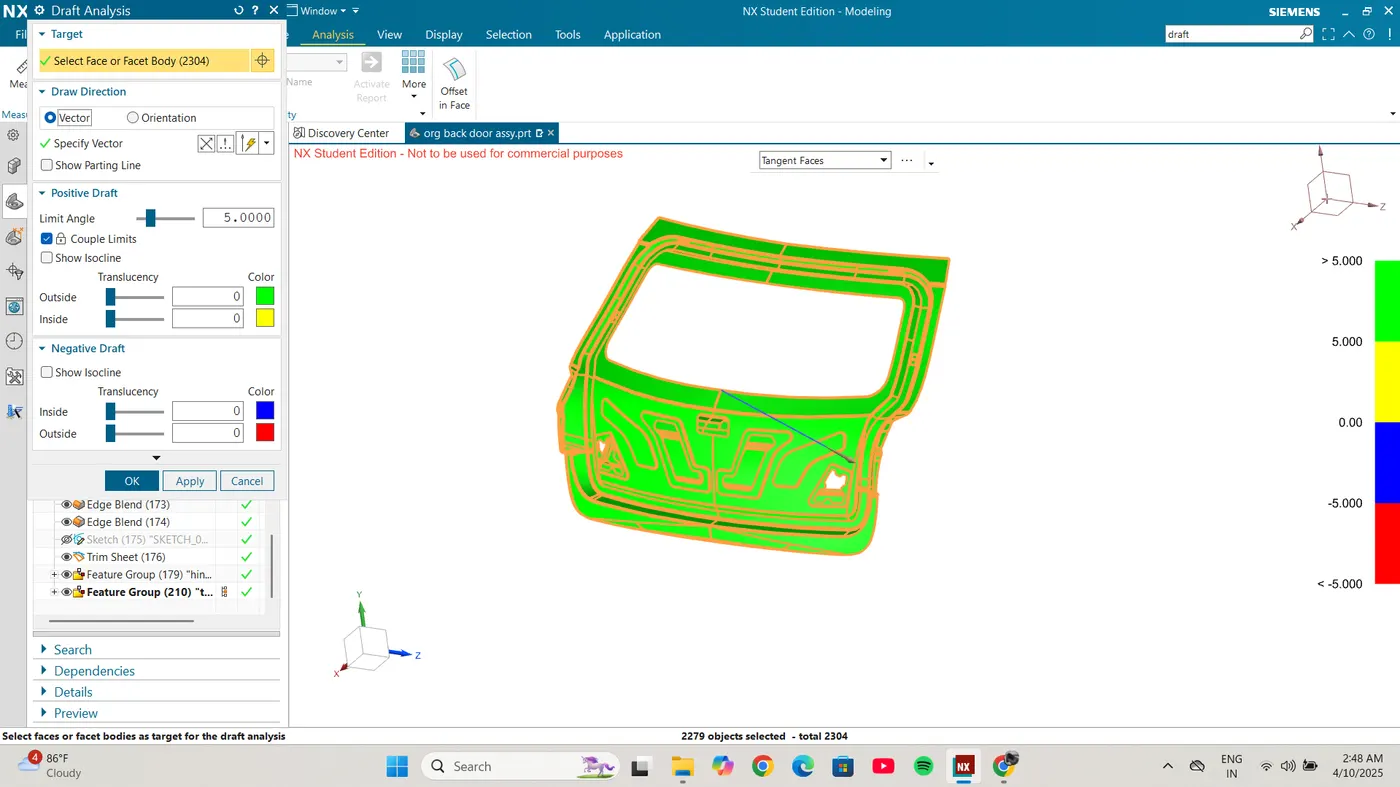
A draft analysis was carried out along the tooling direction (TOOLING AXIS WAS CREATED ) in order to guarantee manufacturability.
To guarantee at least a 7° positive draft, which is necessary for die removal during stamping, every face was examined.
- The model's successful completion of the draft check revealed: No undercuts, Accurate draft angles on vertical faces Smooth transition areas
Conclusion
The supplied outer panel was successfully altered, and a comprehensive interior panel with all the necessary design elements, such as embosses, mastic cuts, and mounting flanges, was created utilizing sound engineering techniques.
Through draft analysis, which produced flawless results, manufacturability was ensured.
The finished design satisfies industry requirements for a tailgate panel.