Design of backdoor
DESIGN OF TAILGATE
OBJECTIVE:
To design and assemble the tailgate outer panel upper and lower, tail gate inner panel and the required reinforcement from the given class A surface.
SOFTWARE USED:
Siemens NX12.0
WHAT IS TAILGATE?
Tailgates are one of the types of doors which are located next to the passenger seat, providing access to the baggage compartment. In most the cars these doors are open with the help of gas stay which in turn reduces the effort of lifting the door. In higher end models these opening are performed automatically by the electric motors. The material used for backdoor varies as per the price range of the vehicle. Most of the low-cost vehicles use steel as it is cheaper and use parts that are stamped using moulds. These parts are usually of uniform thickness and reinforcements are added to improve local strength where needed. The premium vehicles use aluminium parts which are usually die casted and hence can have variable thickness. This removes the need of reinforcements hence keeping the weight even lower as aluminium parts are lighter in comparison. On the contrary aluminium is more expensive than steel hence its applications are limited in cheaper vehicle. Currently due to the extensive use of plastics trims and plastic parts the cost of aluminium is affordable for the manufacturers in all price brackets. Use of aluminium reduces the overall weight of the component and hence the vehicle improving its fuel efficiency.
DESIGN CONSIDERATION:
The major design consideration of tailgate are as follows,
- Functional requirements Hinges and gas stays are functional requirements.
- Rear visibility criteria Federal Motor Vehicle Safety Standard (FMVSS), “Rear Visibility,” currently requires that vehicles be equipped with rear-view mirrors to provide drivers with a view of objects that are to their side or to their side and rear.
- Boot space in order to carry-on baggage, the tailgate should be designed in such a way that it should not cover up the boot space area.
- Rear crash regulations the tailgate should satisfy the Federal Motor Vehicle Safety Standard crash regulations.
- Easy accessibility of components like tail light and wiper motor from the inner panel.
- Mounts for wiper motor and tail light.
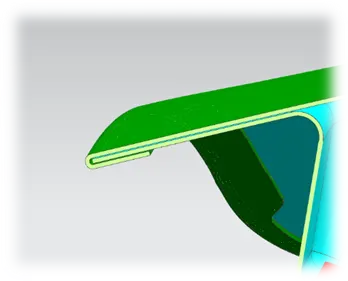
- Fit and clearances mastic sealants are placed in between the outer and inner panel as a joining technique, so a 5mm of gap is provided in between the outer and inner panel. 0.2mm clearance for sealing past between the hemming flanges and the inner panel.
- Sealing and joining techniques like mastics, hemming and spot welding if required in order to prevent water from entering the cabin we are introducing a sealing area where the sealing flange is provided on the inner panel and rubber mounting area is provided on the body side.
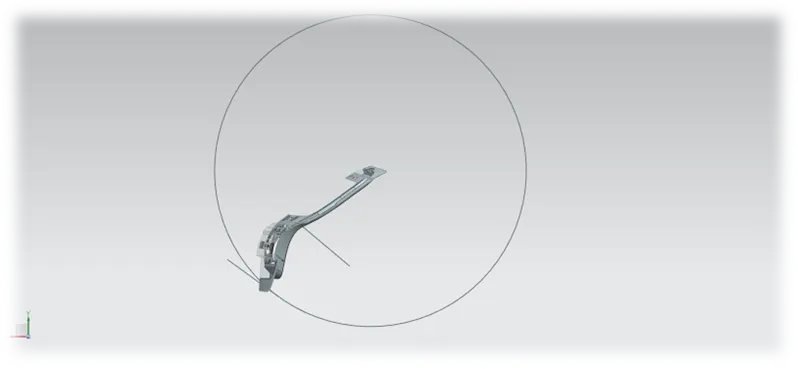
- Striker positions, the position of the hinge should be perpendicular to the latch when the latch and striker meets. for that, a circle is drawn from the centre of hinge axis to find the path of the striker. and positioned it perpendicular to the path.
TYPES OF DOOR OPENING:
Top mounted door, side mounted door and bottom mounted door. Bottom mounted doors are usually meant for heavy vehicles like trucks and pickup trucks, whereas the top and side mounted doors are used in passenger cars.
COMPONENTS OF BACK DOOR:
In this case I designed the top mounted door from the styling surface, so the main components are
- Outer panel upper
- Outer panel lower
- Inner panel
- Hinge reinforcements LH and RH
- Gas stay reinforcements LH and RH
- Latch reinforcement
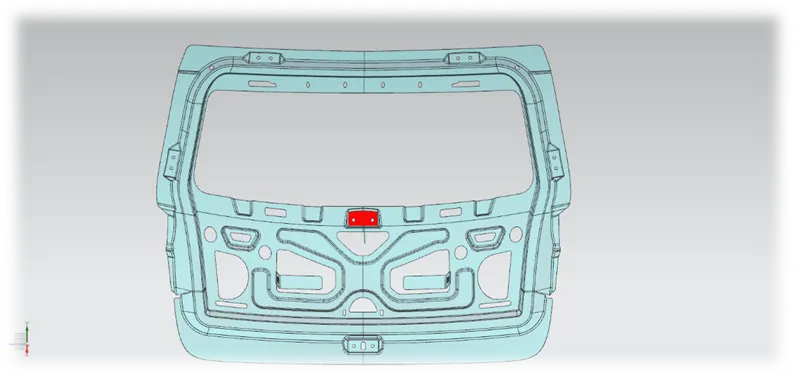
- Wiper motor reinforcement
Outer panel upper
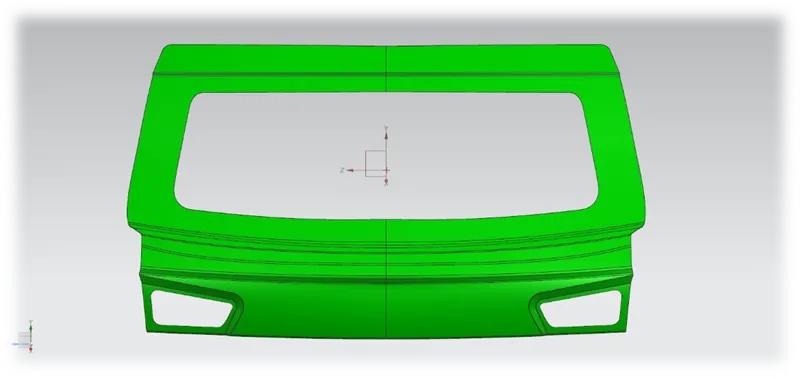
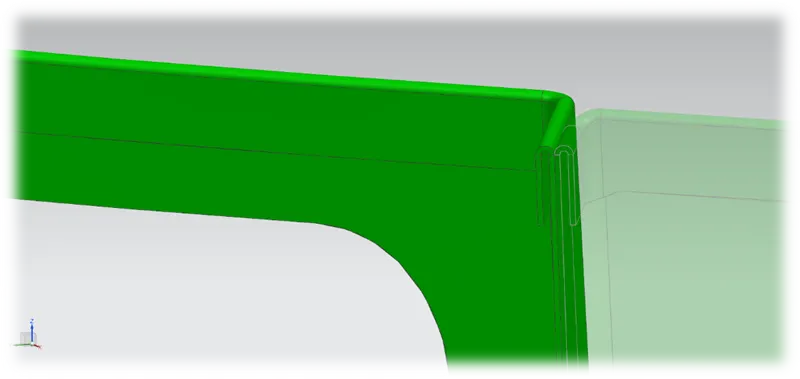
From the given outer styling surface the outer panel upper is designed with hemming flanges and necessary gap tolerances.
Outer panel lower
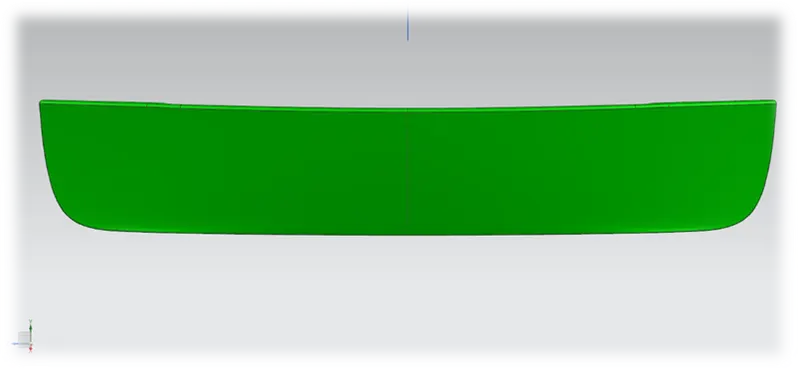
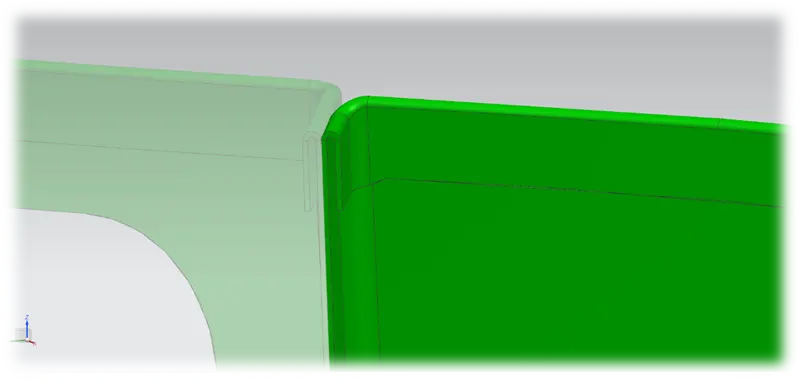
From the given styling surface the outer panel lower is designed witn hamming flanges and necessary gap tolerances.
Inner panel
Backdoor inner panel is made of either steel or aluminium. Some luxury car's inner panel are made of aluminium as it reduces the weight of the vehicle. The major drawback of aluminium is the thickness of the material is not uniform and manufacturing cost is high.
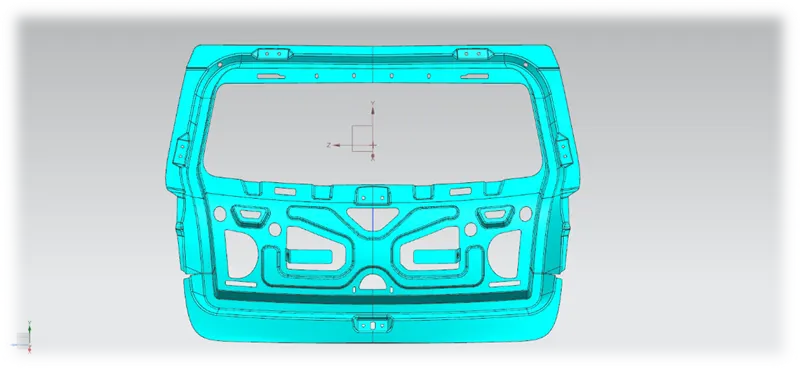
The embosses in the inner panel increases the strength of the inner panel locally and also reduces and diverges the forces while impact. The cut-outs are meant for the access of wiper motor and tail lamp from the inner panel.
Hinge reinforcements LH and RH
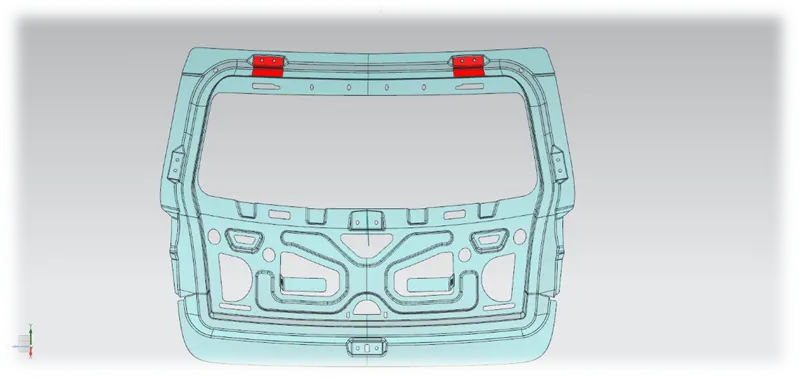
Hinge reinforcements support the weight of the back door while opening and closing. It also reduces the stress concentration of the sheet metal while fastening the hinges.
Gas stay reinforcements
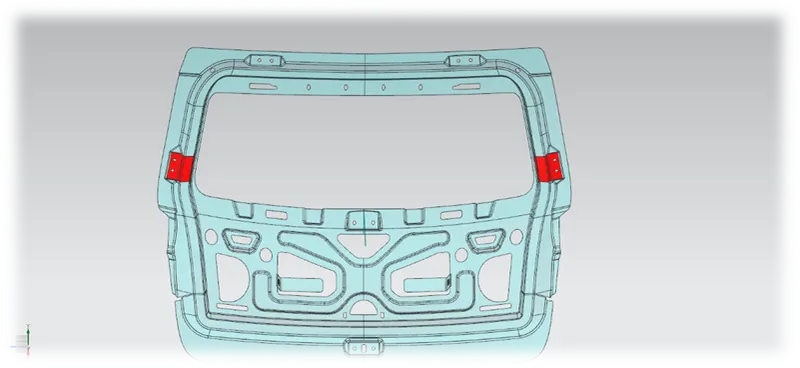
Gas stay reinforcements also does the similar job as of the hinge reinforcements. It supports the weight and reduces the stress concentrations.
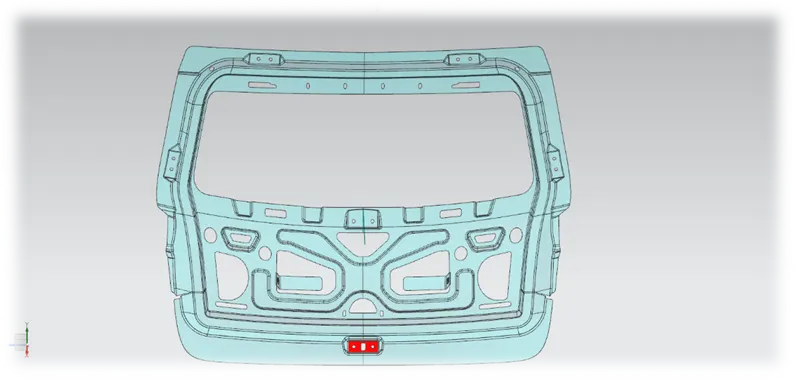
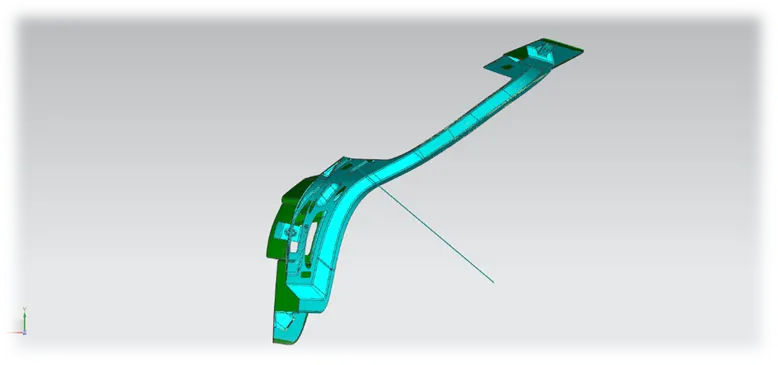
Latch reinforcement
Wiper motor reinforcement
DRAFT ANALYSIS:
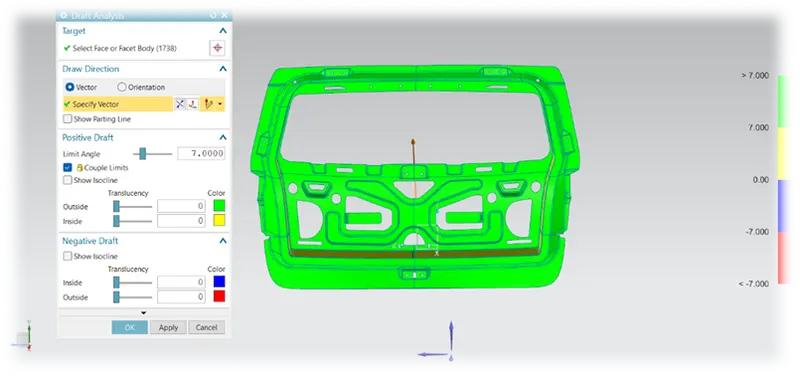
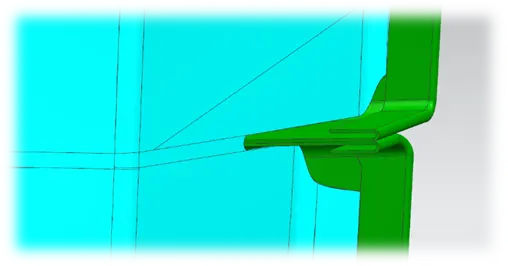
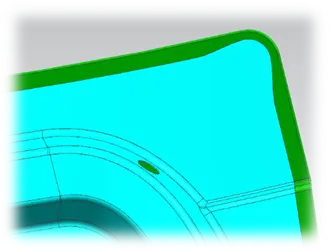
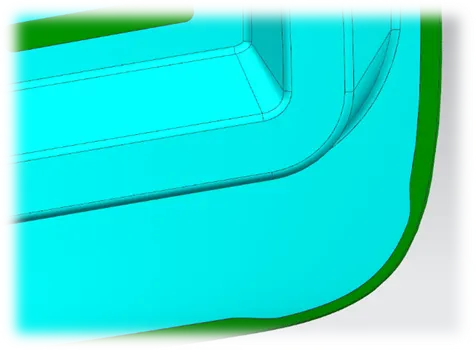
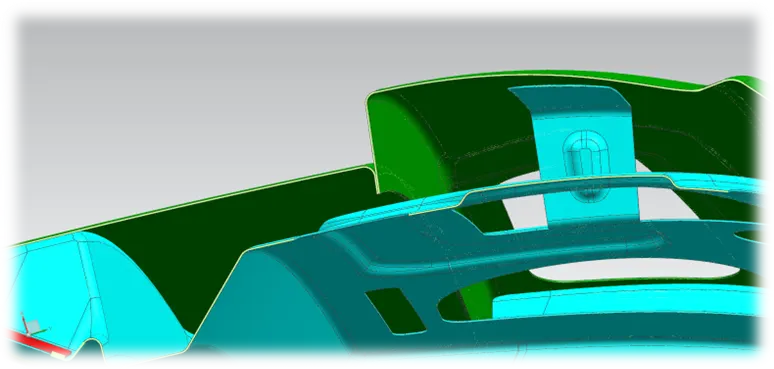
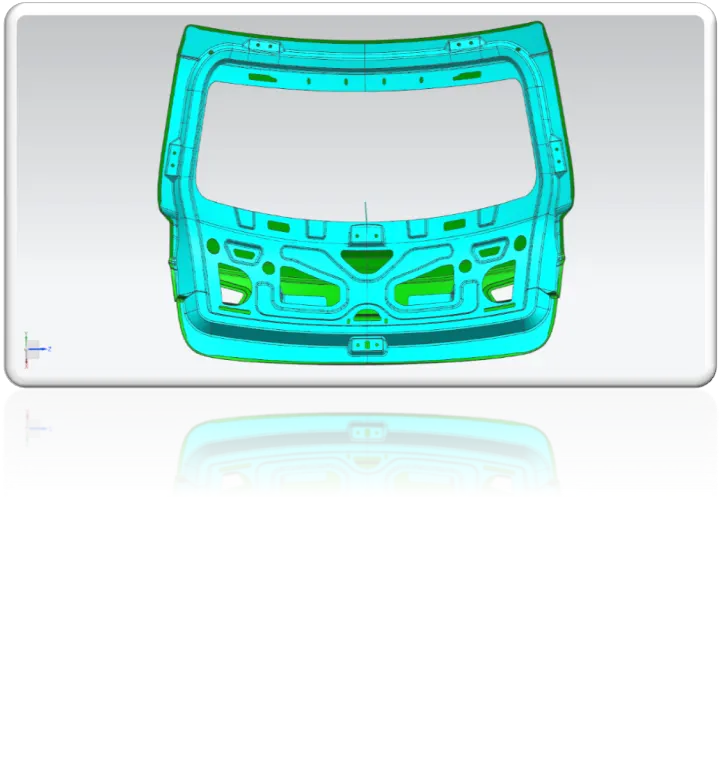
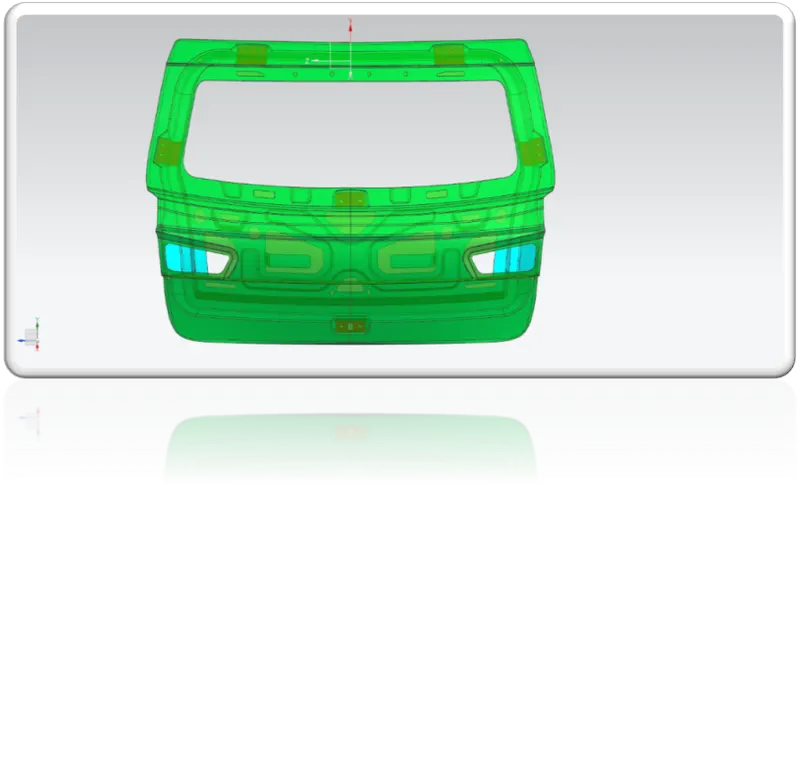
Sheet metals are manufactured by deep drawing process. If the designed parts have negative drafts it may results in tool wear or failure of the press tools. In order to overcome this issues, draft analysis is performed in software. Here the limit angle is given at 7degree which is the optimal angle for deep drawing. The shadowed parts at green are above the limit angle, whereas in some case its nearly 7degrees that’s is totally fine. The analysis is performed with respect to the tooling direction.
FINAL ASSEMBLY:
CONCLUSION:
Thus, the tailgate is designed as per the objective from the given class A surface.