Design of backdoor
AIM:
To develop the car Back door ( Tail Gate) with the provided styling surface to come up with a back door design, use appropriate design methodologies, and provide the necessary reinforcements and embosses by using NX12.
OBJECTIVE:
I. INTRODUCTION:
Nowadays more research are going to
design vehicle which uses fuel economically,
by light weight engineering using low density
material and with advance manufacturing and
joining technology and thereby reducing the
weight of vehicle.The growing demand for
more fuel efficient vehicle to reduce energy
consumption and air pollution provides a
challenge for the automotive industry. The best
way to increase fuel efficiency, without
sacrificing safety is done by employing
aluminum alloy and magnesium alloy within
the body of the cars, due to its higher strength
to weight ratio than that of conventional
steel.Porsche Become First OEM to use
Magnesium alloy as outer body panel and
introduced the model of 911 GT3 RS sports car
in Geneva international Motor show march
2015.Doors are typically hinged but sometimes
attached by other mechanisms such as tracks,
in front of an opening which is used for
entering and exiting a vehicle. A vehicledoor
can be opened to provide access to the opening
or closed to secure it. This door can be opened
manually, or powered electronically. Powered
door are usually found on minivans, high-end
cars, or modified cars. Unlike others types of
doors, the exterior side of the vehicle doors
contrast sharply from its interior side
1) The interior side is also known as the car
door inner panel.
2) The exterior side of the door is door outer
panel.
There are three different Architectures
by which the Car door panel are used to be
assemble,
1) Header Reinforcement
2) Separate Header
3) Integrated header
But here in this study we are using the
integrated header type construction.
To meet these required properties of highstrength and high-toughness, high strength
metals are used to replace conventional steel
for use in side door impact beams. Weight
reduction of cars is currently of great concernto manufacturers, due to the international
movement of regulations in terms of fuel
efficiency and gas emissions of passenger
vehicles. In order to reduce weight, there are
two important methods. One of these methods
is to redesign automobiles parts to optimize
their structure. By using thinning, hollowing,
mini type and compound parts, car weight can
be reduced. The other method is to replace
traditional materials, like mild steel, with
lightweight materials, such as aluminum alloy,
magnesium alloy and high strength steel, and
composite. Of these two methods, material
replacement is generally more efficient in
achieving a lightweight automobile than
structural modification.
In this study the structural modification
and impact absorption of material was
investigated using three different material
simultaneously using finite element analysis
and compared to best way to reduce structural
weight without sacrificing safety is to employ
aluminum alloy and magnesium alloy , due to
is higher strength to weight ratio than that of
conventional steel. Aluminum alloy and
Magnesium alloy are widely used in aerospace
and automotive industries. They are a useful
new candidate material for side impact, in
order to improve impact energy absorption
capacity and resistance plastic deformation
II. PROBLEM STATEMENT :
Materials for lightweight construction n
automotive engineering must meet complex
rquirements, however. It is essential to
combine good formability with high strength
in service, excellent corrosion resistance and
weld ability. The property criteria are as
follows for different variant.
III.LITERATURE REVIEW
Previous Study by research shows that
replacing of steel with composite material like
aluminum, carbon epoxy and S. glass epoxy
reduce the damage percentage of car and
increase the passenger safety and also the use
of E glass, S glass, epoxy material reduces the
weight, increase the cost but decrease the risk
of collision. The use of Cast magnesium for
side door inner panels can provide a good
combination of weight, functional,
manufacturing and economical requirements
.However several challenges exist including
casting technology for thin wall part design, multi material incompatibility and relatively
low strength than steel .And finally concluded
that 2mm magnesium design, through casting
process enablers, has met or exceeds all
stiffness requirement and part consolidation. It
addition, a corrosion mitigation strategy has
been established using industry accepted
galvanic isolation methods and coating
technology. The side impact force will be
considered with respect to tractional force, drag
force and Rear resistance.
Summarising testing with different load sequences with respect to dynamic properties and fatigue was
done for the front section of the BiW on the MAST. The focus was to measure the transfer functions
between accelerations and local strains to verify the proposed methods for the accelerations of this
kind of testing. It became obvious that an approach to evaluate local fatigue only on the acceleration
input signals of the test rig is not sufficient. A sensible approach to reduce test time is to measure the
transfer functions between the accelerations at different points of the system and local strains at the
hotspots. These transfer functions differ for different frequency areas. With these functions it is
possible to calculate the impact of a change of the load input accelerations (scaling of acceleration
values, increasing of frequencies, cutting of sections out of the load-time histories - omission) on the
damage content for the different sections of the test sample.
Additional tests under crash loads were performed using crash test facilities. The results were mainly
used to validate the results of the numerical based crash calculations of task 2.6. As real life crash tests
a front impact against a rigid barrier (according to Euro NCAP), a side pole impact (according to Euro
NCAP) and a modified rear impact (related to FMVSS301) were performed
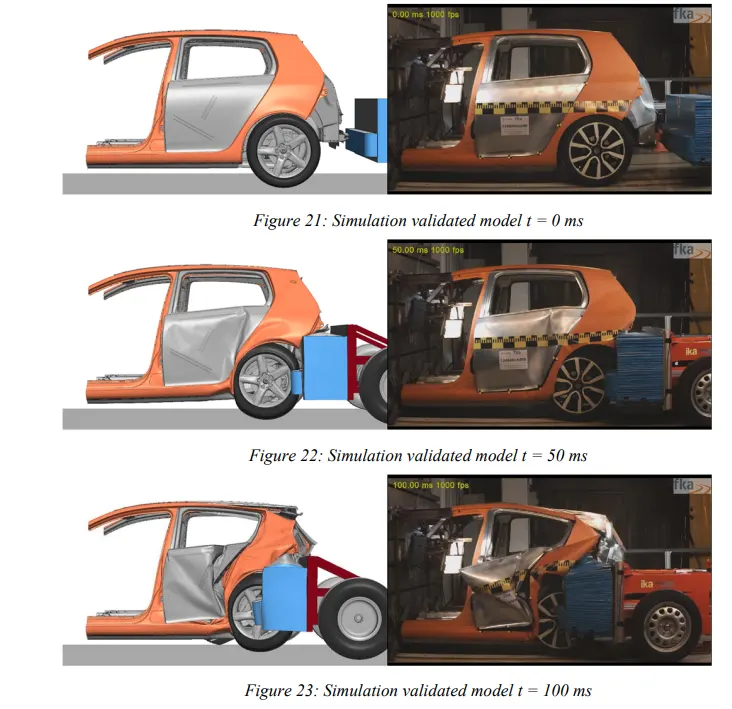
It can be concluded, that a good correlation is achieved in the frontal crash scenario. The main effects
are modelled and are comprehensible. Main divergences between the base model simulation results
and the test results are based on not expected failure in the main front long member material. Also the
designed connection between upper long member and shotgun was too weak. Further differences
occur in the behaviour of the tyre model. The tyres in the simulation behave a lot more elastic. This
can be explained by a closed air volume of the tyre model. A detailed model of the tyres was not
foreseen in the frame of the project. The main effects are adapted in the validated model and the
performance is confirmed.
Furthermore the BiW was tested regarding to NVH. The test setup consists of a BiW with and without
doors suspended by 4 air springs placed at the side skirt to create a free-free boundary condition and
excited by 2 shakers with uncorrelated random signals. The main focus of this work is to validate the
numerical results obtained within the work of task.The NVH studies performed and results obtained within the framework of this deliverable suggest that
the model of the BiW without attachments used in deliverable D2.6 is in good agreement with the
physically built BiW. This conclusion is drawn from the comparison of a simulated and an
experimental modal analysis of this BiW.
From all these investigations it can be inferred that the chosen materials mix and its application to the
mass market production are not unfeasible and only minor modifications are needed to fully withstand
with complex vehicle specifications that are currently set by the design department of the OEMs.
WP5
Magna was defined to build up one demonstrator vehicle including the doors and closures, the chassis
and the driver´s seat. During the project from simulation side the demand came up to test physical
bodies or modules (frontend, rear-end) to evaluate the simulation results. Due to this fact a frontend
module and a rear-end module and an additional complete body were built to evaluate the simulation
results. They were delivered to the institutes involved in testing.
Before making the prototypes and the demonstrator Magna was involved in defining and optimizing
the assembly sequences together with Benteler. This work was basis to be able to produce all the
needed modules with the defined budget and within the timeframe.
Magna also gave its input regarding joining techniques and made some sample testing with spot
welded aluminum sheets.
Jigs and devices based on the released design were developed and produced. Regarding the welding
seams in the floor area of the body, it was necessary to produce a turntable to rotate the complete body
upside down. It is forbidden to weld aluminum overhead because of the danger of molten material
falling onto the worker, on the one hand, and poor welding seam quality on the other.
The bodies and modules were produced on a measuring plate. That is the standard method for
producing bodies with a very limited edition to be cost efficient. Planning the prototype production we
saw that one challenge is the schedule and we had to produce in two shifts.
That is unusual because we had to teach two teams and handing over the data from one team to the
other was very important.
Finally the project gave us the chance to extend our know how in multi material application regarding
joining and prototyping. Following slides show a photo documentation of prototyping the body-inwhite demonstrators PT1 and PT2 for testing in work package WP4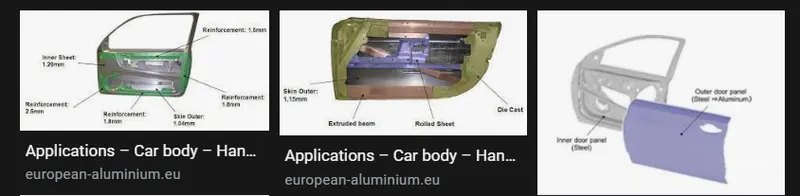
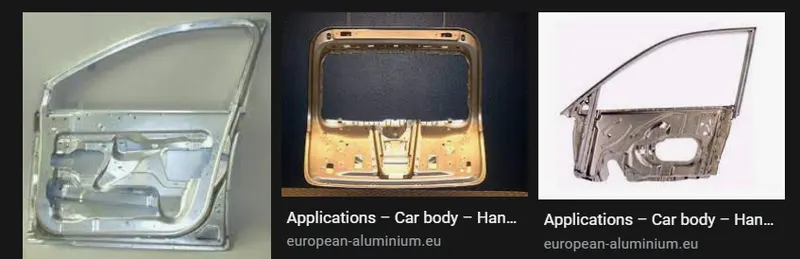
Demonstrator of hang-on parts (assemblies)
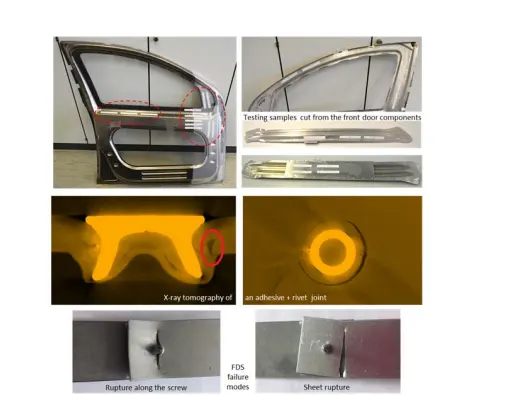
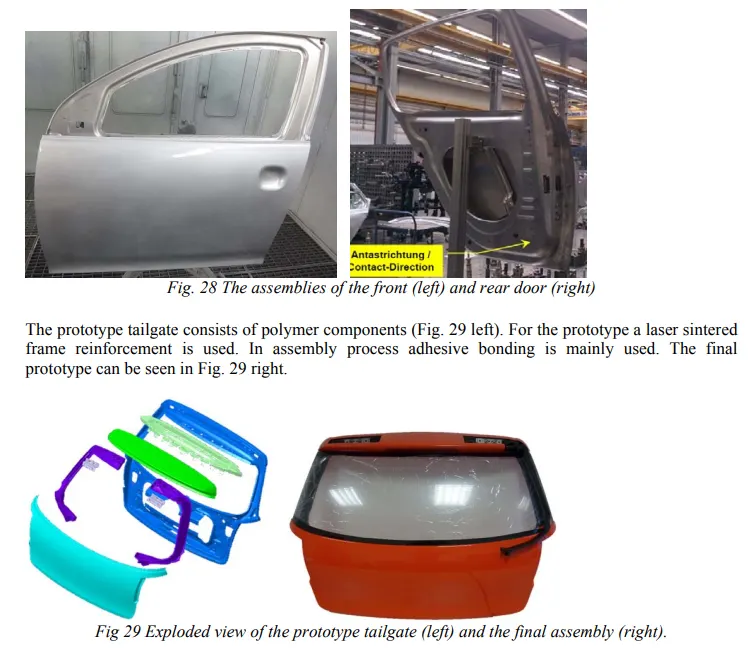
The components of both the front and rear doors are shown in Fig.27. Except the impact beam all
components are made of 5000 or 6000 aluminium alloys. They are formed at room temperature. The
one-piece inner panel of the front door uses a tailored welded blank of 2.0/1.2 mm. It is cold formed
with only one mould. In a series manufacturing process two moulds will be used to achieve better
quality. The impact beam of 7000 alloy can only be formed at elevated temperature. The forming
process is developed in a cooperation between Daimler, AMAG and Magna.The aluminium components are joined together by adhesive and rivets, remote laser welding, spot
welding and hemming.
BACK DOOR :
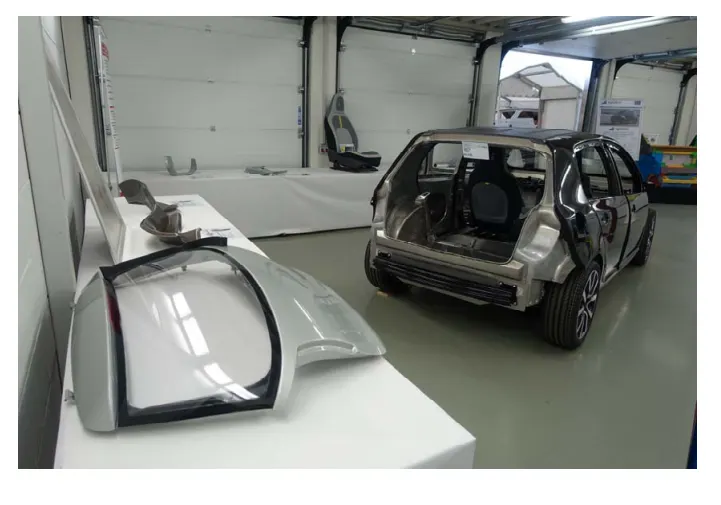
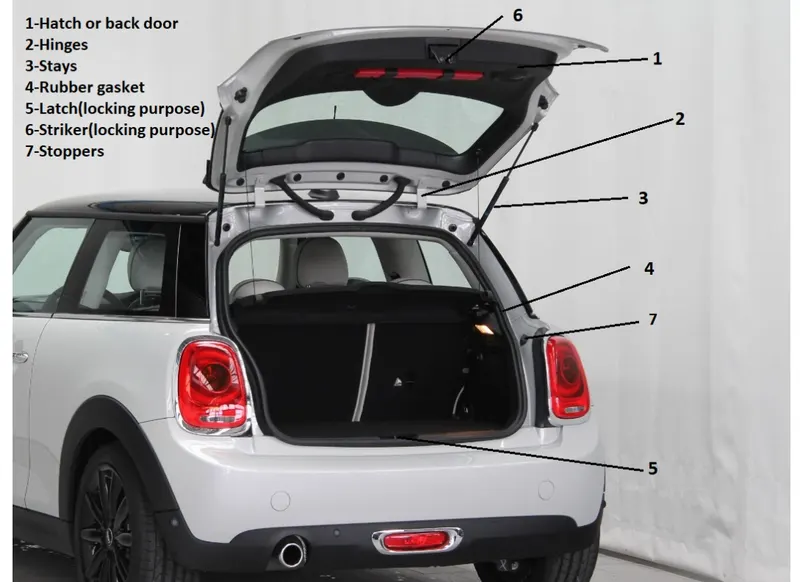
The Back door is typically hinged, but some varient attached by other mechanisms such as Track,
in front of an opening which is used for entering and exiting of a vehicle or inlet or outlet materials from a vehicle .
A Vehicle door can be opened to provide access to opening or closed to secure it.
These doors can be opened manually or powered electronically . That Powered doors are usually found on
mini-vans, high end cars or modified cars.
Types of Back Doors:
The types of Back Doors are divied by their Mounted Region positions of the vehicle . These types are
1.Top Mounted Back Doors
2.Side Mounted Back Doors
3.Bootom Mounted Back Doors.
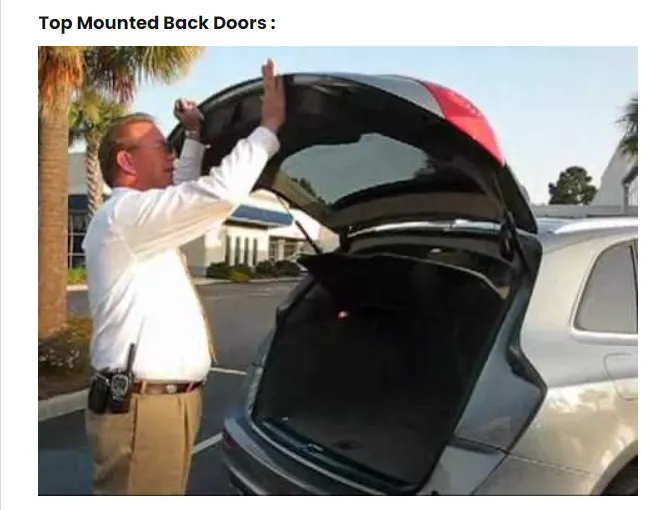
1.Top Mounted Back Doors:
These types of Back Doors are persent in Top position to opening edge Mounted from Top of the vehicle.
The basic types of vehicles from coupes to full-size sedans to crossover SUVs.(subcompact vehicles like Nissan Versa and Kia Rio) to compacts (Honda Civic, Toyota Corolla) to mid-size (Honda Accord, Nissan Altima), and full-size (Toyota Avalon, Dodge Charger). Luxury brands like Mercedes-Benz and Lexus have sedans in similar sizes as well.
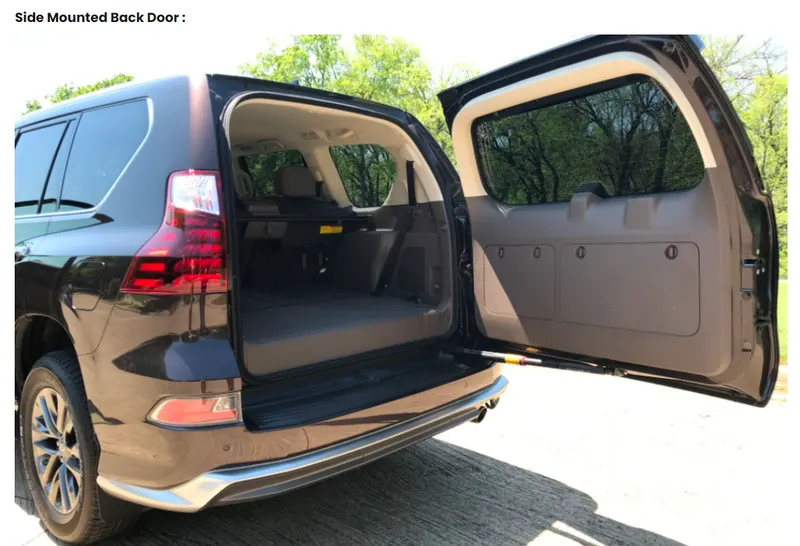
2.Side Mounted Back Doors:
These types of Back Doors are persent in Side position to opening edge Mounted from Side of the vehicle.
This type of back doors is used in a station wagon, pickup trunk and some of the spot utility vehicles.
Sliding doors follow tracks mounted in the doorframe and slide away from the opening, usually toward the back of the car. They aren’t as universal as conventional ones; you’ll mostly find sliding doors on vans, luxury models, and vintage cars. The majority of modern sliding doors open at the push of a button, which can be convenient when your arms are full.
Here some vehicles (mostly vans) featuring sliding doors:
- Honda Odyssey
- Nissan NV200
- Toyota Sienna
- Ford Transit Connect
- Kia Sedona
- Chrysler Pacifica
- Dodge Grand Caravan
- RAM ProMaster City
- BMW Z1
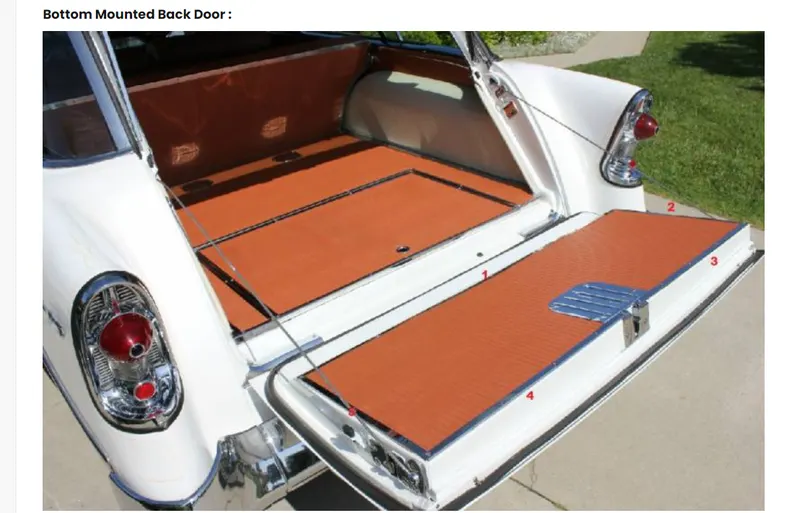
3.Bootom Mounted Back Doors:
These types of Back Doors are persent in Bootom position to opening edge Mounted from Bootom of the vehicle. eg :PEUGEOT 301, Honda Civic SiR II,
Contents
- 1. Scissor Doors
- 2. Gull-Wing Doors
- 3. Butterfly Doors
- 4. Suicide Doors
- 5. Sliding Doors
- 6. Pocket Doors
- 7. Swan Doors
- 8. Canopy Doors
- 9. Dihedral Doors
- 10. Front-Hinged Car Doors.
Design Consideration :
* Visibility Criteria
* Latch and Stricker Position
* Hing Position
* Gas Stay Postion
* Space Avaliblity
* Drain Holes
* Hemming and Relief Area's.
Comoponents of Back Door :
The Components of Back Door as follows,
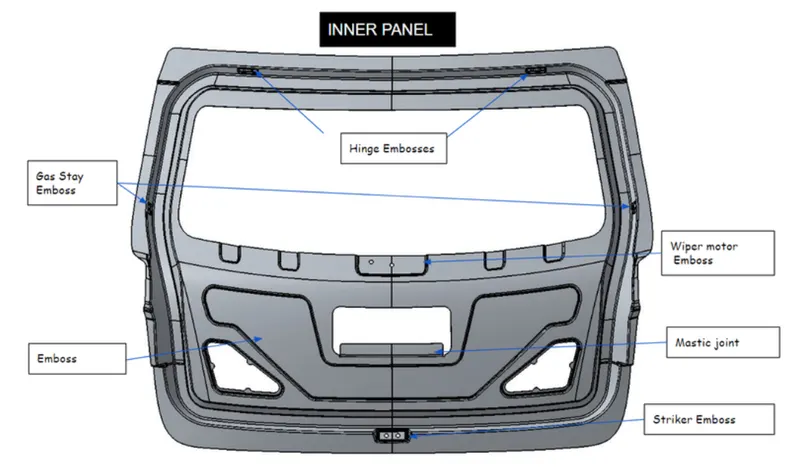
* Inner Panel
* Outer Panel
* Hing Reniforcement
* Latch and Stricker Reinforcement
* Gas Stay Reinforcement
* Wiper Motor Reinforcement.
Materials :
Here we have designed a back dooor for hatchback where the hinge at roof level .it,s similar to hood & side doors to
swinging /closer commondity in car. It's consists of Inner pannel & Outer Pannel .It is a very criticle component because of pedestrain safety luggaging space .
It's consists of Lacth & Striker Motor, Wiper Motor.
Both steel & aluminium are used in manufacturing the back door. Aluminium back doors are ligther in weight and has lesser number
of components as it has varying thickness it does not required reinforcements but steel backdoor is deep drawn with uniform thickness ,added reinforcement and
therefore it is heavier than aluminium backdoor .Since Steel cost is less when compared to aluminium steel is mostly prefered.
Outer Pannel:
Outer Pannel is the styling surface of the Back Door .It is the design of other parts of the back door.
Primarily the inner pannel . It acts as the outer cover and deals with aesthetic of the car.
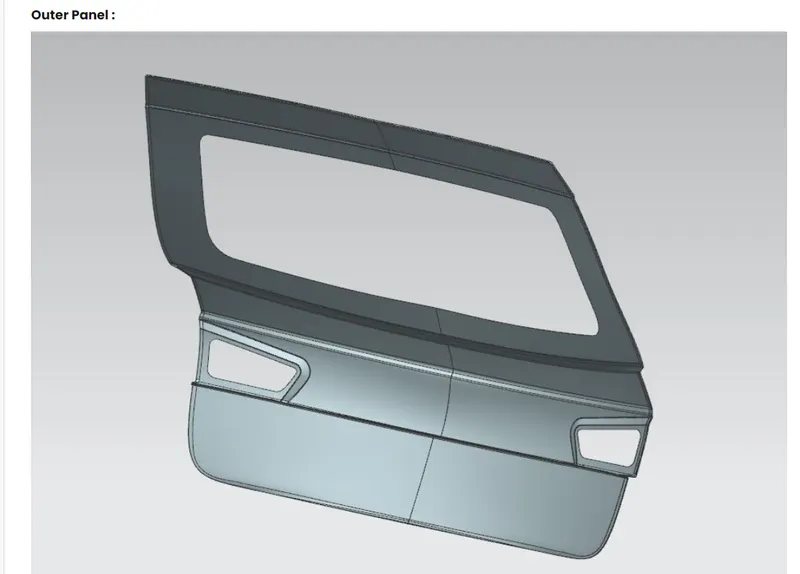
Inner Pannel:
Inner pannel provides strength to the back door. It's thickness is about 0.75mm. The Inner pannel reinforcement
and emboss to provided strength to the back door. There are many cases where the inner pannel is subjected to stress due to frequents
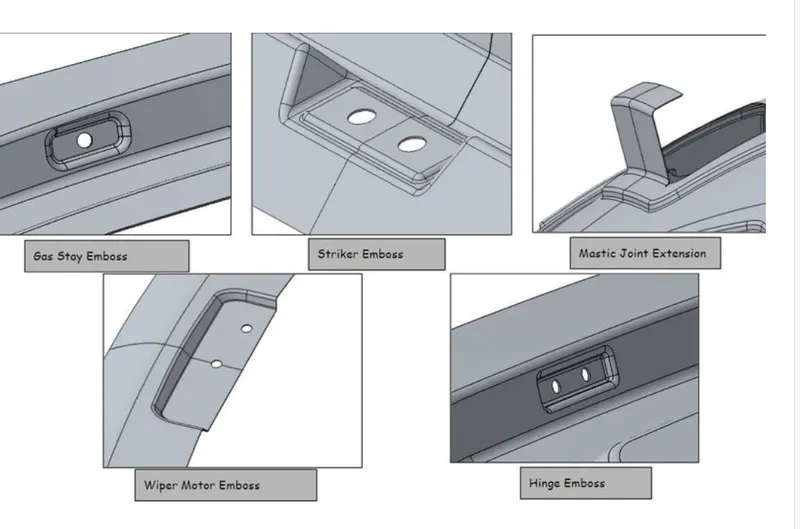
opening and slamming. The inner pannel consists of latch and striker actuator .Wiper motor actuator ,Trim mounting ,Hing and Gas stay emboss, V- emboss ,
Latch ect and therfore the necessary cut are provided .Various reinforcement are also spot welded to the inner pannel.
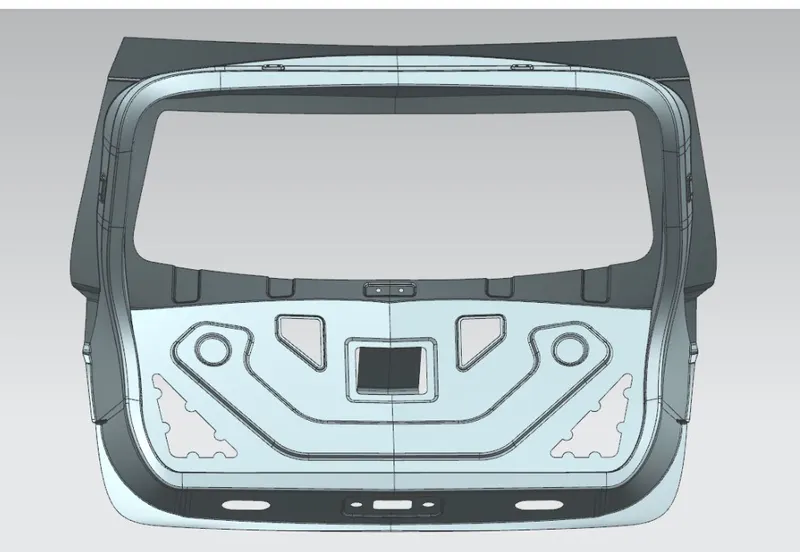
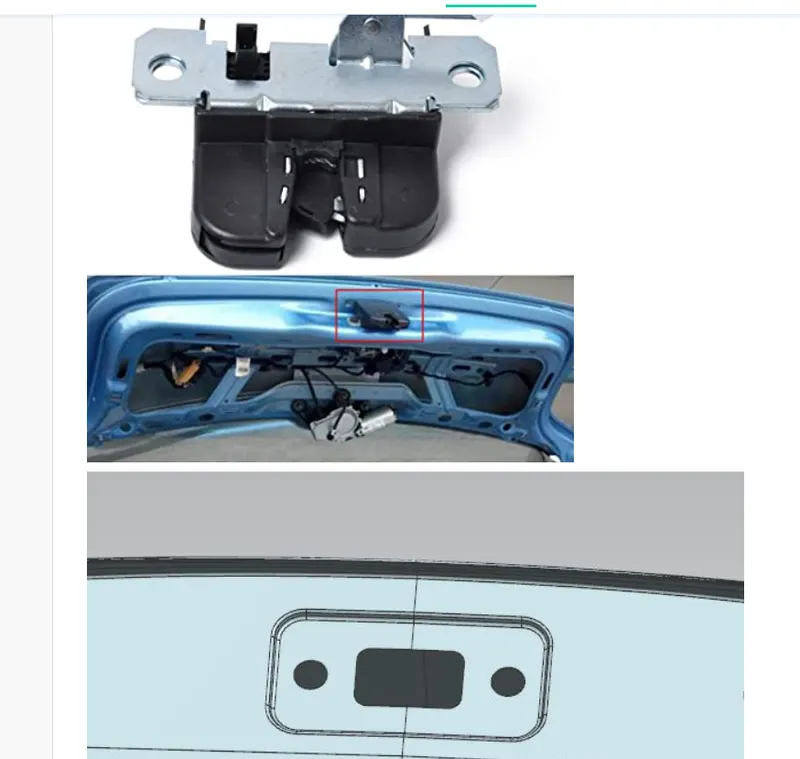
Latch Reinforcement:
A latch is not the same as the locking mechanism of a door or window, although often they are found together in the same product.
Latch range range in complexity from flexible one- piece flat spring of metal or plastic , such as to keep blow molded plastic power tool.
It case to closed, to mulit -point cammed Latches used to keep large doors closed.
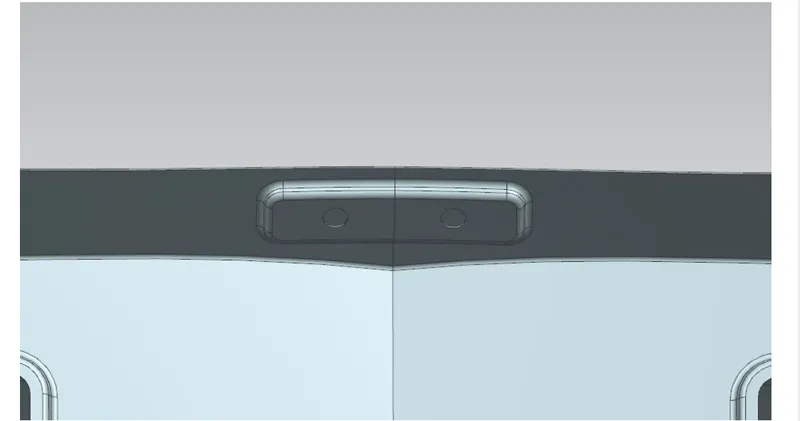
Wiper Motor Reinforcement:
It is small electric motor which is mounted in the rear Tail gate. It is used to clean the wind shied for clear visiability.
Force Distribustion:
When the car hited at rear end, the force which acted should react outside. The Y emboss which is help to move the force to the force to the outer end.
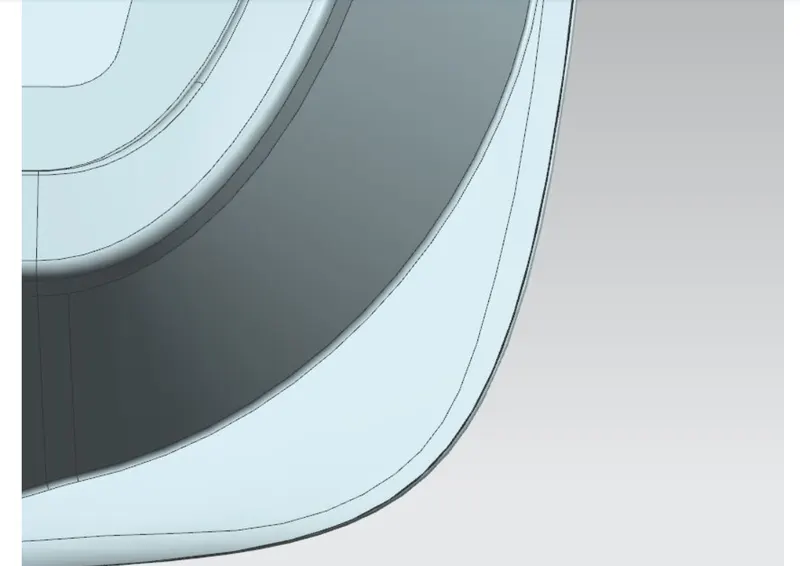
Corner Relief :
Relif helps to control sheet metal material behavior and to prevent unwanted deformation during unbend operation .So,here I gave two cornor relief for Back Door.
Hinge Reinforcement:
Hinge enables the opening and closing of the back door. One end of the hinge is fixed on the back door and the other end on the roof on both sides.
Hinge can be placed outside or inside the back door. The position of the hinges are determined by the mid point of axis of the hinges called as hinge axis point,
Which should be alined with latch and strikes through the trajactory of the back door opening and closing. if the strike is exactly perpendicular to trajactory,
then the hing can be fixed according to the inner pannel.
Gas stay reinforcement:
Gas stay is device used for supporting the back door in it's open position. Gas stay requires no man power and it's engaged
into support postion automatically as the back door opens. One end gas stay is fixed on the back door and the other end on the body side
or on the back door stationary area. Embossing is provided at the gas stay mounting area to compensate for the function holes punched.
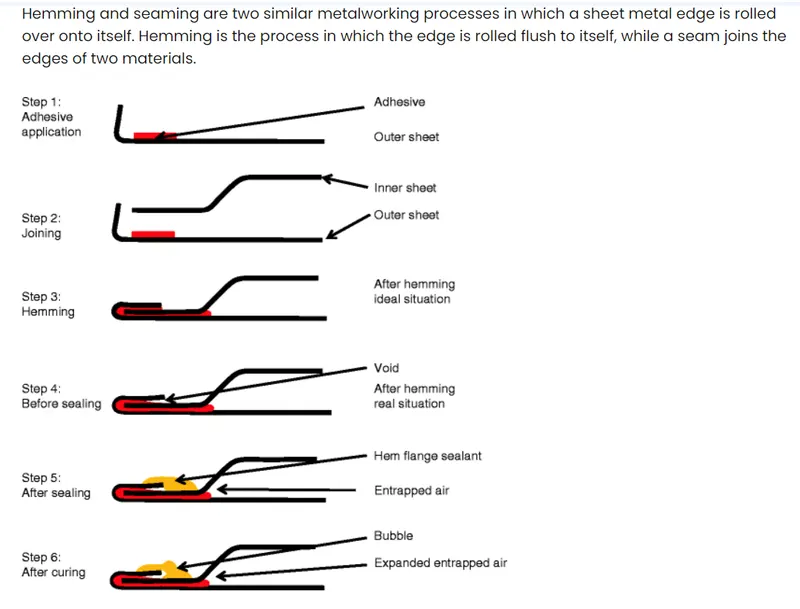
Hemming:
Hemming is a forming operation in which the edges of the sheet are folded or folded over another part in order to achieve a tight fit.
Normally hemming opertions are used to connect parts together, to improve the appearance of a part and to reinforce part edges.
There is a 0.2mm gap between the two pannels and 1-2mm clearance between the edge of the inner pannel.
These space is provided for the sealent to spread properly between the pannels after the Hemming process.
Relief :
The corner relief is given to the sheet metal inorder to prevent deformation during un bend operation.
Emboss:
An embossing is a metal forming process in which a high pressure is applied on a die to make a imprint on the working surface.
The imprint can be raised or sunked, in this process .It assumed that the metal thickness remains the same while embossing.
Thoughout the inner pannel we provide different embosses. We can increase the stiffness of the inner pannel through these embosses .
The shape and size of the embosses also determines the directions of the force distribution resulted from frontal collision.
These force should be always distributed away from the passengers .
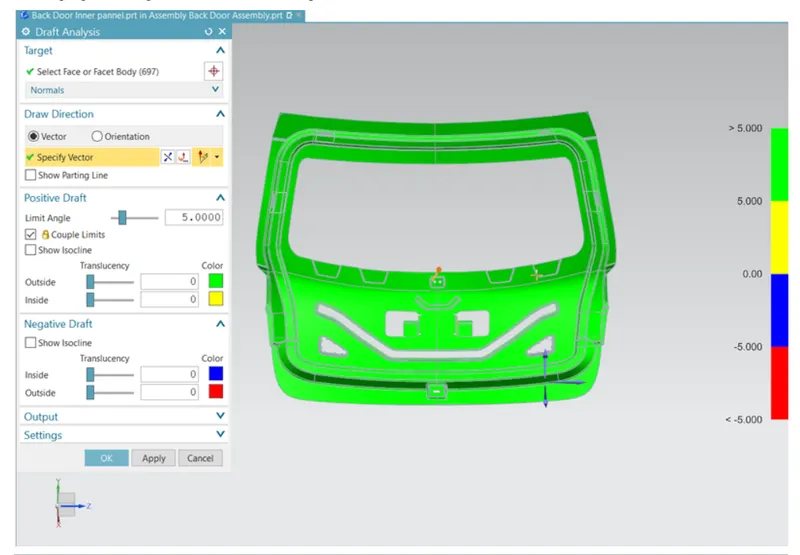
Draft Analysis :
Draft analysis helps to verify wheather the product, will be easily removed from the tool. When designing a product then need to be
angled slightly so slightly so that the can be pulled away from object easily without deforming or damaging .This angle is called draft angle.
Conclusion :
Thus the Back Door is designed from the given styling surface with necessary reinforcement and emboss.