Design of backdoor
Back Door:
BACK DOOR
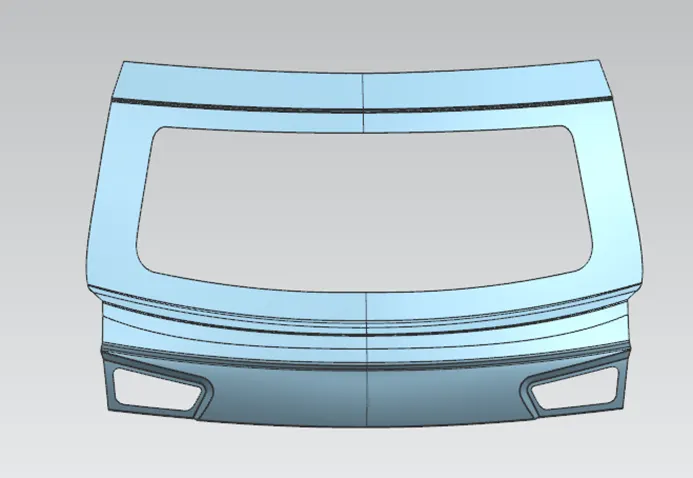
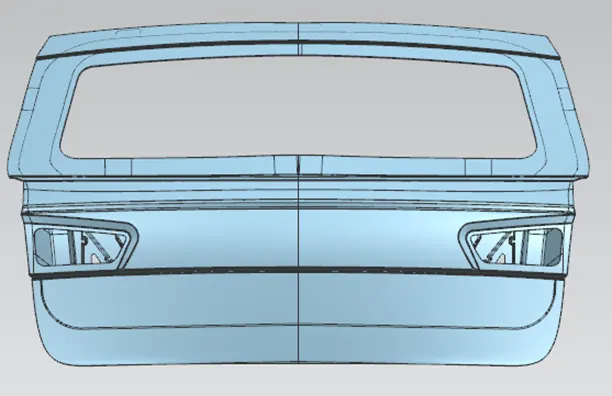
AIM: To design a back door of a car by using given outer class A surface in NX CAD Software.
Introduction:
Back door of the car is also known as Tailgate. This is a critical part for back impacts occurs on the accidents, which should be ensured that crash wouldn’t injured the passengers. Back door consists of one inner panel and two outer panel. Most of the time the back doors are made from steel or aluminum based on the budget of the car the material is selected. In case of the aluminum the strength of the back door would be stronger therefore reinforcement is not required indeed which will reduce overall weight of the part. But an aluminum a bit expensive than steel.
All high-end cars use the aluminum panel with more strength and lesser weight. Inner panel consists of hinge reinforcement, Gas stay reinforcement, Latch and Striker reinforcement and Wiper motor reinforcement.
Sheet metal is metal formed by an industrial process into thin, flat pieces. Sheet metal is one of the fundamental forms used in metalworking, and it can be cut and bent into a variety of shapes. Thicknesses can vary significantly; extremely thin sheets are considered foil or leaf, and pieces thicker than 6 mm (0.25 in) are considered plate steel or "structural steel".
Sheet metal is available in flat pieces or coiled strips. The coils are formed by running a continuous sheet of metal through a roll slitter. Fasteners that are commonly used on sheet metal include clecos, rivets, and sheet metal screws.
Different Sheetmetal process will take place while manufacturing the car parts some of the common processes are
#1) Curling
Curling is a sheet metal forming process that’s used to smooth out the otherwise sharp and rugged edges of sheet metal. Sheet metal often contains sharp edges with “burrs” after it’s initially produced. Curling is a forming process that involves de-burring sheet metal to produce smooth edges.
#2) Bending
Companies typically perform bending on sheet metal using either a brake press or similar machine press. The sheet metal is placed over a die block, at which point a punch press down onto the sheet metal. Bending doesn’t actually create holes in sheet metal. Rather, it lives up to its namesake by “bending” sheet metal in the shape of the die.
#3) Ironing
Sheet metal may also be ironed to achieve a uniform thickness. Most aluminum cans, for instance, are made of ironed aluminum. In its raw state, the aluminum sheet metal is too thick for beverage cans, so it’s ironed to achieve a thinner, more uniform composition. Ironing involves the use of a punch to force sheet metal between two dies.
#4) Laser Cutting
Laser cutting has become an increasingly common sheet metal forming process in recent years. With laser cutting, sheet metal is exposed to a high-powered laser that burns holes in the metal. It’s a faster and more precise cutting method that can even be performed automatically using a computer numerically controlled (CNC) laser cutting machine.
#5) Hydroforming
A lesser-known sheet metal forming process is hydroforming. Like deep drawing, hydroforming involves stretching the blank over a die. So, what’s the difference between hydroforming and deep drawing? The key difference between these two processes is that deep drawing requires multiple draw reductions, whereas hydroforming is performed in just one step.
#6) Punching
Punching is a sheet metal forming process that involves the use of a punch and die set to create holes in sheet metal. The sheet metal is placed between the punch and die. Next, the punch presses down and through the sheet metal to create a hole.
#7) Hemming and seaming
Hemming is a process of folding the edge of sheet metal onto itself to reinforce that edge. Seaming is a process of folding two sheets of metal together to form a joint.
#8) Incremental sheet forming
Incremental sheet forming or ISF forming process is basically sheet metal working or sheet metal forming process. In this case, sheet is formed into final shape by a series of processes in which small incremental deformation can be done in each series.
#9) Laser cutting
Sheet metal can be cut in various ways, from hand tools called tin snips up to very large powered shears. With the advances in technology, sheet metal cutting has turned to computers for precise cutting. Many sheet metal cutting operations are based on computer numerically controlled (CNC) laser cutting or multi-tool CNC punch press.
CNC laser involves moving a lens assembly carrying a beam of laser light over the surface of the metal. Oxygen, nitrogen or air is fed through the same nozzle from which the laser beam exits. The metal is heated and burnt by the laser beam, cutting the metal sheet.[21] The quality of the edge can be mirror smooth and a precision of around 0.1 mm (0.0039 in) can be obtained. Cutting speeds on thin 1.2 mm (0.047 in) sheet can be as high as 25 m (82 ft) per minute. Most laser cutting systems use a CO2 based laser source with a wavelength of around 10 µm; some more recent systems use a YAG based laser with a wavelength of around 1 µm.
#10) Photochemical machining
Photochemical machining, also known as photo etching, is a tightly controlled corrosion process which is used to produce complex metal parts from sheet metal with very fine detail. The photo etching process involves photo sensitive polymer being applied to a raw metal sheet. Using CAD designed photo-tools as stencils, the metal is exposed to UV light to leave a design pattern, which is developed and etched from the metal sheet.
#11) Perforating
Perforating is a cutting process that punches multiple small holes close together in a flat workpiece. Perforated sheet metal is used to make a wide variety of surface cutting tools, such as the Sur form.
#12) Press brake forming
This is a form of bending used to produce long, thin sheet metal parts. The machine that bends the metal is called a press brake. The lower part of the press contains a V-shaped groove called the die. The upper part of the press contains a punch that presses the sheet metal down into the V-shaped die, causing it to bend. There are several techniques used, but the most common modern method is "air bending". Here, the die has a sharper angle than the required bend (typically 85 degrees for a 90-degree bend) and the upper tool is precisely controlled in its stroke to push the metal down the required amount to bend it through 90 degrees. Typically, a general-purpose machine has an available bending force of around 25 tons per meter of length. The opening width of the lower die is typically 8 to 10 times the thickness of the metal to be bent (for example, 5 mm material could be bent in a 40 mm die). The inner radius of the bend formed in the metal is determined not by the radius of the upper tool, but by the lower die width. Typically, the inner radius is equal to 1/6 of the V-width used in the forming process.
The press usually has some sort of back gauge to position depth of the bend along the workpiece. The back gauge can be computer controlled to allow the operator to make a series of bends in a component to a high degree of accuracy. Simple machines control only the backstop, more advanced machines control the position and angle of the stop, its height and the position of the two reference pegs used to locate the material. The machine can also record the exact position and pressure required for each bending operation to allow the operator to achieve a perfect 90-degree bend across a variety of operations on the part.
#13) Punching
Punching is performed by placing the sheet of metal stock between a punch and a die mounted in a press. The punch and die are made of hardened steel and are the same shape. The punch is sized to be a very close fit in the die. The press pushes the punch against and into the die with enough force to cut a hole in the stock. In some cases, the punch and die "nest" together to create a depression in the stock. In progressive stamping, a coil of stock is fed into a long die/punch set with many stages. Multiple simple shaped holes may be produced in one stage, but complex holes are created in multiple stages. In the final stage, the part is punched free from the "web".
A typical CNC turret punch has a choice of up to 60 tools in a "turret" that can be rotated to bring any tool to the punching position. A simple shape (e.g., a square, circle, or hexagon) is cut directly from the sheet. A complex shape can be cut out by making many square or rounded cuts around the perimeter. A punch is less flexible than a laser for cutting compound shapes, but faster for repetitive shapes (for example, the grille of an air-conditioning unit). A CNC punch can achieve 600 strokes per minute.
A typical component (such as the side of a computer case) can be cut to high precision from a blank sheet in under 15 seconds by either a press or a laser CNC machine.
#14) Roll forming
A continuous bending operation for producing open profiles or welded tubes with long lengths or in large quantities.
#15) Rolling
Rolling is metal working or metal forming process. In this method, stock passes through one or more pair of rolls to reduce thickness. It is used to make thickness uniform. It is classified according to its temperature of rolling:[23]
- Hot rolling: in this temperature is above recrystallisation temperature.
- Cold rolling: In this temperature is below recrystallisation temperature.
- Warm rolling: In this temperature is used is in between Hot rolling and cold rolling.
#16) Spinning
Spinning is used to make tubular (axis-symmetric) parts by fixing a piece of sheet stock to a rotating form (mandrel). Rollers or rigid tools press the stock against the form, stretching it until the stock takes the shape of the form. Spinning is used to make rocket motor casings, missile nose cones, satellite dishes and metal kitchen funnels.
#17) Stamping
Stamping includes a variety of operations such as punching, blanking, embossing, bending, flanging, and coining; simple or complex shapes can be formed at high production rates; tooling and equipment costs can be high, but labor costs are low.
Alternatively, the related techniques repoussé and chasing have low tooling and equipment costs, but high labor costs.
#18) Water jet cutting
A water jet cutter, also known as a waterjet, is a tool capable of a controlled erosion into metal or other materials using a jet of water at high velocity and pressure, or a mixture of water and an abrasive substance.
#19) Wheeling
The process of using an English wheel is called wheeling. It is basically a metal working or metal forming process. An English wheel is used by a craftsperson to form compound curves from a flat sheet of metal of aluminum or steel. It is costly, as highly skilled labour is required. It can produce different panels by the same method. A stamping press is used for high numbers in production.
Materials which will be used for sheet are
#1) Stainless steel
Grade 304 is the most common of the three grades. It offers good corrosion resistance while maintaining formability and weldability. Available finishes are #2B, #3, and #4. Grade 303 is not available in sheet form. Grade 316 possesses more corrosion resistance and strength at elevated temperatures than 304. It is commonly used for pumps, valves, chemical equipment, and marine applications. Available finishes are #2B, #3, and #4.
Grade 410 is a heat treatable stainless steel, but it has a lower corrosion resistance than the other grades. It is commonly used in cutlery. The only available finish is dull.
Grade 430 is a popular grade, low-cost alternative to series 300's grades. This is used when high corrosion resistance is not a primary criterion. Common grade for appliance products, often with a brushed finish.
#2) Aluminum
Aluminum, or aluminum in British English, is also a popular metal used in sheet metal due to its flexibility, wide range of options, cost effectiveness, and other properties. The four most common aluminum grades available as sheet metal are 1100-H14, 3003-H14, 5052-H32, and 6061-T6.
Grade 1100-H14 is commercially pure aluminum, highly chemical and weather resistant. It is ductile enough for deep drawing and weldable, but has low strength. It is commonly used in chemical processing equipment, light reflectors, and jewelry.
Grade 3003-H14 is stronger than 1100, while maintaining the same formability and low cost. It is corrosion resistant and weldable. It is often used in stampings, spun and drawn parts, mail boxes, cabinets, tanks, and fan blades.
Grade 5052-H32 is much stronger than 3003 while still maintaining good formability. It maintains high corrosion resistance and weldability. Common applications include electronic chassis, tanks, and pressure vessels.
Grade 6061-T6 is a common heat-treated structural aluminum alloy. It is weldable, corrosion resistant, and stronger than 5052, but not as formable. It loses some of its strength when welded.[5] It is used in modern aircraft structures.
#3) Brass
Brass is an alloy of copper, which is widely used as a sheet metal. It has more strength, corrosion resistance and formability when compared to copper while retaining its conductivity.
In sheet hydroforming, variation in incoming sheet coil properties is a common problem for forming process, especially with materials for automotive applications. Even though incoming sheet coil may meet tensile test specifications, high rejection rate is often observed in production due to inconsistent material behavior. Thus, there is a strong need for a discriminating method for testing incoming sheet material formability. The hydraulic sheet bulge test emulates biaxial deformation conditions commonly seen in production operations.
For forming limit curves of materials aluminum, mild steel and brass. Theoretical analysis is carried out by deriving governing equations for determining of equivalent stress and equivalent strain based on the bulging to be spherical and Tresca’s yield criterion with the associated flow rule. For experimentation circular grid analysis is used.
The different types of sheet metal operations can fall under two different categories: cutting operations and forming operations.
Under these two categories, there are a number of other types of operations.
Different Types of Sheet Metal Operations are:
- Shearing Operation
- Blanking & Fine Blanking Operation
- Punching Operation
- Piercing Operation
- Perforating Operation
- Slotting Operation
- Notching Operation
- Bending Operation
Sheet Metal Cutting Operations: Simply cut, cutting operations cause the sheet metal to be stressed beyond its ultimate strength therefore breaking its structure and separating into different parts.
#1) Shearing Operation
Shearing is the process of separating the sheet metal into two or more pieces, normally by cutting along a line. Commonly used to cut into rectangular shapes but can produce other shaped parts.
#2) Blanking & Fine Blanking Operation
Blanking is the process of cutting out a predefined shape from the sheet metal; the part that is punched out is known as the blank and is the required product, the metal left behind is waste. Fine blanking is similar but provides more accuracy, with smooth edges and no distortion by applying clamping force and using small and close tolerances.
#3) Punching Operation
Punching is the same process as blanking, but the required product is the metal left behind, rather than the part that is punched out. It uses the same punching press and punch and die operation; it is just the opposing desired product.
#4) Piercing Operation
Piercing is the process of cutting small, cylindrical holes in the sheet metal whilst removing very little quantity of material. This is done by using a bullet shaped punch during the punch and die operation.
#5) Perforating Operation
Perforation is a similar process to piercing, but the holes are not usually round in shape. Perforating commonly consists of more than one hole that has been punched in a pattern.
#6) Slotting Operation
Slotting is the process of cutting rectangular holes onto sheet metal, sometimes unfinished.
#7) Notching Operation
Notching is the process where shapes are cut from the edges of the sheet metal; removing and trimming and creating notches at the edge.
Sheet Metal Forming Operations
#8) Embossing
It is the metalworking operation which is used to create raised surfaces or lettering in sheet metal. There is no change in metal thickness during this operation.
Forming operations cause stress below the sheet metal’s ultimate strength, resulting in distortion.
Bending Operation
Bending is the process of transforming the straight sheet metal into a curved form. There are a number of different types of bending such as:
- Channel Bending
- Offset Bending
- Edge Bending
- U-Bending
- V-Bending
- Edge Bending
It is a type of bending operation, In which a piece of sheet metal is fixed or held between two dies from one end, as shown in the fig. Then the other end is forced to strike upon the punch which is free or unfixed. Thus, the free or unfixed edge of the sheet metal piece is bent to make the forming process.
- V-bending
In this type of bending operation, when a piece of sheet metal is pressed between the die and the punch; It is formed into a V-shape in the die.
- U-bending
In this type of a bending operation, in which when the punch is pressed by a force to move into the die, the sheet metal piece gets formed into a U-shape.
- Offset Bending
It is a type of bending operation, in which a piece of sheet metal is formed into an offset shape with the help of a punch and die.
- Channel Bending
In this type of a bending operation, in which when a force is used to the punch to move into the die, the sheet metal piece, in between the punch and die, gets the shape according to the shape of the die and punch i.e. a channel shape.
Criteria for designing the Tailgate
Rear visibility
Luggage area
Hinge and Gas stay reinforcement
Latch and Striker reinforcement
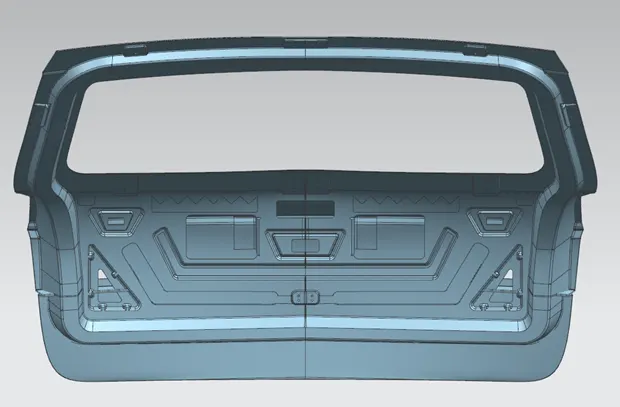
Inner Panel: The left hole is used to mount the latch and striker actuator, there are the mounting points given for it. In middle there is space for the motor assembly to be place to be place and for weight reduction there is a cut on sheet. Thickness of the inner panel is 0.75mm. Rear visibility is maintained as per the styling panel.
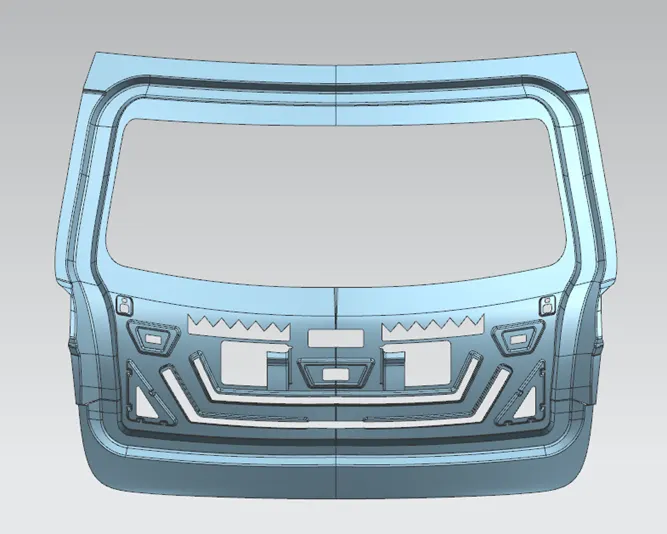
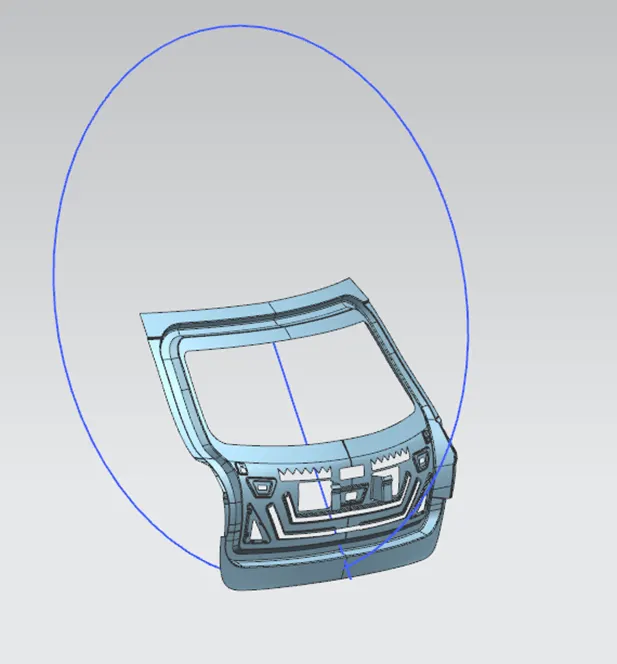
Embosses: All embosses are made to give extra strength to the component. Embosses are placed in such a way it dissipates the force that occur in collision towards corners, which makes the less impact to the passengers present inside the car. Unwanted sheet removal reduces the weight and gives space to accessories to be mounted.
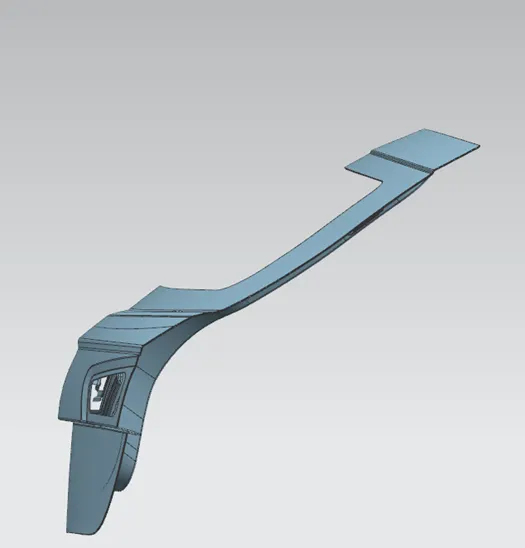
Hinges: Hinges are the embosses on the component it increases the strength around the area. Hinges will be used to mount the back door on the body and one in either side for gas stay mounting points.
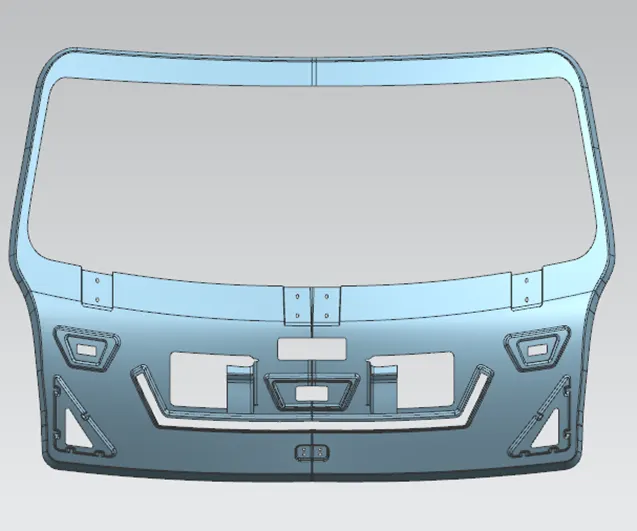
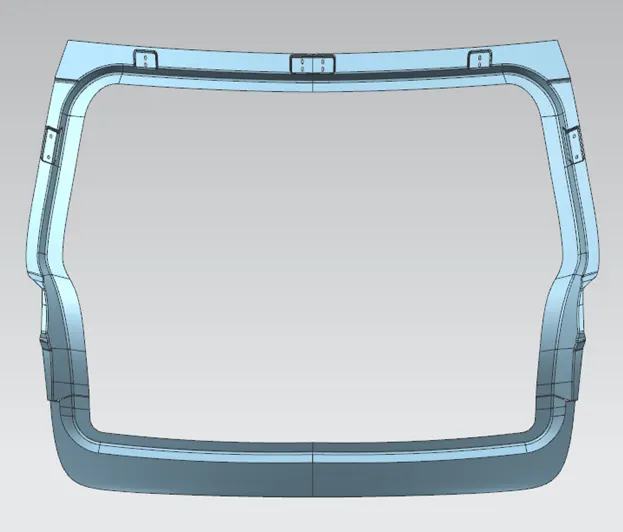
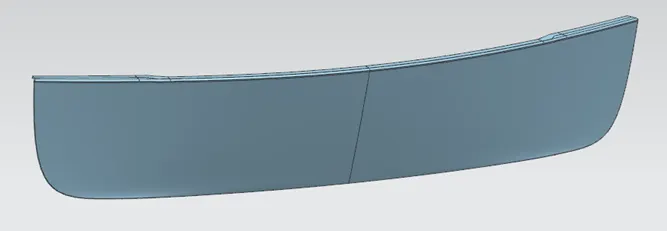
Outer Panel and Inner Panel: Based on the given styling panel the outer panel has been designed. Giving it on wrap on by hemming around the inner panel to protect as well as it is outer most part to avoid the joints hemming used.
Both Outer and Inner panel are done hemming around the panel and both are separate. The thickness of the both panels’ will be 0.75mm.
Draft Analysis:
Draft analysis helps to verify the draft angles, examine angle changes within a face as well as locate parting lines, Injection, and ejection surfaces in parts. As per negative results showing in draft analysis design engineer will modify at that particular place/section to overcome negative draft. It results whether the product is suitable for production or not.
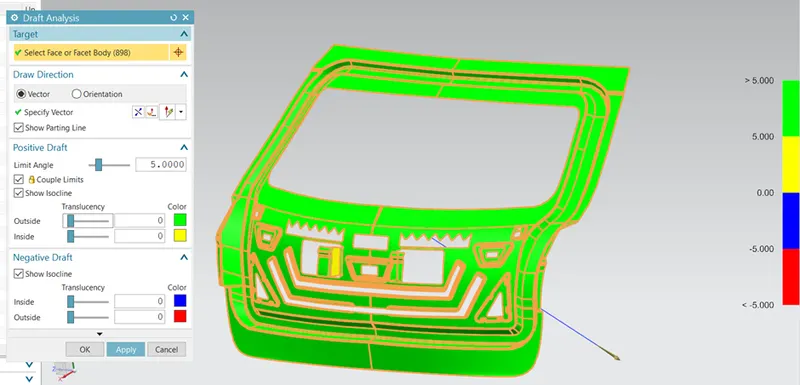
Conclusion: Hence, the Back door is designed with the help of given styling surface and as per the requirements and maintaining the passenger safety and security while designing after completion of back door design draft analysis done to finalize whether the design is suitable for production or not.