Design of backdoor
AUTOMOTIVE SHEET METAL (BIW) DESIGNING OF BACK DOOR (TAILGATE) OF A SUV CAR
Aim:
To design a backdoor of a SUV Car with its components by following its design requirements and industrial standards of automotive in NX CAD Software.
Introduction:
A tailgate(backdoor) is a door at the back of a truck or car, that is hinged at the bottom so that it opens downwards.
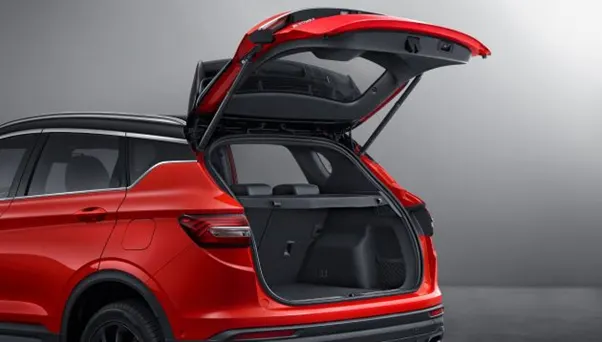
Like hood and side doors, back door is also a swinging closure commodity. We first decide hinge axis and latch and striker point, we join the trajectory to decide the motion of this and find out the door design. Also, like side doors, the sealing flanges are important in back doors. We prepare master on 0Y top, bottom, hinge area top and bottom. We develop the sealing surface like that on corners. Since gas stay is used here, we use the gas stay top mounting and bottom mounting also to sealing flanges. With respect to the styling we position our master and then we develop sealing surface. Once that is done, we continue with the construction. But if that alone sufficient for a backdoor? No. This backdoor will also take responsibilities of rear visibility and the luggage area. More thinner our back door section, More better our luggage area is. For that we cannot make it straight with the styling surface/outer panel. Because we need strength to the panel in rear crash. We need some space to accommodate the latch and striker’s motor. We need some space to accommodate the wiper motor. So, we will have a deepness of inner panel from outer panel. How long the deepness go is the factor. And at that deepness on corners/edges we have sealings. The sealings characteristics is similar as on side door. This will be contact with the rear floor of the boot, roof on the top and with body on side. As a tailgate engineer, we also contact roof engineer, body side engineer and rear panel engineers. Because the sealing flange in the tailgate is the input for bodyside engineers. Sealing flanges on the top will be the input for roof engineers to develop rear roof rail in accordance with rear flange. There will be a rubber section between the roof rear flange and sealing flange of the tailgate.
As we have given with only the styling Class A Surface. We are going to design the tailgate from scratch with all design requirements and industrial standards.
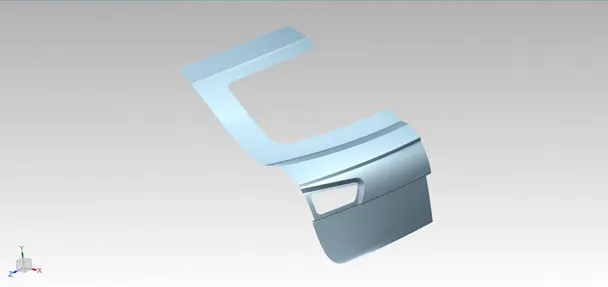
Fig. Class A Surface of Back Door.
Different approach on materials for tailgate:
We are going to prepare the backdoor with steel or aluminum.
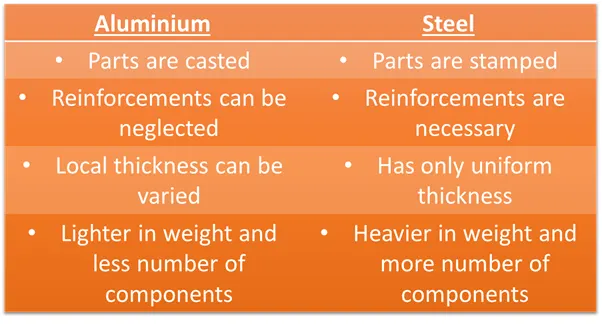
Table. Difference between steel and aluminium
Why we have to choose different material is, in order to reduce the cost or reduce weight of the whole part.
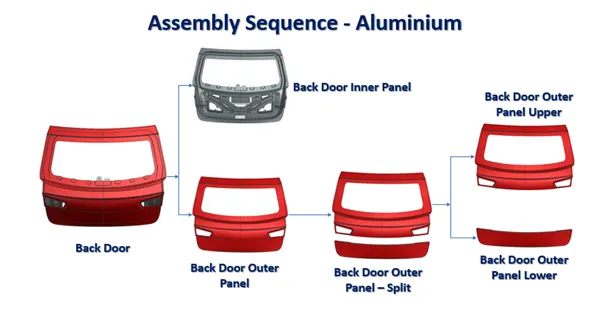
Inner panel of the aluminum cannot be deep drawn but outer panel of the aluminum can be deep drawn, because of the structure. The purpose of using aluminum is, it is having less density, so the final weight of the product will be very small. So, we cast the part which means we vary the thickness on different regions so I avoid the reinforcements completely.
At the end, the inner panel assembly will be one part and weight will be drastically reduced. Designing methodology of aluminum part is quite different when compared to steel on approach how we design. Because we are varying thickness, it cannot be just one sheet metal panel and it cannot be like designing one sheet metal panel as its way different.
Now as we see more about material challenge activity like, how we can change material and reduce weight of the part?
And in steel parts there, only inner panel can be deep drawn, we can have only one thickness. Which means we will have to add reinforcements on local areas like hinge reinforcements, gas stay reinforcements, latch and striker reinforcement in the bottom, wiper motor reinforcement in center. We add gas stay reinforcement because gas stay will have one mounting on tailgate and one mounting body side. As gas stay mounting embosses reducing the strength, we add gas stay reinforcement. As we all know the reinforcement purpose itself compensate the weight reduction to add strength locally. Hinge reinforcements are added to avoid the loss in strength of the inner panel due to addition of hinges.
In steel parts we have prepare reinforcements separately, we will be investing the tool for the reinforcements. We will be investing on individual parts. And with whole parts we increase the weight. Having done all this, the price will be less for steel and the price of the aluminum is more that is the cost the product. So, depending upon the projects budget we decide the part what material we use. Even though aluminum has many advantages over steel, the cost is more.
In aluminum we need not to give minimum 3 mm radius (3+ thickness) we can even have 2. The deep drawing angle need not to be 7deg or minimum 5 deg, it can even be 3deg open. Because we are anyways going to cast the part. Our casting tool should just come out, so it should be positive draft it cannot be negative. But it need not to be that open as steel. So, these are all the advantages of aluminum over steel.
When we reduce the reduce the opening angle, we increase the area outside the part. So, we increase the luggage area. When it comes to back door, we increase the luggage area and in windshield glass region we increase the rear visibility. The point here is when we use aluminum, we need not give 7 deg open or 5 deg open, even minimum 3 deg open is sufficient enough for aluminum parts. So, in this situation we can get an increase in luggage area and increase the rear visibility criteria, but in steel we have a reduced luggage area and reduced rear visibility criteria. And these are all differences of aluminum over steel. Having seen all things aluminum is way costlier than the steel. So, in inner panel we have 7 parts. The cost of these parts is lower than on one aluminum inner panel part.
Assembly sequence:
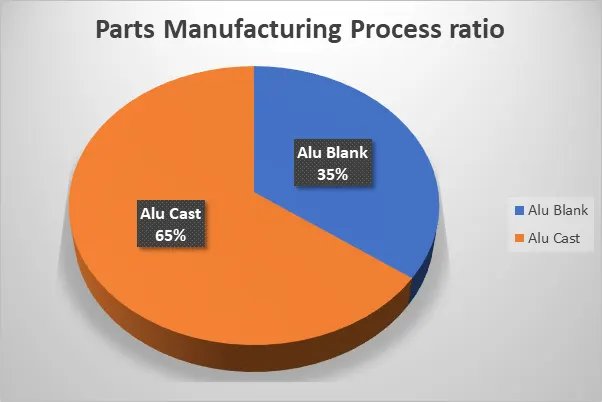
In steel parts it will be the vice versa of this ratio.
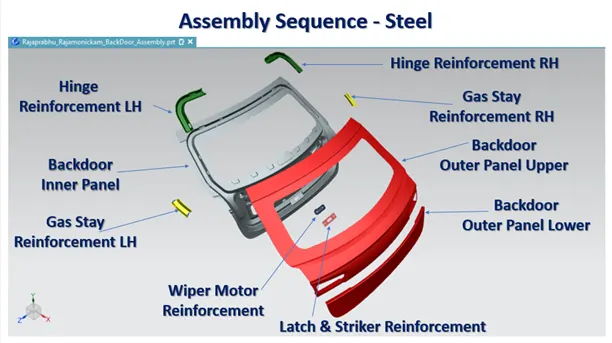
The outer panel and inner panel are hemmed only so we give reliefs on the corners.
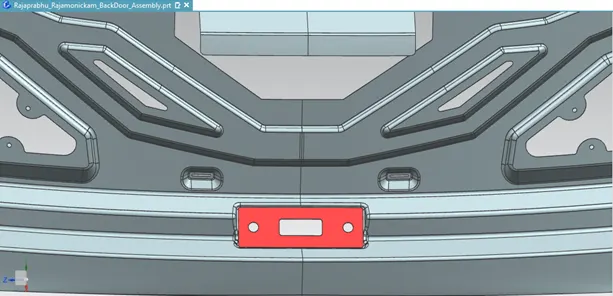
Fig. Latch and Striker Reinforcement.
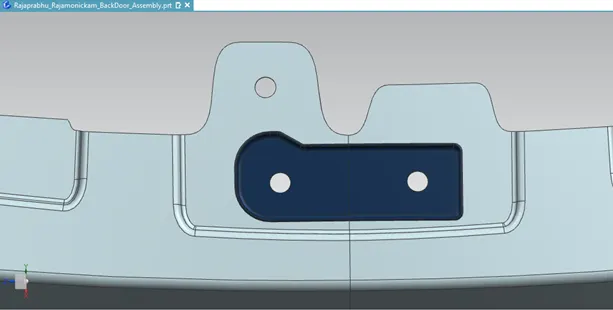
Fig. Wiper Motor Reinforcement.
Here as an engineer what we target is, the wiper motor reinforcements and latch and striker reinforcements are small brackets, which means we can carry over these parts from the previous car or from this car we can take to next car. When we do this, we can reduce the cost more. We don’t invest tooling this. We only invest for hinge reinforcements and gas stay reinforcements. So, we ignore the tooling cost of wiper motor reinforcement and latch and striker reinforcement. Anyways we are not going to produce new. So, this can also be considered when we think of a new material. And this should also be considered to reduce the complete production cost, whatever it is steel or aluminum or whatever. But if it is going to be aluminum, like we have seen inner panel is going to one. The outer panel can be split into two or three. And the inner panel is going to be casted part. Like we have seen the outer panel is deep drawn.
Now everybody is using aluminum parts. Benz, Audi, BMW, Porsche, Skoda etc., are started using aluminum.
Load Cases – General Analysis:
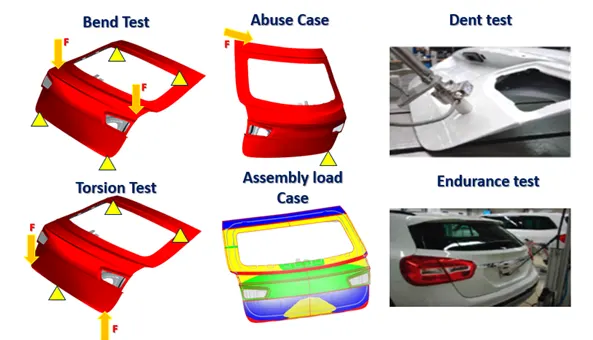
Fig. Load Case – General Analysis.
In backdoor, we will see some load cases. How will we check whether the part is right or not? When we sent to CAE team. They not only test production feasibility. They also test some load cases, so these are all some of the load cases. And this is common for all parts not only for backdoors, for side doors also there will be some similar tests. For hood they do some relevant tests.
Bend Test:
In bending test, we constraint all the four regions and we give force on center. For every door there will be a nominal value at which it should come back to its original position. The upper two are hinge positions and bottom two are corner positions. And in the center of the door we give weight.
Torsion test:
In torsion test, we constraint the hinge positions on upper and latch and striker position in bottom. And on the bottom corners we apply weight on reverse direction. We can assume how it behaves; the thing is we have to see how it comes to its original state.
Abuse Case:
In abuse case, we examine the causes of over slamming or hanging when the door is open. Because some people tent to lie on the door when the door is open.
Dent Test:
It is done to evaluate whether dent is coming back to its original position.
Assembly load Case:
Assembly load case is examined to check the backdoor during assembling the vehicle, how much force is given to the body and whether the door is withstanding or not?.
Endurance test:
It is the workability tests. The backdoor will be opened and closed for a particular number of cycles. And we see how the door behaves at the end of the cycle. If it’s a side door the number of cycles will be more. If it is back door the cycle will be relatively less. Because we don’t open that many times. If we open side doors for 10000 times, we open backdoor only for 2000 times. So, this endurance test will happen with variation in cycles with respect to the commodity. For Hood, we approximately open only 100 times. We open hood only if there is a problem.
So, these are all the load cases which is tested and when tested we get a result of inner panel and how does it behave.
Manufacturing Effects over spindle type and positioning:
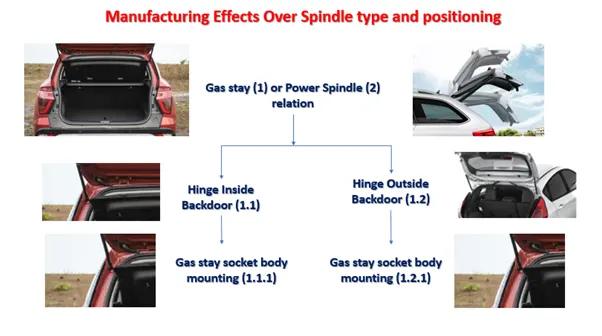
The gas stay positioning is also an important point. Basically, there are two ways to keep the backdoor on open condition. One is gas stay and the same is automated by a motor, we call it power spindle. We can see that in some premium cars like they just press a button the door automatically closes and those thing is activated by power spindle and we can now also see in Morris Garage model that we can wave our leg under the boot and the door opens automatically, this is also actuated by an power spindle.
Now in this gas stay and power spindle condition, some doors have hinge mounted outside the car (i.e., outside the backdoor) which covered by plastic spoilers but actually the hinges are mounted outside the backdoor. In most of the cars the hinge is mounted inside. So, these two are the situation we actually study.
In first case, we mounted hinge inside the backdoor and we use gas stay. At this situation, we mount gas stay’s bulb region, there will be a bulb on one side which is emitting the force. As we have seen about gas stay’s on designing hood part, we take same principle here. We will have bracket or socket. And this socket when it is mounted on the body that is one case, when it is mounted on the other it is other. Now the case forms a cycle. First one, we take a gas stay and hinge is mounted inside the backdoor so the case is named as 1.1.1,1.1.2,1.1.3 etc., (for example). This is just we naming differentiate, if the socket is mounted on the backdoor it will be like 1.1.2. similarly, when we see hinge outside of the door, our case will be 1.2.1, 1.2.2 etc., (just naming). Whatever the scenario is, when we open and close the door, we emit some force like all the load case conditions with respect to a gas stay. The load case conditions cannot be performed without a gas stay. So, the condition with respect to the position of the gas stay or spindle with respect to the position of the hinges also we can divide it into approximately into 8 or 9 conditions.
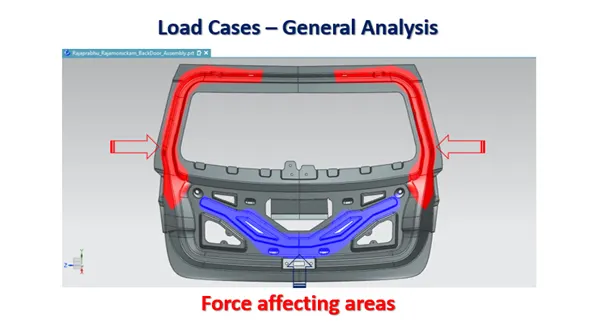
Whatever the case or condition is the force will be acting on the y direction. On more situation we will have a weak zone on the gas stay region. Because when you give inner panel alone for simulation. Now we have designed our inner panel and we have given it for simulation and the simulation people does the load case study. We can understand that we have a deformation in the gas mount region because of the load which is getting acted. So, we compensate this by adding hinge reinforcement and gas stay reinforcement. Also, when we open and close due to over slamming or abusing or due to the endurance wed also tent to see load acting on latch and striker region and during rear collision the region in front the latch and striker is the first contact point. Our intention is to again dissipate the energy outside the car like what we did for hood, so we create a y emboss.
There is another important factor why we use Y emboss or V emboss. It’s from the predefined study done by Mr. Alex Bolgert.
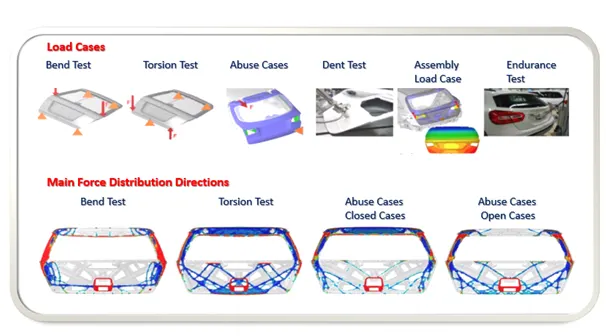
Fig. Load Cases – General Analysis.
And from the thesis done by Mr. Alex Bolgert from Germany, we can clearly see that on six major tests over tailgate gives us that on simulation results, the force normally tends do go over a V or Y direction and that is reason we use V or Y shape emboss in tailgate. While doing this we dissipate the energy outside the car and we create strength locally in that region. And the latch and striker reinforcement which will locally help.
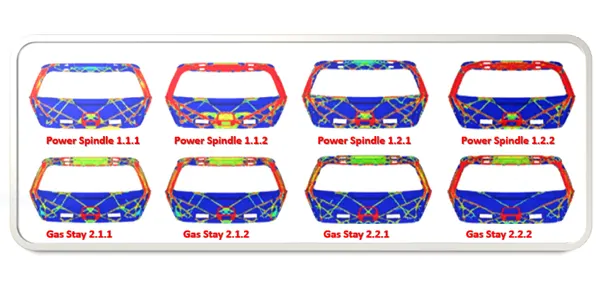
Fig. All Optimized Structure comparison over Manufacturing effect cases.
And over manufacturing effect cases what we have seen before, it can see from the report with eight cases the forces acting on the y direction.
And to compensate the regions that shows red (i.e., gas stay mounting region) we already plan to use gas stay reinforcement and hinge reinforcement.
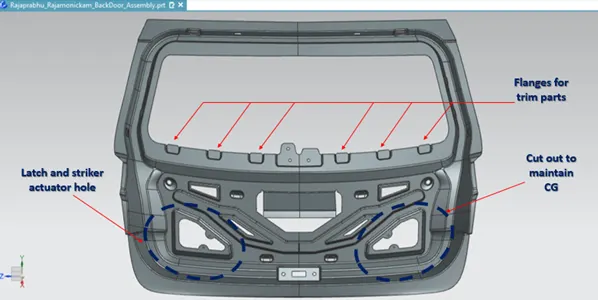
In upper there is cutout for windshield glass and on left side there is a cutout for latch and striker motor. And on center there comes a wiper motor for that region there is cutout there. And do you know why there is a cutout on the right side. We have to maintain the center of gravity, so this a weight reduction cutout.
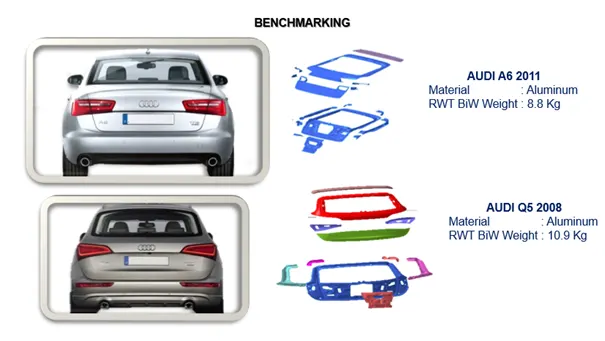
These are all the examples for aluminum panel. What Audi is using is they split the panels into small small parts and they prepared the tail gate and they get only weight of 8.8 kg and 10.9 kg using aluminum, in fact Audi Q5 2008 has a bigger backdoor of aluminum. But in case if we use steel it will cross more than 14 kg.
But the designing methodology and designing consideration is not going to change, its just a material is changing. We will have to know how the property is, what the property of aluminum and steel is and why do we cast and why do we deep draw this is what is important.
Hemming region:
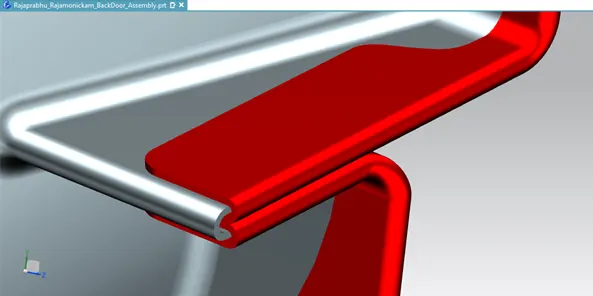
Fig. Hemming of outer panel with inner panel
Like we do in hood, side doors and other commodities. We have this 0.2 mm gap in top and bottom and 2mm clearance on the side. Why do we have this, this is because we will have a sealant applied on the after the hemming which will whoosh out for which we will need a little space to whoosh out and get it stuck properly. On the windshield region we do brazing to join the inner panel and outer panel. And the joining of the inner panel and outer panel lower regions is also carried out by brazing.
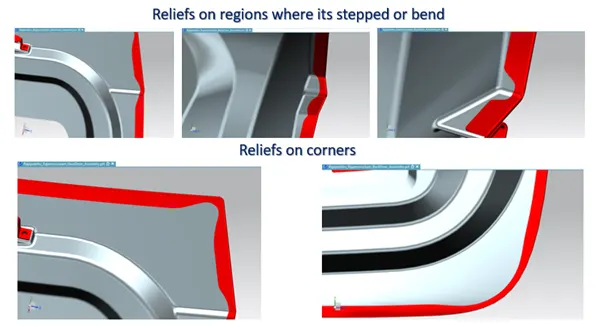
We give some reliefs on corners. And wherever we have a step we ignore the hem. Ignoring in sense we give some small hemming flange region than usual.
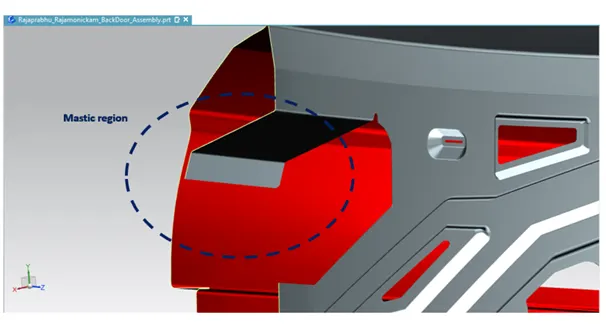
This is region where we use mastics to join the outer panel upper and inner panel. We use mastics to reduce / avoid any rattle noise. As we can’t spot well on the outer panel as it reduces the aesthetics look of the tailgate. Anyway, the hem itself is sufficient enough. But additional strength is provided by this mastic.
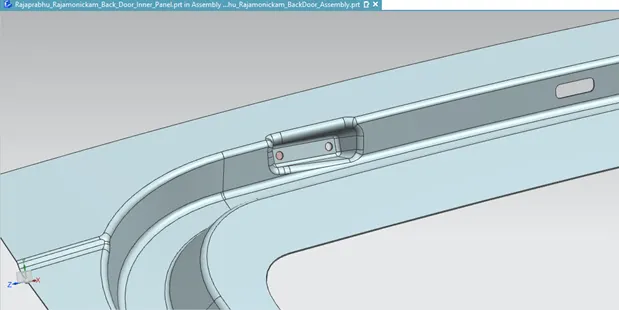
Fig. Hinge emboss
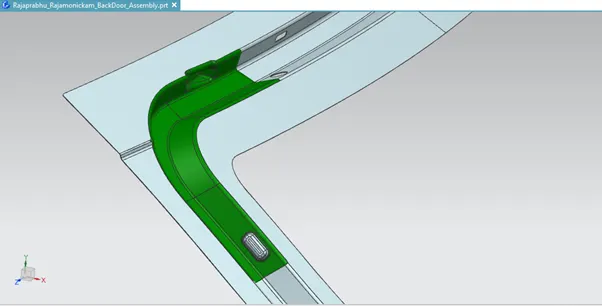
Fig. Hinge Reinforcement
This is the hinge reinforcement area, again if we pierce a hole over a flat area which is a functional hole. When we say functional hole, it means like we add a reinforcement there and add another commodity, we cannot directly punch a hole because it is going to tear my part. So, we give an emboss there locally and then pierce this hole.
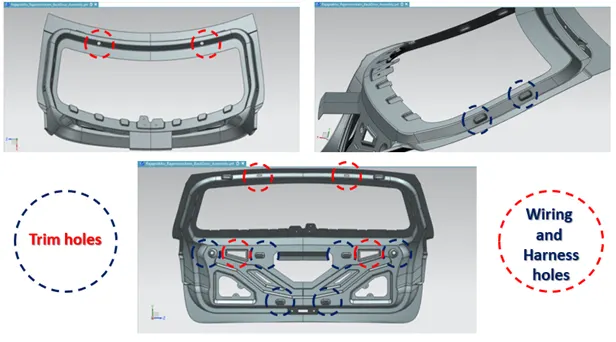
This is the region where the trim parts will be mounted on the backdoor main region and on the sides also, we have the trim parts getting mounted with these holes. Trim parts basically do snap fits and that will be a kind of hook, which will be coming and holding there.
But for harness hole there will be quite a lot of holes, there will be wires passing over for the wiper motor actuator the latch and striker actuator and for these the holes can be even on direct faces and of course this hole should follow draft angle. We get a draft angle from production team and we should keep all positive direction.
In some Cases, we predefine a draft angle while designing and we give that to the production team.
Here we predefined a draft angle for the inner panel.
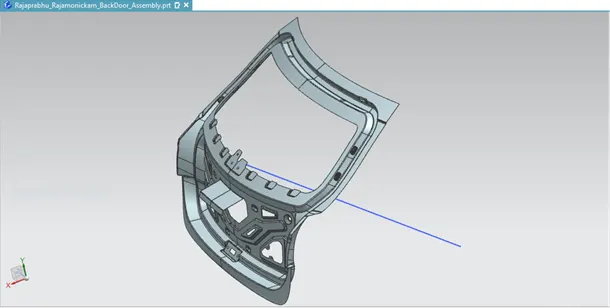
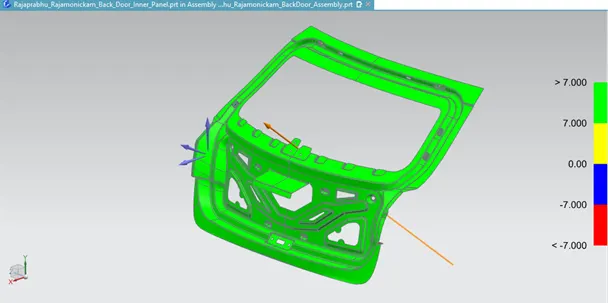
Fig. Draft angle for Tooling Direction.
Draft Analysis:
We do draft analysis our part before giving it to the drafting team, to check whether any negative draft is made. Because if manufacture a part with so many negative draft angles as it costs more and consumes time to produce the parts. So, we maintain the positive draft angle throughout designing as possible. We consider minimum draft angle for this part as 7 deg.
Latch and striker trajectory:
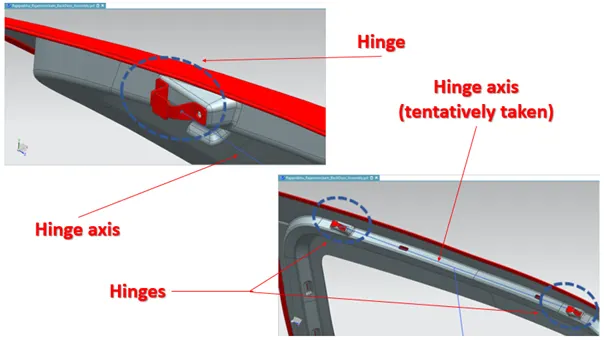
Like hood, we position the hinge axis tentatively.
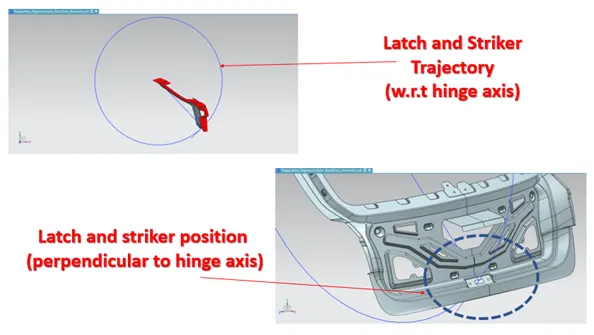
When we get a hinge axis, we prepare a circle keeping the hinge point and striker point (approximate point) to form the trajectory. When we have this circle, it should perpendicular to the striker. If it perpendicular our hinge axis is right. Or else we have to move our hinge axis accordingly to it to ensure the perpendicular striker point. We can also change the angle in striker region.
Sealing Flange:
Sealing flange is a surface which allows the entire back door to sit on the body of the car.
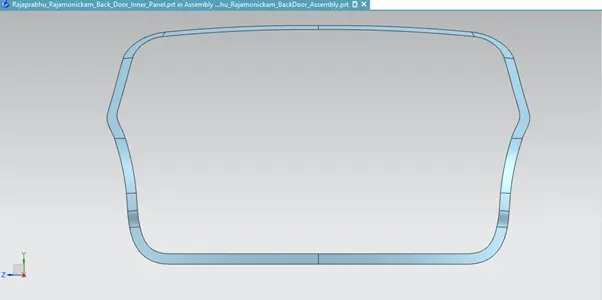
Fig. Sealing Flange.
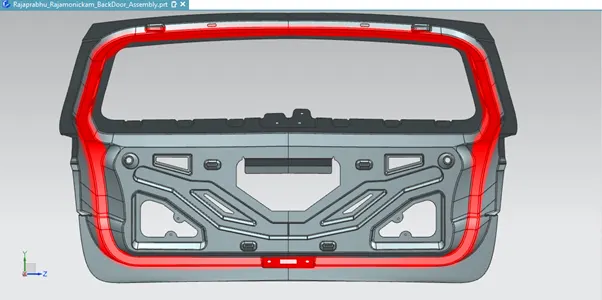
Fig. Sealing Flange region
We define the section; we define the sealing flange. With the perpendicular angle of the sealing flange, the body side is prepared and the roof rear panel is prepared. We will also have a predefined study considering the master.
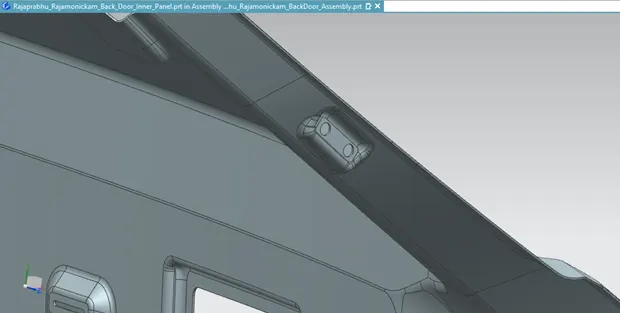
Fig. Diablo emboss for gas stay mounting
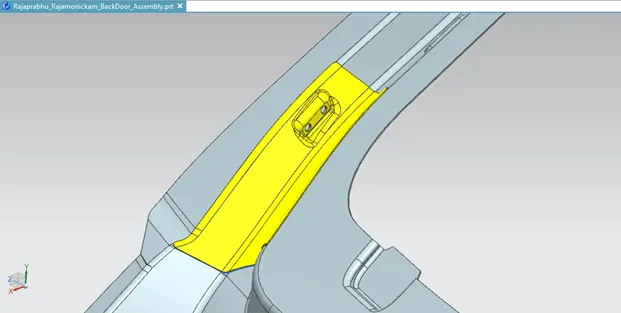
Fig. Gas stay reinforcement.
We also provide a diablo emboss for gas stay mounting, and added reinforcement to add strength locally.
If we change the gas stay mounting point, we will have to notify it to the body side team and they will change the gas stay point according to this in the body side.
Laser brazing:
Laser brazing is a thermal joining process and has been used to join steel with aluminum. In laser brazing, a filler metal is placed at or between the faying surfaces of the metals to be joined and heat is applied using a laser beam to melt the filler material, but not the parent metals.
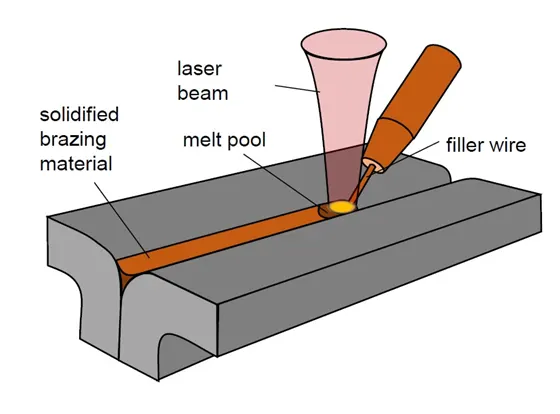
Fig. Laser brazing method
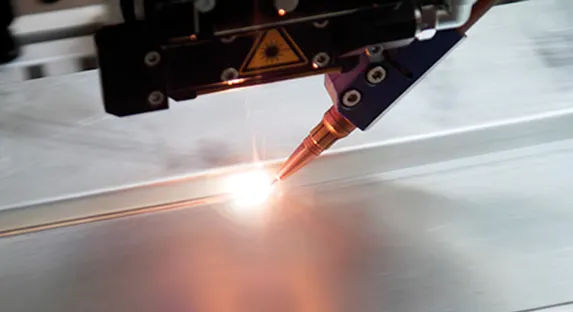
Fig. Laser brazing
The outer panel upper and lower are laser brazed together to join.
For producing the backdoor inner panel(for steel) Or Outer panel (for aluminium) we normally deep draw the part. Most of the steel parts are deep drawn. When there is deep drawing process, one will have to stamp the part. We define the geometry and open the part a lot to provide the tool to come in and go out during stamping.
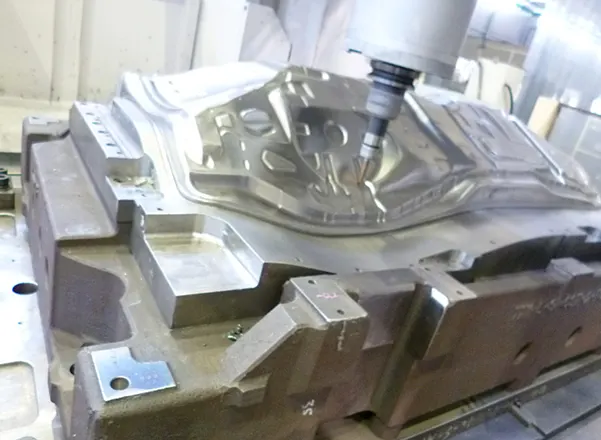
Fig. Tooling the design.
Deep drawing:
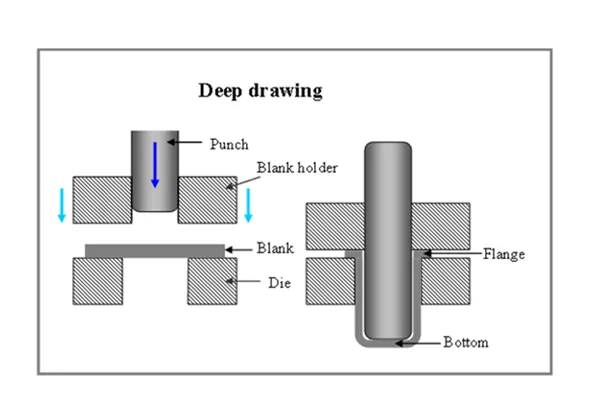
Deep drawing is a sheet metal forming process in which a sheet metal blank is radially drawn into a forming die by the mechanical action of a punch.
It is thus a shape transformation process with material retention. The process is considered "deep" drawing when the depth of the drawn part exceeds its diameter. This is achieved by redrawing the part through a series of dies. The flange region (sheet metal in the die shoulder area) experiences a radial drawing stress and a tangential compressive stress due to the material retention property.
Hemming:
We already designed the inner panel and outer with the thickness of 0.75mm. After that when we join these panels we will produce the bends along the edge of the outer panel towards inner panel. These bending process is called hemming. By doing this with provided nomenclature we avoid spot welds.
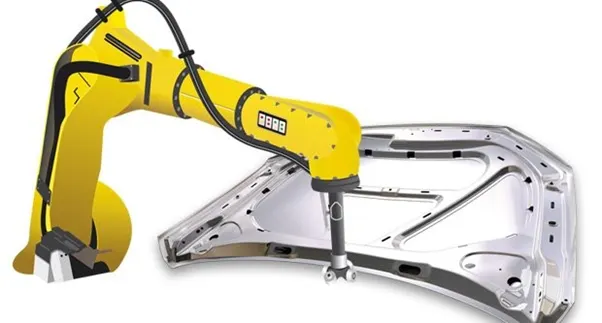
And when we do the hem, on the corner of the hood outer panel we have to give the relief.
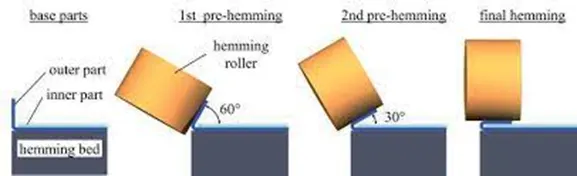
There will be different rollers assembled on different corners. Each rollers will roll over the edges of the sheet metal to close it with the inner panel. And these rollers will roll two or three times to enable perfect rolling provided with different rollers. To avoid intolerance issues we do hemming with different rollers and it will also saves time.
On first roller pass, the minimum closing is happened.
On second roller pass, it completely close the corners and
On third roller pass, it justifies the closing what it attends.
Normally hemming is done for assembling the outer panel with inner panel. And when you pass the rollers over the sheet metal there are some tendency that the sheet metal vibrates. Simulation team also studies that is these force making the panel come back to its original position or it is changing the design of the part. That is what the spring back effect is.
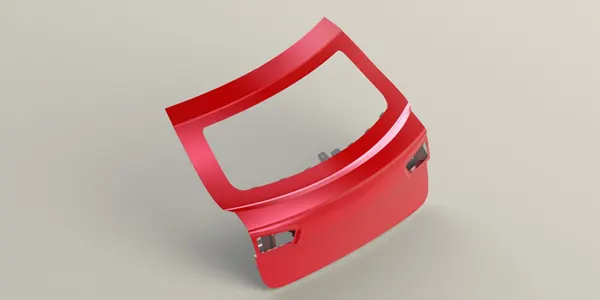
Final Model of Backdoor Assembly:
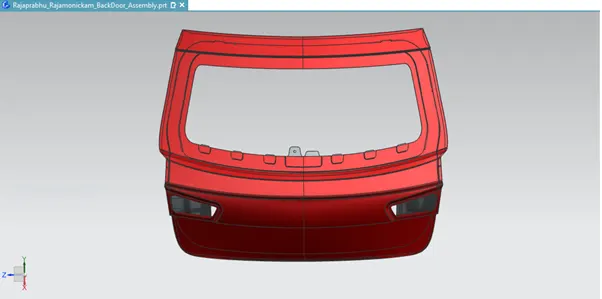
Fig. Backdoor Assembly
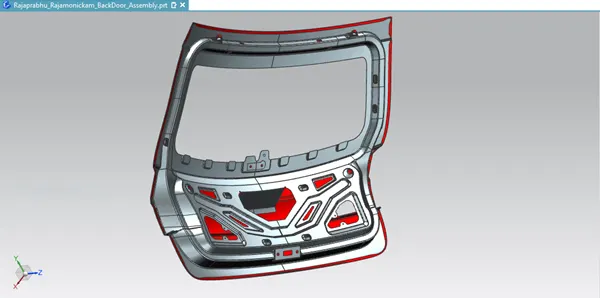
Fig. Backdoor assembly
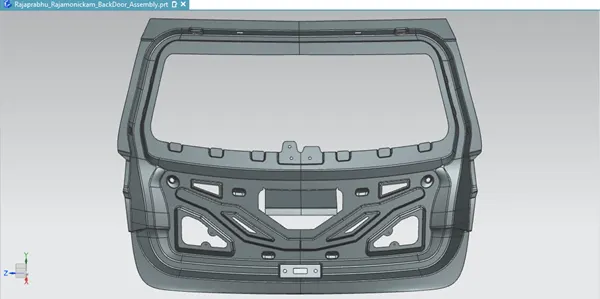
Fig. Inner Panel
Render Image:
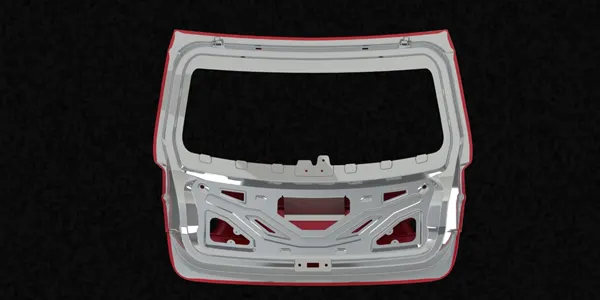
Conclusion:
An Automotive Sheetmetal (BIW) designing of a backdoor of a compact SUV car is successfully designed with its components with its design requirements and its industrial standards in NX CAD Software.