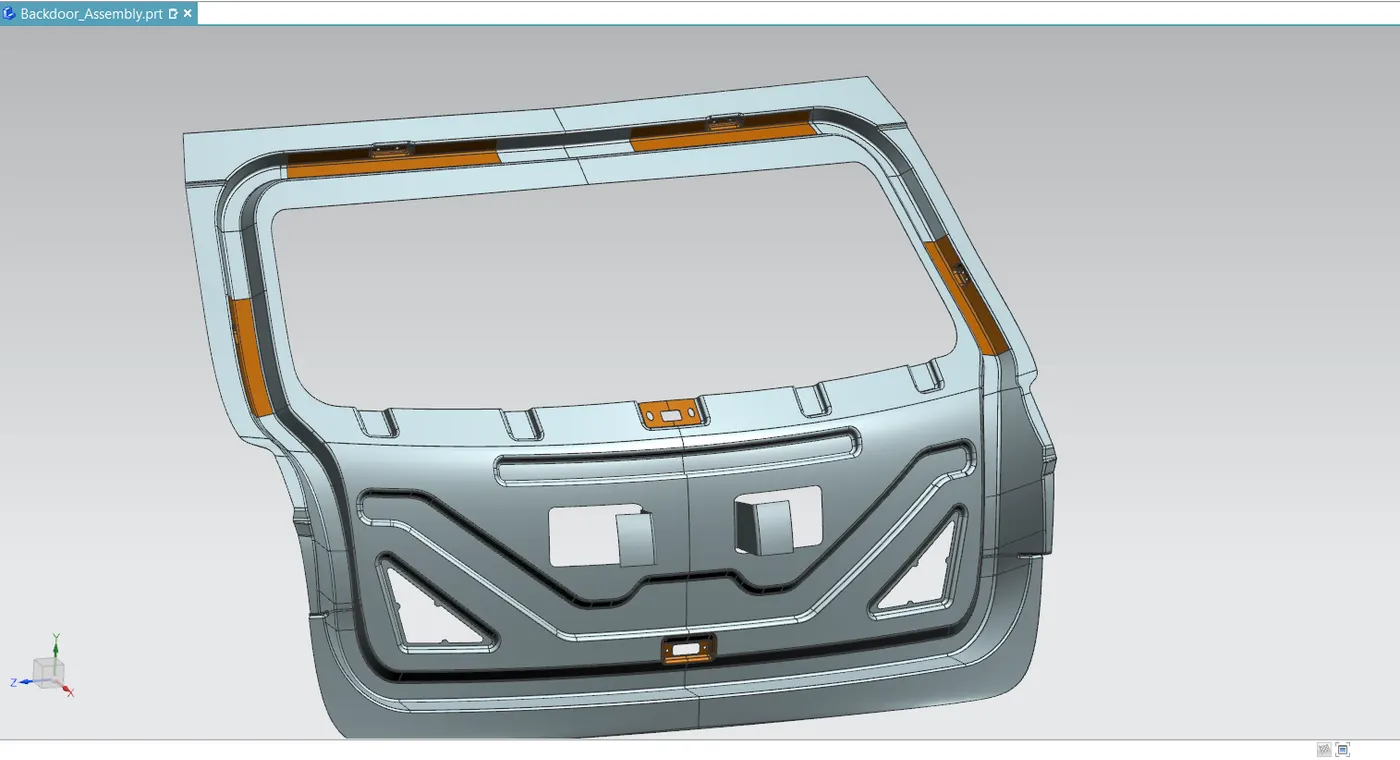
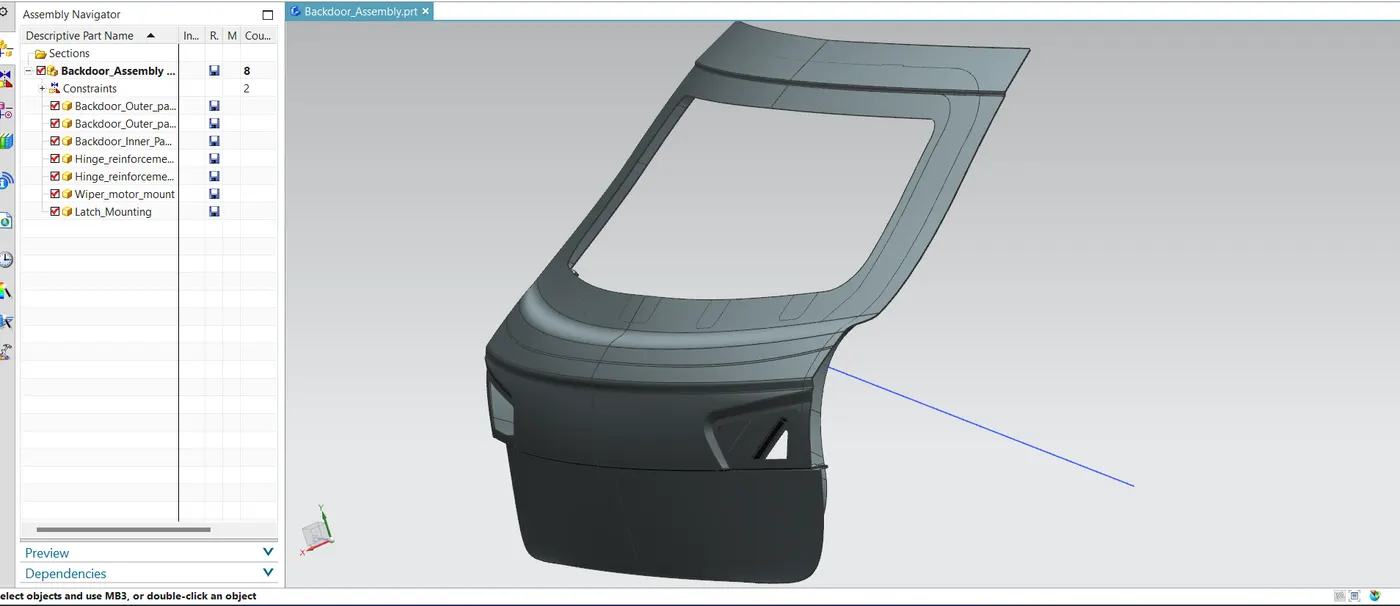
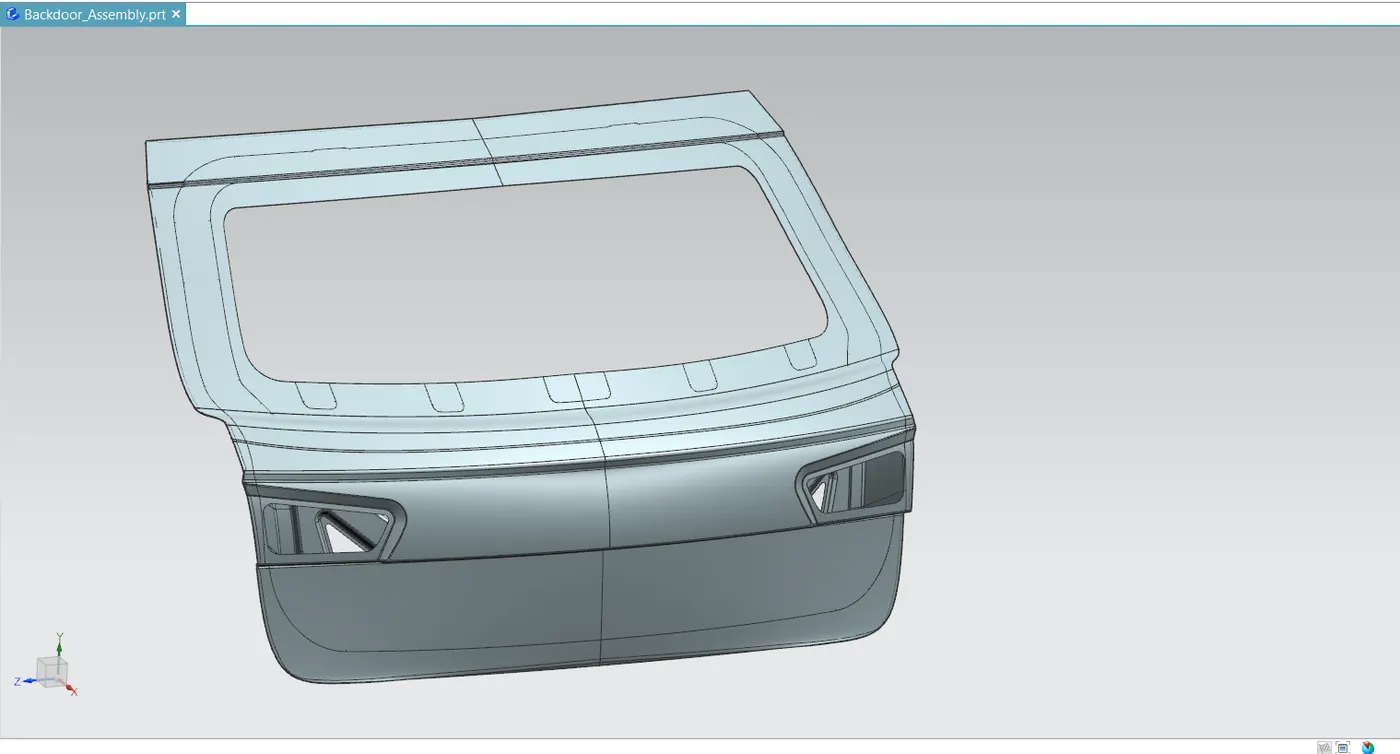
Design of backdoor
AIM
To design the car's rear door, fabricate the inner door panel, and design all required reinforcements with the Siemens NX CAD Software.
1. INTRODUCTION
The primary cargo or storage area of an automobile is called the trunk or boot, and it is typically a hatch in the back of the car. Another name for it is a tailgate. Both manual and electric power are available for operating these doors. The majority of luxury vehicles have electrically actuated doors. It plays a significant part in rear crash scenarios. so, our design needs to adhere to crash regulations. The Institute of Highway Safety rates our car based on a test they developed after analysing several accidents. Therefore, the grade is based on the inner and outer panel connecting method, flanges, embosses, material utilised, and other aspects of the trunk design. The rear door serves the following purposes: it guards against damage to the passengers and their belongings. It contains the wiper motor, tail lamp assembly, and other parts. It has windshield glass, which improves sight from behind. It has a rear-view camera and parking sensors installed.
1.1. Types of Backdoor
A cargo area door or entrance may have hinges on the top, side, and bottom (based on working position). A door is referred to as a tailgate if it hinges at the bottom.
- Top-mounted
- Side mounted doors
- Bottom type
1.1.1. Top-mounted
A station wagon, truck trunk, and certain spot utility vehicles have this style of rear door. The top mounted tailgating systems seen on newer cars are powered and gas stay supported. When compared to side mounted or backdoors with central pillars, these top mounted tailgates offer better rear visibility.
1.1.2. Side mounted doors
The side mounted doors are the ones found in van-style MPVs, SUVs, and pickup trucks, as the name suggests. Compared to top mounted doors, these barn doors or side mounted doors are simpler to install. These doors are usually easier to access and smaller in size. When one door is left open, these doors make handling long pipes and components easier for the goods handlers. Moreover, these doors prevent unintentional head hits. Loading and unloading goods is much simpler with the side mounted doors.
1.1.3. Bottom type
Backdoor systems with a bottom design are utilised in vehicles like cars and pickup trucks. These are the most practical kind of back doors, with the bottom split serving as a table or even a support for those taking tours.
1.2. Types of Backdoor (based on working mechanism)
The back door is operated by two types of commodities,
- Gas stay type.
- Powered lift system.
1.2.1. Gas stays type
The best and most widely utilised tailgate mechanism for cars in the lower to premium automobile segments is the Gas Stay type backdoor. An ideal tailgate should have a hinge, a door, a gas stay, and some rubber beadings to seal the door.
1.2.2. Powered lift system
Another sophisticated method of opening a trunk or lift-gate is the power trunk lift system, which automatically opens and closes the trunk and releases the lock with a touch of the bottom. The PTG main switch, PTG assist, anti-pinch switch, and power latch make up the powered trunk lift system. The entire backdoor opens when the switch, either inside or outside the compartment, is pressed to release the power latch. The anti-pinch switch is positioned to prevent unintentional hand insertion while the door is being operated.
2. MATERIAL SELECTION FOR BACKDOOR
The overall weight of the back door is mostly determined by the material choice. Aluminium and steel are the most often utilised materials. Steel has a higher density than aluminium, which means the door will weigh more. The cost of the car determines the material used for the backdoor; steel is typically used in low-priced cars since it is less expensive than aluminium. Another thing to keep in mind is that using cast aluminium pieces rather as deep drawn steel ones eliminates the need for reinforcements and reduces the car's overall weight by about 5–10 kg, which improves the vehicle's performance. Additionally, to help with luggage/cabin capacity, the draft angle for cast parts is approximately 3 degrees, but the draft angle for deep drew sections is approximately 7–10 degrees.
2.1. Material comparison
The table that follows provides comparison data between steel and aluminium.
| Aluminium | Steel | |
|---|---|---|
| Parts | Parts are casted | Parts are stamped |
| Reinforcements | Reinforcement can be avoided | Reinforcements are necessary |
| Thickness | Thickness can be varied | Thickness should be uniform |
| Weight | Lighter in weight | Heavier in weight |
| cost | Costly as compared to steel | Cheap as compared to Aluminium |
3. MANUFACTURING METHODS
There are two methods that have been used recently to lessen car weight. One involves replacing steel with a lighter material, while the other involves reworking the steel framework. The achievement of lightweight steel can be attributed to either enhanced structural performance or the implementation of novel manufacturing methodologies. The Ultra-Light Steel Auto Body (ULSAB) idea is one effort.
4. DIFFERENT PANELS OR REGIONS IN BACKDOOR
The different type of panels or regions are as follows,
- Upper outer panel.
- Lower outer panel.
- Inner panel.
Backdoor Assembly parts,
- Inner panel.
- Outer panel.
- Hinge reinforcements.
- Gas stay reinforcements.
- Wiper motor reinforcement.
- Latch reinforcement.
4.1. Inner panel
One of the most crucial parts of the door, the inner panel is utilised to reinforce it and is where all accessories like hinges, glass guide channels, mounted trim, latches, etc. are installed. One potential approach is the integration method. A single blank is stamped out of the part when using the integration method. This gets rid of any issues with fit ability and lowers the number of tools required for assembly.
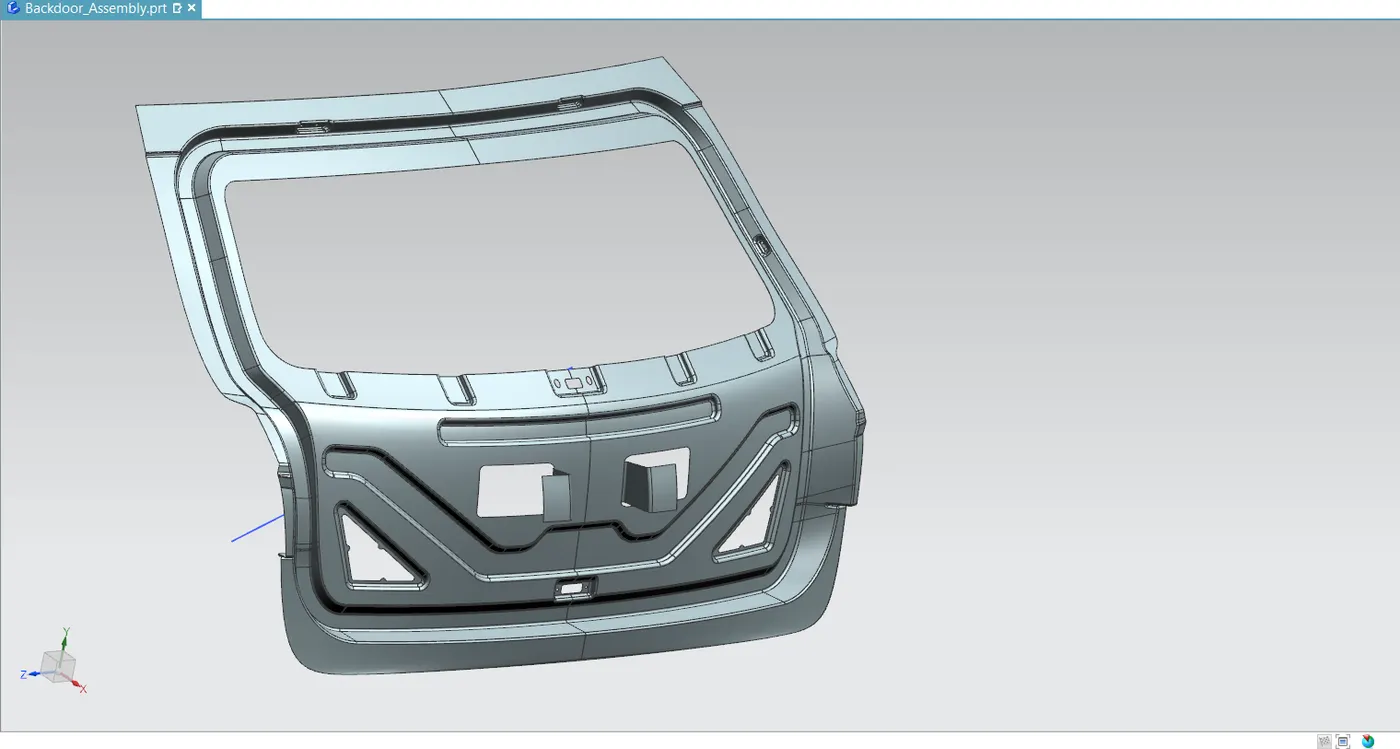
4.1.1. Embosses
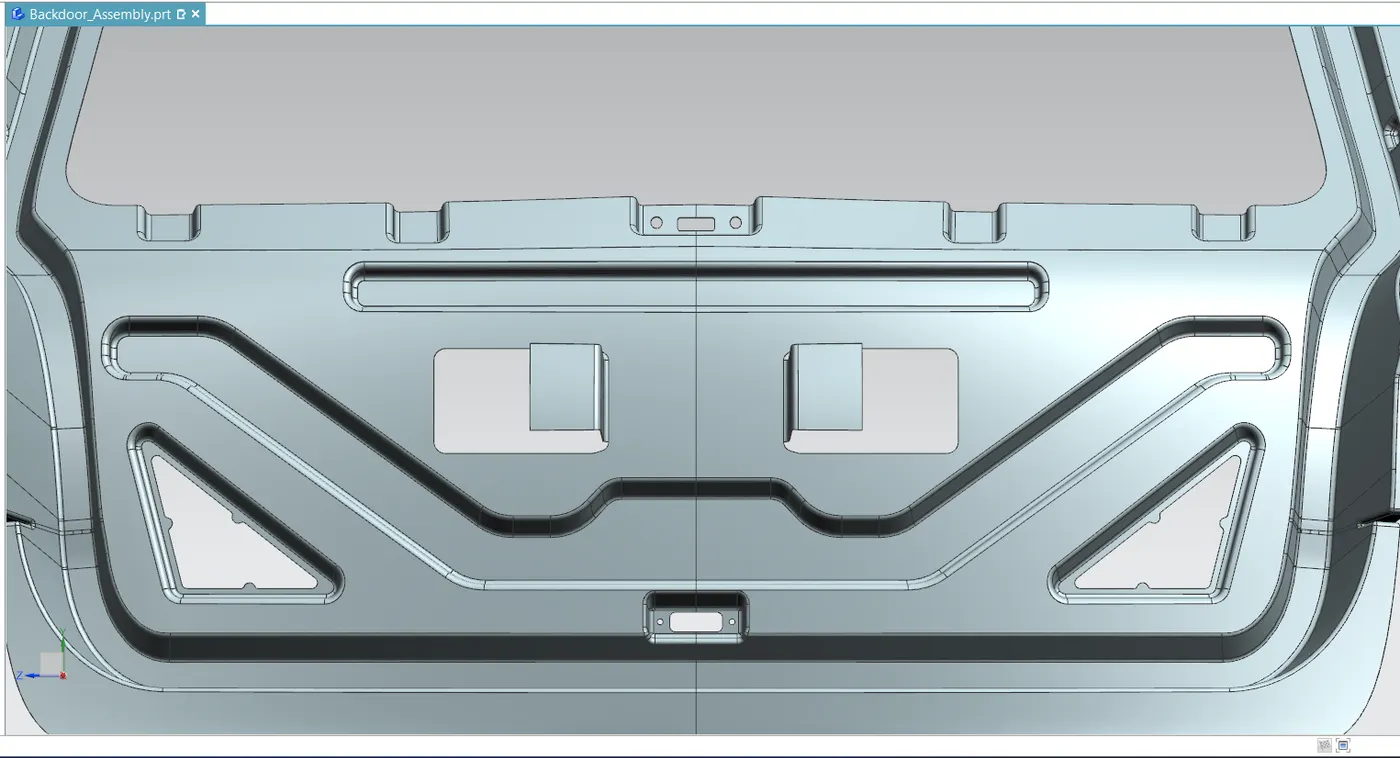
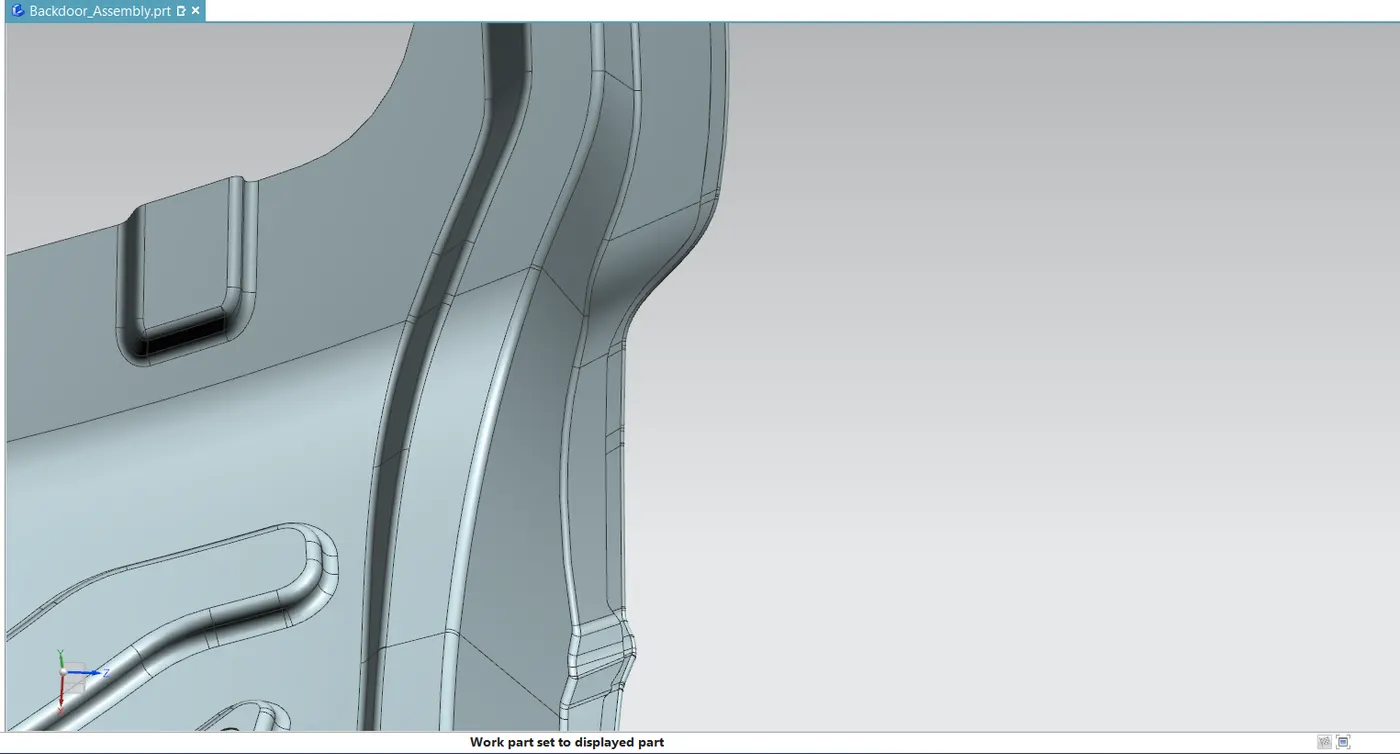
Embosses is included to strengthen sheet metal panels and aid with the dispersal of forces and energy in a particular direction. Here, the Y/V embosses is positioned to point in the direction of the backdoor's outer end, as seen in the picture.
4.1.2. Mastic sealants
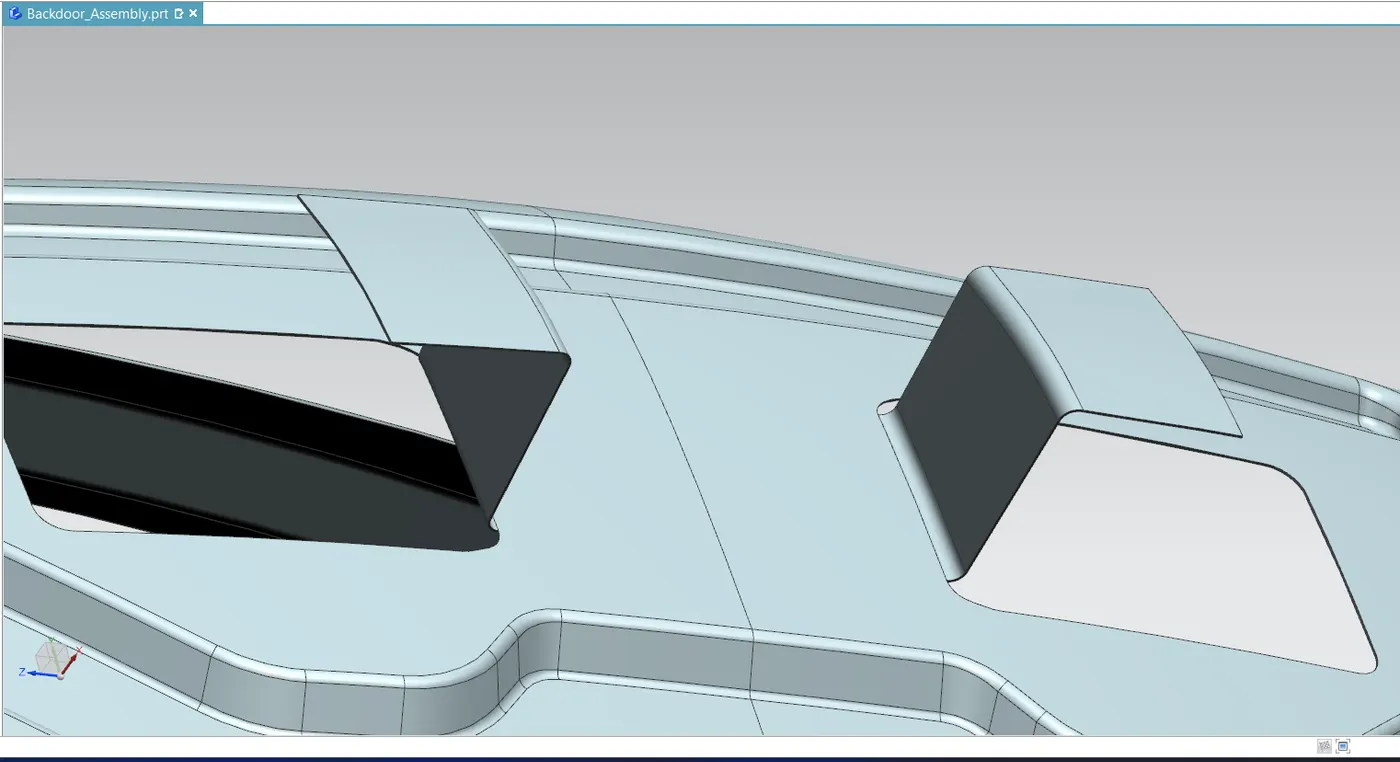
Since the exterior panel contributes to the vehicle's overall appearance, we are unable to employ any joining methods, such as bolting or spot welding, that might detract from the panel's aesthetic appeal. Therefore, to unite the inner panel pieces with the outside panel, mastic sealants are utilized. The maximum distance between components where mastics are to be applied must be kept at 5 mm.
4.2. Outer Panel
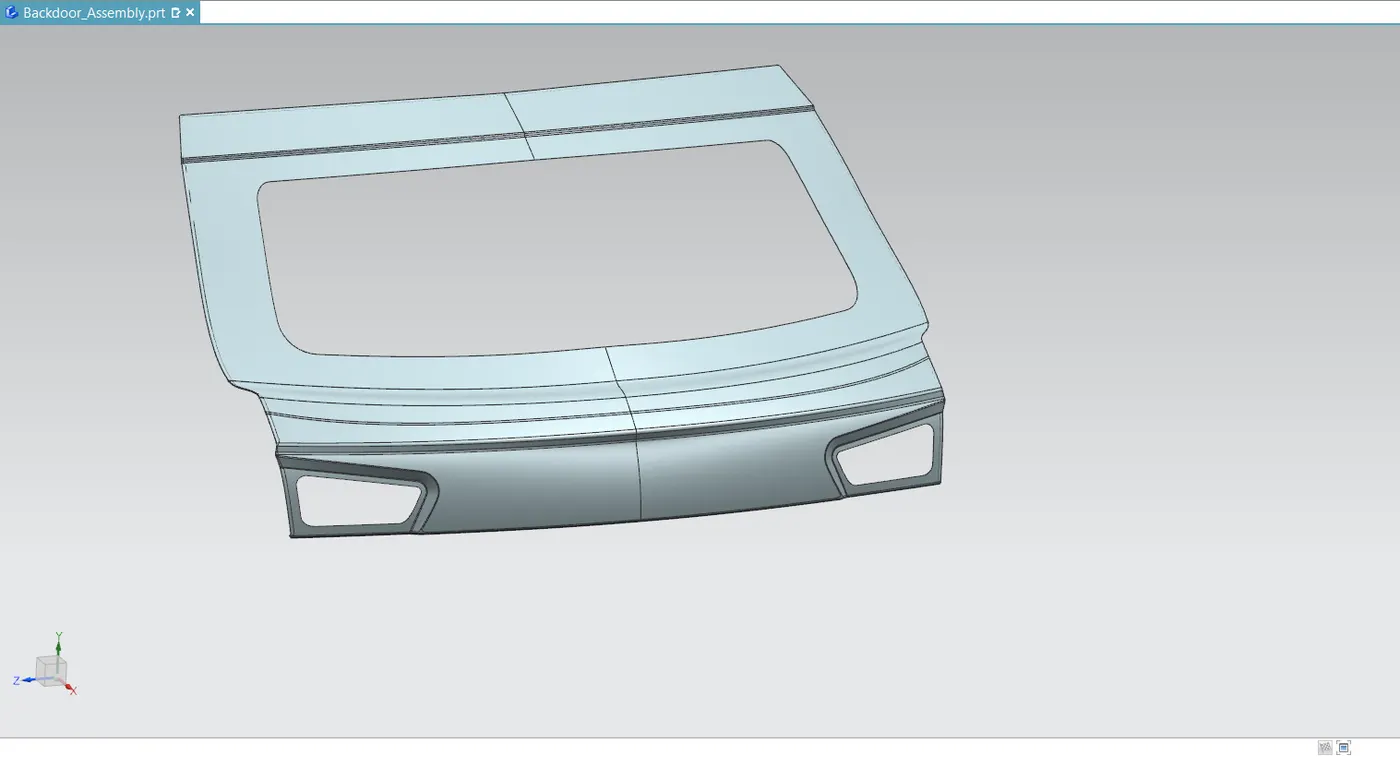
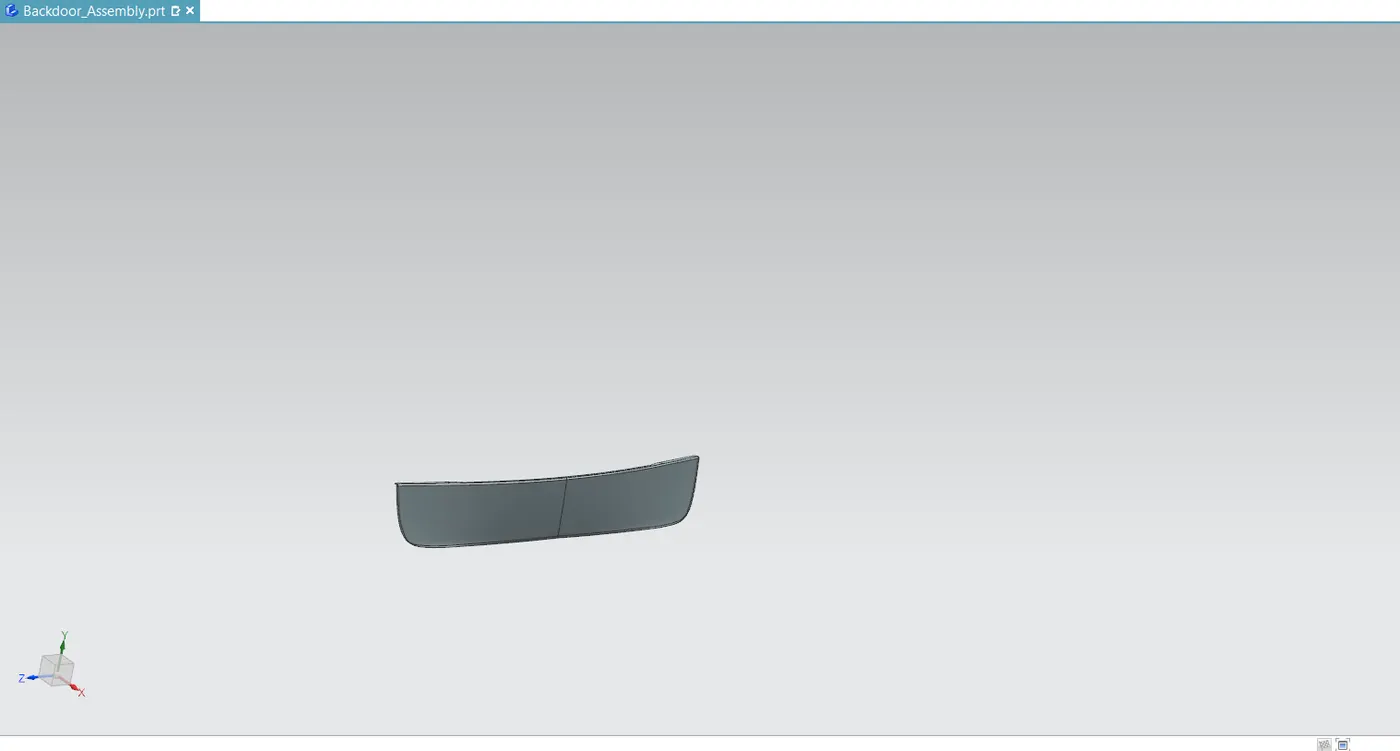
The rear door's outer panel resembles other BIW parts in that it is a vehicle's visible component. The multi-stage coating that is offered includes smooth and appealing surfaces, resistance to scratches, and rush prevention. Additionally, the outer panel features mounting holes for license plates as well as facilities for the tail lamp.
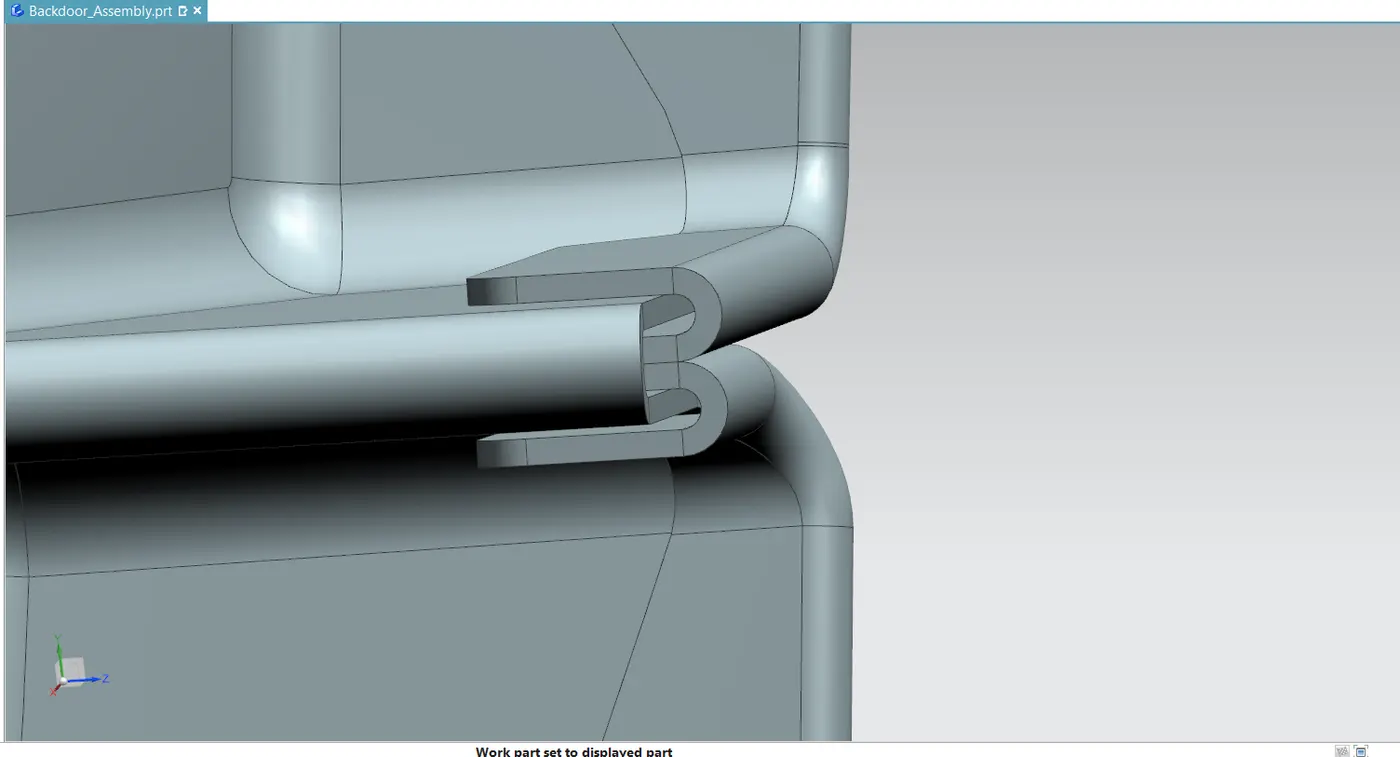
4.2.1. Hemming
Hemming is a shaping process where the sheet's edges are folded over one another to create a snug fit. Hemming procedures are typically used to reinforce component edges, join parts together, and enhance part appearance. Hemming is a secondary assembly step used in automotive component production, following deep drawing, trimming, and flanging procedures, to attach two sheet metal sections (inner and outer) together. This kind of assembly often consists of fenders, doors, trunk lids, and hoods.
4.2.2. Corner relief
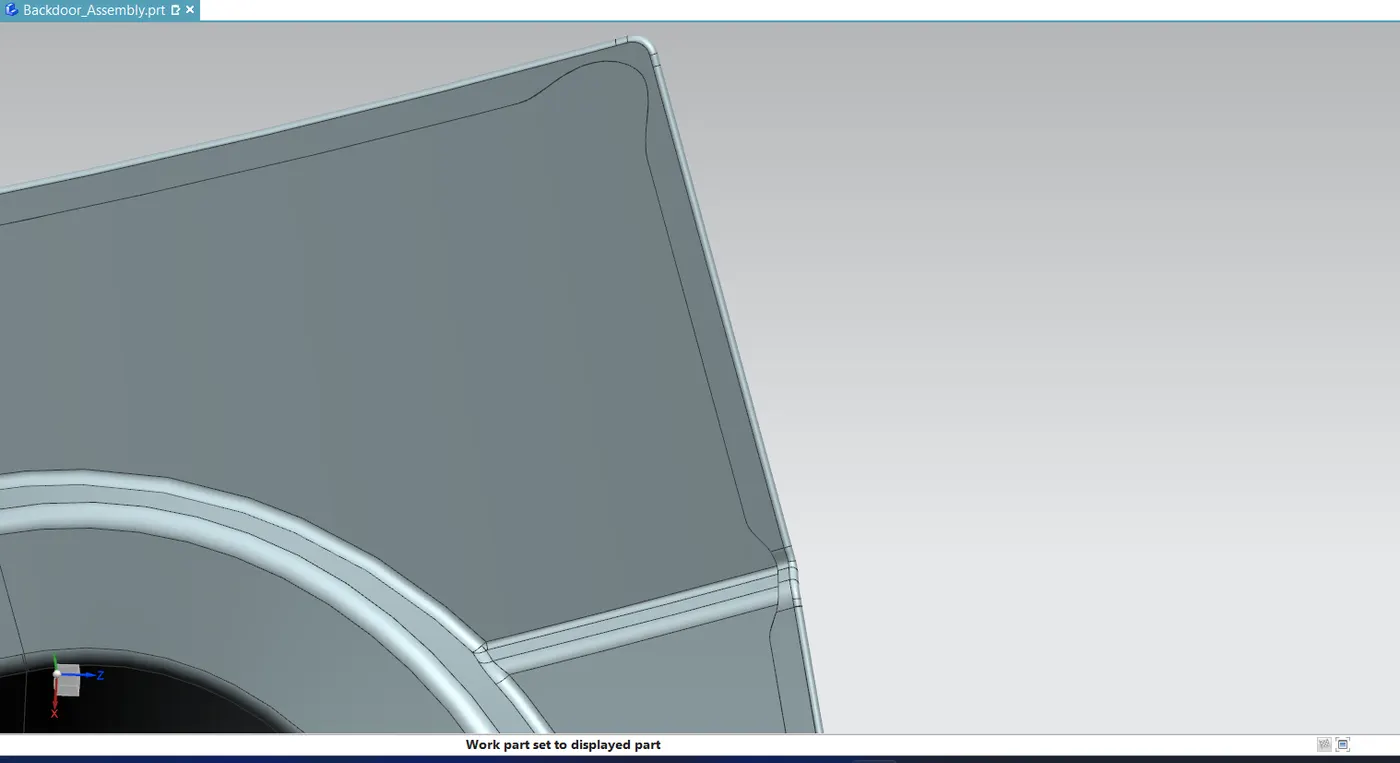
Multiple rollers are employed during the hemming process, which results in vibrations and stress concentrations at specific spots. As a result, the panel's design intent shouldn't be altered; after the roller is withdrawn, the panel should return to its original structure. However, this is typically not the case at corners, thus in order to prevent that situation, corners include situational reliefs.
4.3. Hinge reinforcement
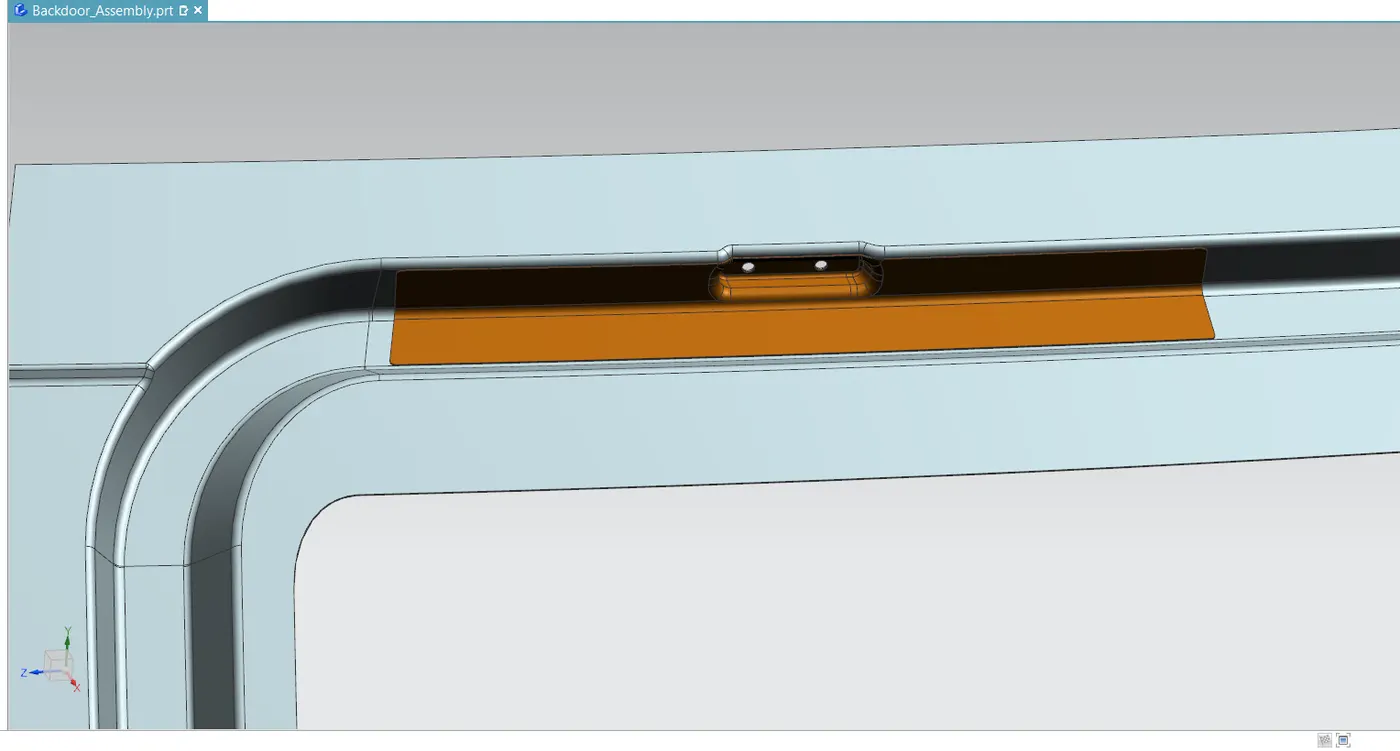
In order to preserve the stiffness of the panel assembly, reinforcements are typically positioned to strengthen the panel in certain regions that are quite small in comparison to sheet metal sections. These reinforcements are intended to absorb loads applied upon the panel and disperse those loads throughout the panel assembly. Typically, the reinforcements are between 1 and 1.5 mm thick, however the panel utilised in this part is 0.75 mm thick.
A hinge is a pivot device that holds the entire weight of the backdoor in place. Thus, for strength and stiffness, reinforcements are applied. Thus, there is also reinforcement given here. The hinges on the embosses should be able to move easily. To keep them hidden, the electrical wiring looms are inserted through the holes around the perimeter.
4.4. Gas stay reinforcement
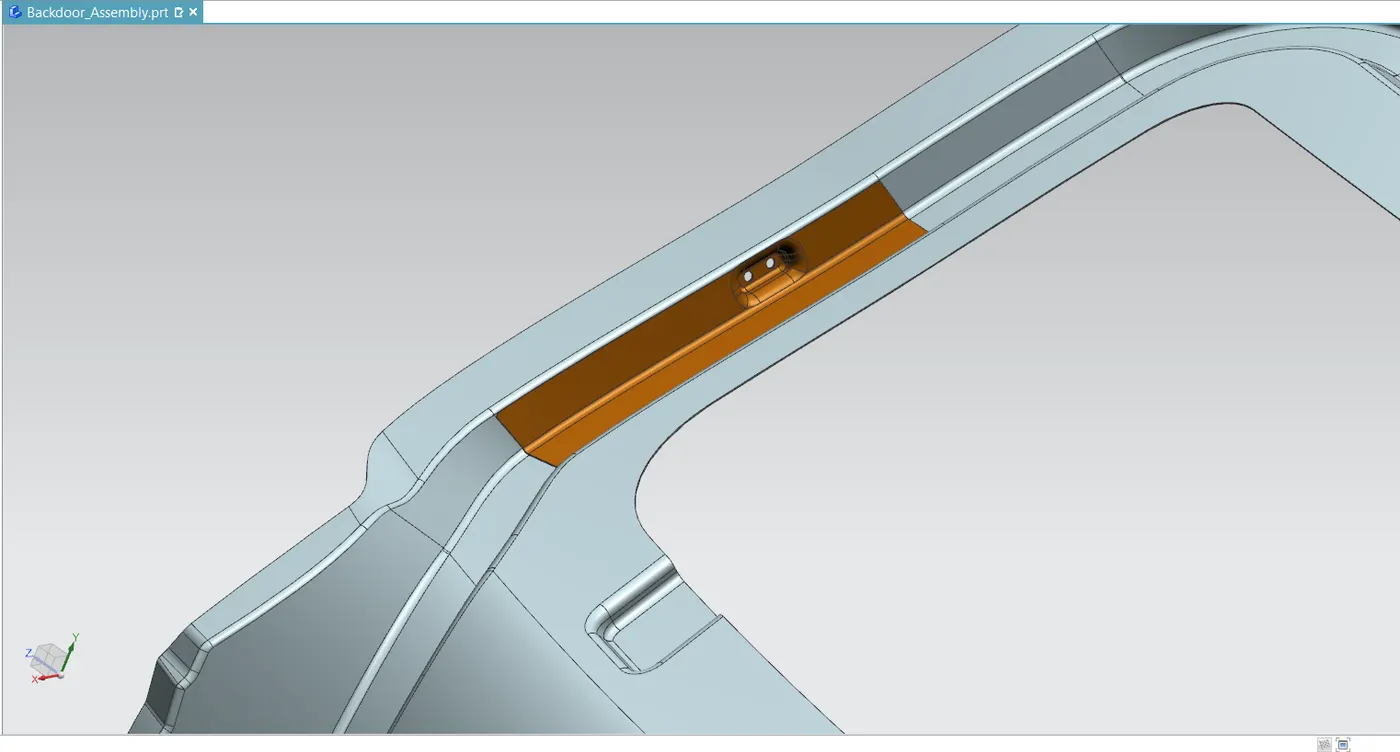
The backdoor is supported in its open position and is raised automatically by a gas stay. There are two possible kinds. both completely and semi-automated. Gas stay mounts have an angled or diabolic emboss supplied for them. It is simple to machine and stamp because of the angle. It is reinforcement using a more substantial sheet.
4.5. Wiper motor reinforcement
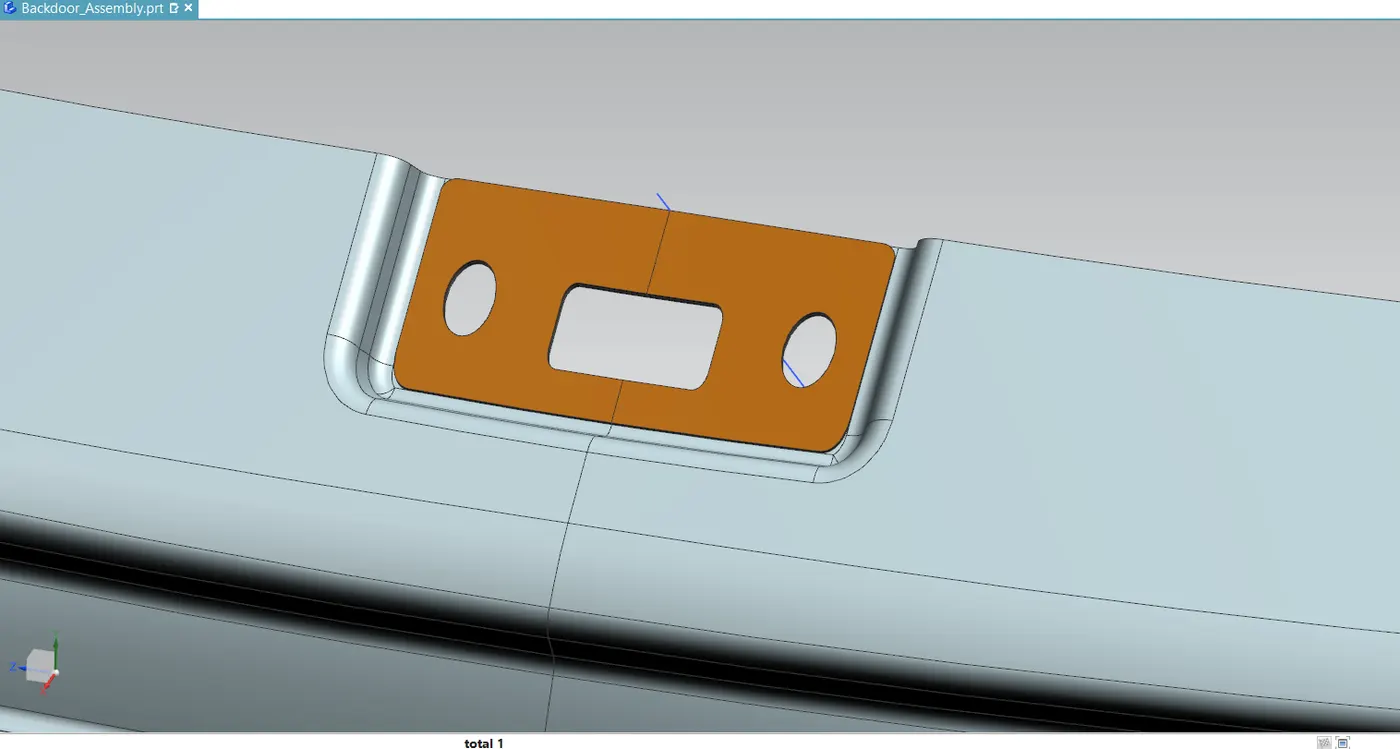
The purpose of a wiper is to remove water or dust particles from the windshield glass that impair rear visibility. The motor, situated on the inner panel, is what drives it. The inner panel deforms as a result of vibration and heat from the motor, which reduces the panel's strength and stiffness and lowers NVH. In order to prevent these circumstances, reinforcement is given. There is a space set aside for the wiper motor assembly close to the window. The panel has a cavity in the centre for the assembly's required parts and other accessories. In order to make room for wiring looms, tail lamp mounts, and other accessories, the holes or cavities have been placed strategically. Embosses function as local reinforcements and aid in strengthening the panel. In the event of a rear crash, the extensions around the holes that are fastened to the outside panels serve as crumple zones.
4.6. Latch reinforcement
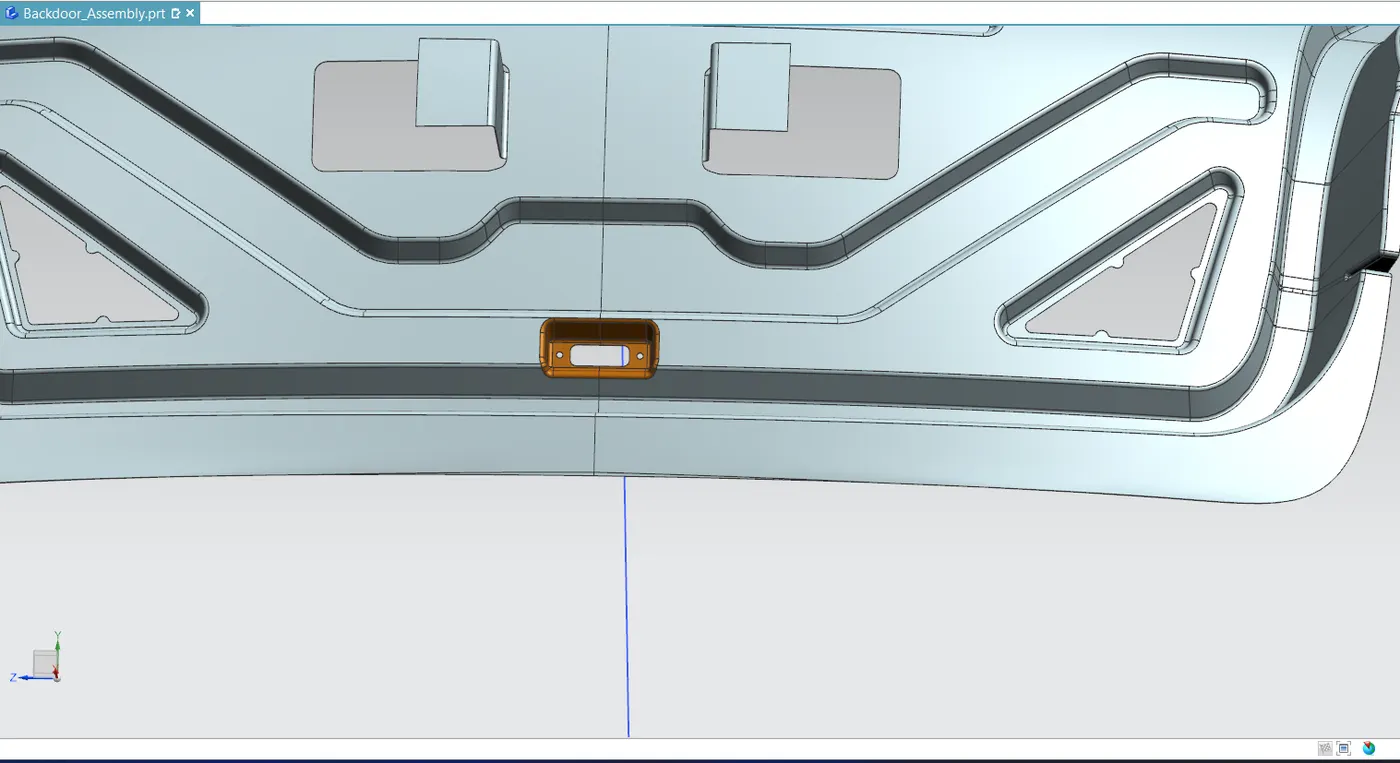
An embossment for the latch is made in the lower portion of the panel. There is excessive slamming and abuse that occurs when the door is opened and closed, thus reinforcing must be installed. beneath the striker and latch assembly. The door is often kept closed and open by an automatic remotely controllable locking system or one that is key operated. The emboss pattern also serves to disperse impact power in the direction of the latch assembly and hinges, which are reinforced and capable of absorbing it.
5. Methodology
The following are the design consideration,
- Rear visibility
- Boot space and accessibility
- Sealing flange
- Support structurer like hinge and gas stays
- Mounts for wiper motor, tail lamp and wiring loops
- Rear crash regulation
- Joining technique like hemming, spot welding's, mastics etc.
- Gap and flush requirements
The methodology is as follow,
- Backdoor exterior surfaces of both higher and lower class need to be fixed based on their level of smoothness. The door is separated into the Door Lower Panel and Door Outer Upper sections after the surfaces are repaired.
- The Tooling direction for the Deep drawing process is created first. It demonstrates how every operation, including embossing, is carried out considering this vector direction, which will aid in the part's manufacture.
- Next, I offset the outer panel by a predetermined amount in order to produce the sealing flange.
- Next, considering the sheet thickness and thickening direction, I offset the outside surface at a distance to create the inner panel flange for the back door.
- Followed by creating the sealing flange and connecting flange to connect the inner panel.
- Next, a windshield panel is made and attached to a sealing flange for mounting.
- It's time to put the back door on the car. The door is opened and closed using hinges. I designed the emboss and added the necessary reinforcements to withstand the load acting against it in order to boost the local area strength.
6. Latch Trajectory
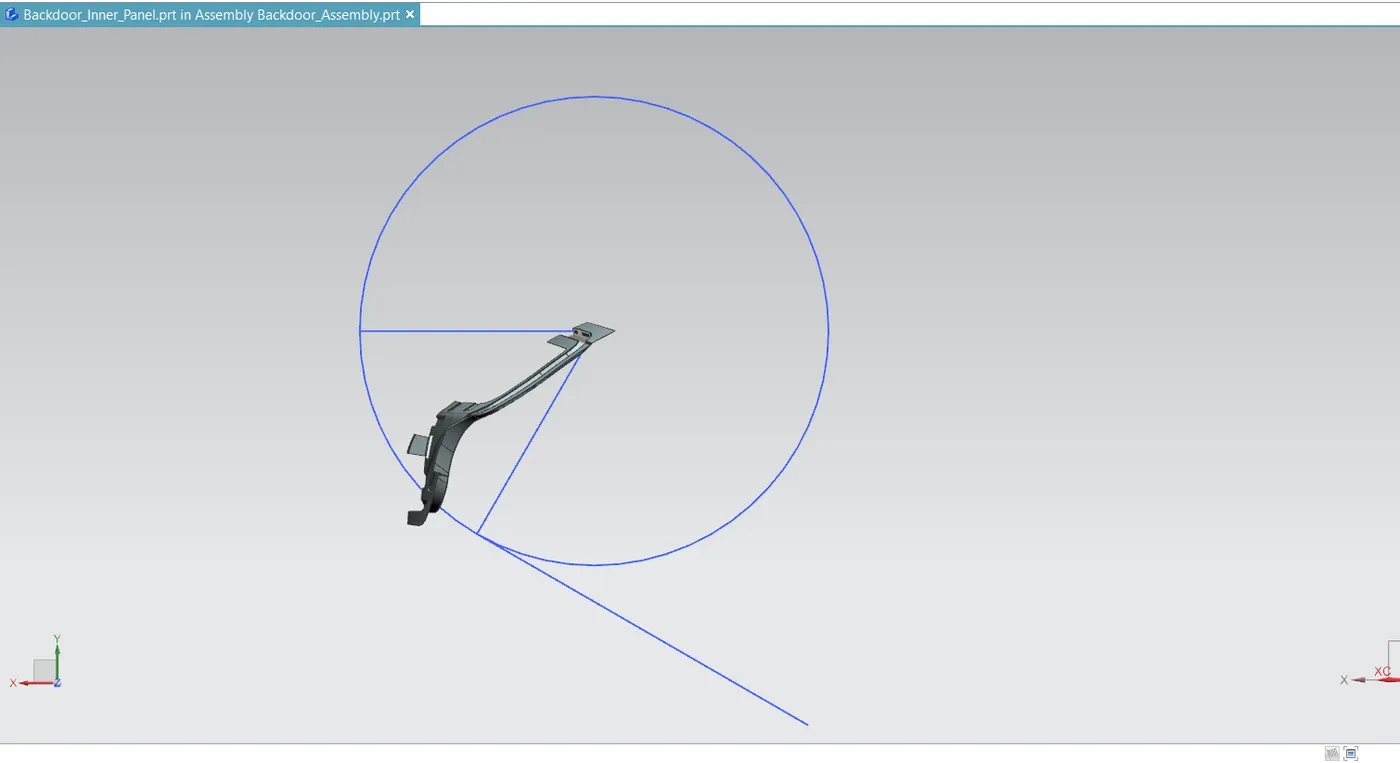
The swinging portion that revolves around the hinge axis is the backdoor. For the backdoor to open and close correctly, the latch striker's position and orientation are crucial. To accurately position the hinge, draw a circle whose centre is the hinge's axis and goes through the striker at the right angle to the inner panel.
7. Draft Analysis
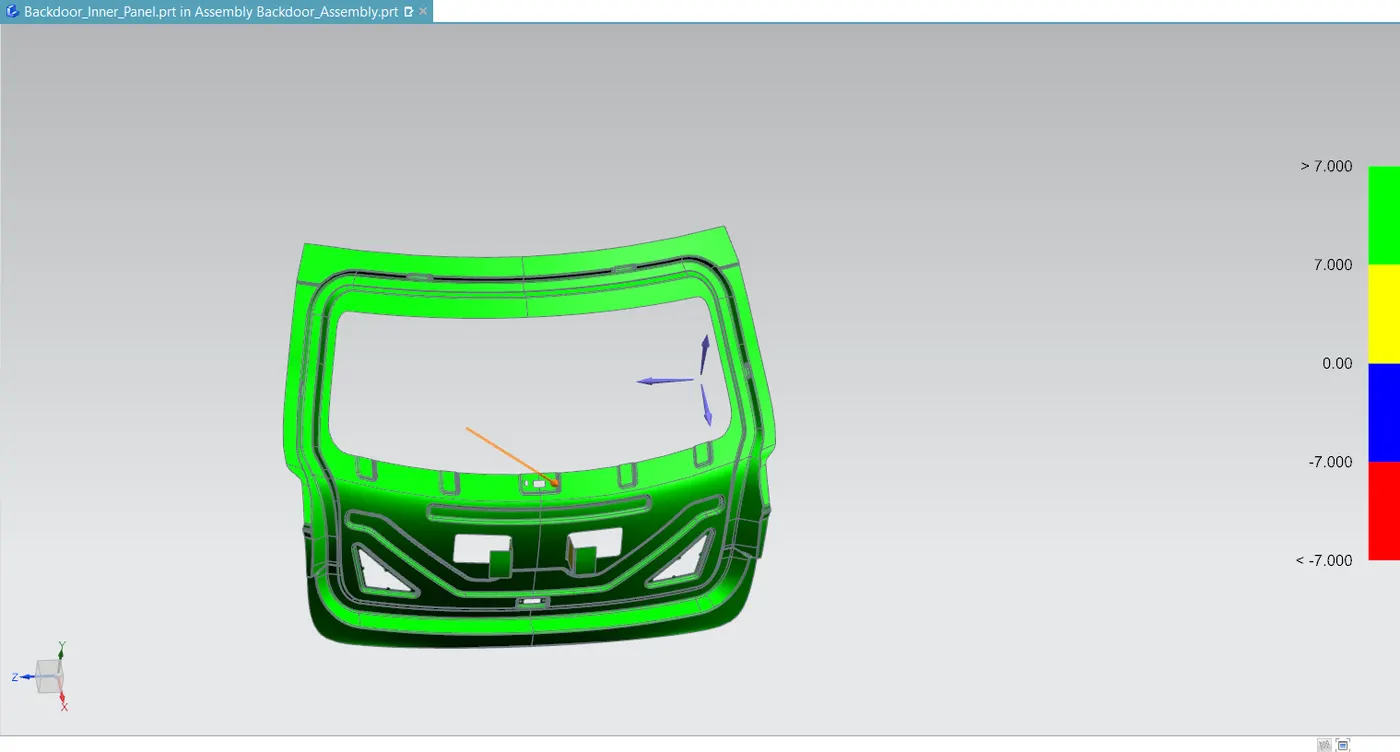
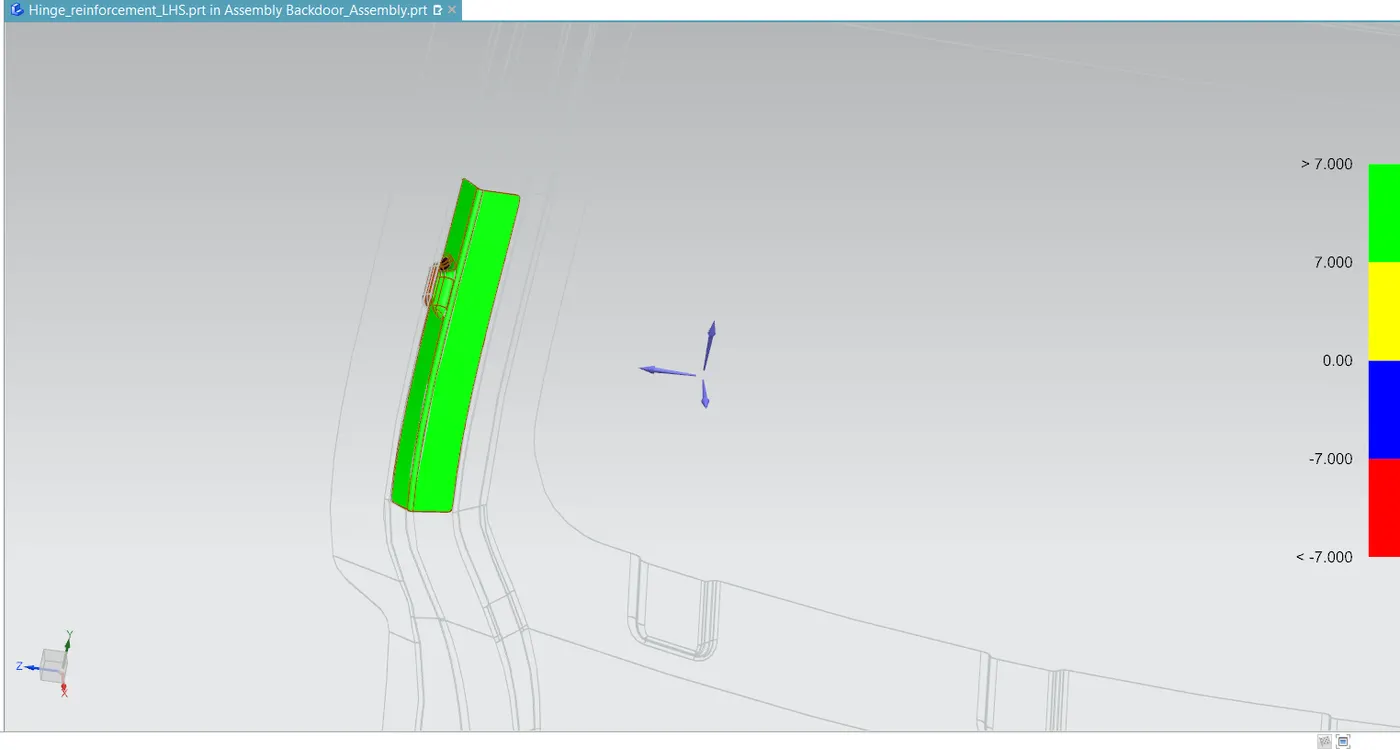
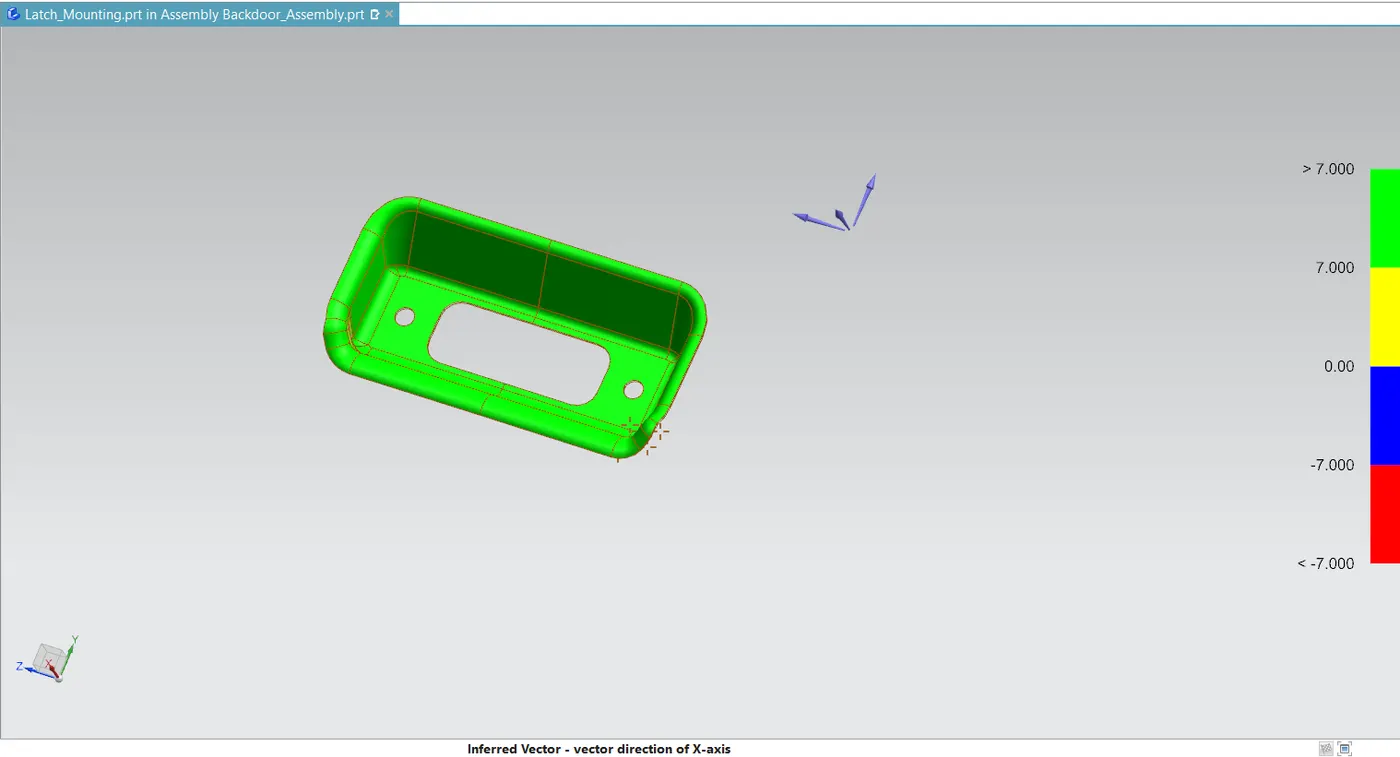
Positive draft is required on the faces parallel to the tooling direction of any item made with a press tool or other forming tool. It will adhere to the mold surface if there is no draft (zero draft) or negative draft on certain faces. When the mold is in motion, this will damage the surface, lowering the surface finish. Therefore, we can determine whether or not the component we have drafted can be easily expelled by using the Draft Analysis command. Additionally, it provides information on the crucial zones, allowing for any necessary adjustments to be made to the design.
8. Conclusion
The Siemens NX software was used to finish designing the backdoor by utilizing solid and sheet modelling methodologies and according to engineering standards.