Design of backdoor
Backdoor of Vehicle:
When referring to a vehicle, the backdoor refers to the component that is located behind the rear compartment, which, in the case of an SUV, MUV, etc., houses the boot and the rear passenger area. The term "backdoor" also refers to the tailboard, which provides access to load and unload goods from the area at the back offered by opening and closing the product.
Types of back doors based on working position,
UPPER-HINGED:
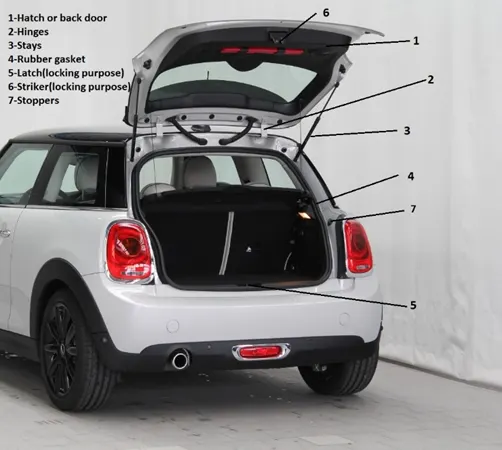
SIDE-HINGED:
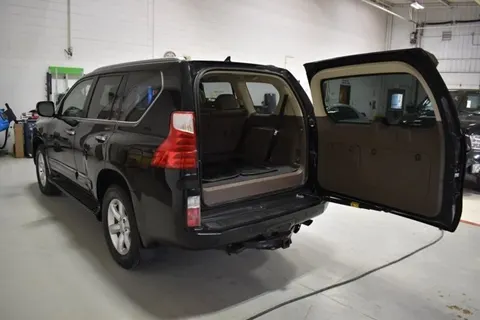
SPLIT OPEN:

BOTTOM-HINGED:
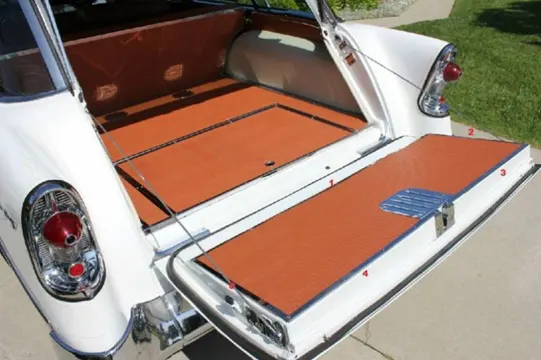
Design consideration of a backdoor:
- Hinge positions: The placement of hinges on car doors affects how they swing open and close. Proper hinge placement is essential for smooth and reliable door operation.
- Gas stay positions: Gas stays or struts are used to support the weight of the door and keep it open. The position of gas stays must be carefully considered to ensure proper support and ease of use.
- Latch and striker: The latch and striker are critical components that hold the door in place when closed. They must be properly aligned and securely attached to prevent the door from coming open while driving.
- Shape of sealing flange: The sealing flange is the part of the door that makes contact with the car's body to create a tight seal. The shape of the sealing flange must be designed to provide a secure and leak-free seal.
- Visibility criteria: The design of the sealing flange should take into account the driver's visibility through the rear glass. The flange should not obstruct the driver's view or cause any blind spots.
- Inner panel shape and thickness: The shape and thickness of the inner panel affect the amount of space available in the car's trunk or cargo area. Careful consideration must be given to ensure adequate space while maintaining the strength and durability of the door.
- Reinforcements: Reinforcements must be provided at critical areas such as hinge and gas stay regions to prevent deformation or failure.
- Embosses and material removal: The design of embosses and material removal on the inner panel can affect the strength and stability of the door. Proper design and engineering are essential to ensure the door's reliability.
- Drain holes: Drain holes must be provided to allow for proper drainage during the electrolytic dipping and painting process.
- Minimum radius of bending: The minimum radius of bending must be carefully calculated to prevent material failure during the stamping operation.
- Hemming relaxation: Hemming relaxation occurs when the metal is bent, and the stress is released over time. This must be taken into account during the design and manufacturing process to ensure proper fit and function over time.
Master Section provided:
This master section has an outer upper and lower panel.
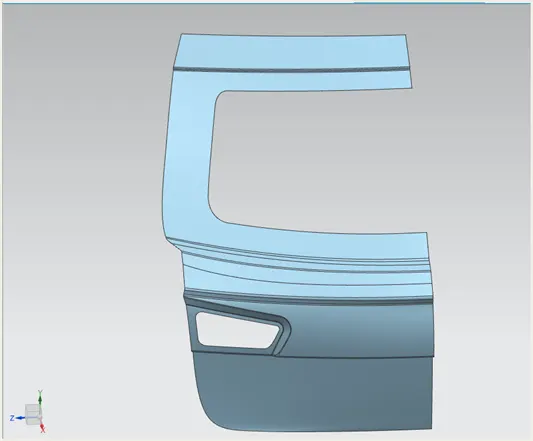
There were several surface abnormalities in the master part that was delivered. Thus, it was redone.
From the above master section inner panel is designed by the following steps:
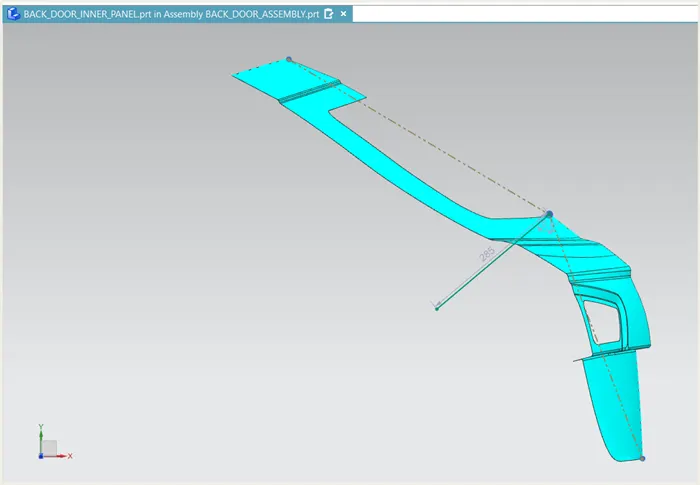
Tooling Direction:
The tooling direction for the deep drawing procedure must first be created. It demonstrates how all processes, such as embossing, are carried out while taking this vector orientation into consideration, which will aid in the part's manufacture.
Design of sealing flange:
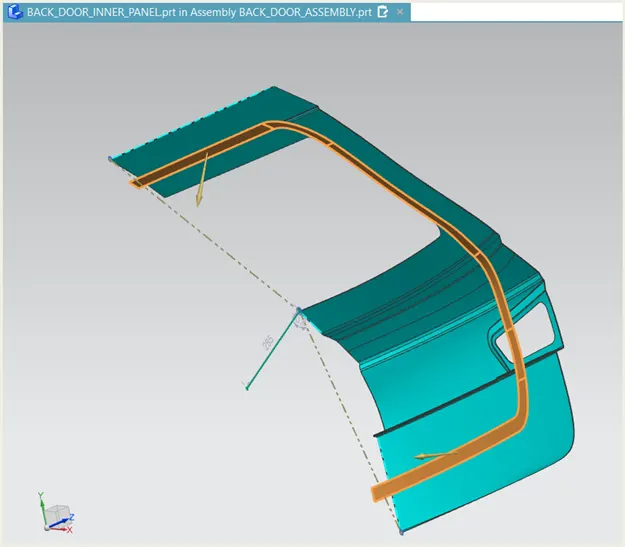
This Sealing flange is that section of the inner panel which enables the backdoor to sit over the rear body side of the car. It is the most important part of the inner panel as it decides how a backdoor is mounted on the rear body side of the car and also restricts any external matter to enter inside the vehicle.
After the creation of the flange, it is connected to the inner panel by using law extension.
Designing of embosses and holes:
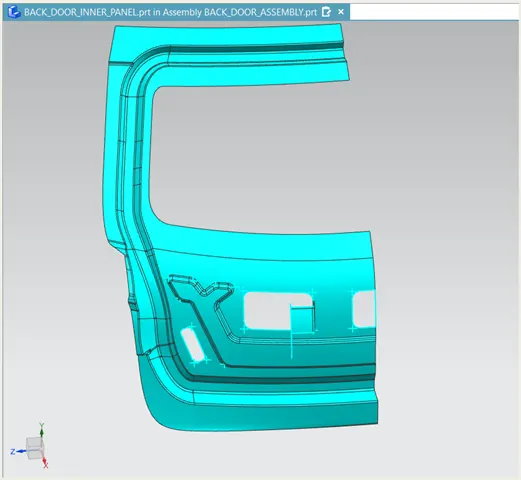
- For improved rigidity and strength, material and embosses are eliminated from the inner panel's less-curved sections. The amount of material removed in this area significantly lightens the backdoor. The backdoor's sides will be protected by the force being directed there, protecting the passengers and their belongings in the back.
- This component greatly minimises vibrations as well as acting as an additional joining piece to connect the inner panel to the higher outer panel. The flange and outer upper panel are separated by a 0.2mm gap so that mastic sealants can be used to bond them.
Cable Harness Gaps
- These gaps are for Headlamp Harness and tailgate light harness cables also dissipates the force when collision
Mounting Flange
- Two mounting Flanges are provided for mounting the inner panel with outer stylish panel. In between inner panel and outer panel we providing sealants.
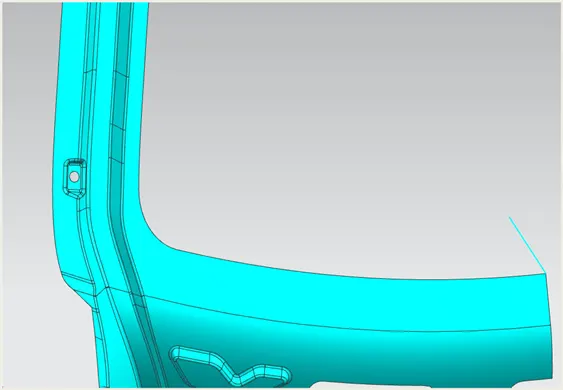
Hinge and Gas Stay emboss:
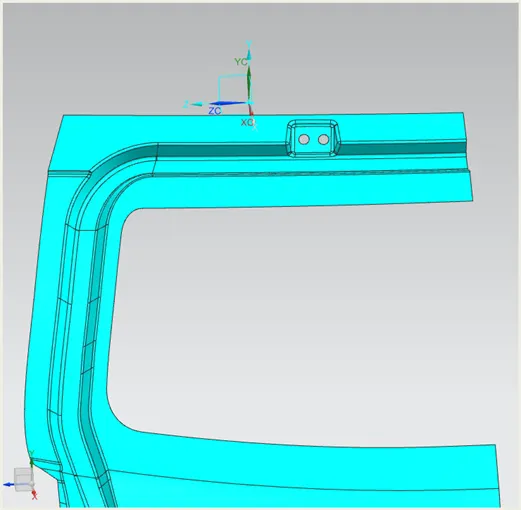
Hinge embosses
Hinges are basic mechanical bearing components that join two elements together and enable them to rotate in relation to one another around a fixed axis. The components can move (most frequently) inside a constrained arc or with 360° freedom, depending on the kind used.
At hinge emboss, hinges will be affixed to this section so as backdoor can swing up and down about the hinge axis.
Gas Stay emboss
Gas springs, also known as gas struts, are rods that support horizontally hinged doors, hatches, lids and coverings. Because of their adaptability and ability to provide support in a variety of methods, including lifting, positioning, and lowering, they are utilised in a wide range of applications.
Reinforcement:
Vehicle Door reinforcement structures are offered to lessen impact during collisions. In one version, the structure will have a lower reinforcement panel that can attach to a vehicle's chassis and an upper reinforcement panel that is attached to the lower reinforcement panel by welding, with the upper reinforcement panel's front deformable wall set up to cause the lower reinforcement panel's rear deformable wall to deflect.
Additional latch and hinge reinforcement has been added to the hood to lessen the impact on the passengers within the vehicle. There is a loss of strength when the latch and striker are installed, necessitating strengthening. Stiffness pads are also used to lessen NVH. The thickness of the hinge and latch reinforcement is fixed at 0.75 mm, however it may change.
When there are motions, such as hinges, hood opening and shutting, doors, etc., there is typically less strength in those opening and closing parts, thus we need to add reinforcement to those areas to give them more strength.
Latch and Stiker Reinforcement:
The latch and striker are important components of car doors that are responsible for securely holding the door in place when closed. The latch is typically located on the inside of the door, while the striker is attached to the car's body. . If the latch and striker are not properly aligned, the door may not close or may come open while driving. The latch and striker must also be properly adjusted to ensure that the door seals properly when closed, preventing air and water leaks.
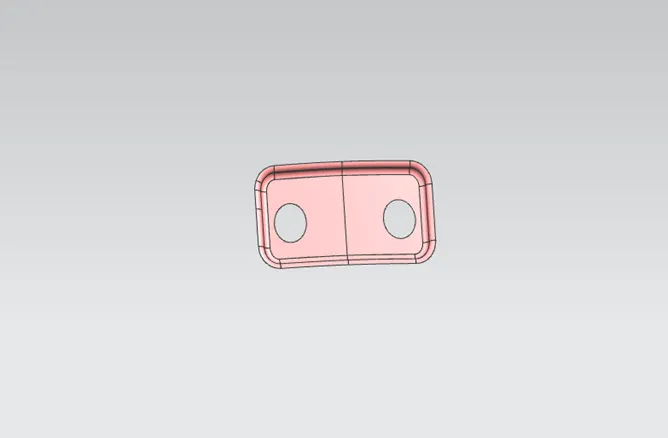
Hinge Reinforcement:
Hinge needs additional strength since it loses some strength when it rotates around the rotational axis, which implies a large back door can open using a small hinge. We provide reinforcement for this purpose.
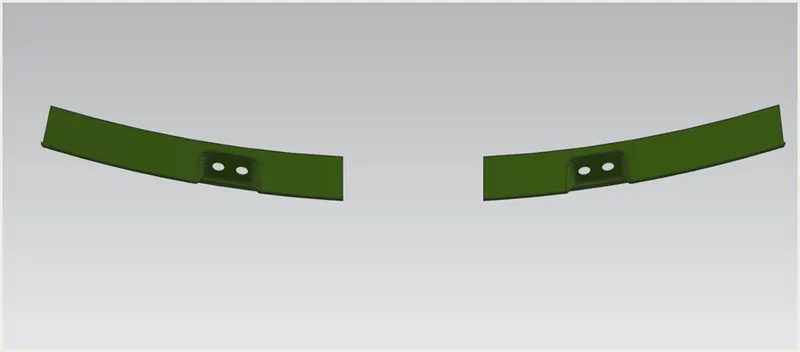
Gas stay reinforcement:
Gas stay reinforcement involves adding extra support to the areas where the gas stays attach to the back door. This reinforcement helps to distribute the weight of the door more evenly, reducing the risk of damage or failure.
Proper gas stay reinforcement is important for ensuring the safety and reliability of car back doors. Without proper reinforcement, the gas stay attachment points can become damaged or fail over time, causing the door to fall or become difficult to open and close. Regular maintenance and inspection can help identify any issues with gas stay attachment points and ensure that the door remains safe and reliable.
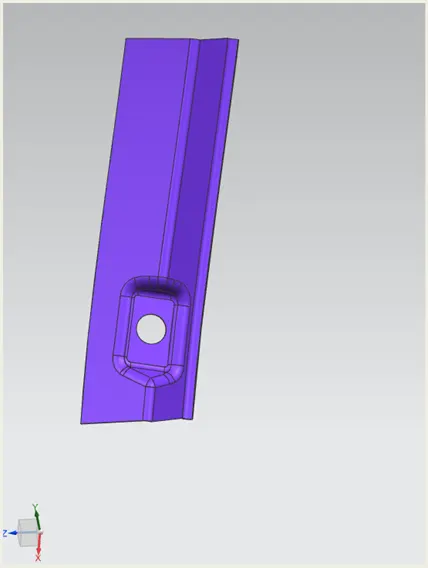
Wiper Motor Reinforcement:
A little electric motor, typically installed on the firewall or behind the cowl (the region beneath the base of the windscreen), powers the windscreen wipers. The motor engages a linkage, which causes the wiper arms to reciprocate. When a car has a rear window wiper, the one at the back is powered by a different motor.
POSITION OF LATCH:
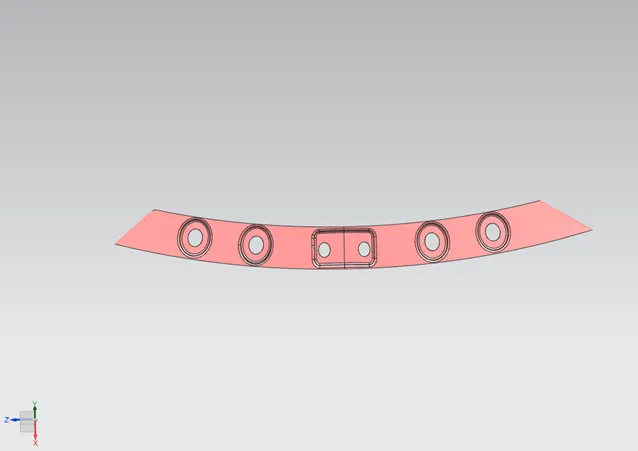
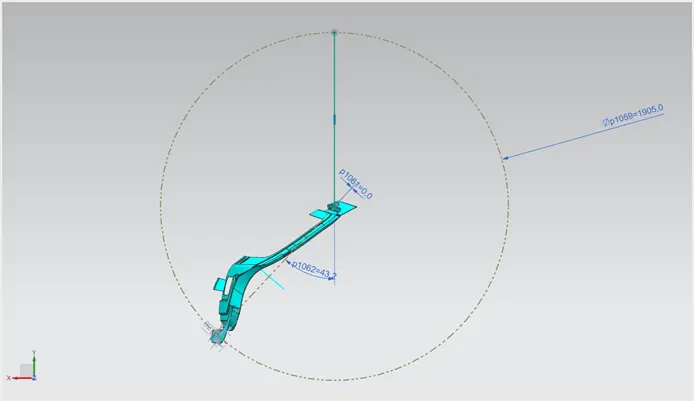
To ensure that the latch and striker mechanism of a door operates properly during opening and closing, it is essential to position them perpendicular to the hinge. This requires proper placement of the hinge along the trajectory of the door. Once the hinge is in place, its axis is determined by drawing a circle around it.
To position the latch perpendicular to the door's trajectory, a large circle is drawn
- The latch is placed at the point where it intersects the circle.
- The striker should be placed perpendicular to the midpoint of the two hinges to ensure that opening and closing actions are consistent.
- Proper alignment of the latch and striker with respect to the hinge is crucial for the reliable operation of the door.
Hemming and Relief:
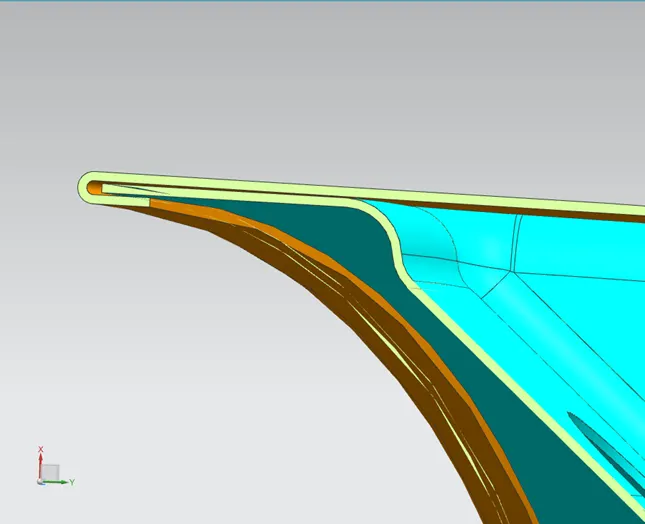
- Mechanical interlocking joining method with mastic sealants:
- The method used to join sheet metals is mechanical interlocking with the help of mastic sealants.
- This method ensures a strong and durable bond between the panels.
- A minimum gap of 0.2mm is necessary between the panels to achieve perfect sealing.
- Three panels:
- The car body comprises three panels - outer upper panel, outer lower panel, and inner panel.
- The outer upper panel is joined to the upper section of the inner panel, while the outer lower panel is joined to the lower section of the inner panel.
- This arrangement provides stability and strength to the car body.
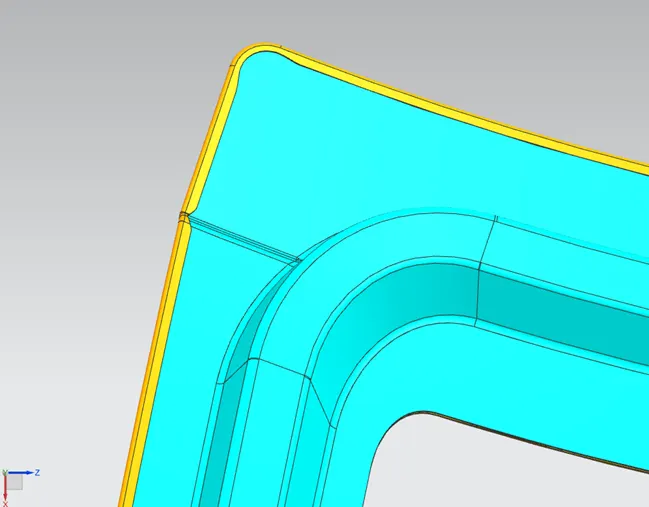
- Relaxation at bends:
- To avoid material failures at the bends, relaxation is given at every bend during the joining process.
- This ensures that the material does not experience any stress or strain, which can lead to deformation or cracking.
- Hemming length:
- The maximum hemming length is 6mm, while the minimum length is 2mm.
- Hemming is a process where the edge of a panel is folded over another panel to create a secure joint.
- The hemming length is important to ensure a proper and strong joint.
- Gap between panels:
- A gap of 2mm is maintained between the inner edge of the outer panel and the outer edge of the inner panel.
- This gap is necessary to allow for the expansion and contraction of the panels due to temperature changes.
- It also helps in achieving a perfect seal between the panels.
Overall inner panel design:
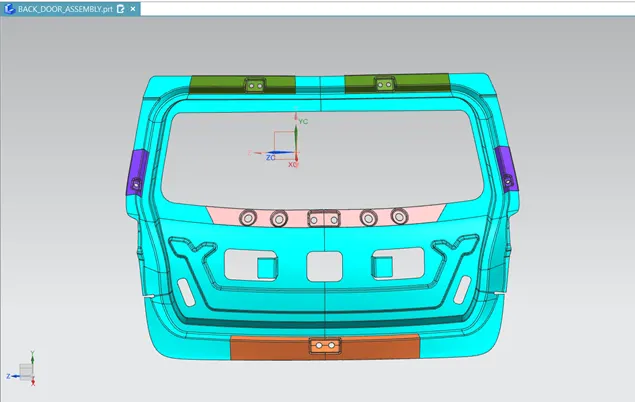
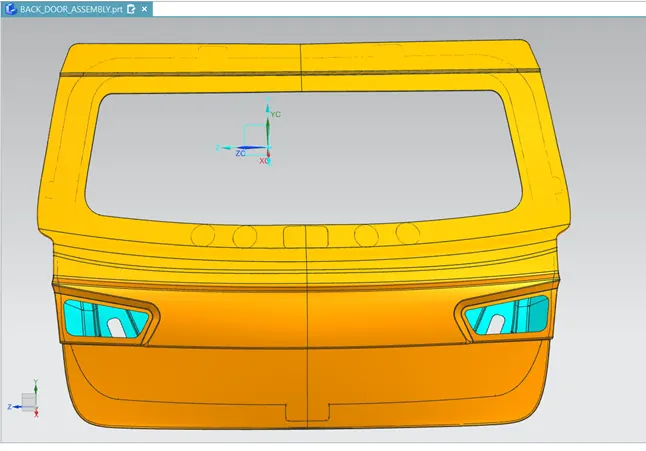
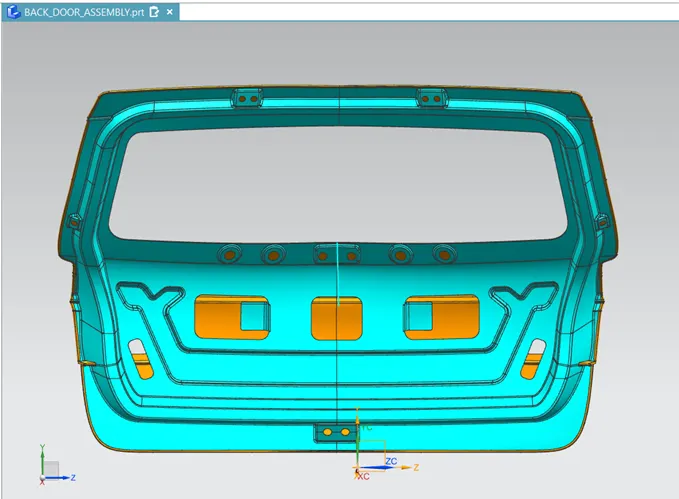
In the above inner panel design, it is made sure that
- The design incorporates embosses and material removal in flat regions to provide better stiffness and strength to the body while reducing weight.
- The inner emboss structure is designed to divert force outside the car body.
- Drain holes are provided at certain sections to allow liquid to drain out.
- The position of the latch-striker is perpendicular to the hinge axis to ensure proper locking to the rear body side.
- The inner panel thickness is 0.75mm.
- The minimum radius at each bend is 3mm.
- A vertical rectangular hole is provided at the latch-striker location to mount the latch-striker.
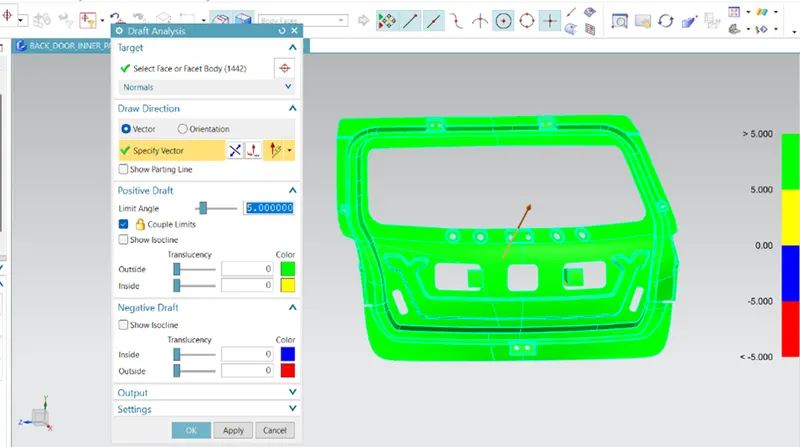
Draft Analysis:
The purpose of this analysis is to determine if a part can be produced successfully. Based on the analysis report shown below, the part is indicated in green color, which means that it is producible and is not likely to experience any failures during the stamping process when imprinting the design onto the actual commodity.
Inertia Analysis:
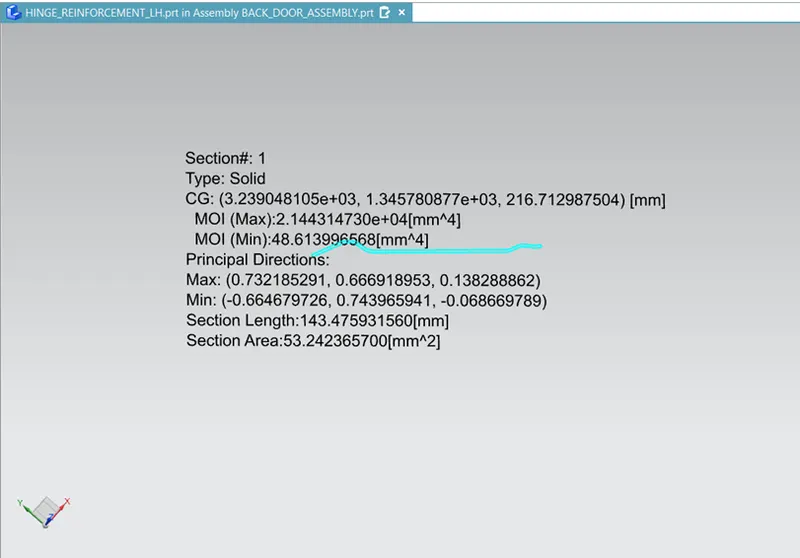
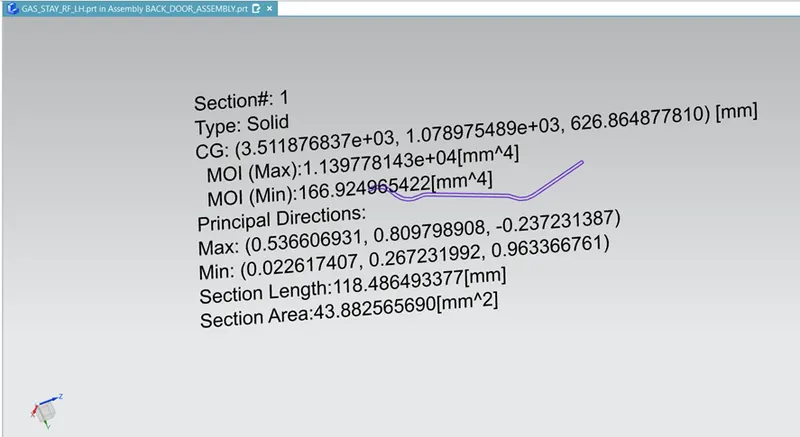
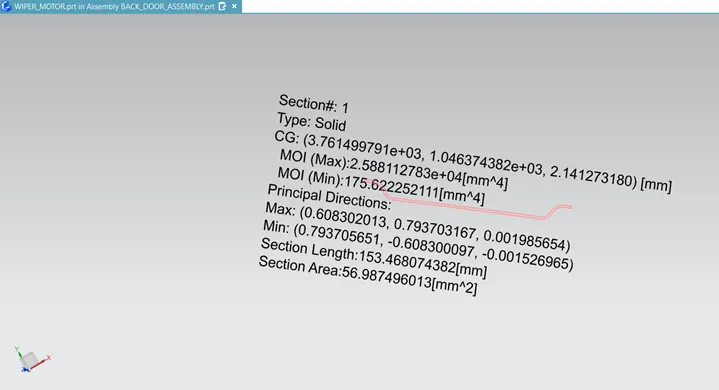
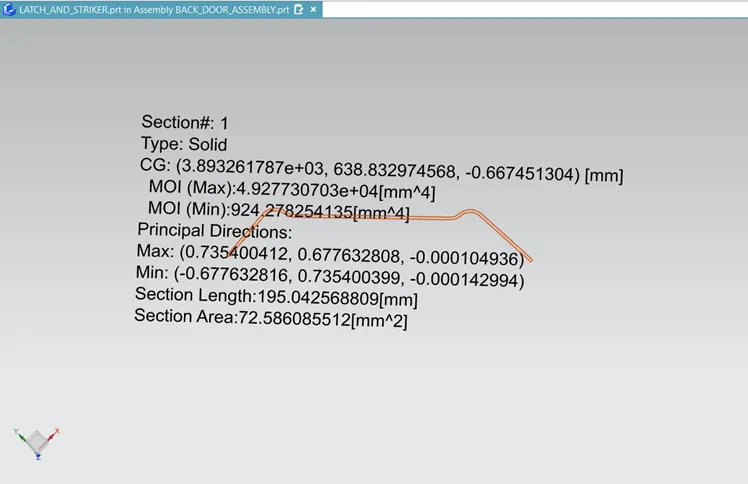
The purpose of Inertia Analysis is to determine the amount of bending stress that a commodity can withstand without failing. During this analysis, the minimum moment of inertia value is examined, as this is the point where the part may start to break. This minimum value is also referred to as the critical moment of inertia value.
- Inertia Analysis of Hinge Reinforcement
- Inertia Analysis of gas stay reinforcement
- Inertia Analysis of Wiper reinforcement
- Inertia Analysis of latch and striker
Conclusion:
Using appropriate design methodologies, I incorporated necessary reinforcements and embosses to the provided styling surface for the back door design. As a result of these efforts, I successfully designed a back door.