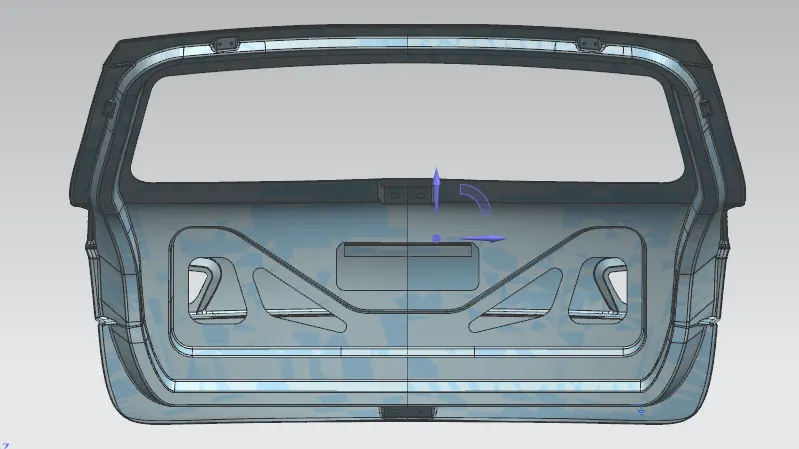
Design of backdoor
Aim: To design a car back door from given styling surface data under given design rules and regulations.
Objective:
>From the given styling surface, develop a back door using appropriate design methodologies.
>The objective of this project is to design a BIW Back Door of a car with an Inner Panel, Outer Panel, and Reinforcements for the Hinges, Gas stay, Wiper Motor, and Latch by following the engineering standards.
>The Inner Panel must be subjected to Draft Analysis for verifying whether it satisfies the Deep Drawing requirements for the tooling direction created in the design.
Introduction:
>The Back Door of a car is the rearmost part of the vehicle which gives access to the trunk space of the vehicle. The rear door also supports the reinforcements and added weights of the Wiper Motor, Gas Stay, Tail Lamp, and Latch and Striker.
>The Backdoor/tailgate is one of the closure commodities in BIW sheet Metal Design. The backdoor has a lot of components inside and is designed to incorporate them easily. It affects the rear visibility and luggage area.
>The material used for door manufacturing depends on the budget and performance of the vehicle. Mostly Aluminium and Steel will be used whereas low-budget vehicles use Steel which makes the manufacturing process easy and cost-efficient since it follows the Stamping of Moulds.
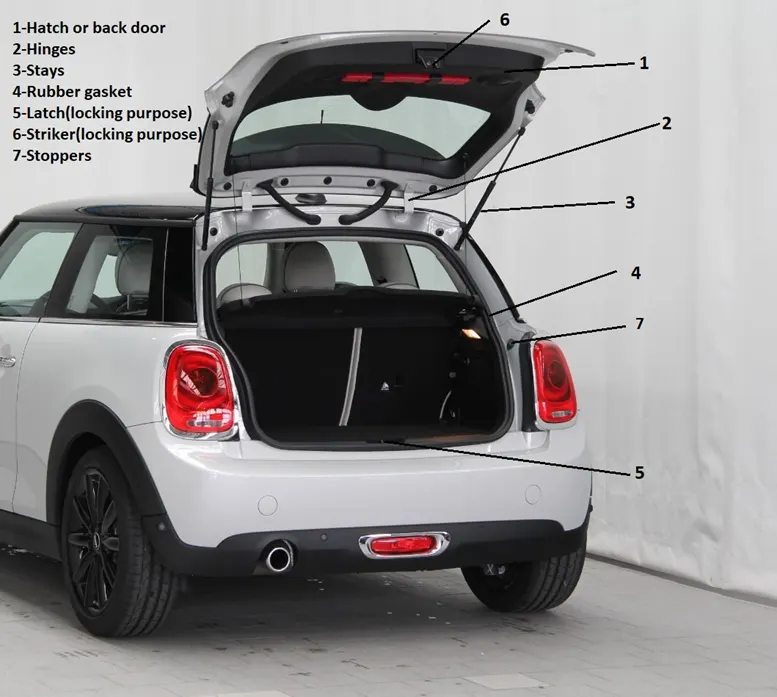
Different Sheetmetal processes used for manufacturing the Back Door
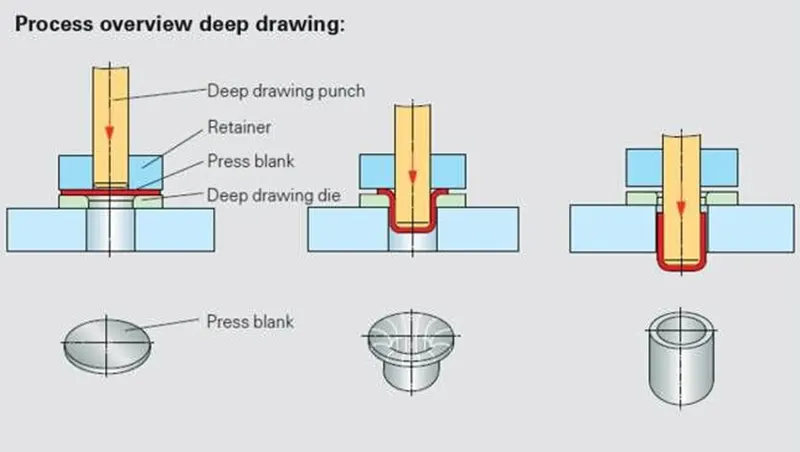
1.Deep Drawing:
>The metal deep drawing process is an effective method of manufacturing of cups, cans and other similar deep drawing products. The deep drawings having two main categories.
>First- stage drawing: The blank shape of metal is placed on the die and contact with the punch. When the metal specimen is flat piece of sheet metal used in forming and finish the product. Initially the punch moves in downward direction. The outer rim of blank is subjected to pure radial drawing (drawing toward in vertical axes) between die and blank metal. The metal become a bend and sliding over die and also stretched between die and punch. The metal in vicinity of punch head and contact with it bend and slide over radii and stretch over punch head.
2.Redrawing:
>The components drawn from first stage again it is redrawn convert into more depth to form a cup shape in the die and punch. The second stage of drawing is called as redrawing.
3.Hemming
>The inner & outer panels are joined by the process of hemming.
>Hemming is a forming operation in which the edges of the sheet are folded over other parts in order to achieve a tight fit. Usually, hemming operations are used to connect parts together, to improve the appearance of a part, and to reinforce part edges.
>In car part production, hemming is used in assembly as a secondary operation after deep drawing, trimming & flanging operations to join two sheet metal parts together. Typical parts for this type of assembly are hoods, doors, trunk lids & fenders.
>The accuracy of the hemming operation is very important since it affects the appearance of the surface & surface quality. Material deformations, which occur while the hemming process, can lead to dimensional variations & other defects in parts. Typical hemming defects are splits and wrinkles in the flange, material overlaps in the corner areas. So it is very important to use simulation software tools to better understand the hemming process and minimize the number of “trial & error” during the tryout.
ypes of Back Door :
1.Top Mounted
2.Side Mounted
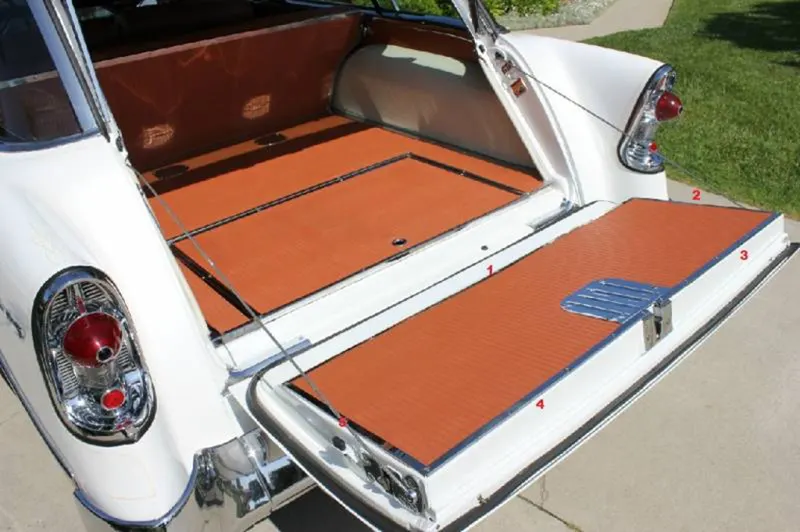
3.Bottom Mounted
1.Top Mounted
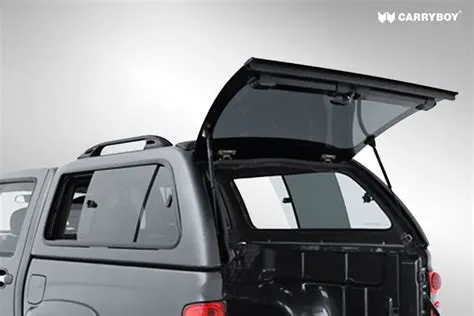
2.Side Mounted
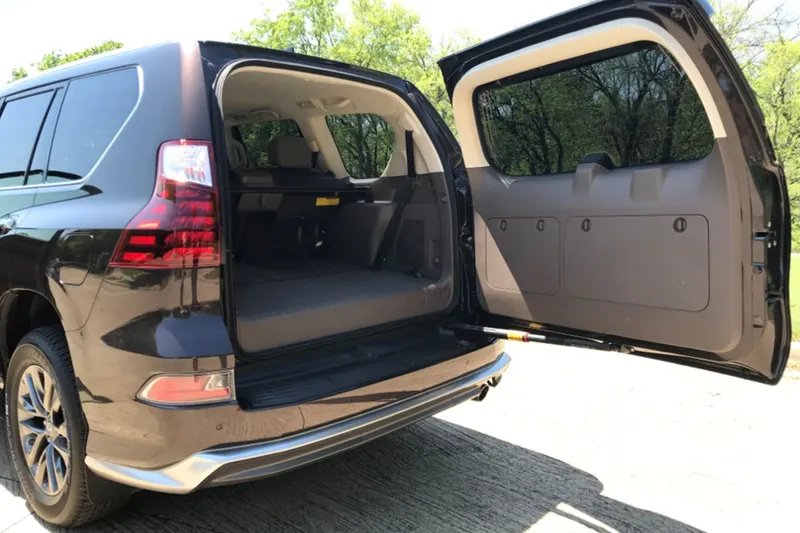
3.Bottom Mounted
Design Consideration :
Visibility Criteria
Latch and Stricker Position
Hing Position
Gas Stay Position
Space Avalibility
Drain Holes
Hemming and Relief area's.
Major Parts and Reinforcement
The backdoor consists of the following basic components:
- Backdoor Outer Panel (Upper)
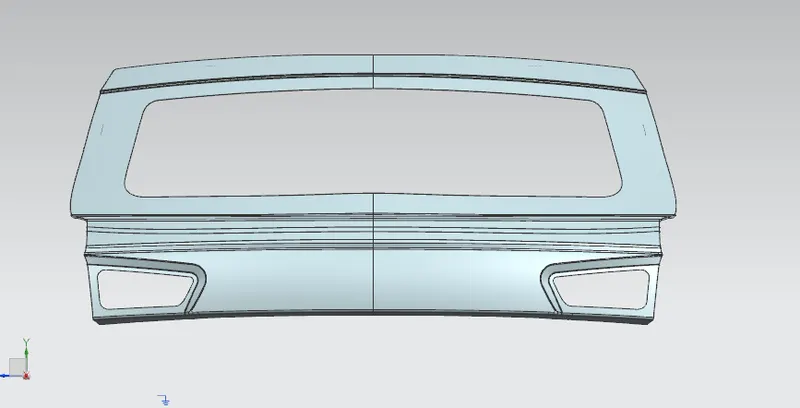
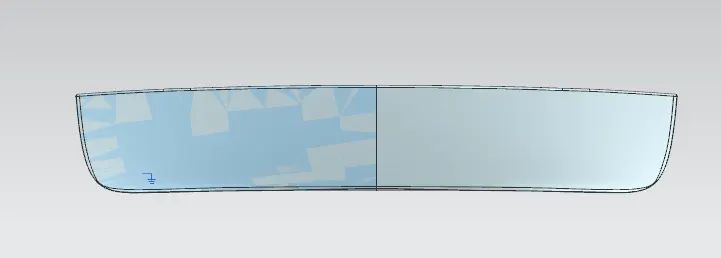
- Backdoor Outer Panel (Lower)
-
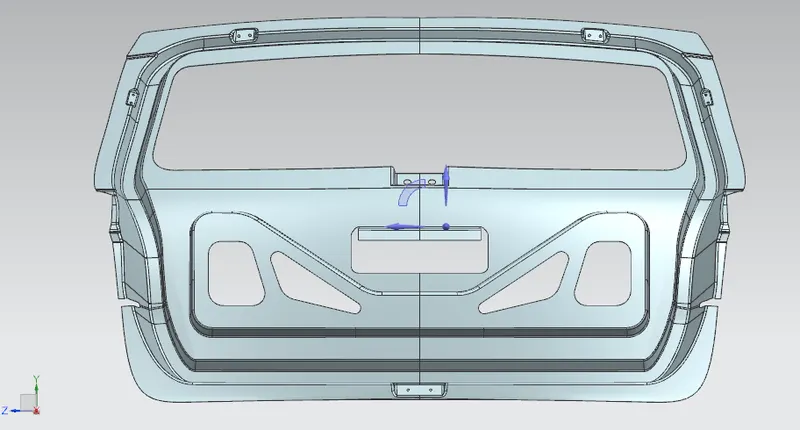
Backdoor Inner Panel
-
Hinge Reinforcements (LH & RH)

-
Gas-Stay Reinforcements (LH & RH)

-
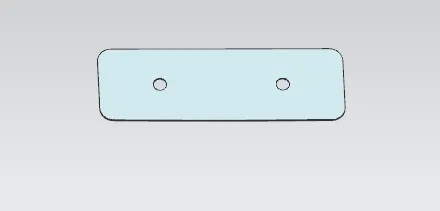
Latch and Striker Reinforcement
-
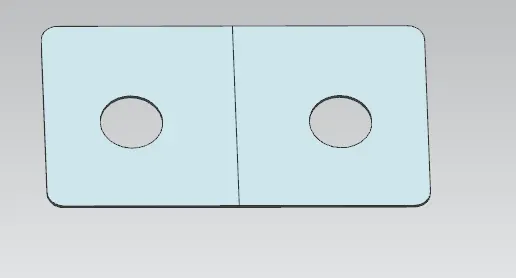
Wiper motor Reinforcement
1.Backdoor Upper Outerpannel and Hemming:
>As the name suggests, it is the outer part of the rear door and is mostly responsible for aesthetics of the vehicle. Outer and inner panels are connected by mastic sealants in center and by hemming process at edges.
>The outer door handle and in some cases, the number plate may also be installed on the outer panel of the back door. We have considered a 2-part outer panel for our design, outer upper panel and outer lower panel prospectively. Outer panel is manufacture by stamping sheet metal. Thickness for outer panel is 0.75
Hemming :
Hemming and seaming are two similar metalworking processes in which a sheet metal edge is rolled over onto itself. Hemming is the process in which the edge is rolled flush to itself, while a seam joins the edges of two materials.
FEATURES 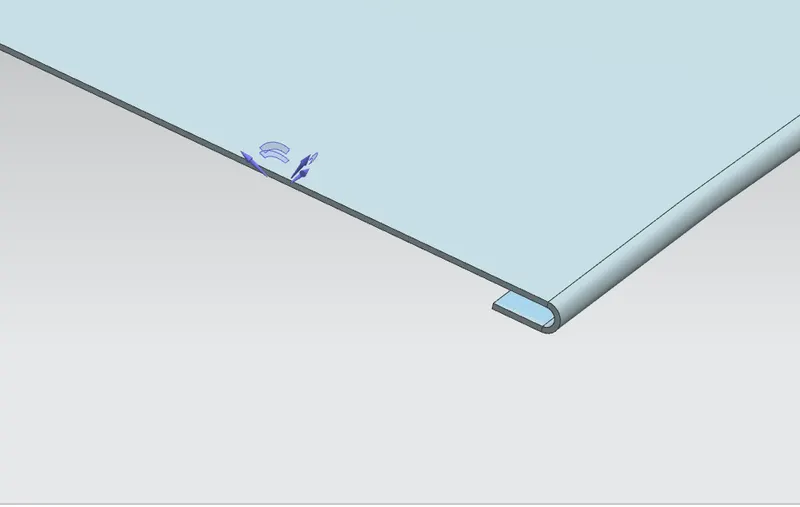
- Wave Geometry Linker – With this you can create, associative or linked copies of any entity of a part into other parts. It may be a surface, edge, curve, body, sketch etc. The changes made to the original entity will be reflected in the copy of that entity.
- Extract Body – It is used to create an associative body by extracting faces, entire body or region of faces.
- Bridge Curve – It helps to create a tangent blend curve between two objects. The objects may be edges or sketch curves.
- Sew – It combines sheet bodies together by sewing their common edges. There shouldn’t be any gaps larger than specified tolerance.
- Unsew – This command is used to separate the existing sheet body or solid body into multiple bodies.
- Projected Curve – It is used to project an existing curve/curves on a selected plane or surface by selecting a direction for projection.
- Trim Body – It is used to trim one or more bodies using a face or plane. You can also specify the bodies to retain and the bodies to discard.
- Offset Surface – It allows you to offset one or more existing surfaces.
- Offset Curve in Face – This command will allow you to offset particular edges or curves on selected faces.
- Trim Sheet – It is used to trim off a portion of a sheet body using curves, faces, edges or planes.
- Through Curves – It will allow you to create a body Through multiple sections, where it’s shape changes to pass through each section.
- Law Extension – This command extends a curve or edge to create a sheet body at desired angle length by changing the rules under angle law and length law.
- Trim and Extend – It helps you to trim and extend intersecting surfaces and make corner at their intersection.
- Face Blend – It creates fillets between faces.
- Edge Blend – It creates fillets on edges.
- Extend Sheet – It will allow you to extend an existing surface to required distance.
- Emboss – Emboss command creates an embossing by modifying a body with faces created by projecting a curve/section along a direction. You can modify the emboss using options like endcap location and draft angle.
- Mirror Geometry – As name suggests, it allows you to mirror geometries about selected plane or surface.
- Thicken – It is used to convert a surface to solid body by providing thickness.
CORNER RELIEF
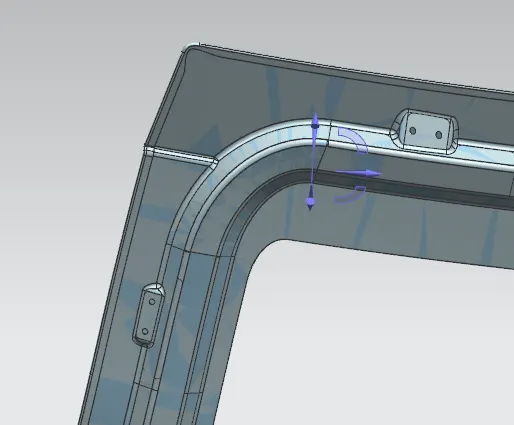
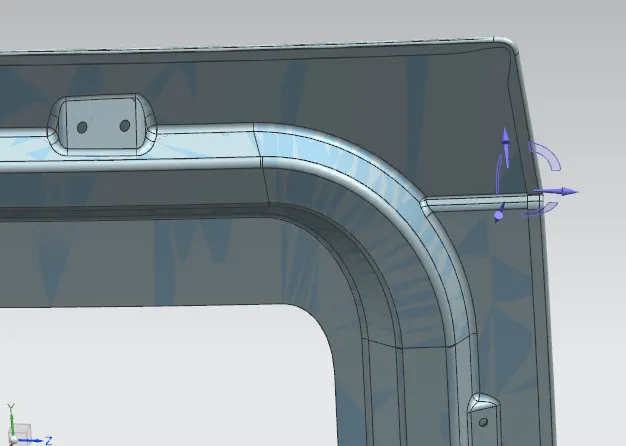
RHS TOP LHS TOP
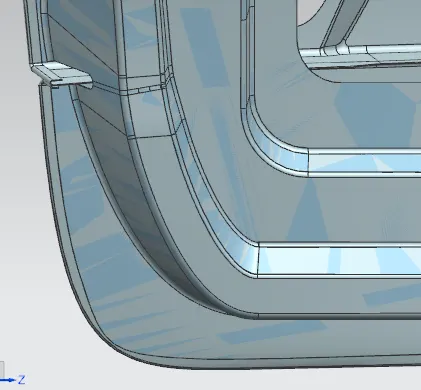
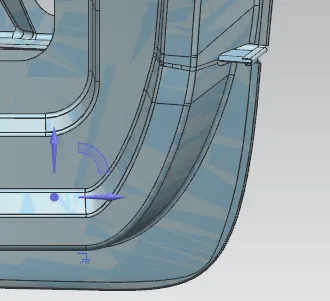
RHS BOTTOM LHS BOTTOM
DRAFT ANALYSIS
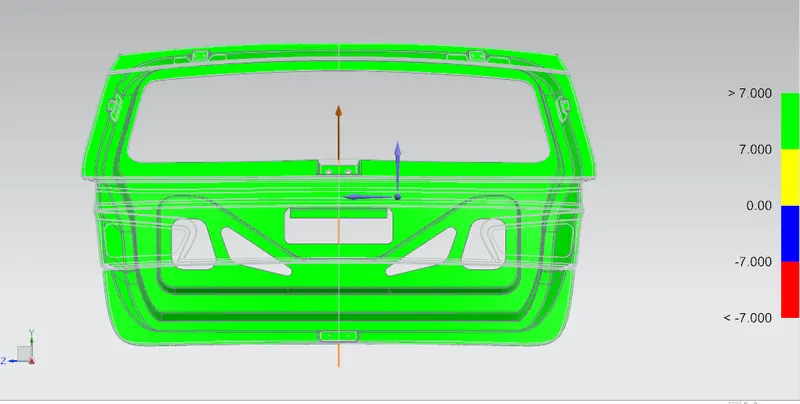
It is acheived 7 degree by tool axis.
CONCLUSION
In this challange backdoor is created by Nx cad design as per requirement and draft analysed.
Here explantion had been done.