Conceptual design of a building with columns and shear walls
Question 1:
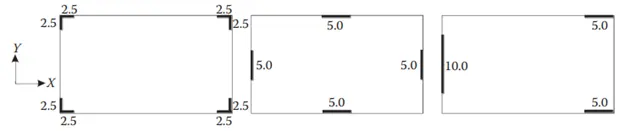
The building shown, 20 × 35 m in plan, has columns on a 5 × 5 m grid and shear walls (with dimensions shown in m, 250 mm in thickness) in three alternative arrangements, (a), (b), (c), all with the same total cross-sectional area of the shear walls. Compare the three alternatives, taking into account the restraint of floor shrinkage, the lateral stiffness and the torsional one with respect to the vertical axis, the vertical reinforcement required for the same total flexural capacity at the base, the static eccentricity, the system’s redundancy, foundation systems, architectural constraints etc.
Answer:
It is not possible to compare the three alternatives of the building based solely on the information provided. A comprehensive analysis that takes into account multiple factors such as the ones mentioned in the question would be necessary.
Regarding the restraint of floor shrinkage, the arrangement of the shear walls can affect the distribution of shrinkage forces throughout the structure and potentially cause differential settling or cracking.
The lateral stiffness and torsional stiffness of the building will depend on the distribution of mass and stiffness of the structure and the layout of the shear walls. Alternative (a) provides the greatest amount of continuity in the direction of the long walls, which could result in increased lateral stiffness. Alternative (c) has the greatest amount of shear wall area, which could result in increased lateral and torsional stiffness.
The vertical reinforcement required will depend on the axial and bending forces in the structure and the dimensions and layout of the shear walls. A detailed analysis would be necessary to determine the exact reinforcement required for each alternative.
The static eccentricity of the building refers to the offset between the center of gravity and the center of stiffness of the structure. This will also depend on the distribution of mass and stiffness and the layout of the shear walls.
The system's redundancy refers to the ability of the structure to continue to support loads in the event of a failure in one of its components. Alternative (a) has the least amount of shear wall area and therefore may have the lowest redundancy. Alternative (c) has the greatest amount of shear wall area and therefore may have the highest redundancy.
Foundation systems, architectural constraints, and other factors will also play a role in the comparison of the three alternatives. It is important to consider these factors in a comprehensive analysis in order to make an informed comparison of the alternatives.
Question 2:
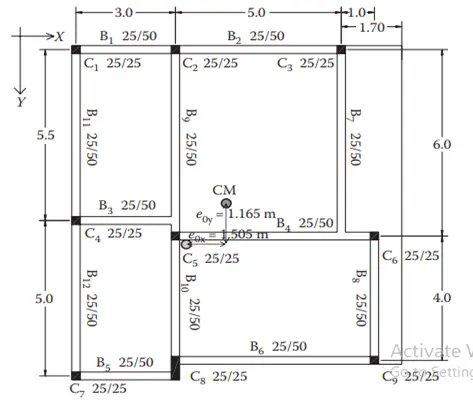
Discuss the suitability for earthquake resistance of the moment resisting framing plan of a three-storey building depicted here (cross-sectional dimensions in cm), the eccentricity of the centre of mass (as centroid of floor plan) to the centre of stiffness (from the moments of inertia of the columns) are shown. Suggest an alternative. Also, is there torsional flexibility? Are the two fundamental translational modes of vibration larger than the fundamental torsional mode of vibration. Discuss qualitatively.
Answer:
There is a two way eccentricity in the frame along X direction and Y direction also with stiffness the eccentricity in X direction is larger when compared to Y direction.
There is only two continuous frames in the structure that is B1 and B2 in the X direction and B9, B10 and B11,B12 in the Y direction and all other beams are broken at the midway in the frame.
There will be Torsional flexibility in the structure.To avoid torsional restraints it is better to make the room dimensions even in both X and Y direction and placing the columns at the junction of two wall if it is feasible better to provide shear wall at appropriate location.
The fundamental translation mode of vibration is larger than the fundamental torsional mode of vibration.
Question 3:
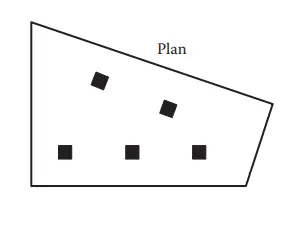
A multi-storey building with basement, with a quadrilateral (non symmetrical floor plan) plan as, has interior columns in an irregular (not in a grid) pattern in plan that serves architectural and functional considerations. Partition walls and interior beams supporting the slab have different layout in different stories. However, there is no constraint to the type, location and size of the lateral force resisting components and sub-systems on the perimeter. Proposals are to be made and justified for the choice of the lateral-load-resisting system and its foundation.
Answer:
When choosing the lateral-load-resisting system for a multi-storey building, several factors must be considered, including the geometry of the building, the type of lateral loads to be expected, the architectural and functional requirements, and the site-specific conditions.
In this case, the building has an irregular floor plan, so it may be appropriate to consider a combination of different lateral force resisting components and sub-systems to provide a balanced and efficient lateral load resistance. These components could include shear walls, braced frames, buckling-restrained braces, or a combination thereof.
The foundation system must also be chosen to suit the specific conditions of the site and the lateral-load-resisting system selected. For example, if a shear wall system is used, the foundation may need to be reinforced to provide adequate support for the vertical loads and lateral loads. If a braced frame system is used, the foundation may need to be designed to resist uplift forces from the brace members.
The choice of the lateral-load-resisting system and foundation system should be based on a comprehensive analysis that considers the site-specific conditions, the lateral loads to be expected, the architectural and functional requirements, and the potential for future changes to the building. This analysis should consider factors such as seismicity, wind loads, and soil type and conditions, as well as the cost and constructability of the proposed solution.
In conclusion, the choice of the lateral-load-resisting system and foundation system for this building will require a detailed and comprehensive analysis that takes into account multiple factors, including the geometry of the building, the type of lateral loads to be expected, the architectural and functional requirements, and the site-specific conditions.