Concept on positioning of Columns
1.
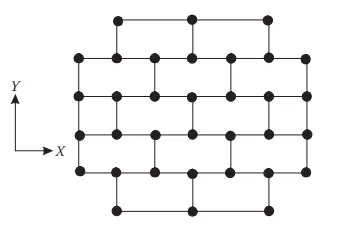
Answer :
- The plan of the building looks symmetrical in both X and Y direction. There does not seem to be any kind of plan irregularity in the structural drawing. So it holds good symmetrical property.
- The horizontal seismic motion is a bi directional phenomenon and thus the building should br able to resist the horizontal actions in any direction.
- The load path between the top and bottom edge columns are more as compared to other columns,thus a large portion of the lateral forces will be transferred to these columns.
- The number of structural members in X direction is more as compared to Y direction.
- So the stiffness of the building in X direction is higher than that of in Y direction.
- The ductility of the building is inversely proportional to the stiffness of that building. Considering this, the building has high stiffness in X direction and lesser stiffness in Y direction.
2.

- The mass irregularity shall be considered to exist, when the seismic weight of any floor is more than 150% of floor above. The seismic response of buildings with such irregularity must be done using dynamic analysis.
- A building is said to be torsional irregular when the maximum horizontal dispalcements of any floor in the direction of the lateral force at one end of the floor is more than 1.5 times its minimum horizontal displacement at the far end of the same floor in that direction. In such a case the building configuration must be revised.
- The distribution in plan of the lateral stiffness and mass must be approximately symmetrical with respect to two orthogonal horizontal axes.
- If there is irregularity in elevation, it is unlikely to have a dominant response from the first mode shape that varies almost linearly from the base of the building to the roof. The overall seismic response will have significant contributions from higher modes of vibration.
- As such the lateral-force method of analysis is not considered applicable to buildings characterized as irregular in elevation.
- The modal response spectrum method, by contrast, capable of capturing well the effects of structural irregularity in elevation on the linear elastic response... the application of modal response spectrum analysis becomes necessary for buildings which are irregular in elevation.
- Out of the many possible irregularities in building structures, the final structural design should, in absolute terms, avoid the two most dangerous irregular situations:
* Soft storeys and
* Extremely flexible structures in torsion.
- Both cases correspond to extremely irregular stiffness distributions: the former regarding the distribution in height/elevation with a very weak story and the latter regarding the distribution in plan, with the concentration of the stiffness at the center or at a corner.
- The concept of building regularity is presented separately for regularity in plan and regularity in elevation.
3.
- In this building, floors play a very important role in the overall seismic response of the structure. They acts as horizontal diaphragms that collect and transmit the inertial forces to the vertical structural systems and ensure that those systems act together in resisting the horizontal seismic action.
- A soft story at ground level is certainly the most serve situation, because therein the inter-storey shear force is at its maximum and that storey supports the whole building.
- However, a soft storey at any other height of a building, for instance due to interruption of a shear wall at an intermediate height, may be extremely detrimental to the seismic response as well.
- In this building, there is no proper placement of Masonry infill walls.
- In this building, Redundancy in the vertical direction is not provided properly.