Concept on positioning of Columns
Q.1)
1)
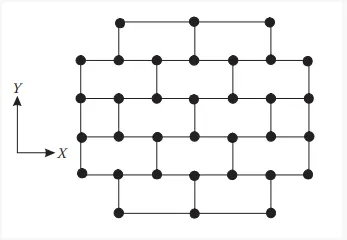
1) Symmertry -
i) The given framing layout of plan is Symmetrical in nature by seeing the aspect ratio of the framing plan.
ii) Because of the symmetrical nature the distribution of load is uniform through out the frame.
iii) Which helps in Resisting the Lateral forces which are acting on the structure.
iv) As there is minimum chances of eccentricity between Center of mass and Center of stiffness because of that structure will not subjected to Torsional effect.
v ) This tends to reduce the horizontal displacements in both of the two horizontal displacements in both of the two Orthogonal Horizontal directions.
2) Redundancy -
i) As the structure is symmetrical about both the axis , the structure has more redundancy.
ii) Redundancy is also the configuration of a structure that has more reserve strength than loading for which it has been designed.
iii) An important aspect of redundant structure is that it is possible to have internal forces within the structure, with no external loading being applied.
iv) Because this structure has perfect redundant, the structure becomes more reliable in resisting any lateral forces acting on the structure.
v) The columns in x -direction are compartively more and evenly spaced. So the structure is more redundant in x direction
vi) The column in y direction are comparatively lesser but evenly spaced. So the structure is redundant but lesser that that of x direction-
3) Bi-directional Stifness:
i) Stiffness is provided in a structure to resisi the lateral movement of the structure.
ii) As the structure is symmetrical and stiffness is provided in bi-directional, so it can resist lateral force at greater instant.
iii) The given plan has an orthogonal layout in both the X and Y directions, so it can transfer forces evenly, and its structure will be able to withstand direct action from seismic forces.
iv) But the column in vertical direction are not connected straight to staright beam.
v) So a lateral load passing from y direction it get diverted into x direction beams. Therefore there will be major force diversion take place with Seismic force in Y direction.
vi) Therefore framing plan is weak with respect to Bi-directional stiffness in Y direction.
4) Ductility -
i) Generally we don't designed the building for fully plastic region because it is costly and practically impossible to predict the Earthquake magnitude.
ii) So we have designed it for Minimum force as per code, and we allow the structure to deform in inelastic region.
iii) We can perform liner analysisi of the structure and we can extract the results and roughly we can calculate maximum displacement.
iv) As we know that Ductility is inversely proportional to Stiffness.
v) As the no of columns is x direction are more which means it has more stiffness in x direction. Therefore it reduces ductility in x direction.
vi) Where as the no of columns is y direction are less which mean it has less stiffness as compared to x direction . which meams it has more ductility in Y direction.
vii) So plan is More ductile in Y direction than that of in X directions.
Q.2)
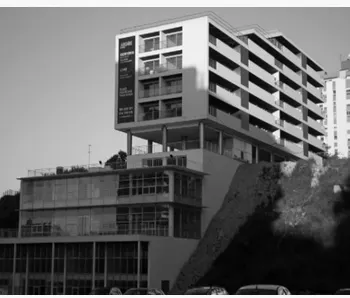
1) When building subjected to seismic forces - Following are the possibility occur in irregularities of given builduing-
i) Soft Storey mechanisms
ii) Irregularities in R factor
iii) Stiffness Irregularity
iv) Mass irregularity
v) Floating Columns
vi) Vertical Irregularities
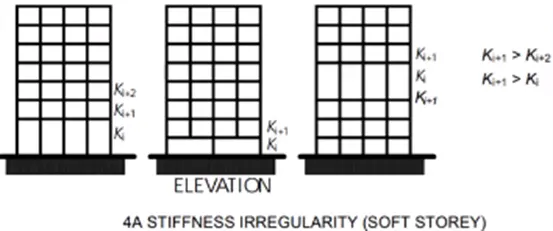
1) Soft storey mechanisms -
i) Generally the ground floor of the building is mostly considered soft stories because no shear wall and a lot of mass properties are prsent.
ii) Soft story may occur at highest level also.
iii) When Stiffnes of any story is less than the stiffness of above story, Soft story mechanism occurs.
iv) The displacement at that story is equal to the total displacement of the structure.
v) Which may cause damage such as a collapse, buckling of the column, etc.
2) Irregularities in R factor -
i) The R factor for different structure system is an indication of its ability to dissipate energy or its ability to resists the larger deformation (or ductility).
ii) The higher the R factor, higher is ductility in strength system.
iii) This implies that systme which characterize as torsional flexibility are considered with reduction factor (R) reduceds to low value.
3) Stiffness Irregularity
i) The lateral stiffness of the story at the mid-height which is open is very less when compared to the above levels because the main reason is the structure is discontinued at the mid-height.
ii) It is obseverved that the open storey causes reduction in the stiffness in the Building and attracts lateral seismic exicitation more in that floor which causes severe damage to the upper floors
iii) The Irregularity can be solved by providing the Shear walls to this high seismic action prone floor
4) Mass Irregularity
i) The seismic response should not be considered because of the structure's mass irregularity at any floor.
ii) The susceptibility of an irregular frame to seismic excitation has been found to decrease as the mass irregular floor moves towards the top of the building.
iii) In a structural system, mass irregularity is defined as a variation of more than 150 percent of mass between adjacent stories.
iv)The open story also causes mass irregularity in the Building because the high mass concentration is present above the open floor.
v) That is the upper floors carry more mass than the open floor. also the no of floors are higher above this open floor.
5) Floating Columns
i) Floating column is strictly prohibited in a structure as per Is 1893 code
ii) The column is regarded as a vertical member of the structure that resists lateral forces.
iii) If horizontal forces act about the structure, they may transfer through the vertical member and to the base shear foundation.
iv) As a result, the column is at the structure's discontinuity, and it is unable to withstand lateral forces during earthquakes because the load cannot be transferred to the foundation.
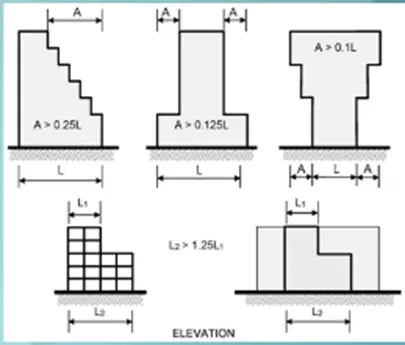
6) Vertical Geometrical irregularity
i) There is a change with the horizontal dimension of the lateral force resisting due to the open storey in mid height and also the vertical geometry of the Building which means the length of the Top storeys are varying along the Building unit.
ii) This causes Torsional effects in the Building which need to be Decoupled by providing shear walls or Decoulped moments.
iii) The Flexibility provided due the variation need to be compensated by providing Ductility.
Q.3)
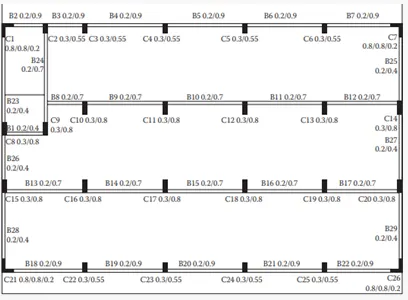
The following are the responsible factors:
1) Open Ground Floor
2) Two short sides of the perimeter in-filled
3) Extreme left hand bay Staircase filled with the Concrete
4) Columns not in the same line
5) No framing conncetions in Y directions
6) Beams connected along column minor axes
1) Open Ground Floor - ( Soft Storey )
i) The ground floor of the building is open,which may be a softstorey (having long columns) due to this the Ground floor excitation the columns could have been unable to resist the Earthquake and form collapse.
ii) This is called as soft storey mechanism.
iii) This can be avoided by having Strong column-weak beam mechanism.
iv) The ground floor must have lesser strength and stiffness as compared to upper stories which are stiffened by masonry in-fill walls.
v) Therefore it increases flexibility of the ground floor results in extreme deflections.
vi) The damage may also happen due to the collapse and buckling of columns, especially where parking places are not covered appropriately
vi) It can be avoided by providing shear walls.
2) Two short sides of the perimeter in-filled
i) The mass has been undistributed in all the sides of the Building in all storeys because it is given that the two sides of the perimeter of the building is in-filled which causes the Irregular distribution of mass called as Mass Irregularity.
ii) This can be avoided by providing the shear walls in the directions of Two short sides of the perimeter which can resist the Lateral loads by providing stiffness in the Building frame and helps to resist the Earthquake actions.
3) Extreme left hand bay Staircase -
i) The extreme left hand bay has Staircases due to which there is eccentricity between Center of mass and center of stiffness which causes Torsional effects.
ii) To avoid this type of failure the staircases should be kept in the centre of the Building which makes the Torsional effect as zero by Uncoupling the moment.
iii) As the structural element has more stiffness therefore Staircase portion is survived during the collapse as it has more stiffness.
4) Columns not in the same line
i) It is observed that the columns in the Extreme left side middle line columns has the deviation in the line of the construction at the staircase which again a reason for the Irregularity in plan having the Torsional flexibilty.
ii) To avoid this the Eccentricity should be maintained for the deviation to be with in the limits of Beam size and the Columns sizes.
iii) Also the sizes of the Beams and Columns in the Plan should be redesigned in such a way that the line of the columns doesn't deviate even in the staircase area.
iv) The columns in this layout are closely spaced, resulting in the formation of short paths for the transfer of stresses, which is also an important factor in earthquake resistance.
5) No framing connection along Y direction -
i) This is the main reason of failure of building.
ii) We could see that there is no structural beams are provided in Y direction between columns
iii) So when seismic force occurs in y direction how the loads are gonna transferred as there is no path for transfer of forces
iv) This makes the building more vulnerable during earthquake.
6) Beams connected along minor axis -
i) As we could see that columns having larger dimensions in y directions
ii) It means that they are more stiffer along the Y directions
iii) But the beams are provided in X directions only which would attract much lesser latral force
iv) So it is of no use providing larger size of columns.