Challenge 7
Aim:
Q1) Calculate the moment for design of pier cap considering reactions @ 250mm from tip of cantilever: D.L. (100kN), SIDL (80kN), & LL (120kN). Total length of the cantilever from the pier face is 4.5m. Consider an impact of 1.3 for live load.
Given Data:-
- Dead Load= 100kn
- SIDL = 80kn
- Live Load = 120kn
- Impact (I) = 1.3
Solution:-
- SLS Load Combination = DL + 1.2 x SIDL + 1.1 x L.L x I
Moment (M)= (100+1.2 x 80 + 1.1 x 120 x 1.3)
= 367.6 kN-m
Reactions from the tip of the cantilever = 0.250 M
Total eccentricity = ( 4.5 - 0.250)
= 4.250 M
Total Moment = 367.6 x 4.250
= 1562.3 kN-m
Q2) Differentiate between RCC and PSC pier caps in all aspects.
-->
| Reinforcement Cement Concrete Pier Cap | Prestress Concrete Pier cap |
| Weight of the structure is more. | Weight of the structure is less. |
| In case of deflection it deforms more compare to PSC | Incaseof deflection it deforms less ( 1/4 th of RCC level ) |
| Material cost is the low | Material cost is high |
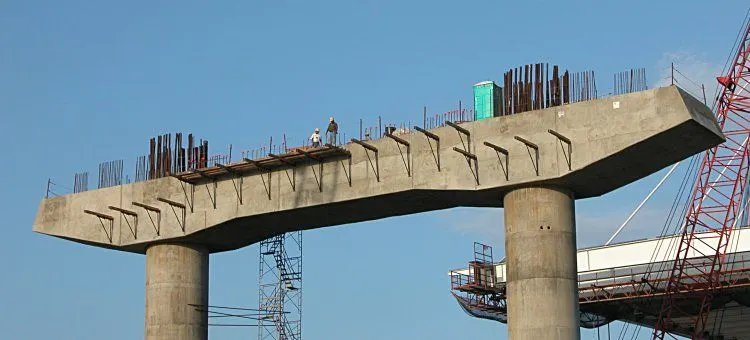 |
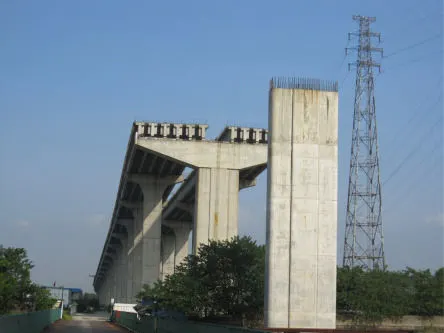 |
| Mild Steel and deformation bars is used | High strength tendons are used. Tendons are made from high-tensile steel in the form of a single-wired or multiwire strand |
| Tensile crack will be visible | No tensile crack |
| No quality control required | Required good quality control and skilled labor |
| Time required is more as compared to PSC. | Less time required than RCC. |
| The construction of this piers are slow. | The construction of this piers are fast. |
| Steel corrosion is possible in RCC. | Corrosion of steel is negligible in PSC. |
| This type of Pier Cap is less brittle. | This type of Pier Cap is More brittle |
Q3) Provide the codal provisions for design crack width depending on the various exposure conditions.
--> As per IRS CBC code Clause 10.2.1(a)
TABLE 10: DESIGN CRACK WIDTHS
| Exposure Condition | Design crack width in mm |
| Moderate | 0.20 |
| Severe | 0.10 |
| Extreme | 0.10 |
Q4) At what conditions, the cantilever pier cap is preferred, and state the limitations of the same.
--> We know that metro alignment is curved in nature there would be curves and bifurcation of the metro line & in that location not always possible for the pier can be placed directly below. the tracking on the elevated metro because there could be a road that would be running below the metro & If the metro is taking a turn it may go outside of the boundary under that condition we tried to find an alternative as a cantilever pier cap where pier remains on its place but cantilever arm slightly move.
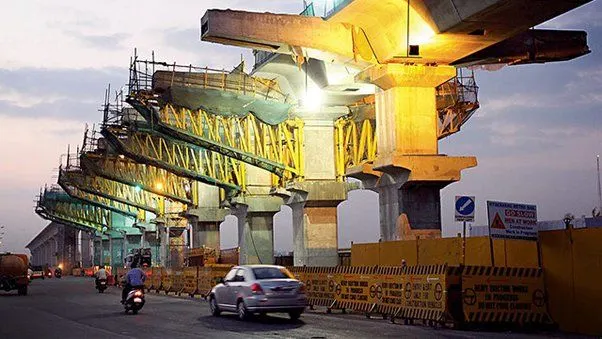
Limitation:
- If the eccentricity is 2 meters then we go for the RCC pier cap, If above 2 meters up to 3 meters we prefer as PSC pier cap but above 3 meters we have to give the portal frame.
- The width should be sufficient enough to accomodate superstructures from both sides. It should range between 3-3.5M.
- Vehicle cleareance should be 5.5m for safe moment of vehicles below metro viaducts.