Challenge 4-Windshield Modeling
WINDSHIELD
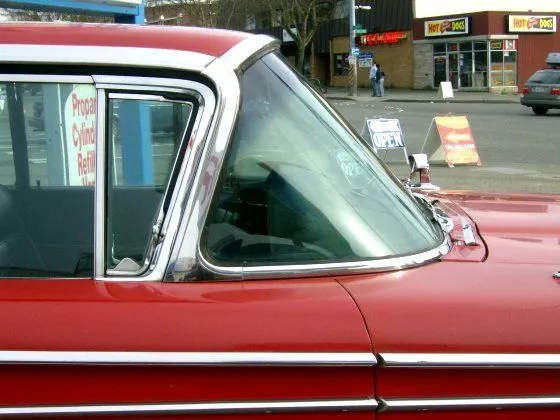
The windshield (North American English) or windscreen (Commonwealth English) of an aircraft, car, bus, motorbike, truck, train, boat or streetcar is the front window, which provides visibility while protecting occupants from the elements. Modern windshields are generally made of laminated safety glass, a type of treated glass, which consists of, typically, two curved sheets of glass with a plastic layer laminated between them for safety, and bonded into the window frame.
The Differences Between Laminated and Tempered Auto Glass
When it comes to vehicle safety, people often forget the importance of the right auto glass on their cars. Not only is the right glass clear and allows you to see the road, but windshield glass should be able to stand up to a certain amount of impact from debris and protect the people in the car, whereas window glass should be easier to break in the event of an emergency.
When it comes to auto glass, there are two different kinds – for two very different purposes.
Laminated Glass
Laminated glass is made up of a thin layer of vinyl between two layers of glass. This creates a thicker, sturdier window. They’re considered one of the safest kinds of glass because they are not easy to break or shatter. Most vehicle windshields are made of laminated glass. They’re considered to be effective for preventing break-ins because of the effort required to break them.
Tempered Glass
Tempered glass is used for the exact opposite reason that laminated glass is used for windshields. Tempered glass is much easier to break than laminated glass, and is made by one of two ways. Glass can be tempered with chemicals, or a special heating and rapid cooling process. This process produces a breakable glass that breaks into small pieces with rounded edges, which is where it gets its other name: “safety glass.”
While both types of glass have different functions and uses when it comes to safety, they both work together with the rest of the safety features of your car to protect you and your family in the case of an accident.
If you think your windshield may need to be repaired or replaced, call Go! Glass at one of our locations in Kitchener and across Ontario and the Maritimes!
Motorcycle windshields are often made of high-impact polycarbonate or acrylic plastic
USAGE;
Windshields protect the vehicle's occupants from wind and flying debris such as dust, insects, and rocks, and provide an aerodynamically formed window towards the front. UV coating may be applied to screen out harmful ultraviolet radiation. However, this is usually unnecessary since most auto windshields are made from laminated safety glass. The majority of UV-B is absorbed by the glass itself, and any remaining UV-B together with most of the UV-A is absorbed by the PVB bonding layer.[1]
On motorbikes their main function is to shield the rider from wind, though not as completely as in a car, whereas on sports and racing motorcycles the main function is reducing drag when the rider assumes the optimal aerodynamic configuration with their body in unison with the machine and does not shield the rider from wind when sitting upright.
SAFETY;
Early windshields were made of ordinary window glass, but that could lead to serious injuries in the event of a crash. A series of crashes led up to the development of stronger windshields. The most notable example of this is the Pane vs. Ford case of 1917 that decided against Pane in that he was only injured through reckless driving.[citation needed] They were replaced with windshields made of toughened glass and were fitted in the frame using a rubber or neoprene seal. The hardened glass shattered into many mostly harmless fragments when the windshield broke. These windshields, however, could shatter from a simple stone chip. "Triplex" glass laminating, however, had been available for windshields in France from 1911 and in Britain from 1912; it was adopted as an accessory by some high-end American auto manufacturers beginning in 1913, and from 1919 to 1929 Henry Ford ordered the use of laminated glass on all of his vehicles.[2]
Modern, glued-in windshields contribute to the vehicle's rigidity, but the main force for innovation has historically been the need to prevent injury from sharp glass fragments. Almost all nations now require windshields to stay in one piece even if broken, except if pierced by a strong force.
The urethane sealant is protected from UV in sunlight by a band of dark dots called a frit around the edge of the windshield.[3] The darkened edge transitions to the clear windshield with smaller dots to minimize thermal stress in manufacturing. The same band of darkened dots is often expanded around the rearview mirror to act as a sunshade.[
 KK
KK
Size and depth;
Repair of cracks up to 6.1 cm (2.4 inches) is within permissible limits; automobile glass with more severe damage needs to be replaced. However, this is dependent on local laws. If a crack extends to the edge of the panel then this would compromise the structural integrity of the windshield. Aircraft windshields are designed in such a way that even if a crack were to extend all the way across the panel, the structural integrity is maintained via multiple failsafe methods in both frame and the glass plies. A sacrificial outer layer that cracks rather than devitrifies is the first failsafe.
Type;
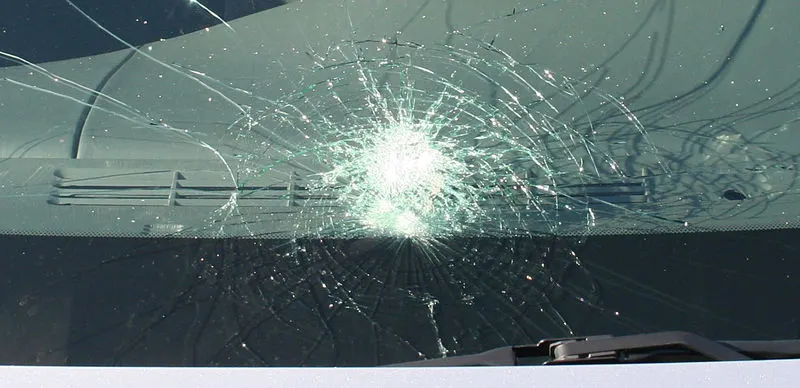
Circular bullseyes, linear cracks, crack chips, dings, pits and star-shaped breaks can be repaired without removing the glass, eliminating the risk of leaking or bonding problems sometimes associated with replacement.
Location;
Some damages are very difficult to repair, or cannot be repaired:
- on inside of the windshield
- deep damage on both layers of glass due to solar absorption or oxidation.
- damage over rain sensor or internal radio antenna
- complex multiple cracks
- very long cracks (i.e. over 45–60 cm or 18–24 inches long)
- contaminated cracks
- edge cracks
In cracked windshield repair, air is removed from the damaged area on the windshield with a specified vacuum injection pump. Then using the injection pump, the clear adhesive resin is injected to replace the air in the windshield crack. The resin is then cured with an ultraviolet light. When done properly, the damaged area’s strength is restored, as is 90–95% of the clarity.