Challenge 12
Aim:
Q1) Explain in detail about open foundation.
--> The 'open' refers to the fact that the foundations are made by first excavating all the earth till the bottom of the footing, and then constructing the footing. During the early stages of work, the entire footing is visible and is therefore called an open foundation. also known as the shallow foundation and spread footing.
This type of bridge foundation is suitable for moderate height, to be built on dry ground which is sufficiently firm to support the bridge structure. It is best suited in situations where the soil is available within 1.5 to 3 M below the bed level of the water course and when the scouring is minimum.
Design Parameter -
- Shallow foundation shall be kept below 2 Meters from the ground strata.
- Allowable differential settlement shall not exceed 1/400 of distance between two foundation
- No tension shall be allowed on the footing
- Minimum reinforcement of 250 mm2/m in each direction to be provided
- Spacing shall not be more than 300 mm
Construction Parameter -
- Protective work to be done around the foundation.
- Excavation shall be done as per Indian standards.
- In rocky strata - controlled blasting can be done
- PCC laying
- Steel binding and concreting.
Q2) Explain in detail the components of the Well Foundation.
-->Well, Foundation is the type of deep foundation which is mainly equipped below the water level for bridges. A Well foundation is the same as an open caisson and it can be established on the dry bed or after making a sand island. At locations where the velocity of water is high and the depth of water is higher than 5 to 6 m, wells can be created on the river bank and then floated to the last position and grounded. Much care is needed while grounding a well to assuring that the position of the well is exact. To prevent scour, sandbags are protected around the well. Wells or caissons are large-diameter foundations obtained in underwater conditions such as bridge foundations in rivers. Caissons are large-width foundations that transmit the load of the superstructure through the layer of weak soil to a firm stratum at a significant depth. The well may sink into the river bed by 500 mm to 600 mm under its self-weight. Additional sinking operation is equal to the sinking of wells on the dry bed. The construction of a well foundation is in principle, related to the ordinary wells sunk for obtaining underground water; in fact, it derives its word owing to this construction process.
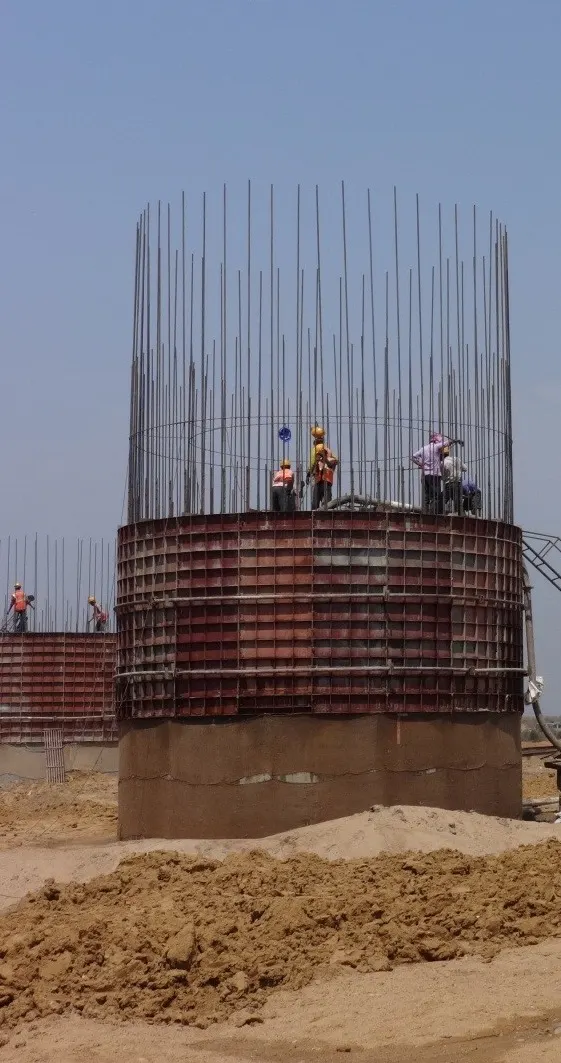
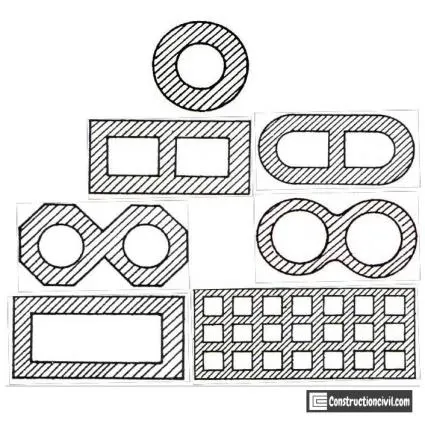
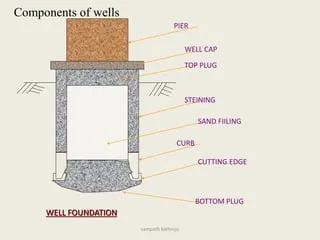
The following are the components of well foundation:-
- Staining
It is the wall or shall of the well, made of R.C.C. and which transfers the load to the curb. It acts as an enclosure for excavating the soil for the penetration of the well.
- Curb
It is an R.C.C. ring beam with a steel cutting edge below. The cross-section of the curb is wedge-shaped which facilitates the sinking of the well. The curb supports well stening. The curb is kept slightly projected from the stoning to reduce the skin friction.
- Cutting edge
It is the lowest part of the well curb which cuts the soil during the sinking.
- Bottom plug
After the completion of the well sinking the bottom of the well is pluged with concrete. The bottom plug which is confined by the well curb acts as a raft against soil pressure from below.
- Backfill
The well is dewatered after the setting off of the bottom plug and it is backfilled by sand or excavated material.
- Top plug
It is a concrete plug provided over the filling inside the well.
- Well cap
It is an R.C.C. slab provided at the top of the stening to transmit a load of superstructure to the stening and over which the pier is laid. The minimum thickness of the slab is about 750 mm.