Challenge 1
1.Why is a metro rail needed in countries with developing economy? What is your basic understanding on the differences between a conventional rail system and a metro rail system?
Ans:
- Generally In a developing country the population of the country increases. So it causes hindrace in the city for communocating to places for the increase in population and no. of vehicles in the mode of road transport.
- Metro enhances mobility which improves economic growth development in countries.
- It is time consuming than any other mode of transport
- It consumes low energy and it is cheap to travel long distances in metro rail either than roadways.
Difference
-
Difference Si. No. Metro Rail Conventional Rail 1 The speed of metro rail is very high comparative to normal rail. So it is time consuming The speed of this type of rail is comparatively lower than metro. 2 This type of rails are powered by electricity which makes them ecofriendly. This type of rails are normally powered by electrically or by steam or diesel which makes environment pollute. 3 This mode of transport is generally used to travell within a major city. This mode of transport is used to travel greater distance & major cities within a country.
2. The course depicts the data regarding the operational and upcoming metro rail projects of India with reference to the statistics of latest by August 2019. Research and provide the current statistics of metro rail operations in India. At the end you can identify the necessary of metro rail transit system followed by you will be able to resonate/analyze the feasibility of metro rail to one’s own city.
Ans:
- According to a report published in 2021, a total of 2.63 billion people travelled annually in metro systems across India's fifteen major cities, placing the country as one of the busiest urban rapid transit hubs in the world in terms of ridership.
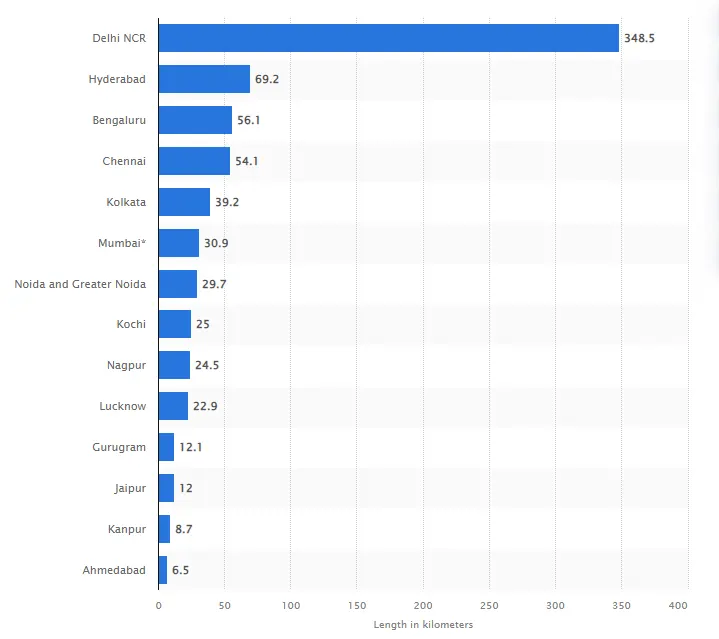
- The combined length of 801.50km (498.03 miles) of metro systems in India makes it the fourth longest in operation in the world.
- There are 15 cities in which metro is operating.
- The name of the cities are Delhi, kolkata, Mumbai, Chennai, Bengaluru, Hyderabad, Nagpur, Ahmedabad, Noida, Kochi, Lucknow, Gurgaon, Kochi, Jaipur, Pune & Kanpur.
- There are other 19 cities in India within which Metro has been proposed or under construction.
Length of operational metro rail across India as of 2021, by city in KM
 3.Why DMRC is the busiest metro in India. Apart from the points mentioned in the course video. You can find several interesting facts on the internet. Please research and provide your learnings.
Ans:
- The Delhi Metro is a mass rapid transit (MRT) system serving Delhi and its satellite cities of Ghaziabad, Faridabad, Gurgaon, Noida, Bahadurgarh & Ballabhgarh in the capital region of India. The network consists of serving 255 stations with a total length of 348.12 kilometres (216.31 mi). It is by far the largest and busiest metro rail system in India, and the second oldest after the Kolkata Metro. The system has a mix of underground, at-grade, and elevated stations using both broad gauge& standard gauge. Delhi Metro operates over 2,700 trips daily, starting at around 05:00 and ending at 23:30 working around 18.30 hrs a day
- Construction started in 1998, and the first elevated section (Shahdara to Hazari) on the red line opened on 25 December 2002. The first underground section (Vishwa Vidyalaya - Kashmere Gate) on the yellow line opened on 20 December 2004. The development of the network was divided into phases. Phase I with 3 lines was completed by 2006, and Phase II in 2011. Phase III is in the finishing stage and is scheduled to be complete by end of 2022. Construction under Phase IV was formally started on 30 December 2019.
- (DMRC), a company with equal equity participation from the Govt. of India and the Govt, of Delhi, built and operates the Delhi Metro. DMRC was certified by the UN in 2011 as the first metro rail and rail-based system in the world to get carbon credits for reducing greenhouse gas emissions, reducing carbon emission levels in the city by 630,000 tonnes every year.
Q4)What are the components of a Metro rail? Explain briefly about the concepts of the components?
Ans:
There are three main components of Metro Rail:
ELEVATED:
- An Elevated Metro Rail is a rapid transit railway with the tracks above street level on a vaiduct or other elevated structure. It is usually constructed from steel, cast iron, concrete, or bricks.
- The railway may be broad-guage, standard-guage or narrow-guage railway. Elevated railways are normally found in urban areas where there would otherwise be multiple level crossing or obstacles.
- Usually, the tracks of elevated railways that run on steel viaducts can be seen from street level.
STATION:
- A Station Metro Rail is provided in Elevated Metro Rail or Underground Metro Rail.
- This station forms important hub of metro station because it operates various operations of the Metro Rail like Ticketing, Maintenance of the Metro corridor or providing access to the people into the Metro system.
- This station is a Frame kind of struture.
UNDERGROUND:
- The metro rail which is constructed under the ground surface is known as underground metro rail.
- While construction of this metro rail we face many construction challenges as we have pipelines, telephone wires, Naala , electricity wires etc so we cant just move them from their source as it connects the whole city .
5)Elevated metro or Underground metro which metro rail system shall be preferred? Justify your choice of the system.
Ans:
- First of all at a location before finalizing of wheather elevated metro or underground metro is to be constructed it is mandatory to go through thouroghly by topographical survey.
- After that if both the system will be feasible then it is good to go with elevated system because it is economical than underground system. Then it involves less complicacy at the time of construction.
6)What is a Design Basis Report (DBR)? In which phase of a project a DBR is prepared?
Ans:
-
Design Basis Report (DBR) is a very first report that the Design Engineer for Elevated Metro Viaducts Project needs to prepare.
-
This report is basically the document to standardize the design procedure of the elevated metro viaducts.
-
The making of this report is the first phase of a project in Elevated Metro Viaducts . After creating this report it is published in tender for contractors to study and take part in the construction project.
7)What is significance of a DBR of an elevated metro?
Ans:
- The significance of a DBR is that it shows us standardized design procedure of Elevated Metro Viaducts. It shows us what materials we should use, what will be reinforcement details as per the clauses given in Indian Standard Codes or Railway Codes.
8)In the planning of metro project, what are the chronology of activities before the construction?
Ans:
-
Topographical Survey - This step involves to locate the manmade or natural features coming within the area of consideration for the possible alignment plan.
-
Possibles changes in the alignment - This step involves that to decide for alternate best possibility due to presence of some feature which can not be dismentaled.
-
Other challenges like if there is any houses, religious places, existing flyover then there will be some chnages.
- Possible Solution for the different kind of issue.
9)What is topographical survey? Why it is necessary for the metro rail project?
Ans:
- Topographic surveys are typically a first step in any construction or development project, it may be necessary to perform a topographic land survey to identify various features and elevations of area land.
- Necessity
- Having a detailed and accurate picture of your land can reduce the risk of costly downstream mistakes caused by unforeseen issues.
- It can provide the necessary data you will need about the land before making any changes to it.
- It provide engineers and architects with the necessary information to create correct and suitable designs for the property’s unique features.
- It provide final as-built data to verify that the site was built in substantial conformance with proposed plans.
10) What are the hindrances that could be there whilst planning to connect any to two stations in a city during metro construction?
Ans:
- For connecting two major stations there may be many huddles occure at the planning stage.
- So first of all the first option as the straigth which is the shortest is taken for alignment consideration.
- So in this stage many hindrances may occure such as
- there will be some shops or offices but we cannot relocate the shops or residents as it is commercial and economical hub for the people. So we realign the corridor.
- There will be school and universities so that we have to realign our corridor.
- There might be some permanent or religious structur which can not be shifted or dismantled.
11)What are underground utilities which would be there existing under the ground level. Also mention some other utilities apart from the ones mentioned in the course.
Ans:
- The under ground utilities are such as mentioned below.
- Telephone Cable
- Water lines
- Power cables
- Internet cables
- Underground Nallah
- Gail or any other petroleum crossing
- Thermal pipe line crossing
- Telecom lines
- Mines pipe line crossing
- Water lines Such as P.H. & RWSS
- Railway Utilies etc.
12)Mention in detail about the solutions a designer would be suggesting as the challenges of underground utilities.
Ans:
- When the designer has to face this type of challenges then one option the designer can suggest to relocate the position of the foundation by increasing or decreasing the length of the span as per the convinience.
- Otherwise another option can be taken for consideration that to change the alignment slightly in the perticular section taking the sll other effects that can cause/ affect due to the change in alignment.
- Or the designer should change the Pile Arrangement.
- If the above mentioned arrangement is difficult to manage then the decission to change the alignment completly can be worked out.
13)What is known as feeding of U-girders and how it is launched during construction?
Ans:
- Feeding U girders will involve casting the entire span of a viaduct between two piers in a single piece, whereas box girders will have many segments between two piers. One U girder between two pillars can be erected overnight, against 6 to 7 days in case of segmental construction. The weight of a complete span of U girder is much lesser than the segmental box girder.
- It is launched through various cranes carring the precast girder from both the sides of the girder which is to be placed in its place througly.
14)What are advantages of precast girders in an elevated metro? Explain in detail about the how it is efficient over the cast in-situ girders?
Ans:
- Advantages
- In this case the ntire span of a viaduct between two piers in a single piece, whereas box girders will have many segments between two piers.
- It is very less time consuming according the concventional box gider construction.
- As the metro construction is generally occuring within the city so it can be done with running traffic condition.
- The weigth of the U girder also very less compared to box girder.
- Rather than this this u girder is very economical also.