Calculation of Stiffness in Structural elements
CALCULATION OF STIFFNESS IN STRUCTURAL ELEMENTS
1. Compute lateral stiffness of the one story frame with an intermediate realistic stiffness of the beam. The system has 3 DOFs as shown. Assume L = 2h and Elb = Elc .
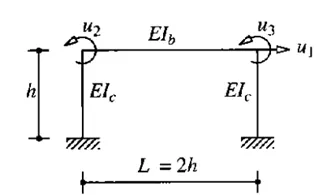
Stiffness matrix is determined using stiffness matrix method of analysis.
Here, the degree of freedom is 3 hence the size of the stiffness matrix will be 3x3.
Let us assume, Elb = Elc = EI.
- First step is to determine the system coordinates and element coordinates.
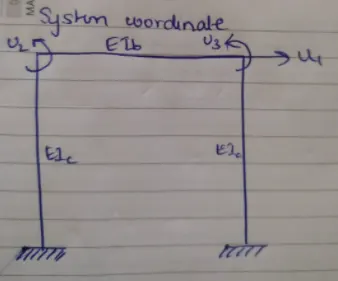
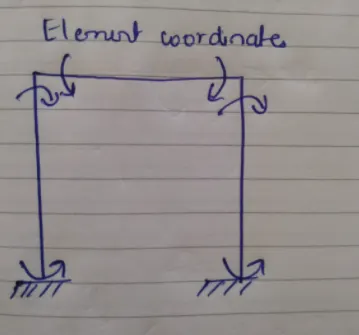
- Next, we have to find out the Displacemnt transformation matrix `[a]`.
- For this apply unit force corresponding to each system coordinates and then find the displacement transformation matrix for each element coordinates.
1. Apply u1 = 1kN and u2=u3=0
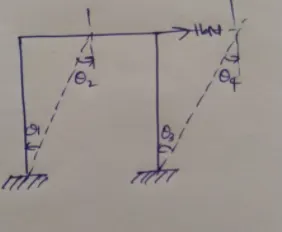
The first column of transformation matrix:
`[a1]`=`[[-1/h],[-1/h],[0],[0],[-1/h],[-1/h]]`
2. Apply u2=1kNm and u1=u3=0
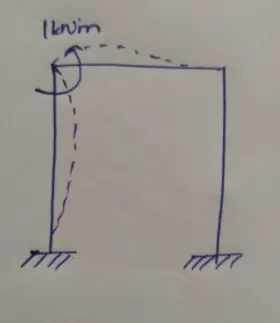
The second column of transformation matrix:
[a2] = `[[0],[-1],[-1],[0],[0],[0]]`
3. Apply u3=1kNm and u1=u2=0.
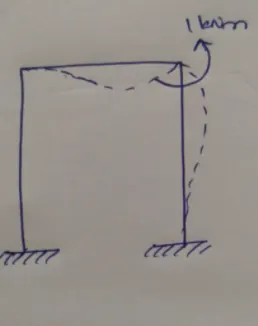
The third column of transformation matrix:
[a3]=`[[0],[0],[0],[-1],[-1],[0]]`
Hence, the displacement transformation matrix can be written as :
[a] = `[[-1/h,0,0],[-1/h,-1,0],[0,-1,0],[0,0,-1],[-1/h,0,-1],[-1/h,0,0]]`
Now, [aT] = `[[-1/h,-1/h,0,0,-1/h,-1/h],[0,-1,-1,0,0,0],[0,0,0,-1,-1,0]]`
- Next , we have to find out the Element stiffness matrix:
[ke1] = `(EI)/h*[[4,2],[2,4]]`
[ke2] = `(EI)/(2h)* [[4,2],[2,4]]`= `(EI)/h*[[2,1],[1,2]]`
[ke3] = `(EI)/h*[[4,2],[2,4]]`
- Now, Element matrix for the structure can be determined as:
[ks] = `(EI)/h*[[4,2,0,0,0,0],[2,4,0,0,0,0],[0,0,2,1,0,0],[0,0,1,2,0,0],[0,0,0,0,4,2],[0,0,0,0,2,4]]`
- The stiffness matrix, k = [aT][ks][a]
k = `[[-1/h,-1/h,0,0,-1/h,-1/h],[0,-1,-1,0,0,0],[0,0,0,-1,-1,0]]` `(EI)/h*[[4,2,0,0,0,0],[2,4,0,0,0,0],[0,0,2,1,0,0],[0,0,1,2,0,0],[0,0,0,0,4,2],[0,0,0,0,2,4]]``[[-1/h,0,0],[-1/h,-1,0],[0,-1,0],[0,0,-1],[-1/h,0,-1],[-1/h,0,0]]`
k = `(EI)/h*[[-6/h,-6/h,0,0,-6/h,-6/h],[-2,-4,-2,-1,0,0],[0,0,-1,-2,-4,-2]]``[[-1/h,0,0],[-1/h,-1,0],[0,-1,0],[0,0,-1],[-1/h,0,-1],[-1/h,0,0]]``
k = `(EI)/h*[[24/h^2,6/h,6/h],[6/h,6,1],[6/h,1,6]]`=`(EI)/h^3*[[24,6h,6h],[6h,6h^2,h^2],[6h,h^2,6h^2]]`
We know that, k.u = fs
i.e, `(EI)/h^3*[[24,6h,6h],[6h,6h^2,h^2],[6h,h^2,6h^2]]`.`[[u1],[u2],[u3]]`= `[[fs],[0],[0]]` --> 1
Now, by Static condensation method, we get,
`[[u2],[u3]]=[[6h^2,h^2],[h^2,6h^2]]^(-1)*[[6h],[6h]]*u1`=`-6/(7h)[[1],[1]]u1` --> 2
Now, substitute eqn 2 in first eqn of eqn 1.
i.e, fs = `(24(EI))/h^3*u1+(EI)/h^3(6h*u2+6h.u3)`
fs = `(24EI)/h^3*u1+(EI)/h^3*[6h,6h]*[[u2],[u3]]`
fs = `(24EI)/h^3*u1+``(EI)/h^3*[[6h,6h]]*(-6/(7h)*[[1],[1]]*u1)`
fs = `(24EI)/h^3*u1-``(72EI)/(7h^3)*u1`
fs = `96/7*(EI)/h^3*u1`
We know that, Stiffness is defined as the force required per unit deformation.
So, when u1=1, fs=k
Hence, lateral stiffness k= `96/7*(EI)/h^3`
2. For the following structures:
- Determine the number of degrees-of-freedom for dynamic analysis
- Establish the equation of motion
- Calculate their natural frequencies
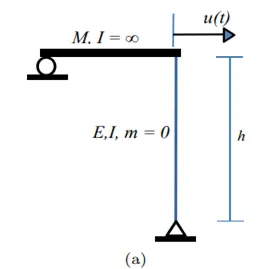
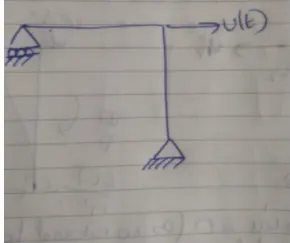
a)
- Degree of freedom: - 1 (one translation)
- Equation of motion
The standard equation of motion is given by: m`ddotu`+c`dotu`+ku = P(t)
But here, there is no damping and no external force hence, c=0. So the equation of motion becomes,
m`ddotu`+ku = P(t)
Now, we have to find the stiffness value i.e, k.
Here, the far end is hinged, so the stiffness value k11 = 3EI/`l^3`
So the eqn of motion can be written as
m`ddotu`+(3EI/`l^3`)u = P(t)
- Natural frequency, fn
fn=1/Tn --> Tn=2`pi`/`omega`
`omega`=2`pi`/Tn
Also, `omega`=`sqrt(k/m)`
i.e, `omega`=`sqrt((3EI)/l^3)/m`
`omega`= `sqrt((3EI)/(ml^3))`
Tn=2`pi`/ `sqrt((3EI)/(ml^3))` --> Tn = `2pisqrt((ml^3)/(3EI))`
Hence, fn=`1/(2pi)sqrt((3EI)/(ml^3))`.
But here, I value is`oo`
Hence, fn = `oo`
b)
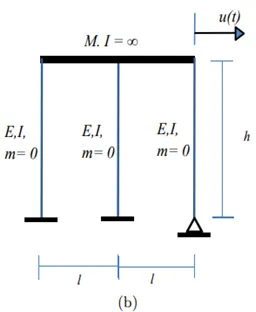
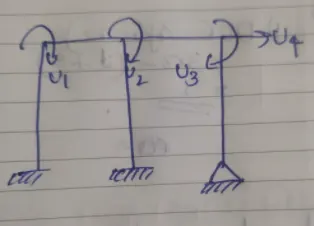
- Degree of freedom: 4 (3 rotations at beam joints and one translation)
- Equation of motion
The standard equation of motion is given by: m`ddotu`+c`dotu`+ku = P(t)
But here, there is no damping and no external force hence, c=P(t)=0. So the equation of motion becomes,
m`ddotu`+ku = 0
Now, we have to find the stiffness value i.e, k.
k value is `(12EI)/l^3`for the columns with fixed ends and`(3EI)/l^3)` for column with far end hinged.
k value for rotation is (`(6EI)/l^2`)
So the eqn of motion can be written as
m`ddotu`+(`(24EI)/l^3`+`(3EI)/l^3`)u4 + (`(6EI)/l^2`)(u1+u2+u3)u = P(t)
- Natural frequency, fn
fn=1/Tn --> Tn=2`pi`/`omega`
`omega`=2`pi`/Tn
Also, `omega`=`sqrt(k/m)`
But here, I value is `oo` so, K value will be `oo`
Hence, fn = `oo`
3. Consider the propped cantilever shown in the figure below. The beams are made from the same steel section and have lengths as shown on the diagram. Determine the natural period of this system if a large mass, M, is placed at the intersection of the beams at point A. The weight of the beams in comparison with the mass M is very small.
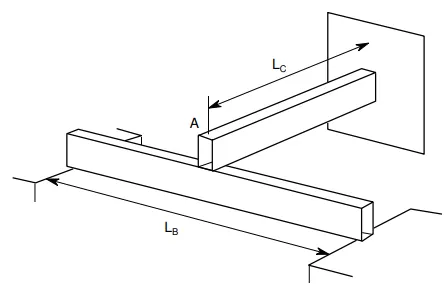
Natural period:
Tn=2`pi`/`omega`
`omega`=`sqrt(k/m)`
W=ku --> k=`W/u`
W=Mg --> M=`W/g`
`omega`=`sqrt((W/u)/(W/g))`
`omega`= `sqrt(g/u)`
Hence, The natural time period, Tn = `(2pi)*sqrt(u/g)`
4. Determine an expression for the effective stiffness of the following systems:
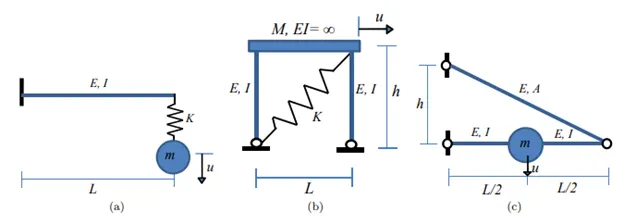
a) In this question one fixed beam and one spring is connected to the mass in series connection, so the effective stiffness can be determined as
Effective stiffness, `1/(Keff )`=`1/ (k1)`+`1/(k2)` where, k1 is the stiffness of Beam and k2 is the stiffness of spring.
Keff =`(k1*k2)/(k1+k2)`
k1 = `(3EI)/L^3`
k2 = K
Keff = `(((3EI)/L^3)*K)/(((3EI)/L^3)+K)`
Keff = `(3EI*K)/(3EI+KL^3)`
b) In this question 3 components are connected to the mass and they are two columns(stiffness k1 and k2) and one spring (stiffness k3). These are connected in parallel. Hence, the expression for effective stiffness is:
Keff = k1 + k2 + k3
k1 = k2 = `(12EI)/h^3`
k3 = K
Keff = `(12EI)/h^3`+ `(12EI)/h^3` + K = `(24EI)/h^3`+ K
Keff = `((24EI)+Kh^3)/h^3`
c) Here, two components are connected to the mass which includes one beam with flexural rigidity(k1) and the other with axial rigidity(k2). These are connected in parallel.
Keff = k1 + k2
k1 = `(48EI)/L^3`
k2 = `(AE)/sqrt(L^2+h^2)`
Keff = `(48EI)/L^3`+ `(AE)/sqrt(L^2+h^2)`