Calculation of Stiffness in Structural elements
Calculation of Stiffness in Structural elements
Question 1:
Compute lateral stiffness of the one story frame with an intermediate realistic stiffness of the beam. The system has 3 DOFs as shown. Assume L = 2h and Elb = Elc
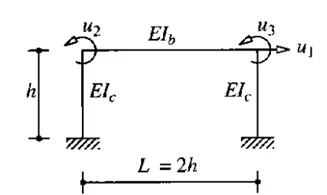
Answer:
assuming unit value as a 1
so, in 1st case,
unit diaplacement u1=1
stiffness coefficient of column translation
2X12EI/h3.....(2 similar)
stiffness coefficient of beam rotation
EI/h2.......(two ends)
2nd case
unit rotation u2 =1
stiffness coefficient of column rotation at right end
6EI/h2
stiffness coefficient of column + beam rotation at left end
4EI/h + 4EI/L
4EI/h + 4EI/2h = 6EI/h
3rd case
unit rotation u3=3
stiffness coefficient of column rotation at left end
6EI/h2
stiffness coefficient of column + beam rotation at right end
4EI/h + 4EI/L
4EI/h + 4EI/2h = 6EI/h
[24EIC/h3 6EIc/h2 6EIc/h2
6EIC/h2 6EIC/h EIc/h
6EIc/h2 EIc/h 6Eic/h ]
Fs = k.u
EIc/h3 [24 6h 6h { u1} { fs }
6h 6h2 h2 { u2 } = { 0 }
6h h2 6h2] { u3 } { 0 }
By applying static condensation method, we are deducting the 3 unknown expression into 2 unknown equation
{ u2 } [ 6h2 h2 ] -1 [6h] [1]
= u1 = - 6/7h u1
{ u3 } [ h2 6h2 ] [6h] [1]
Question 2:
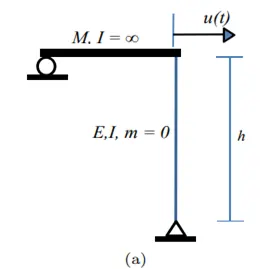
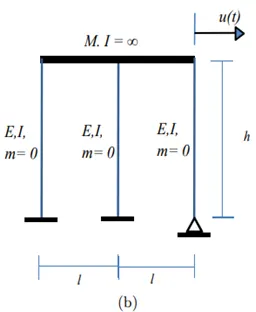
For the following structures:
- Determine the number of degrees-of-freedom for dynamic analysis
- Establish the equation of motion
- Calculate their natural frequencies
Answer:
position of the element can be described by one coordinate only
the system has single degree of freedom structure
the column has fixed end at bottom. so the stiffness coefficient will be as follow
K= 3EI/h3
the equation of motion shall be Mu + ku = 0
natural frequency formula i = `under root k/m` under root 3EI/mh3
Answer:
position of the element can be described by one coordinate only
because beam with infinite stiffness will induced uniform translation in all columns
the system has single degree of freedom structure
two columns with both end fixed and one column has pinned fixed ends, so the stiffness coefficient will be as follow
k1 = 12EI/h3 k2= 12Ei/h3 k3= 3EI/h3
for parallel stiffness elements Ke = ( K1 + K2 + K3 ) = 27EI/h3
the equation of motion shall be Mu + Ku = 0
natural frequency formula (i) = under root of k/m
i = under root of 27EI/Mh3
Question 3:
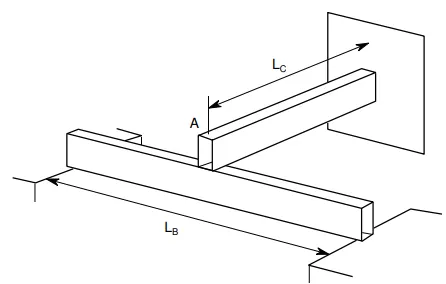
Consider the propped cantilever shown in the figure below. The beams are made from the same steel section and have lengths as shown on the diagram. Determine the natural period of this system if a large mass, M, is placed at the intersection of the beams at point A. The weight of the beams in comparison with the mass M is very small.
Answer :
Both elements have same materials ans section it means they have same modulus of elasticity and second moment of inertia. But the length are diffrent
When mass M is applied at the point both elements will respond simultaneopusly it means they are connected in parallel ( as depiicted in the sketch below )
Effective stiffness of the system Ke= Kb + Kc
Kb = 48EI/tb3
Kc = 3EI/ Ic3
Ke = 3EI ( 1/Ic3 + 16/Ib3 )
natural frequency formula (i) = under root of k/m
i = under root of [ 3EI(1/Ic3 +16/Ib3)/ M ]
Time period T = 2`pi`/(i)
Question 4
Determine an expression for the effective stiffness of the following systems:
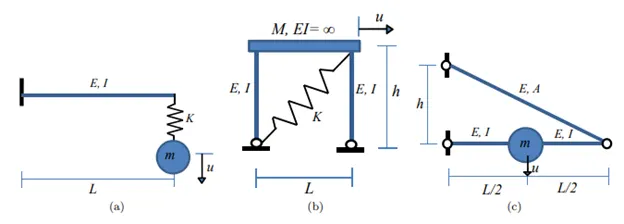
Answer
A)
the stiffness coefficient of the beam elements is 3EI/L3
the stiffness coefficient of the spring is K
the stiffness elements are in series so,
1/Ke = L3/3EI + 1/K
1/Ke = KL3+3EI/3EIK
Ke = 3EIK/KL3+3EI
B)
the stiffness of coefficient of the both the column elements is 3EI/h3
The stiffness coefficient of the spring is K, but is inclined. so the horizontal force (P) and deformation (u) has to be resolved into inclined components to arrive actual coefficient of the spring
Inclined component of load P = p/cos0
Inclined component of deformation u = u cos0
stiffness coefficient of spring
K= p/ucos20
p/u = Ks = Kcos20
cos0 = L/ under root of L2 + h2
cos20 = L2/L2 + h2
Ks = K L2/L2 + h
the effective stiffness of the system, Ke = 6EI/h3 + KL2/L2+h2
C)
The stiffness coefficient of the pinned-pinned beam is K1= 48EI/L3
the effective stiffness coefficient for the system has to be formed by adding the relative axial stiffness provided by the inclined strut connected to the right end
force acting at the right end is mg/2 and deformation caused by the strut at the point of m is half of its right end nodal deformation
mg/2 = Kea.vert X 2 X ^2
mg/^2 = 4 Kea.vert
K2 = 4 Kea.vert
we assumed vertical axial stiffness in our calculation but we have an inclined axial stiffness in the given system. so we have to resolve the (Kea.vert) into (Kea)
K2 = 4Keah2/L2+h2
the effective stiffness shall be arrived as 1/Ke = 1/k1 + 1/k2
1/Ke = 1/(48Ei/L3) + 1/(4Keah2/L2+h2)
1/Ke = 1/(48EI/L3) + 1/(4EAh2/(L2+h2)1.5)
Ke = {4 AEH2/(L2+h2)3/2) 48EI/L3} / {4EAH2/(L2+h2)3/2 + 48EI/L3