Calculation of Stiffness in Structural elements
Calculation of Stiffness in Structural elements
Question 1:
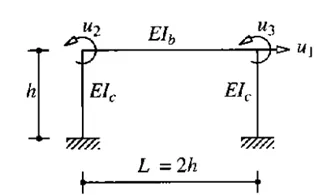
Compute lateral stiffness of the one story frame with an intermediate realistic stiffness of the beam. The system has 3 DOFs as shown. Assume L = 2h and Elb = Elc
Answer:
In this question the Stifness matrix is determined using stifness matrix method of analysis.
As show in figure we observre that here the degree of freedom is 3.so, the stiness matrix is will ne 3X3.
assumptions are L=2h and Elb = Elc .
Firstly, determine the system coordinates and elements Coordinates.
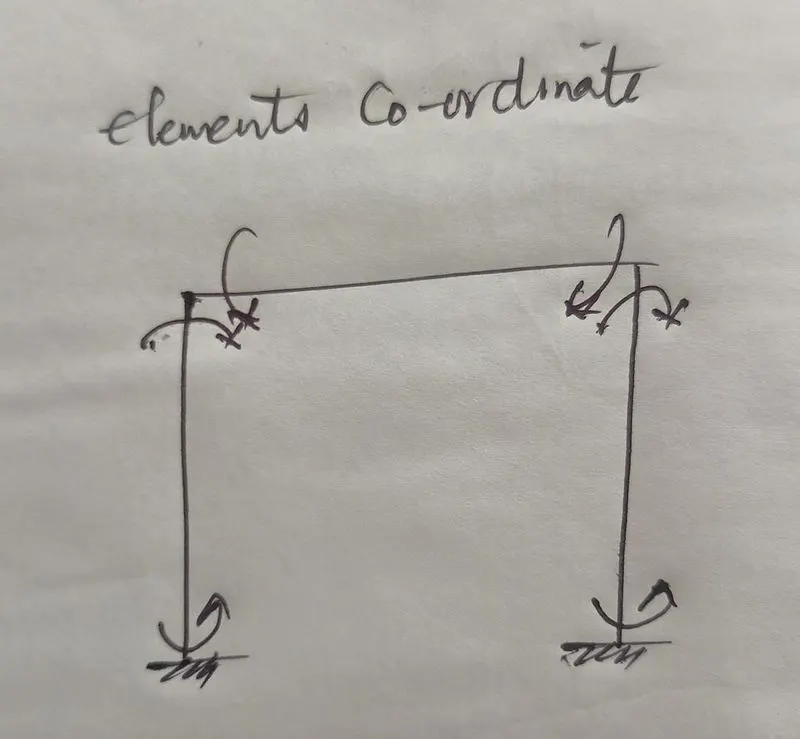
Then we have find out the displacement transformation matrix.For this we have considered for each system correspondingly to their unit forces. respespectively the displacement transformation matrix are also done for each element coordinates.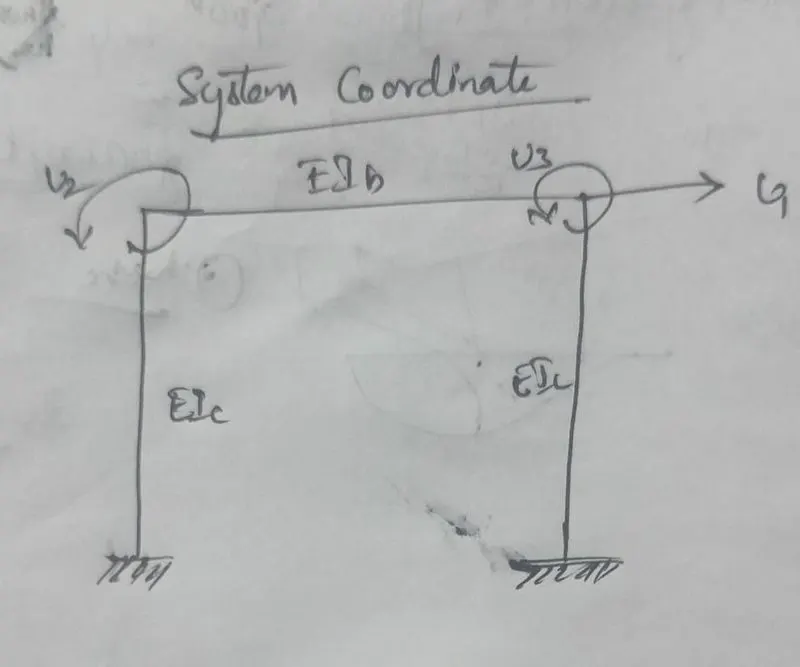
- Now apply u1= 1 unit and reamaing respectively zero like u2 & u3=0.
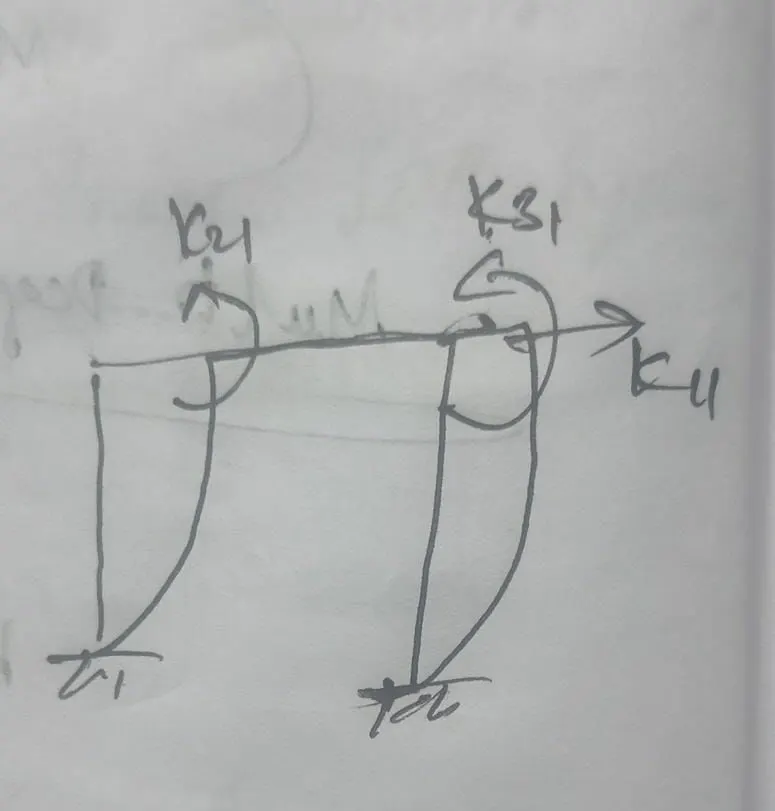
Transformation matrix:
`[a1]=[[-1/h],[-1/h],[0],[0],[-1/h],[-1/h]]` - now apply u2= 1unit and reamaining as zero like u1 & u3=0
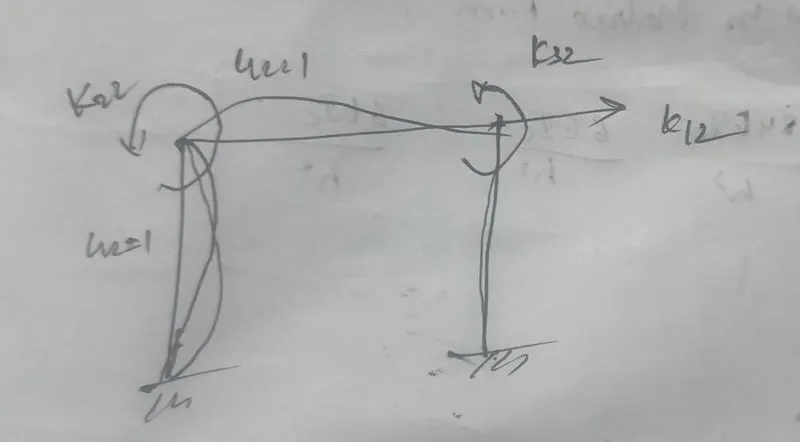
Transformation matrix:
`[a2]=[[0],[-1],[-1],[0],[0],[0]]` - now apply u3= 1unit and reamaining as zero like u1 & u2=0
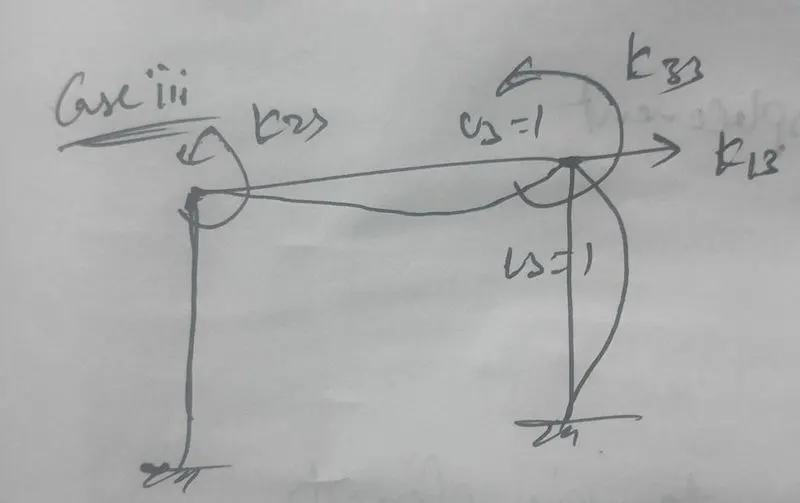
Transformation matrix:
`[a3]=[[0],[0],[0],[-1],[-1],[0]]`
then its time to determine the transformation matrix:
`[a]=[[-1/h,0,0],[-1/h,-1,0],[0,-1,0],[0,0,-1],[-1/h,0,-1],[-1/h,0,0]]`
Now,`[a^T]=[[-1/h,-1/h,0,0,-1/h,-1/h],[0,-1,-1,0,0,0],[0,0,0,-1,-1,0]]`
coming to the elements of stifness matrix.
`[k_(e1)]= [(EI)/h].[[4,2],[2,4]]`
`[k_(e2)]= [(EI)/(2h)].[[4,2],[2,4]]=[(EI)/(h)].[[2,1],[1,2]]`
`[k_(e3)]= [(EI)/h].[[4,2],[2,4]]`
Elements matrix for strcuture can be determined as:
`[k_(s)]=[(EI)/h].[[4,2,0,0,0,0],[2,4,0,0,0,0],[0,0,2,1,0,0],[0,0,1,2,0,0],[0,0,0,0,4,2],[0,0,0,0,2,4]]`
stiffness matrix,`k=[a^T][k_s][a]`
`k=[[-1/h,-1/h,0,0,-1/h,-1/h],[0,-1,-1,0,0,0],[0,0,0,-1,-1,0]][(EI)/h].[[4,2,0,0,0,0],[2,4,0,0,0,0],[0,0,2,1,0,0],[0,0,1,2,0,0],[0,0,0,0,4,2],[0,0,0,0,2,4]][[-1/h,0,0],[-1/h,-1,0],[0,-1,0],[0,0,-1],[-1/h,0,-1],[-1/h,0,0]]`
`k=[(EI)/h].[[-6/h,-6/h,0,0,-6/h,-6/h],[-2,-4,-2,-1,0,0],[0,0,-1,-2,-4,-2]][[-1/h,0,0],[-1/h,-1,0],[0,-1,0],[0,0,-1],[-1/h,0,-1],[-1/h,0,0]]`
`k=[(EI)/h].[[24/(h^3),6/h,6/h],[6/h,6,1],[6/h,1,6]]=[(EI)/h^3].overset[[24,6h,6h]][[[6,6,],[h,h^2,h^2],[6,,6],[h,h^2,h^2]]]`
We know that,k.u=`F_s`
i.e, `[(EI)/h^3].overset[[24,6h,6h]][[[6,6,],[h,h^2,h^2],[6,,6],[h,h^2,h^2]]].overset[u][[[1],[overset(u)(2)],[overset(u)(3)]]=overset[f][[[],[overset(s)(0)],[0]]--->1`
`overset[u][[[2],[overset(u)(3)]]`=`[[overset(6)(h^2),h^2],[h^2,overset(6)(h^2)]]`.`overset(6)([[h],[overset(6)(h)]].u1=-6/(7h)[[1],[1]]u1-->2`
now subtitute the equation 2 in 1
`ie, f_s= (24(EI))/h^2.u1+(EI)/h^3(6h.u2+6h.u3)`
`f_s= (24(EI))/h^2.u1+(EI)/h^3[6h,6h].overset[u][[[2],[overset(u)(3)]]`
`f_s=(24EI)/h^3.u1-(72EI)/(7h^3).u1`
`f_s=96/7.(EI)/h^3.u1`
WKT, The stifness is determined as the force required per unit Defortaion.
Thenu1=1, `f_s=k`
Then, lateral stiffness K=`96/7.(EI)/h^3`
Question 2:
For the following structures:
- Determine the number of degrees-of-freedom for dynamic analysis
- Establish the equation of motion
- Calculate their natural frequencies
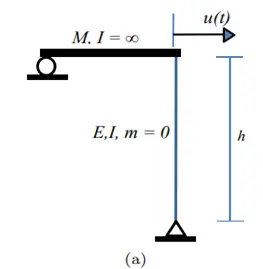
2(a) ANSWER: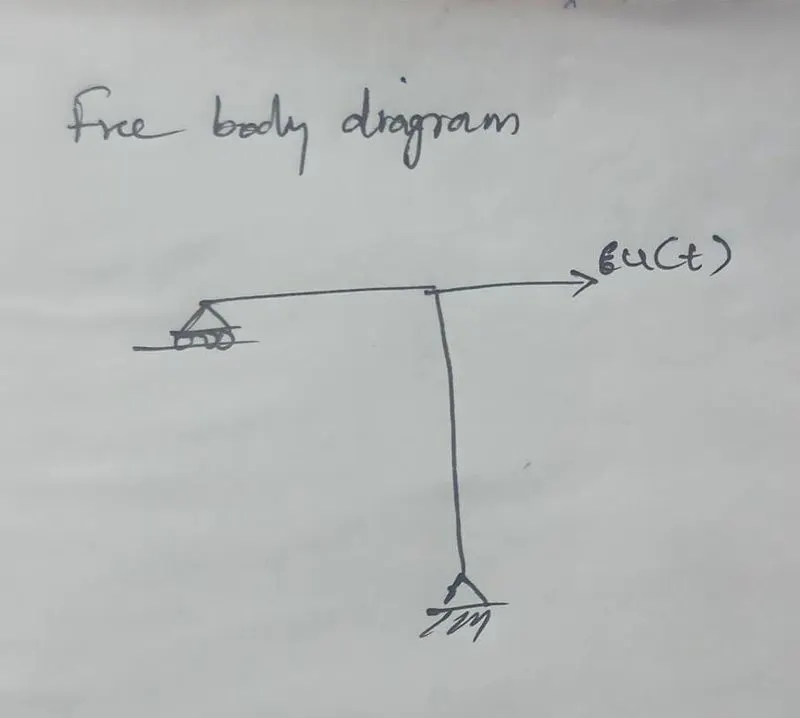
This structure is single degree of freedom system.It consists of only one degree of freedom i.e, one transulation= -1
Now equation of motion is given m`overset(..)(u)`+c`overset(.)(u)`+ku=p(t)
here, c=0 because there is no damping nad external forces.
Then the equation of moption becomes:
m`overset(..)(u)`+ku=p(t)
Now, we have to determine the value of stiffness value i.e, k
for the case End hinge the stiffness is `k_(11)=(3EI)/l^3`
Then the equationof the motion can written has,
m`overset(..)(u)`+ `(3EI)/l^3`u=p(t)
Now, coming to the natural frequency:(fn)
fn=1/Tn
Tn=`(2pi)/(omega)`
`(omega)=(2pi)/T_n`
We also know that: `omega=sqrt (k/m)`
i.e, `omega=sqrt ((3EI)/l^3)/m`
`T_n=2pi sqrt((3EI)/(ml^3))`
Then,
`f_n=1/(2pi)sqrt((3EI)/(ml^3))`
here, Llvalue is `infty`
therefore,`f_n =infty`
2(b) ANSWER: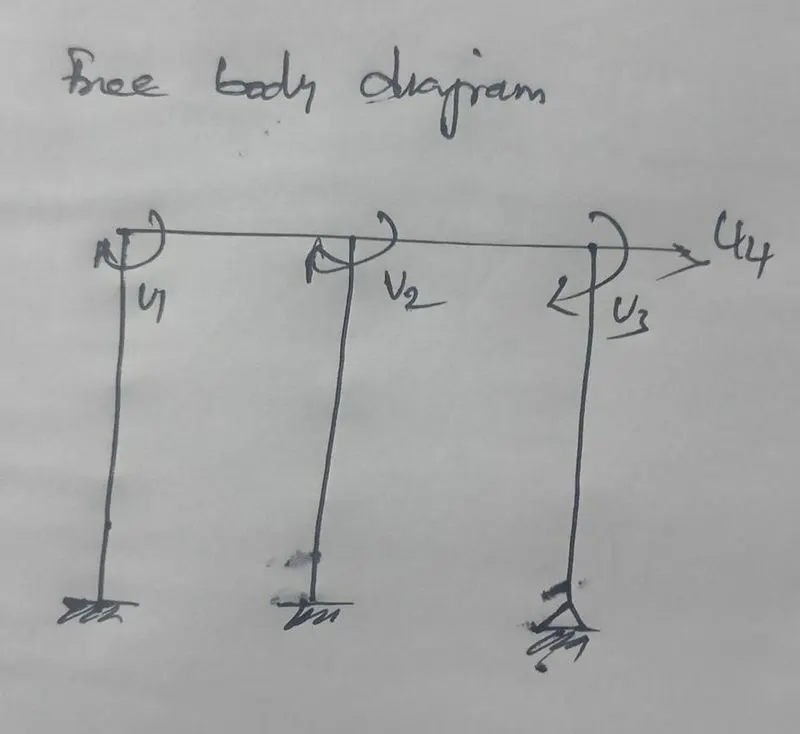
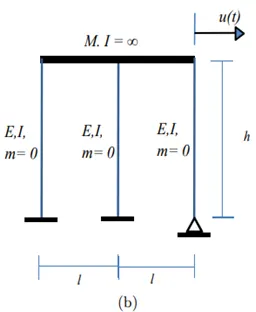
This structure is single degree of freedom system.It consists of only 4 degree of freedom i.e, 3 rotations and 1 translation.
In this one column is pinned and other 2 are fixed.
Now equation of motion is given m`overset(..)(u)`+c`overset(.)(u)`+ku=p(t)
here, c=0 & p(t)=0 because there is no damping and external forces.
Then the equation of moption becomes:
m`overset(..)(u)`+ku=0
Now, we have to determine the value of stiffness value i.e, k
For fixed ends of columns-`(12EI)/(l^3)`
For hinged type of columns-`(3EI)/(l^3)`
Then the k becomes the for rotation is `(6EI)/(l^2)`
Then the equation of moption becomes:
m`overset(..)(u)`+`((24EI)/(l^3)+(3EI)/(l^3))`u4+`(6EI)/(l^2)`(u1+u2+u3)=p(t)
Now, coming to the natural frequency:(fn)
fn=1/Tn
Tn=`(2pi)/(omega)`
`(omega)=(2pi)/T_n`
We also know that: `omega=sqrt (k/m)`
Here,
L value is `infty`
So, k value will be`infty`
therefore,`f_n =infty`
Question 3:
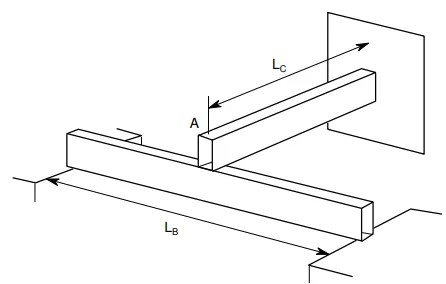
Consider the propped cantilever shown in the figure below. The beams are made from the same steel section and have lengths as shown on the diagram. Determine the natural period of this system if a large mass, M, is placed at the intersection of the beams at point A. The weight of the beams in comparison with the mass M is very small.
ANSWER:
For the above question the given details are consists of both elements are are having same material and section that means haves the same elasicity of modulus and moment of interia.
Now we determining the natural period of this system:
Tn=`(2pi)/(omega)`
`(omega)=(2pi)/T_n`
Where the weight of the beams in comparsion with mass is small and as like shown in below.
W=ku
k=`W/u`
also, W=Mg
M=`W/g`
subtitue the K and M vaules in the qution of `omega`
where, `omega=sqrt((W/u)/(W/g))`
Then W get cancled.
`omega=sqrt(g/u)`
Finally, The Natural time period,`T_n=(2pi).sqrt(u/g)`
Question 4
Determine an expression for the effective stiffness of the following systems:
4(a) ANSWER:
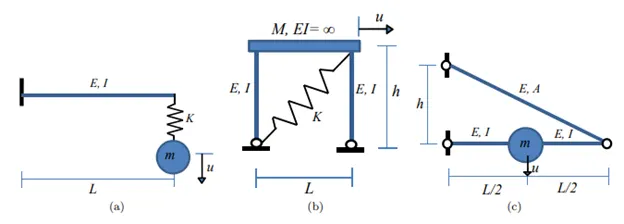
Firstly the question tells the beam is fixed at one end and placed horizontally and the other end of the beam its connect with spring and mass in series coneection actiong downward due to the accleration of gravity(u).
For this given question we are determinig the effective stifness and shown teh caluclation below.
`(1/(k_(eff)))=(1/(k_1))+(1/(k_2))`
Where the
`k_1-` Stiffness of the beam.(`k_1= (3EI)/l^3`)
`k_2-`stiffness of spring.(`k_2= k`)
`k_(eff)= (k_1.k_2)/(k_1+k_2`
Now, the effective stiffness will be: `k_(eff)= ((3EI)/l^3.k)/((3EI)/l^3+k`
`k_(eff)= (3EI.k)/(3EI+kl^3`
4(b) ANSWER:
For this question two columns are hinged and placed vetically and the beam are connected to the two columns. and the spring is placed daigonally.
For this given question we are determinig the effective stifness and shown teh caluclation below.
`k_(eff)= k_1+k_2+k_3`
Where
`k_1 &k_2-`coefficentof stiffness for the both columns.
i.e, `k_1=k_2=(12EI)/h^3`
`k_3-` stiffness cofficent of spring.
`k_3=k`
Now, the effective stiffness will be:
`k_(eff)=(12EI)/h^3+(12EI)/h^3+k`
`k_(eff)=(24EI)/h^3+k`
`k_(eff)=(24EI+kh^3)/h^3`
4(c) ANSWER:
For this question one beam is placed horizontally at the center of the beam acting a concentrated load(Mass).Another beam is inclined with an vertical height(h).
It can simply tell has the one beam with flexural rigidity(k1) and beam is axial rigidity(k2).now we can tell gha the beams are connected parallel.
For this given question we are determinig the effective stifness and shown the caluclation below.
`k_(eff)= k_1+k_2`
Where
`k_1-`horizontal beam with flexural rigidity.(`k_1= (48EI)/l^3`)
`k_2-`inclined beam with axial rigidity.(`k_2=(AE)/(sqrt(l^2+h^2))`)
Now, the effective stiffness will be:
`k_(eff)= (48EI)/l^3+(AE)/(sqrt(l^2+h^2))`