Bird Strike - Project - 2
Aim:
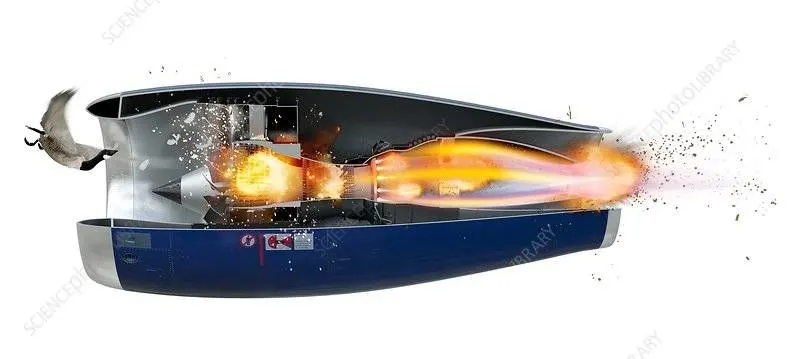
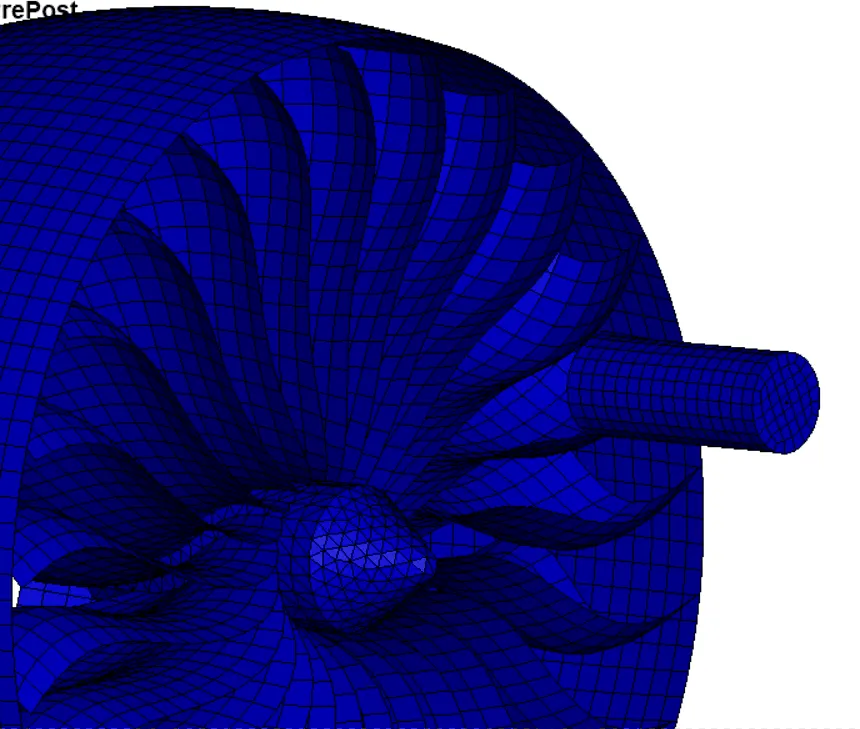
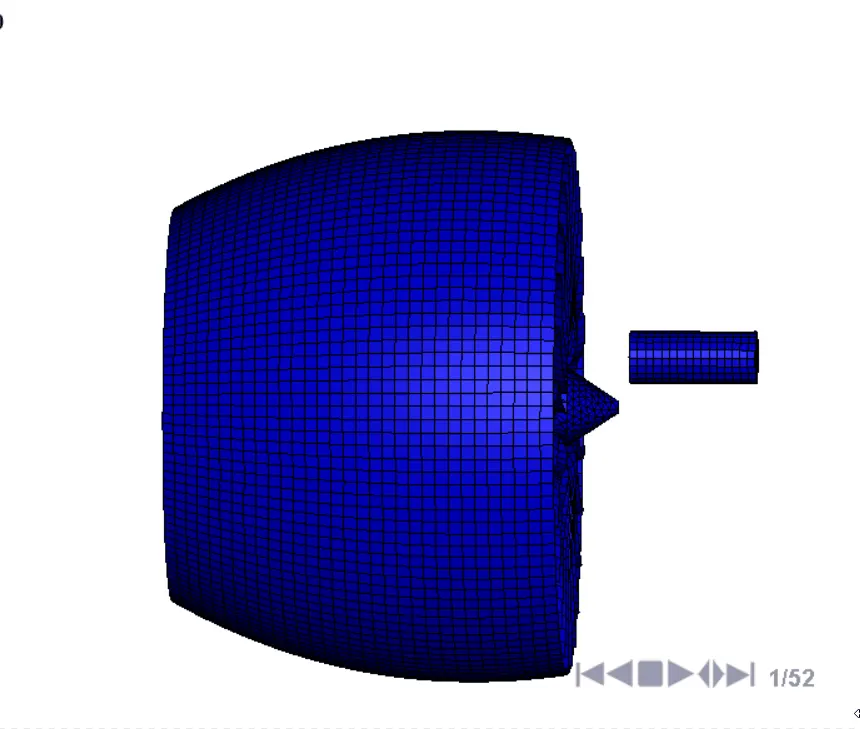
In this project, we have performed the bird strike analysis using Lagrange formulation. The bird is simplified in this case because shell element is used and material used for bird is elastic material. Except that everything is kept quite similar to actual bird strike simulation.
Objectives:
- Simulate a bird strike situation using given models with appropriate material models as required.
- Establish a numbering system for the Id’s of all the keywords with proper ranges for multiple cards.
- Distribute the given model in individual keyword files for various components as well as analysis sub-components.
- Use the ‘Include’ keyword to put these keyword files together and run the analysis such that moving the folder with these files won’t cause a problem with the analysis.
- Use mass scaling to minimise the analysis time and its effect on the outputs.
INTRODUCTION
The collision of birds on an aircraft while cruising in the air is called Bird Strike event and it is one of the most dangerous accidents that often occur. Therefore, certification of a bird strike is one of the important processes in aircraft design. In particular, the areas where bird strikes occur a lot are on the front leading edge of the wing, the cowling part of the engine, rotating engine fan blades, the cockpit transparency and the landing gear part. This project is a classic nonlinear transient dynamics problem similar to car crash and mobile drop. While accurate modelling of the problem requires advanced techniques such as SPH, this problem can be solved using generic explicit solver
- This usually happens during the landing or take-off but isn’t limited to them. Even though a bird is a light projectile with low density and doesn’t pose much danger in stationary condition, during flight or when the plane is in motion at comparatively high speeds, things can go south. In many cases, even a small bird is capable of bringing down a commercial plane if it hits any crucial component on the plane essentially making the onboard crew and systems to lose control and crash. One such crucial part is the turbojet engines which are placed under the wings of a plane.
- The compressor blades and guide vanes suck in the ambient air, pressurise it and then combust it in the combustion chamber to produce thrust which pushes the plane forward. These blades are usually open to the surroundings and are carefully designed to survive such an accident and still operate. Moreover there are various redundancy protocols in an airplane with backups and emergency systems to counter any such incidents but in past when there were none, bird strike was a significant problem and still is.
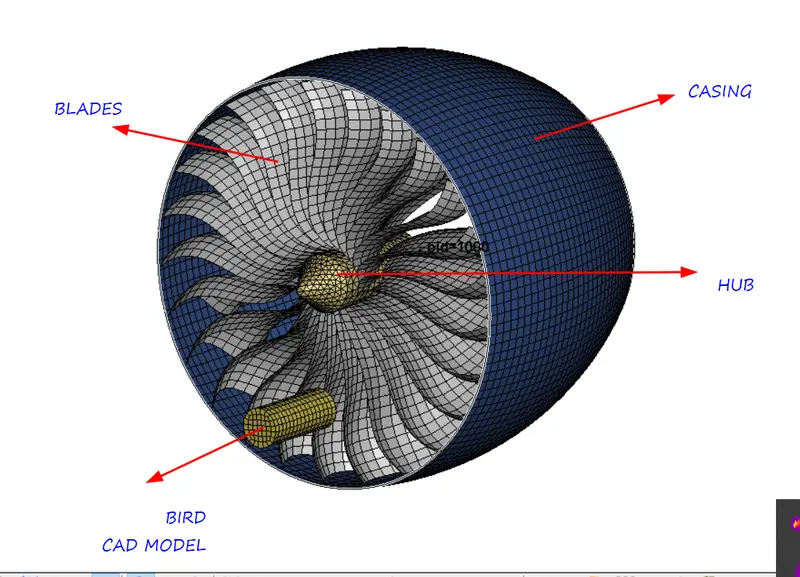
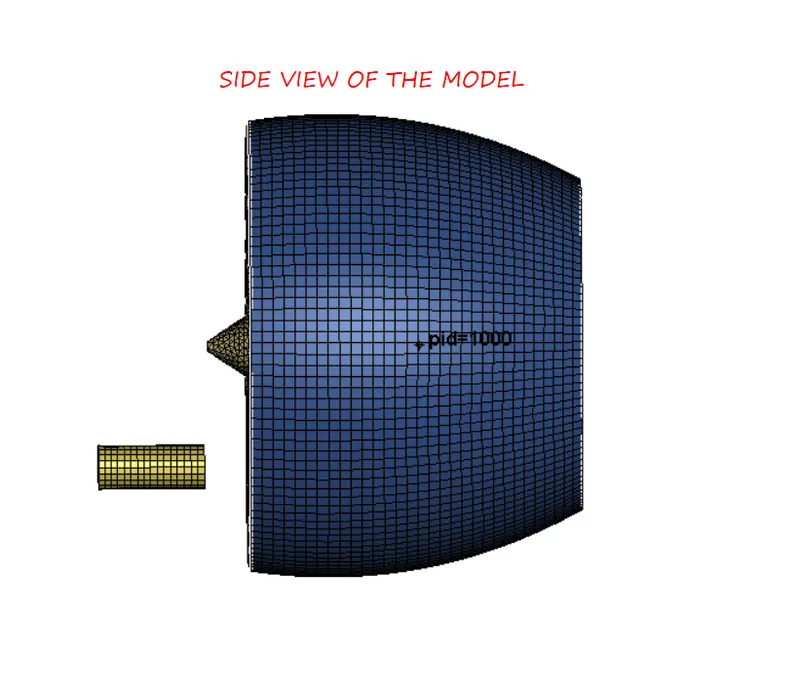
CAD MODEL :
INCLUDE CARD :
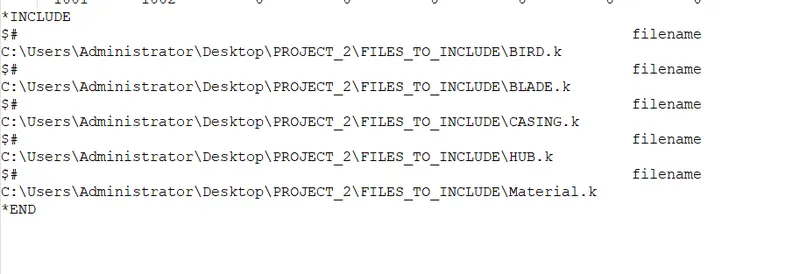
one of the main goal is to develop the understanding the INCLUDE keyword so that we can work with multiple file simultaneously and use them for our simulation
i generated separate keyword file for each part and include them in one keyword file nammed as main file. in the main file i defined the the boundary condition contact and control card
MODEL SETUP :
MATERIAL :
BIRD MODELLING :
Generally in bird strike modelling bird is challenging task because it consist bones blood and organ ,so for simplicity , In Aerospace industry bird is modelled as 90% water and 10% air like gelatin material.
In our case , bird is modelled with lower density and higher poisson ratio and lower young modulus
- density = 1.0E-06 kg/mm^3
- poisson ration = 0.47
- young modulus = 2 GPA
BLADE MODELLING :
in this model, elasto plastic material (MAT_24 LINEAR PIECEWISE PLASTICITY ) has choosen. ALUMINIUM is selected
- young modulus = 68 GPA
- density = 2.3E-06 kg/mm^3
- poisson ratio = 0.33
- yiled strength = 0.013362 GPA
- failure plastic strain value = 0.2723
HUB MATERIAL :
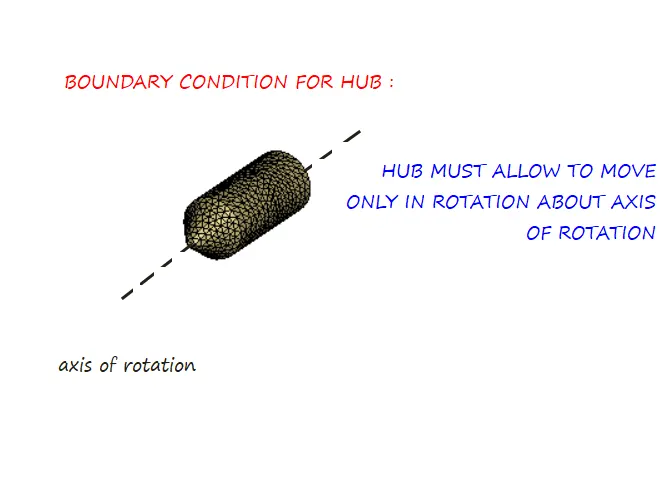
in this model we only focus on the blade so i defined the rigid material for hub because it provide addition benifit of constraining part in required degree of freedom otherwise we have to define the cylindrical joint between casing and the hub so that hub must be maintained in position
- density = 7.8E-6 kg/mm^3
- poisson ration = 0.3
- young modulus = 200 GPA
CASING MATERIAL :
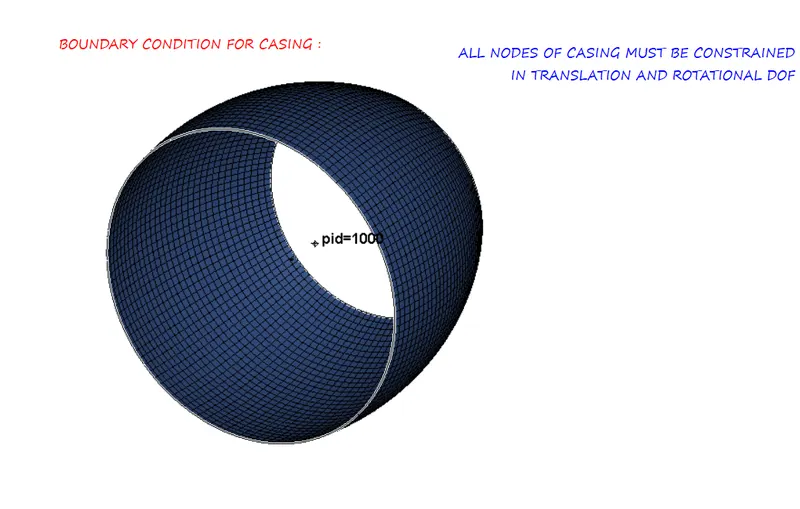
for casing i have choosen the ELASTIC steel material
- density = 7.8E-6 kg/mm^3
- poisson ration = 0.3
- young modulus = 200 GPA
CONTACT CARDS:
in this model contact card is required to identify contact between parts. here several contact is generated,
- contact between blade and bird
- contact between blade and casing
- contact between blade self penetration
- contact between blade and bird is defined by AUTOMATIC_NODES_TO_SURFACE card here bird is slave and blade is master
- contact between blade and casing is defined by AUTOMATIC_SURFACE_TO_SURFACE card here blade is slave and casing is master
- contact between blade and blade due to self penetration is defined by AUTOMATIC_SINGLE_SURFACE card here blade is slave and blade is maste
- addition contact card can also be define between bird and casing(AUTOMATIC_SURFACE_TO SURFACE) ,blade and hub(TIED_SURFACE TO SURFACE)
BOUNDARY CONDITION :
in this model there are two boundary condition
essential boundary condition :
these boundary condition is specified by BOUNDARY_SPC_SET card
- constraining DOF of casing in all direction
- constraining hub in all DOF except rotation along the axis of the rotation
natural boundary condition :
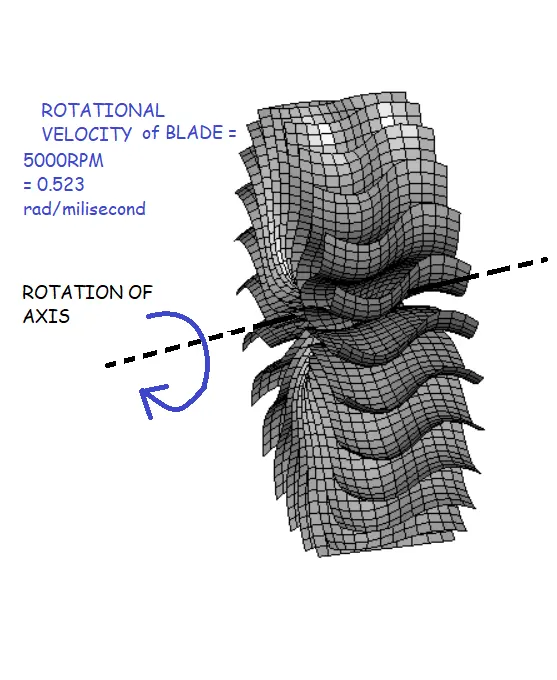
these boundary condition is specified using INITIAL_VELOCITY_GENERATION card
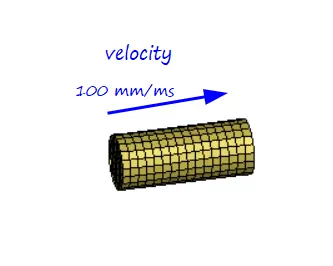
- velocity of the bird 100 mm/ms toward the blade
- rotation velocity (omega = 0.53 rad/milisecond) of the blade and hub about axis of rotation
SECTION OF THE PART :
- Bird , Blade, Casing are SHELL element
- Hub is SOLID element
element formulation for shell is 16(fully integration) and for solid is 10(1 point tetrahedron)
thickness for
- bird = 1.0 mm
- blade = 3.0 mm
- casing = 3.0 mm
OTHER CARD :
Model problem is nonlinear transient type so it is solved by explicit solver
for explixit analysis some card is defined
CONTROL_TERMINARION
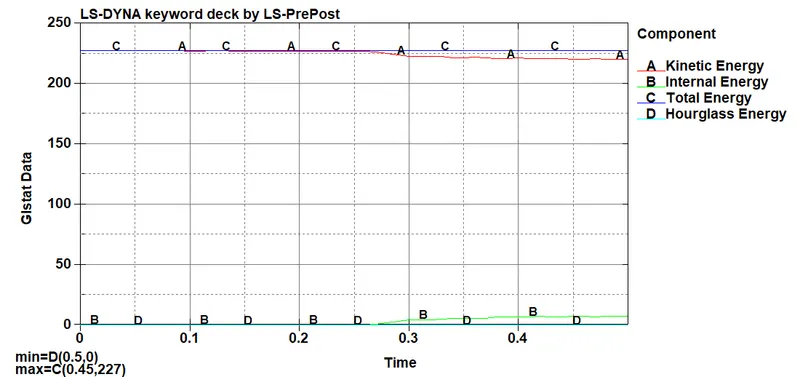
DATABASE_ASCII(glstat, matsum)
DATABASE_D3PLOT
MASS SCALING :
when we run the simulation it takes around 1hr30min so for reducing the time i used the mass scaling
for enabling the mass scaling CONTROL_TIMESTEP(TSFAC =0.6 and DT2MS = -1.0E-05) is used. After enabling the mass scaling simmlation only take 10 minutes.
RESULT :
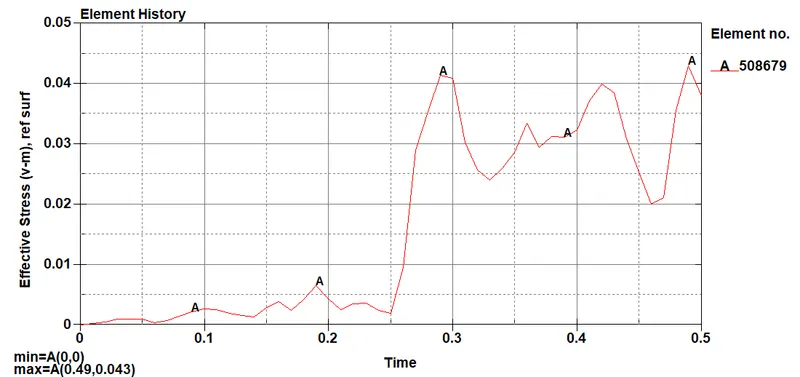
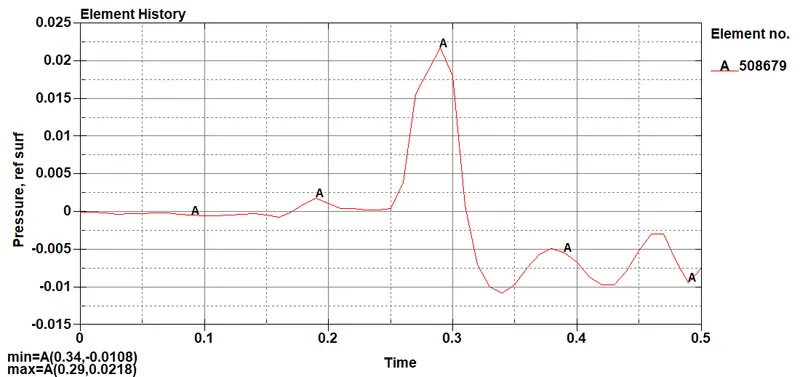
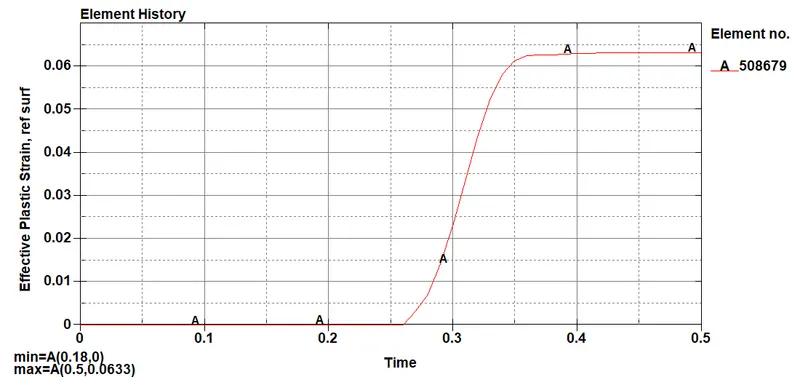
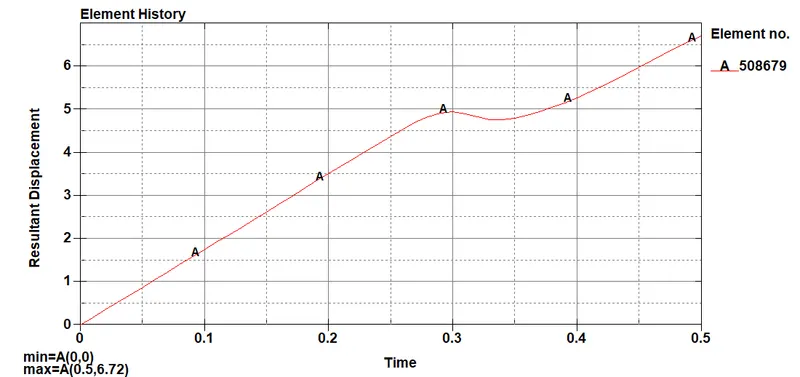
PLASTIC STRAIN
CONCLUSION
The keyword file to simulate bird strike on an Aero Engine is created by following the necessary conditions and requirements.
In the simulation, the blades at the impact zone are damaged.
Mass scaling approach was adopted to reduce the runtime with optimum value of DT2MS = -1.0E-5.
The initial keyword files were debugged to get a realistic simulation of bird strike phenomenon.
Learned to create and organise as well as debug the input keyword files similar to a professional setting when dealing with large models and multiple people working with the same model simultaneously.