Benchmarking
Benchmarking
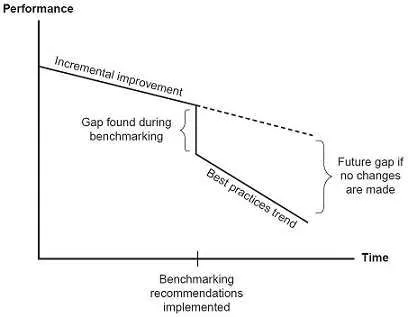
Benchmarking is the process of comparing the performance of a company’s products, services, or processes against industries and companies which are considered best.
By studying companies that are superior in performance, companies can implement changes that will yield significant improvement.
Benchmarking helps gain insight for innovation and further improvements.
It helps organizations identify areas, systems, or processes for continuous or dramatic (business process re-engineering) improvements
The primal step in benchmarking is the requirement of quantitative data available to study, which is obtained by breaking down the internal process to calculate performance metrics. As quantified information can be accurately compared.
Steps in benchmarking
Benchmarking is a five-step simple process that is studied in detail.
- Product, Service, or Internal Department is selected.
- Determine which companies are considered best in the market, and which organizations are selected for benchmarking.
- Gather detailed information on the performances or metrics.
- Compare the data from all the organizations to identify gaps in your company’s product performance.
- Adopt the processes and policies which provide the best performance.
Benchmarking is classified into two categories
- Technical Benchmarking – It is performed by design staff to compare and determine the capabilities of products or services, in comparison with the products or services of leading competitors.
- Competitive benchmarking – It is a comparison of how well the organization is doing as compared to the leading competition.
Benefits of benchmarking
Benchmarking has several other benefits as well:
- Improved Quality:
Benchmarking helps organizations achieve the best quality of their product and services and also helps to continuously improve their standards.
- Better performance:
Benchmarking leads to better performance of the product and services of the organization as they continuously improve to stay relevant in the market.
- Cost efficiency:
Benchmarking provides organizations with the required and valuable data on the current and last technology in the market and also the details of the processes and methods followed in the business environment. These processes help the organization to make future processes cost-efficient.
- Prioritizing areas of improvement:
Even though continuous improvement is necessary, organizations find it difficult to find the area for improvement which will provide the most benefits and bridge the gap between standard and industry requirement, Benchmarking help identify the areas which require improvement and helps an organization prioritize the area that they need to work on.
- Leveraging strength areas:
Benchmarking helps identify the areas in which an organization is performing better than other companies in the market, having this information help organization to build its reputation and also for marketing purposes.
Why are benchmarks important?
Many times, it is observed that companies are reluctant to use benchmarking. They believe they are their organization and hence do not need to imitate or reproduce the function and action of other organizations. It is very imperative and critical to underline the fact that benchmarking does not mean blindly copying what competitors do. It just means understanding the needs of the market and being relevant and understanding towards the acceptable standard of the industry. And understanding the position of the organization with respect to that standard.
Benchmarking helps organizations to stay in sync with the market and customer needs.
Customer prefers an organization that tends to their need and resolve their issues as soon as possible. Not adapting to industry standards and staying relevant to the market may result in the loss of the reputation of the organization and also the result in the organization losing its market base.
Requirement:
Mr. D.S. Pughazhyendhii is a married man who lives in Bangalore which is a highly crowded city. His Family comprises five members including his wife, a five-year-old boy, his father, and his mother. He visits his native place Madurai which is 500kms away from Bangalore once a month. Also, he will be using his car to commute to his office. His budget falls between 8 to 10 lakhs on road. Please suggest to him options so that he will buy a good car for his family.
Note: Pughazhyendhii is fond of big cars
- Prepare a report explaining what is benchmarking
- Compare at least 4 vehicles.
- Provide a proper conclusion for the report, suggesting a suitable vehicle among the comparison made.
Benchmarking as per requirement –
After studying the requirements comparison is done on the following cars
- Tata Nexon
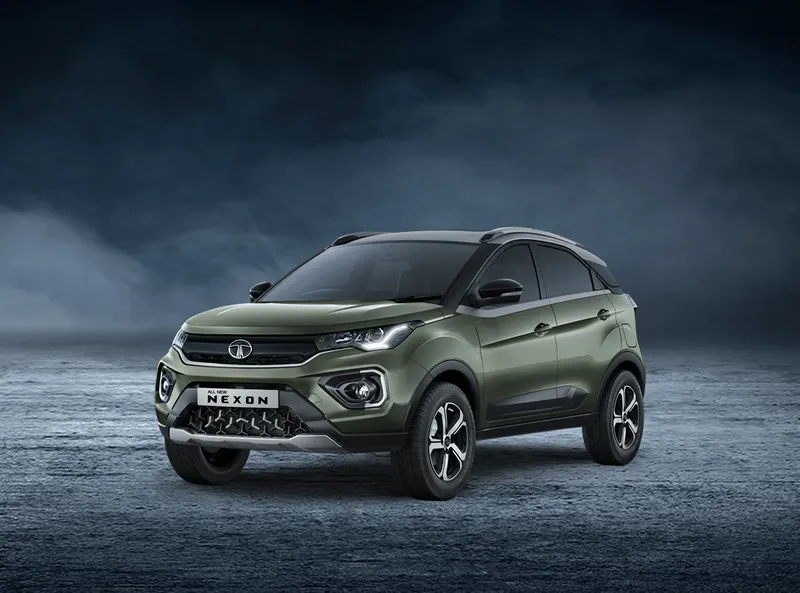
The Tata Nexon has 1 Diesel Engine and 1 Petrol Engine on offer. The Diesel engine is 1497 cc while the Petrol engine is 1199 cc. It is available with Manual & Automatic transmission. Depending upon the variant and fuel type the Nexon has a mileage of & Ground clearance of Nexon is 209. The Nexon is a 5-seater 4-cylinder and has a length of 3993, width of 1811, and a wheelbase of 2498.
Pros -
- Best in class safety with a 5-star rating.
- Powerful engines (Both petrol and Diesel)
- Provide Good ground clearance and smooth ride in congested cities.
- Good milage
- It has good stability
- Provides good Boot space
Cons –
- Parking camera is not up to the expectation.
- Ergonomics - not so convenient in having an extremely comfortable ride. Getting into the Vehicle is not easy.
- Loud cabin noise
Key features –
- Power steering
- Anti-Lock braking system
- Driver Airbag
- Automatic Climate control
- Multi-function steering wheel
- Passenger airbag
- Alloy wheels
Specification –
|
ARAI Mileage |
21.5 Kmpl |
|
Fuel Type |
Petrol/ Diesel |
|
No. of Cylinder |
4 |
|
Max- torque |
260nm@1500-2750rpm |
|
Transmission Type |
Automatic / Manual |
|
Engine Displacement (cc) |
1497 |
|
Max Power (bhp@rpm) |
108.49bhp@4000rpm |
|
Seating Capacity 5 |
|
|
Boot Space (Litres) |
350 |
|
Fuel Tank Capacity |
44 |
|
Body Type |
SUV |
|
Ground Clearance Unladen |
209 |
|
Service Cost (Avg. of 5 years) |
Rs.4,447 |
On road price - 8,46,032 Lakh
2. Maruti Suzuki Vitara Brezza –
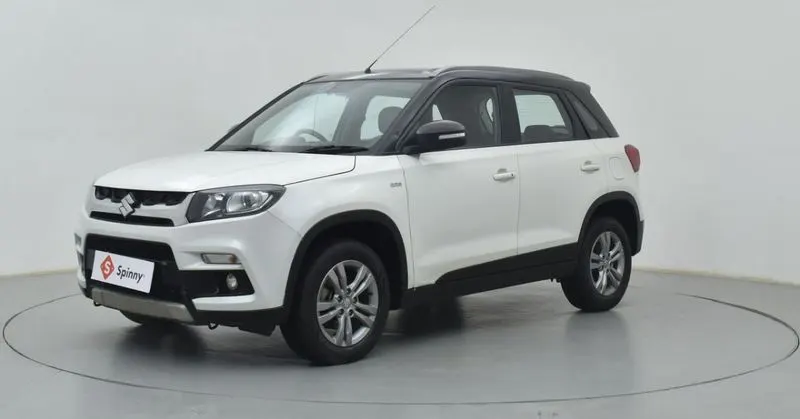
The Vitara Brezza has been one of the best-selling SUVs since it went on sale in India in the year 2016. The SUV has witnessed unparalleled success in India. It also became the first subcompact SUV to clock the 5.5 lakh sales milestone in just 4 and a half years. The mid-life facelift for the SUV was introduced last year in February, and the SUV also made its transition from a diesel-only car to a petrol-only SUV.
he Maruti Vitara Brezza has 1 Petrol Engine on offer. The Petrol engine is 1462 cc . It is available with Manual & Automatic transmission. Depending upon the variant and fuel type the Vitara Brezza has a mileage of 17.03 to 18.76 kmpl . The Vitara Brezza is a 5-seater 4-cylinder and has length of 3995mm, width of 1790mm and a wheelbase of 2500mm.
Pros:
- Affordable stylish SUV
- Good styling elements with good Milage
- Sporty interiors and exteriors and boxy design.
Cons:
- Quality is compromised
- Loud Noise, ride quality is bouncy
- Powerless engine.
Key features –
- Power Steering
- Power Windows Front
- Anti-Lock Braking System
- Air Conditioner
- Driver Airbag
- Passenger Airbag
- Automatic Climate Control
- Fog Lights - Front
- Alloy Wheels
Specification –
|
ARAI Mileage |
18.76 kmpl |
|
Fuel Type |
Petrol |
|
Engine Displacement (cc) |
1462 |
|
No. of cylinder |
4 |
|
Max Power (bhp@rpm) |
103.26bhp@6000rpm |
|
Max Torque (nm@rpm) |
138nm@4400rpm |
|
Seating Capacity |
5 |
|
Transmission Type |
Automatic |
|
Boot Space (Litres) |
328 |
|
Fuel Tank Capacity |
48 |
|
Body Type |
SUV |
|
Service Cost (Avg. of 5 years) |
Rs.6,619 |
On-road price – 8,78,023 Lakh
3. Kia Sonet
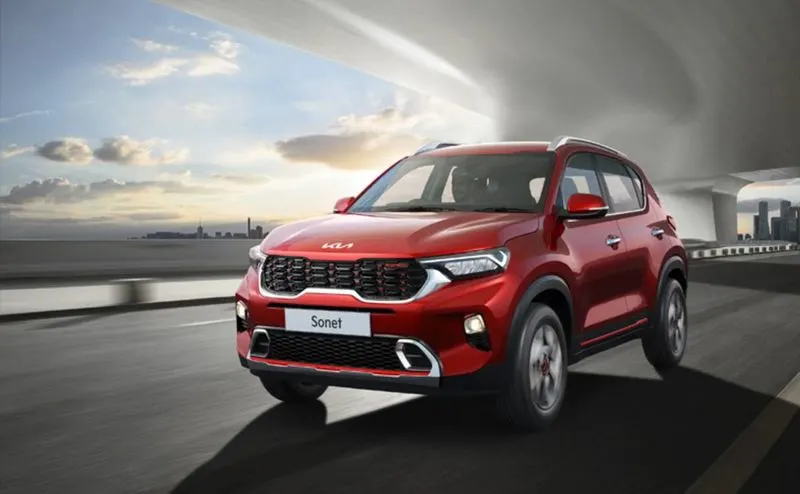
The Kia Sonet has 1 Diesel Engine and 2 Petrol Engines on offer. The Diesel engine is 1493 cc while the Petrol engine is 1197 cc and 998 cc. It is available with Automatic & Manual transmission. Depending upon the variant and fuel type the Sonet has a mileage of. The Sonet is a 5-seater 4-cylinder and has a length of 3995, width of 1790, and a wheelbase of 2500.
Pros –
- Kia sonnet has an overall great look.
- It comes with a great choice of engine options.
- Better drive train
- The Kia Sonet offers a tonne of smart and premium features.
Cons –
- It is a bit cramped
- Not good at handling
- 0-lite turbo petrol doesn't come with a manual gearbox.
Key features –
- Power Steering
- Power Windows Front
- Anti Lock Braking System
- Air Conditioner
- Driver Airbag
- Passenger Airbag
- Automatic Climate Control
- Fog Lights - Front
- Alloy Wheels
Specification –
|
ARAI Mileage |
15.9 kmpl |
|
Fuel Type |
Petrol |
|
Engine Displacement (cc) |
1496 |
|
No. of cylinder |
3 |
|
Max Power (bhp@rpm) |
120.69bhp@6500rpm |
|
Max Torque (nm@rpm) |
149Nm@4500rpm |
|
Seating Capacity |
5 |
|
Transmission Type |
Manual |
|
Boot Space (Litres) |
352 |
|
Fuel Tank Capacity |
52 |
|
Body Type |
SUV |
On-road price - 8,03,914 Lakh
4. Ford Ecosport
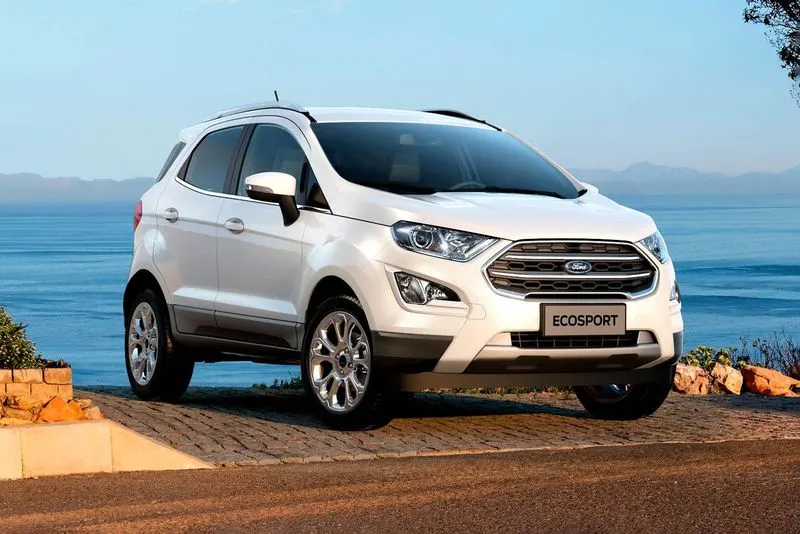
The Ford EcoSport has 1 Diesel Engine and 1 Petrol Engine on offer. The Diesel engine is 1498 cc while the Petrol engine is 1496 cc . It is available with Manual & Automatic transmission. Depending upon the variant and fuel type the EcoSport has a mileage of 14.7 to 21.7 kmpl . The EcoSport is a 5-seater 3-cylinder and has a length of 3998, width of 1765 and a wheelbase of 2519.
Pros –
- Handsome Peculiar looks
- Balanced stewing wheel and better ride quality
- Spacious and well built cabin
Cons –
- Loss character with the spare wheel
- Need of major update
- Stiff suspension system
- Thick-a-pillar causes blind spot.
Key features –
- Power Steering
- Power Windows Front
- Anti Lock Braking System
- Air Conditioner
- Driver Airbag
- Passenger Airbag
- Wheel Covers
Specification
|
ARAI Mileage |
15.9 kmpl |
|
Fuel Type |
Petrol |
|
Engine Displacement (cc) |
1496 |
|
No. of cylinder |
3 |
|
Max Power (bhp@rpm) |
120.69bhp@6500rpm |
|
Max Torque (nm@rpm) |
149Nm@4500rpm |
|
Seating Capacity |
5 |
|
TransmissionType |
Manual |
|
Boot Space (Litres) |
352 |
|
Fuel Tank Capacity |
52 |
|
Body Type |
SUV |
On-road – price - 9.26 Lakh
Conclusion
After comparing all the mentioned vehicles, I would suggest Tata Nexon for Mr. D.S Pughazhyendhii family,
For 4 adults and 1 child, Nexon stands apart from its rivals with an NCAP safety rating of 5 and good mileage efficiency, and spacious cabin and leg room.
Nexon will be my first priority to suggest.
Overall Tata Nexon has the best performance.