Benchmarking
BENCHMARKING :
Benchmarking involves a structured comparison between similar products, services or processes on some dimensions of performance. For example it can be used to compare the availability and delivery of features in a product and in this form often provides the basis of consumer tests and reviews. These look at products and services and provide recommendations based on which is best or some form of ranking amongst competitors. It is particularly useful when comparing not only performance but also practice – in other words what do the different organizations do to enable that performance to be delivered? And applied in this way it is a powerful tool in process innovation since studying how the ‘best’ achieve their performance can provide powerful clues for changing the way processes operate.
The objective of benchmarking is to use the data gathered in your benchmarking process to identify areas where improvements can be made by:
- Determining how and where other companies are achieving higher performance levels than your company has been able to achieve.
- Comparing the competition’s processes and strategies against your own.
- Using the information you gather from your analyses and comparisons to implement changes that will improve your company’s performance, products, and services.
Process benchmarking of this kind can operate at several levels:
• Between similar processes in the same factory or service branch
• Between different factories or service branches
• Between different competing organizations
• Between different sectors using the same process
Steps of Benchmarking process :
1. Select a subject to benchmark : Executives and other senior management should be involved in deciding which processes are critical to the company’s success. The processes should then be prioritized based on which metrics are most important to all stakeholders. After prioritizing, select and define the measures you want to collect.
2. Decide which organization or company you want to benchmark : Determine if you are going to benchmark processes within your own company, a competitor, or a company outside of your industry.
3. Document your current processes : Map out your current processes so you can identify areas that need improvement and more easily compare against the chosen organization.
4. Collect and analyse data : This step is important—but it can prove difficult when you are trying to gather data from a competitor because a lot of that information may be confidential. Gather information through research, interviews, casual conversations with contacts from the other companies, and with formal interviews or questionnaires.
5. Measure the performance against the data you have collected : This step is important—but it can prove difficult when you are trying to gather data from a competitor because a lot of that information may be confidential.
Gather information through research, interviews, casual conversations with contacts from the other companies, and with formal interviews or questionnaires.
6. Create a plan : Create a plan to implement changes that you have identified as being the best to close performance gaps. Implementation requires total buy-in from the top down. Your plan must include clearly defined goals and should be written with the company’s culture in mind to help minimize any pushback you may get from employees.
7. Implement the changes : Closely monitor the changes and employee performance. If new processes are not running smoothly as expected, identify areas that need to be tweaked. Make sure all employees understand their jobs, are well trained, and have the expertise to complete their assigned tasks.
8. Repeate th process :
BENEFITS OF BENCHMARKING PROCESS:
- Improve processes and procedures.
- Gauge the effectiveness of past performance.
- Give you a better idea of how the competition operates, which will help you to identify best practices to increase performance.
- Increase efficiency and lower costs, making your business more profitable.
- Improve quality and customer satisfaction.
BENCHMARK STUDY TO CHOOSE BEST CAR FROM THE MARKET AS PER REQUIREMENT OF Mr. D.S. Pughazhyendhii :
Clients Requirements :
- A married man stays in banglore with his family includes his Wife, Father, Mother and five year old son.
- Native place Madurai use to visit once every month which is 500 km away.
- Daily travel via car to office
- Budget : 8 - 10 Lakhs ( ON ROAD PRICE )
- Mr. D.S. Pughazhyendhii is a fond of big cars.
As per the requirements of client we clearly come to know he requires a 5 seater SUV in the budget 8-10 lakhs.
As per the requirement i have choosen five SUV cars from market and here i am with comparision and conclusion for the same.
1. TATA NAXON XM DIESEL (MANUAL)

2. TOYOTA GLANZA PETROL (MANUAL)

3. HUNDAI VENUE PETROL (MANUAL)

4. TATA ALTROZ PETROL (MANUAL)
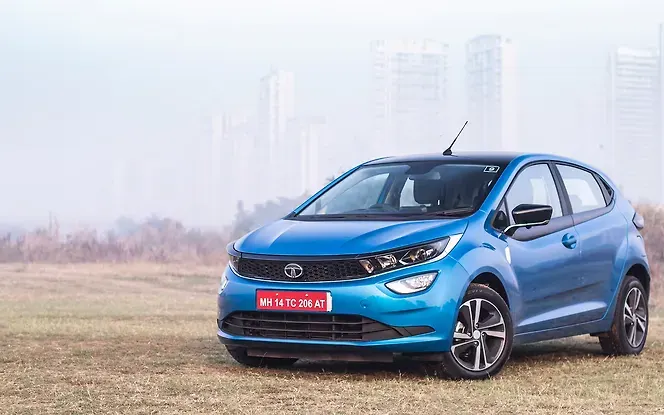
5. MARUTI SUZUKI VITARA BREZZA PETROL (MANUAL)

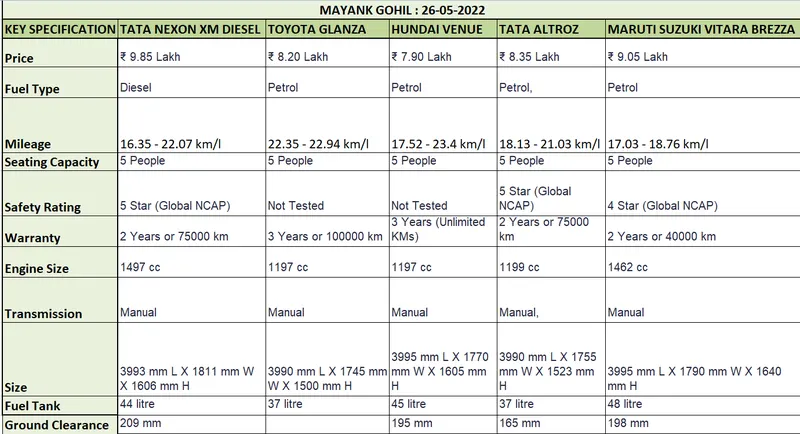
COMPARISION REPORT OF ABOVE FIVE SUV CAR :
CONCLUSION :
When it comes to safety, engine performance and build quality i will recommended TATA ALTROZ. As this is the best car as per safety rating and actual incidents after launch. Also our customer is a family man so highly recommended this car to him.Because of petrol,higher in price & lower in mileage i will not suggest him as its cost effective in future.
But, As we know Mr. D.S. Pughazhyendhii is a fond of big cars, TATA NEXON Diesel has best engine performance, a diesel varient with good mileage, engine power and ground clearance. Also has 5 star NCAP safety test rating. Meets clients budget and also awarded india's safest car within SUV segment.
So, I would like to suggest Mr. D.S. Pughazhyendhii to go with TATA NEXON DIESEL XM.