Benchmarking
BENCHMARKING
DEFINATION:
Benchmarking is the competitive edge that allows organizations to adapt, grow, and thrive through change. Benchmarking is the process of measuring key business metrics and practices and comparing them—within business areas or against a competitor, industry peers, or other companies around the world—to understand how and where the organization needs to change in order to improve performance.
There are four main types of benchmarking: internal, external, performance, and practice
- Performance benchmarking: Involves gathering and comparing quantitative data (i.e., measures or key performance indicators). Performance benchmarking is usually the first step organizations take to identify performance gaps.
What you need: Standard measures and/or KPIs and a means of extracting, collecting, and analyzing that data.
What you get: Data that informs decision making. This form of benchmarking is usually the first step organizations take to identify performance gaps.
- Practice benchmarking: Involves gathering and comparing qualitative information about how an activity is conducted through people, processes, and technology.
What you need: A standard approach to gather and compare qualitative information such as process mapping.
What you get: Insight into where and how performance gaps occur and best practices that the organization can apply to other areas.
- Internal benchmarking: Compares metrics (performance benchmarking) and/or practices (practice benchmarking) from different units, product lines, departments, programs, geographies, etc., within the organization.
What you need: At least two areas within the organization that have shared metrics and/or practices.
What you get: Internal benchmarking is a good starting point to understand the current standard of business performance. Sustained internal benchmarking applies mainly to large organizations where certain areas of the business are more efficient than others.
- External benchmarking: Compares metrics and/or practices of one organization to one or many others.
What you need: For custom benchmarking, you need one or more organizations to agree to participate. You may also need a third party to facilitate data collection. This approach can be highly valuable but often requires significant time and effort. That’s why organizations engage with groups like APQC, which offers more than 3,300 measures you can use to compare performance to organizations worldwide and in nearly every industry.
What you get: An objective understanding of your organization’s current state, which allows you to set baselines and goals for improvement.
FOR EXAMPLE,
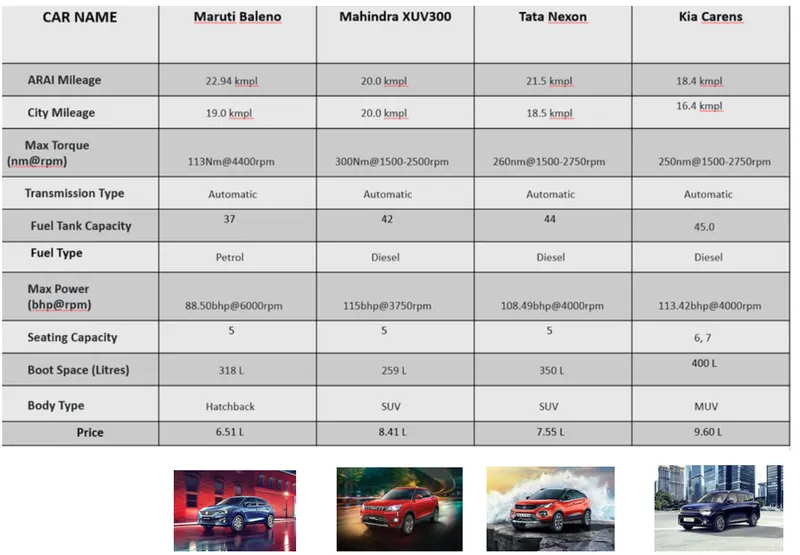
- Mr.D.S.Pughazhyendhii is a married man who lives in Bangalore which is a highly crowded city. His family comprises of 5 members including his wife, 5 year boy, father and his mother. He once in a month visits his native place Madurai which is almost 500 kms away from Bangalore. Also he will be using his car to commute to his office. His budget falls between 8 lakh to 10 lakh on road. Please suggest him with options so that he will buy a good car for his family.
CURRENT TREND CARS DETAILS,
CONCLUSION:
- I recommend Tata nexon.
- Because of good driving and good safety design.
- Handsome look.
- It has a good mileage recover.
- Impressive ride quality.
- safe car with solid build quality.
- The estimation maintenance cost of tata nexon is very low as compared to others.